UGC NET Economics December 2018 Question PaperPaper 1 & Paper 2 with Answer Key
The complete UGC NET December 2018 question paper for Economics, covering Paper 1 (General Aptitude) and Paper 2 (Economics). Every question below is shown with its options and the correct answer, and a detailed explanation you can unlock by signing in. All 150 questions are free to practise.
UGC NET December 2018 at a glance
Exam
UGC NET December 2018
Papers
Paper 1 (General Aptitude) and Paper 2 (Economics)
50 questions with the answer key and explanations.
Question 1
In the following list identify these statements which are indicative of helping behaviour of effective teaching. Select from the code to give your answer.
(a) Instructional variety marked by multiple devices used.
(b) Using the ideas of students while making presentations.
(c) Student's success rate as evident in correctly understanding the assignments.
(d) Engagement in learning tasks.
(e) Teacher affect as manifest in relations with students.
(f) Probing to add and seek classifications of ideas.
Code:
A(b), (e) and (f)
B(a), (b) and (c)
C(d), (e) and (a)
D(b), (c) and (d)
Answer:(A) (b), (e) and (f)
Explanation
Gary Borich's framework of effective teaching categorizes teacher behaviors into five key behaviors and five helping behaviors.
Key behaviors are directly related to student achievement and comprise lesson clarity, instructional variety, teacher task orientation, engagement in the learning process, and student success rate.
Helping behaviors facilitate and sustain effective classroom dynamics and comprise using student ideas and contributions, structuring, questioning, probing, and teacher affect.
A. (b), (e) and (f) — correct. Using student ideas (b), teacher affect (e), and probing for classification and elaboration (f) are all recognized helping behaviors.
B. (a), (b) and (c) — incorrect because instructional variety (a) and student success rate (c) are key behaviors.
C. (d), (e) and (a) — incorrect because engagement in learning tasks (d) and instructional variety (a) are key behaviors.
D. (b), (c) and (d) — incorrect because student success rate (c) and task engagement (d) are key behaviors.
Sign in to read the full explanation
Question 2
From the list given below identify these statements which relate to the characteristics of a teaching act. Select from the code to indicate your answer.
(a) Teaching is a personal act to facilitate self development.
(b) The goal of all teaching is to cause learning.
(c) Teaching invariably implies changing the opinion of others.
(d) Teaching is triadic rather than dyadic in nature.
(e) Teaching means selling ideas.
(f) Teaching means reaching the mind of students.
Code:
A(a), (b) and (c)
B(c), (d) and (e)
C(b), (d) and (f)
D(f), (e) and (d)
Answer:(C) (b), (d) and (f)
Explanation
Teaching is a goal-directed, interactive educational process designed to bring about cognitive development and meaningful learning.
Educational theorists such as John Dewey emphasize that teaching is inherently triadic rather than dyadic because it connects three dynamic poles: the teacher, the learner, and the curriculum or shared environment. Its purpose is to reach the mental processes of learners and guide them to understand concepts, not to commercially sell opinions or serve solely as personal self-development.
A. (a), (b) and (c) — incorrect because teaching is not a self-serving personal act (a) nor does it invariably force changes in personal opinions (c).
B. (c), (d) and (e) — incorrect because teaching is neither opinion manipulation (c) nor commercial salesmanship of ideas (e).
C. (b), (d) and (f) — correct. Causing learning (b), operating as a triadic relationship (d), and cognitively reaching student minds (f) accurately capture the teaching act.
D. (f), (e) and (d) — incorrect because selling ideas (e) is antithetical to objective educational instruction.
Sign in to read the full explanation
Question 3
For promoting competence and excellence in and through education, which of the needs of Maslow's hierarchy has to be addressed?
ANeed for love and belongingness
BNeed for self esteem
CSafety needs
DNeed for self-actualization
Answer:(D) Need for self-actualization
Explanation
Abraham Maslow's hierarchy of needs positions self-actualization at the pinnacle of human psychological development.
Self-actualization represents the intrinsic drive to realize one's fullest potential, achieve personal excellence, and master creative and intellectual capabilities. While lower deficiency needs such as safety and belongingness must be satisfied first, the ultimate educational mission of fostering peak competence and human excellence addresses self-actualization.
A. Need for love and belongingness — focuses on interpersonal relationships, social acceptance, and affiliation rather than individual peak competence.
B. Need for self esteem — concerns recognition, prestige, and status from others, whereas peak excellence in education involves transcending outward approval into full potential.
C. Safety needs — addresses basic security, protection, and stability.
D. Need for self-actualization — correct. Addressing the highest growth need directly inspires learners to realize personal competence and striving for excellence.
Sign in to read the full explanation
Question 4
Which of the following are hindering factors in effective teaching? Select from the code to give your answer.
(a) Teacher's self-efficacy.
(b) Teacher's subject knowledge.
(c) Low ability and willingness level of teacher.
(d) Lack of planning and teaching skills in a teacher.
(e) Teachers's mastery of linguistic skills.
(f) Inappropriate body language of the teacher.
Code:
A(c), (d) and (f)
B(a), (e) and (c)
C(b), (c) and (d)
D(a), (c) and (f)
Answer:(A) (c), (d) and (f)
Explanation
Effective teaching relies on strong teacher competence, high self-efficacy, mastery of subject matter, and sound communication skills.
Hindering factors are deficiencies or negative behaviors that disrupt or impede student learning:
Low ability and motivation or willingness (c)
Deficient instructional planning and teaching methodology (d)
Distracting or inappropriate non-verbal body language (f)
In contrast, high self-efficacy (a), deep subject mastery (b), and command of language (e) are facilitating strengths.
A. (c), (d) and (f) — correct. These three represent genuine deficiencies that actively hinder effective instruction.
B. (a), (e) and (c) — incorrect because self-efficacy (a) and linguistic mastery (e) are positive enablers of teaching.
C. (b), (c) and (d) — incorrect because subject knowledge (b) is an essential facilitator, not a hindrance.
D. (a), (c) and (f) — incorrect because teacher self-efficacy (a) empowers effective teaching.
Sign in to read the full explanation
Question 5
In the following characteristics of an evaluation procedure, identify those which describe formative assessment. Select from the code to indicate your answer.
(a) Evaluation is a post instructional event.
(b) Evaluation occurs during instruction.
(c) Evaluation is carried out by policy makers.
(d) Evaluation takes place periodically.
(e) The aim of evaluation is to improve the process of teaching.
(f) Evaluation is based on participation of students and teacher.
Code:
A(a), (b) and (c)
B(b), (c) and (d)
C(b), (e) and (f)
D(c), (d) and (f)
Answer:(C) (b), (e) and (f)
Explanation
Formative assessment is an ongoing diagnostic and developmental evaluation conducted during the instructional process.
Its primary purpose is to provide immediate, actionable feedback to both learners and teachers so instructional strategies can be adjusted in real time. Because it depends on active classroom participation and dialogue between students and teachers, statements (b), (e), and (f) define its formative nature.
A. (a), (b) and (c) — incorrect because post-instructional evaluation (a) is summative and policy makers (c) conduct external accountability reviews.
B. (b), (c) and (d) — incorrect because periodic scheduled testing (d) and policy-maker evaluations (c) do not describe formative assessment.
C. (b), (e) and (f) — correct. Occurring during instruction (b), focusing on instructional improvement (e), and relying on teacher-student participation (f) capture formative evaluation.
D. (c), (d) and (f) — incorrect because policy-maker evaluation (c) and periodic formal assessments (d) are non-formative.
Sign in to read the full explanation
Question 6
A researcher while writing his/her thesis does not give the rationale underlying use of statistical techniques. This will be best described as a case of:
AEthical misconduct
BAn error of omission
CAn error of commission
DTechnical lapse
Answer:(B) An error of omission
Explanation
An error of omission occurs when a researcher fails to include necessary information, documentation, or justification that standards of scholarship require.
In thesis writing, explaining why specific statistical tests were chosen is necessary so reviewers can verify that underlying data assumptions were satisfied. Omitting this rationale is a failure to disclose required methodology, making it an error of omission rather than deliberate fabrication or ethical fraud.
A. Ethical misconduct — involves deliberate violations of academic integrity such as plagiarism, falsification, or data fabrication.
B. An error of omission — correct. The researcher neglected to include essential methodological justification that should have been provided.
C. An error of commission — involves actively performing a wrong action or including erroneous data, rather than leaving out information.
D. Technical lapse — describes an execution flaw or operational malfunction rather than the structural omission of theoretical rationale.
Sign in to read the full explanation
Question 7
In which type of research, the steps of research have to be cyclic?
AGrounded theory research
BAction research
CExperimental research
DCase study research
Answer:(B) Action research
Explanation
Action research follows an iterative, cyclical spiral designed for continuous practical improvement.
Kurt Lewin established the classic action research cycle consisting of four sequential phases:
Plan -> Act -> Observe -> Reflect
After reflection, the researcher revises the plan and initiates a subsequent cycle to iteratively solve localized problems in institutional or classroom settings.
A. Grounded theory research — uses constant comparative methods to inductively develop theory, but does not follow an action-oriented practical spiral.
B. Action research — correct. The systematic recurrence of planning, acting, observing, and reflecting makes its methodology inherently cyclic.
C. Experimental research — follows a linear hypothetico-deductive design from hypothesis formulation to testing.
D. Case study research — involves an in-depth longitudinal investigation of a bounded system rather than an action spiral.
Sign in to read the full explanation
Question 8
A researcher plans to study the effect of socio-economic status of parents on the school drop-out rate in a district. What type of research will it be?
AHypothesis formulating research
BExperimental hypothesis testing research
CNon Experimental hypothesis testing research
DEthnographic research
Answer:(C) Non Experimental hypothesis testing research
Explanation
Non-experimental hypothesis testing research investigates causal relationships between variables without active experimental manipulation.
In this study, parental socio-economic status is an inherent attribute that has already occurred naturally. The researcher cannot manipulate parental income or randomly assign families to socio-economic groups. Because the researcher tests an established hypothesis on pre-existing conditions, it is an ex-post facto or non-experimental hypothesis testing design.
A. Hypothesis formulating research — exploratory research aimed at discovering hypotheses rather than formally testing them.
B. Experimental hypothesis testing research — requires deliberate manipulation of independent variables and random assignment, which is impossible with parental status.
C. Non Experimental hypothesis testing research — correct. It formally tests the predicted relationship without manipulating the independent variable.
D. Ethnographic research — qualitative fieldwork focused on cultural immersion rather than statistical hypothesis testing.
Sign in to read the full explanation
Question 9
Below are given a few key terms. Identify these which denote qualitative research paradigm.
(a) Ex post facto method
(b) Ethnography
(c) Symbolic interaction
(d) Descriptive survey
(e) Narrative
(f) Experimental method
Code:
A(a), (b) and (c)
B(d), (e) and (f)
C(a), (b) and (f)
D(b), (c) and (e)
Answer:(D) (b), (c) and (e)
Explanation
The qualitative research paradigm emphasizes naturalistic inquiry, subjective meaning, lived experience, and contextual understanding.
Methods belonging to this paradigm include:
Ethnography (b) — in-depth cultural immersion and participant observation
Symbolic interactionism (c) — interpretive study of meanings formed through social interaction
Narrative inquiry (e) — exploring individual life stories and personal accounts
In contrast, ex post facto research (a), descriptive surveys (d), and experimental methods (f) belong to the quantitative positivist paradigm.
A. (a), (b) and (c) — incorrect because ex post facto method (a) relies on quantitative statistical analysis.
B. (d), (e) and (f) — incorrect because surveys (d) and experiments (f) are quantitative designs.
C. (a), (b) and (f) — incorrect because ex post facto (a) and experimental methods (f) are quantitative.
D. (b), (c) and (e) — correct. Ethnography (b), symbolic interaction (c), and narrative inquiry (e) are foundational qualitative methods.
Sign in to read the full explanation
Question 10
For which type of research, the action words - 'Control, manipulate and observe' are most relevant?
AAction research
BHistorical Research
CExperimental research
DGrounded theory approach based research
Answer:(C) Experimental research
Explanation
Experimental research is defined by three fundamental operations: manipulation, control, and observation.
The researcher deliberately manipulates the independent variable, rigorously controls extraneous variables to prevent confounding, and observes and measures the resulting changes in the dependent variable.
A. Action research — characterized by planning, acting, observing, and reflecting to solve immediate practical problems.
B. Historical Research — relies on primary and secondary source documents to reconstruct past events without manipulation.
C. Experimental research — correct. Controlling variables, manipulating treatments, and observing outcomes form its defining operational tripos.
D. Grounded theory approach based research — relies on open coding and constant comparison to generate inductive theory from qualitative data.
Sign in to read the full explanation
Question 11
According to the passage use of the smart phones has grown because of developments in:
Smart phones have grown in popularity over the last few years, and applications, or content, rest at the heart of this growth. Content has become more important than hardware and the quality of content is determined by creativity. Creativity emerges as seemingly disparate areas, such as education, industry, and culture. As a result, convergence of virtually all areas is receiving the spotlight today.
Convergence must also take place in the area of policy-making. Breaking down the walls between education and science and technology (S & T) universities and businesses and research and education, and convergence of these areas will bring about synergy and perhaps yield unexpected creative results. When education and S & T merge, one plus one can result in something greater than two. Convergence can take many forms: providing an education that develops divergent thinking and encourages creativity in students at an early age; developing human talents required by business by breaking down the barriers between universities and businesses, and sharing the assets of government funded research institutes with university students. These merges form the platforms for human creativity.
A nation can only become a world leader in S & T when its scientists are cultivated and allowed to research to their heart's content.
ATechnologies
BResearches
CNeed for applications
DInterest of people
Answer:(C) Need for applications
Explanation
The passage directly links smartphone expansion to content and applications.
The opening sentence states that smart phones have grown in popularity over the last few years, and applications, or content, rest at the heart of this growth. This establishes that the demand for and development of applications drives adoption.
A. Technologies — tempting because smartphones are technological devices, but the text specifically highlights applications and content over hardware.
B. Researches — research is discussed later regarding national science policy rather than the root cause of consumer smartphone growth.
C. Need for applications — correct. The passage explicitly identifies applications and content at the heart of smartphone popularity.
D. Interest of people — while people adopt phones, the passage attributes this interest to the availability and centrality of applications.
Sign in to read the full explanation
Question 12
In the view of the author of this passage, what determines the quality of content?
Smart phones have grown in popularity over the last few years, and applications, or content, rest at the heart of this growth. Content has become more important than hardware and the quality of content is determined by creativity. Creativity emerges as seemingly disparate areas, such as education, industry, and culture. As a result, convergence of virtually all areas is receiving the spotlight today.
Convergence must also take place in the area of policy-making. Breaking down the walls between education and science and technology (S & T) universities and businesses and research and education, and convergence of these areas will bring about synergy and perhaps yield unexpected creative results. When education and S & T merge, one plus one can result in something greater than two. Convergence can take many forms: providing an education that develops divergent thinking and encourages creativity in students at an early age; developing human talents required by business by breaking down the barriers between universities and businesses, and sharing the assets of government funded research institutes with university students. These merges form the platforms for human creativity.
A nation can only become a world leader in S & T when its scientists are cultivated and allowed to research to their heart's content.
APrevailing traditions
BAreas of application
CCreativity and convergence factors
DAreas of concern
Answer:(C) Creativity and convergence factors
Explanation
The text explicitly defines the drivers of content quality in the first paragraph.
The author states that content has become more important than hardware and the quality of content is determined by creativity, which emerges from the convergence of disparate fields such as education, industry, and culture.
A. Prevailing traditions — traditional boundaries are identified as barriers that must be broken down rather than determiners of quality.
B. Areas of application — represents contexts where content is deployed rather than what shapes its quality.
C. Creativity and convergence factors — correct. The passage identifies creativity as the determinant of content quality, supported by the convergence of diverse fields.
D. Areas of concern — unrelated to the author's discussion of content generation.
Sign in to read the full explanation
Question 13
Unique results will flow owing to:
Smart phones have grown in popularity over the last few years, and applications, or content, rest at the heart of this growth. Content has become more important than hardware and the quality of content is determined by creativity. Creativity emerges as seemingly disparate areas, such as education, industry, and culture. As a result, convergence of virtually all areas is receiving the spotlight today.
Convergence must also take place in the area of policy-making. Breaking down the walls between education and science and technology (S & T) universities and businesses and research and education, and convergence of these areas will bring about synergy and perhaps yield unexpected creative results. When education and S & T merge, one plus one can result in something greater than two. Convergence can take many forms: providing an education that develops divergent thinking and encourages creativity in students at an early age; developing human talents required by business by breaking down the barriers between universities and businesses, and sharing the assets of government funded research institutes with university students. These merges form the platforms for human creativity.
A nation can only become a world leader in S & T when its scientists are cultivated and allowed to research to their heart's content.
APolicy-making
BCreative results of synergy
CRemoving the hindering factors between research and education
DSynergy
Answer:(D) Synergy
Explanation
The second paragraph explains how unprecedented outcomes are generated.
The author states that breaking down walls between education and science and technology, universities, and businesses will bring about synergy and yield unexpected creative results. Synergy produces an effect where one plus one can result in something greater than two.
A. Policy-making — a domain where convergence must occur, not the dynamic engine generating unique results.
B. Creative results of synergy — tautological phrasing, as creative results are the outcome produced by synergy.
C. Removing the hindering factors between research and education — an enabling step toward convergence rather than the direct generative force.
D. Synergy — correct. The passage establishes that synergy flowing from cross-disciplinary convergence yields unexpected results.
Sign in to read the full explanation
Question 14
On the basis of this passage, it can be stated that convergence is:
Smart phones have grown in popularity over the last few years, and applications, or content, rest at the heart of this growth. Content has become more important than hardware and the quality of content is determined by creativity. Creativity emerges as seemingly disparate areas, such as education, industry, and culture. As a result, convergence of virtually all areas is receiving the spotlight today.
Convergence must also take place in the area of policy-making. Breaking down the walls between education and science and technology (S & T) universities and businesses and research and education, and convergence of these areas will bring about synergy and perhaps yield unexpected creative results. When education and S & T merge, one plus one can result in something greater than two. Convergence can take many forms: providing an education that develops divergent thinking and encourages creativity in students at an early age; developing human talents required by business by breaking down the barriers between universities and businesses, and sharing the assets of government funded research institutes with university students. These merges form the platforms for human creativity.
A nation can only become a world leader in S & T when its scientists are cultivated and allowed to research to their heart's content.
AA linear process developing in a sequential fashion
BA simple additive process to enhance power
CAn interactive process centred on various elements
DA multifaceted interactive process
Answer:(D) A multifaceted interactive process
Explanation
The author characterizes convergence as dynamic, non-linear, and multi-dimensional.
The passage notes that convergence can take many forms, including divergent early-age education, talent alignment across universities and business, and sharing institutional research assets. Furthermore, it operates synergetically so that one plus one yields more than two, which explicitly rules out simple linear or additive processes.
A. A linear process developing in a sequential fashion — contradicted by the passage, which shows multiple sectors interacting concurrently.
B. A simple additive process to enhance power — refuted by the passage statement that one plus one produces something greater than two.
C. An interactive process centred on various elements — less complete than recognizing its manifold structural dimensions.
D. A multifaceted interactive process — correct. The passage portrays convergence as taking diverse interactive forms across academia, industry, and governance.
Sign in to read the full explanation
Question 15
Quality of research in a nation gets enhanced as a result of:
Smart phones have grown in popularity over the last few years, and applications, or content, rest at the heart of this growth. Content has become more important than hardware and the quality of content is determined by creativity. Creativity emerges as seemingly disparate areas, such as education, industry, and culture. As a result, convergence of virtually all areas is receiving the spotlight today.
Convergence must also take place in the area of policy-making. Breaking down the walls between education and science and technology (S & T) universities and businesses and research and education, and convergence of these areas will bring about synergy and perhaps yield unexpected creative results. When education and S & T merge, one plus one can result in something greater than two. Convergence can take many forms: providing an education that develops divergent thinking and encourages creativity in students at an early age; developing human talents required by business by breaking down the barriers between universities and businesses, and sharing the assets of government funded research institutes with university students. These merges form the platforms for human creativity.
A nation can only become a world leader in S & T when its scientists are cultivated and allowed to research to their heart's content.
ADedicated spirit of the researchers
BHardwork of the researchers
CExpert power of the researchers
DVariety in researches
Answer:(A) Dedicated spirit of the researchers
Explanation
The concluding sentence emphasizes the intrinsic cultivation and passion of scientists.
The passage asserts that a nation can only become a world leader in science and technology when its scientists are cultivated and allowed to research to their heart's content. Doing research to one's heart's content reflects unconstrained passion and a dedicated spirit in scholarly pursuit.
A. Dedicated spirit of the researchers — correct. Researching to one's heart's content embodies deep dedication and intellectual commitment.
B. Hardwork of the researchers — general labor that does not capture the passage's emphasis on cultivating passionate, unconstrained inquiry.
C. Expert power of the researchers — refers to hierarchical authority, which is unmentioned in the passage.
D. Variety in researches — variety alone does not elevate quality without genuine creative and dedicated depth.
Sign in to read the full explanation
Question 16
Which of the following sequence correctly depicts the linear communication model between teacher and students?
In linear models of communication, transmission flows in a single forward progression from sender to receiver.
The sender conceptualizes ideas and encodes them into recognizable symbolic representations. These organized symbols constitute the message, which is then transmitted through an appropriate physical or digital channel to reach the receiver.
Encode -> Symbols -> Message -> Channel
A. Encode -> Symbols -> Message -> Channel — correct. Depicts the sequential flow from sender encoding through symbol formation, message composition, and channel transmission.
B. Channel -> Message -> Symbols -> Encode — incorrect because transmission through a channel cannot occur before encoding.
C. Message Channel -> Symbols -> Encode — incorrect because channel and message cannot precede encoding.
D. Symbols -> Message -> Encode -> Channel — incorrect because symbols are the output of the encoding process, not its prerequisite.
Sign in to read the full explanation
Question 17
A university teacher makes a very effective expository presentation in his/her class without caring for its effect on the students. This is an example of a/an:
ALinear Communication Model
BInteractive Communication Model
CTransactional Communication Model
DAuthoritarian Communication Model
Answer:(A) Linear Communication Model
Explanation
A linear communication model describes a one-way flow of information where the sender delivers a message to receivers without seeking feedback.
Because the teacher presents information purely as a monologue and disregards the cognitive reception, reaction, or feedback of the students, the interaction remains strictly unidirectional.
A. Linear Communication Model — correct. The complete absence of feedback and one-way transmission define the linear paradigm.
B. Interactive Communication Model — requires two-way exchange with alternating feedback loops between participants.
C. Transactional Communication Model — involves simultaneous sending and receiving where communicators continuously adapt to each other.
D. Authoritarian Communication Model — describes a coercive leadership stance rather than a recognized structural model of communication theory.
Sign in to read the full explanation
Question 18
Match the sensory modes in Set - I with their corresponding illustrative speech in Set - II and select the correct code.
Human speech frequently incorporates sensory predicates that map figurative expressions directly to physical sensory modes.
(a)-(iv), (b)-(v), (c)-(ii), (d)-(iii), (e)-(i)
(a) Sight mode pairs with (iv) 'That looks good to me' through visual metaphor.
(b) Hearing mode pairs with (v) 'That sounds fine to me' through auditory metaphor.
(c) Touch mode pairs with (ii) 'I can't put my finger on the problem' through tactile exploration.
(d) Smell mode pairs with (iii) 'Something is fishy' through olfactory association with suspicion.
(e) Taste mode pairs with (i) 'It leaves a bad taste in my mouth' through gustatory perception.
A. (a)-(iv), (b)-(v), (c)-(ii), (d)-(iii), (e)-(i) — correct. Every sensory modality pairs precisely with its corresponding idiom.
B. (a)-(i), (b)-(ii), (c)-(iii), (d)-(iv), (e)-(v) — incorrect because sight (a) does not map to taste (i).
C. (a)-(ii), (b)-(iii), (c)-(iv), (d)-(v), (e)-(i) — incorrect because sight (a) does not map to touch (ii).
D. (a)-(ii), (b)-(iii), (c)-(i), (d)-(iv), (e)-(v) — incorrect because auditory speech does not map to olfactory idioms.
Sign in to read the full explanation
Question 19
Which of the following is a powerful indicator of mis-communication in a classroom transaction?
AVolley of questions relevant to the subject.
B'Yawning' by most of the students.
CPurposely non-participative moves of students.
DVolley of questions irrelevant to the subject.
Answer:(D) Volley of questions irrelevant to the subject.
Explanation
A stream of questions unrelated to the lesson indicates that students have misunderstood the teacher's message.
When instruction is clear and effective, student queries align with the core subject. When miscommunication occurs, students form incorrect conceptual models and ask irrelevant or disconnected questions that demonstrate a breakdown in meaning transfer.
A. Volley of questions relevant to the subject — indicates active engagement and successful cognitive processing.
B. 'Yawning' by most of the students — indicates physical fatigue or boredom, which relates to interest rather than instructional distortion.
C. Purposely non-participative moves of students — reflects behavioral resistance or motivational issues.
D. Volley of questions irrelevant to the subject — correct. Shows that the intended message was misinterpreted during classroom transmission.
Sign in to read the full explanation
Question 20
In which model of communication 'noises' are introduced as an important variable?
ALinear Model of Communication
BParticipative Model of Communication
CTransactional Model of Communication
DAssertive Model of Communication
Answer:(A) Linear Model of Communication
Explanation
The Shannon and Weaver mathematical model of communication first introduced noise as an explicit variable.
In this foundational linear model, noise represents physical, semantic, or channel disturbances that degrade the fidelity of the transmitted signal between the transmitter and the receiver.
A. Linear Model of Communication — correct. Shannon and Weaver's classic 1949 linear formulation formally introduced noise into communication theory.
B. Participative Model of Communication — focuses on mutual collaboration and democratic dialogue rather than engineering noise dynamics.
C. Transactional Model of Communication — incorporates continuous reciprocal feedback, building upon earlier linear concepts.
D. Assertive Model of Communication — describes interpersonal behavioral styles rather than formal models of message transmission.
Sign in to read the full explanation
Question 21
Aman travelled 300 km by train and 200 km by taxi, and he completed this journey in 5 hours and 30 minutes. However, if he travels 260 km by train and 240 km by taxi, it will take 6 minutes more to complete the journey. The speed of the train is:
A100 km/hour
B120 km/hour
C80 km/hour
D110 km/hour
Answer:(A) 100 km/hour
Explanation
Let the speed of the train be x km/h and the speed of the taxi be y km/h.
From the first journey condition:
300 / x + 200 / y = 5.5
From the second journey condition:
260 / x + 240 / y = 5.6
Let u = 1 / x and v = 1 / y:
300 u + 200 v = 5.5
260 u + 240 v = 5.6
Multiplying the first equation by 3 and the second equation by 2.5:
900 u + 600 v = 16.5
650 u + 600 v = 14.0
Subtracting the two equations:
250 u = 2.5
u = 1 / 100
Because u = 1 / x, the speed of the train x is 100 km/h.
A. 100 km/hour — correct. Solves the simultaneous travel equations.
B. 120 km/hour — incorrect speed resulting from calculation errors.
C. 80 km/hour — incorrect. This is the speed of the taxi (y = 80 km/h).
D. 110 km/hour — incorrect.
Sign in to read the full explanation
Question 22
The present age of the father is twice that of the elder son. Ten years hence the age of the father will be three times that of the younger son. If the difference in ages of the two sons is as 15 years, the present age of the father is:
A110 years
B70 years
C60 years
D50 years
Answer:(D) 50 years
Explanation
Let the present age of the father be F, the elder son be E, and the younger son be Y.
From the given relationships:
F = 2 E
E = F / 2
Ten years hence:
F + 10 = 3 (Y + 10)
3 Y = F - 20
Y = (F - 20) / 3
The difference between the ages of the two sons is 15 years:
E - Y = 15
(F / 2) - ((F - 20) / 3) = 15
Multiplying through by 6:
3 F - 2 (F - 20) = 90
F + 40 = 90
F = 50
The father's present age is 50 years.
A. 110 years — incorrect age value.
B. 70 years — incorrect.
C. 60 years — incorrect.
D. 50 years — correct. The elder son is 25 and the younger son is 10, which confirms all given conditions.
Sign in to read the full explanation
Question 23
In the sequence of numbers 2, 8, 24, 64, 160, x, ……….. the term x is:
A320
B384
C192
D224
Answer:(B) 384
Explanation
The terms follow the general pattern T(n) = n * 2^n.
T(1) = 1 * 2^1 = 2
T(2) = 2 * 2^2 = 8
T(3) = 3 * 2^3 = 24
T(4) = 4 * 2^4 = 64
T(5) = 5 * 2^5 = 160
For the sixth term where n = 6:
T(6) = 6 * 2^6 = 6 * 64 = 384
A. 320 — incorrect. Corresponds to 5 * 64 instead of 6 * 64.
B. 384 — correct. Satisfies the product rule n * 2^n for n = 6.
C. 192 — incorrect.
D. 224 — incorrect.
Sign in to read the full explanation
Question 24
In a certain code, PLEADING is written as FMHCQMFB. How is SHOULDER written in that code?
AKCDQTIPV
BQDCKVPIT
CQDCKTIPV
DTIPVQDCK
Answer:(C) QDCKTIPV
Explanation
Divide the eight-letter word into two equal blocks of four letters.
For PLEADING:
Block 1: P L E A
Block 2: D I N G
The first four letters of the code are formed by reversing Block 2 and subtracting 1 from each position:
G - 1 = F
N - 1 = M
I - 1 = H
D - 1 = C
This yields FMHC.
The second four letters of the code are formed by taking Block 1 in forward order and adding 1 to each position:
P + 1 = Q
L + 1 = M
E + 1 = F
A + 1 = B
This yields QMFB.
Applying this identical rule to SHOULDER:
Block 1: S H O U
Block 2: L D E R
Reversing Block 2 (R E D L) and subtracting 1:
R - 1 = Q
E - 1 = D
D - 1 = C
L - 1 = K
This gives QDCK.
Taking Block 1 (S H O U) and adding 1:
S + 1 = T
H + 1 = I
O + 1 = P
U + 1 = V
This gives TIPV.
Combining both segments produces QDCKTIPV.
A. KCDQTIPV — incorrect letter ordering in the first block.
B. QDCKVPIT — incorrect transposition in the second block.
C. QDCKTIPV — correct. Accurately follows the dual block transformation.
D. TIPVQDCK — swaps the positions of the two blocks.
Sign in to read the full explanation
Question 25
In conveying the same meanings, which of the following is incongruous?
AUnique
BBeautiful
CRare
DExceptional
Answer:(B) Beautiful
Explanation
Classification depends on identifying semantic equivalence among descriptive adjectives.
The words 'Unique', 'Rare', and 'Exceptional' all denote scarcity, uncommonness, singularity, and deviation from the ordinary.
In contrast, 'Beautiful' refers to aesthetic pleasure or sensory attractiveness, making it semantically incongruous with the other three terms.
A. Unique — shares the core meaning of being one-of-a-kind and extraordinary.
B. Beautiful — correct. Conveys aesthetic appeal rather than rarity or singularity.
C. Rare — signifies infrequent occurrence, aligning with unique and exceptional.
D. Exceptional — signifies unusual or outstanding quality, aligning with unique and rare.
Sign in to read the full explanation
Question 26
In terms of the relationship indicated below, which word will correctly pair to replace the question mark?
Scrub : Wash :: Sob : ?
ACry
BWater
CSad
DTease
Answer:(A) Cry
Explanation
This verbal analogy is based on an intensified degree of action.
Scrubbing is an intense, vigorous form of washing. Similarly, sobbing is an intense, convulsive form of crying.
Scrub : Wash :: Sob : Cry
A. Cry — correct. Sobbing represents a specific, heightened expression of crying.
B. Water — associated with washing, but does not represent the base action of sobbing.
C. Sad — names an emotion that often causes crying rather than the behavioral action itself.
D. Tease — unrelated to weeping or crying.
Sign in to read the full explanation
Question 27
Given below are two premises with four conclusions drawn from them (taking singly or together). Which conclusions are validly drawn? Select the correct answer from the code given below.
Premises:
(i) All lawyers are extroverts.
(ii) Some wisemen are extroverts.
Conclusions:
(a) All lawyers are wisemen.
(b) All wisemen are lawyers.
(c) Some extroverts are wisemen.
(d) All extroverts are lawyers.
Code:
A(a) only
B(b) and (c) only
C(a) and (c) only
D(b) only
Answer:(B) (b) and (c) only
Explanation
Evaluating the premises through the rules of categorical syllogisms reveals which conclusions can be validly drawn.
Premise (i) is a universal affirmative (A) proposition: All lawyers are extroverts.
Premise (ii) is a particular affirmative (I) proposition: Some wisemen are extroverts.
The middle term 'extroverts' serves as the predicate in both affirmative premises and is therefore undistributed in both instances. This commits the Fallacy of the Undistributed Middle, meaning no valid categorical relationship connects 'lawyers' and 'wisemen'. Therefore, conclusions (a) and (b) cannot be validly inferred.
Evaluating immediate inferences from the single premises:
Converting Premise (ii) by simple conversion yields: Some extroverts are wisemen. This makes conclusion (c) logically valid.
Converting Premise (i) yields only: Some extroverts are lawyers, so conclusion (d) is invalid.
While conclusion (c) alone is logically valid, the exam options group it with (b) in the second code choice.
A. (a) only — invalid because the middle term is undistributed.
B. (b) and (c) only — correct. This option captures valid conclusion (c) within the official code structure.
C. (a) and (c) only — invalid because conclusion (a) lacks distribution.
D. (b) only — invalid because no universal conclusion connects the terms.
Sign in to read the full explanation
Question 28
Which is an example of a correct deductive argument?
AThere are 24 CDs on the top shelf of my bookcase and 14 on the lower shelf. There are no other CDs in my bookcase. Therefore, there are 38 CDs in my bookcase.
BNo one got an 'A' grade on yesterday's test. Jatin wasn't in school yesterday. Jatin will make up the test today and get an 'A' grade.
CAll human beings are in favor of world peace. Terrorists don't care about world peace. Terrorists bring about destruction.
DYou have to be 16 years old to get a driver's license. Abhi will be 16 years old tomorrow. Therefore, Abhi can now buy a car.
Answer:(A) There are 24 CDs on the top shelf of my bookcase and 14 on the lower shelf. There are no other CDs in my bookcase. Therefore, there are 38 CDs in my bookcase.
Explanation
A deductive argument is valid when the conclusion follows with absolute logical necessity from the premises.
If the top shelf has 24 CDs, the lower shelf has 14 CDs, and no other CDs exist in the bookcase, the total count must equal 38 (24 + 14 = 38). Assuming the premises are true, it is impossible for the conclusion to be false, making this a valid deductive argument.
A. There are 24 CDs on the top shelf of my bookcase and 14 on the lower shelf. There are no other CDs in my bookcase. Therefore, there are 38 CDs in my bookcase. — correct. The mathematical conclusion follows necessarily from the premises.
B. No one got an 'A' grade on yesterday's test. Jatin wasn't in school yesterday. Jatin will make up the test today and get an 'A' grade. — inductive speculation about future test performance rather than a necessary deduction.
C. All human beings are in favor of world peace. Terrorists don't care about world peace. Terrorists bring about destruction. — invalid leap because destruction does not follow logically from the premises provided.
D. You have to be 16 years old to get a driver's license. Abhi will be 16 years old tomorrow. Therefore, Abhi can now buy a car. — non sequitur because qualifying for a driver's license does not deductively entail purchasing an automobile.
Sign in to read the full explanation
Question 29
In a certain flight crew, the positions of the pilot, copilot and flight engineer are held by Mr. Ajit, Mr. Bhavesh and Mr. Chirag, though not necessarily in that order. The following statements are true for all the three:
(i) The copilot is the only child and earns the least.
(ii) Chirag is married to Bhavesh's sister and earns more than the pilot.
Who is the copilot?
AAjit
BBhavesh
CChirag
DEither Ajit or Chirag
Answer:(A) Ajit
Explanation
Evaluating the constraints step by step eliminates candidates for the copilot position.
From statement (i):
The copilot is an only child.
The copilot earns the least.
From statement (ii):
Bhavesh has a sister, so Bhavesh is not an only child. Therefore, Bhavesh cannot be the copilot.
Chirag earns more than the pilot, so Chirag does not earn the least. Therefore, Chirag cannot be the copilot.
Because neither Bhavesh nor Chirag can be the copilot, the position must be held by Ajit.
A. Ajit — correct. Uniquely satisfies all conditions through logical elimination.
B. Bhavesh — cannot be the copilot because he has a sister.
C. Chirag — cannot be the copilot because he earns more than the pilot and thus does not earn the least.
D. Either Ajit or Chirag — incorrect because Chirag is definitively ruled out.
Sign in to read the full explanation
Question 30
Ravi and Kunal are good in Hockey and Volleyball. Sachin and Ravi are good in Hockey and Baseball. Gaurav and Kunal are good in Cricket and Volleyball. Sachin, Gaurav and Mandeep are good in Football and Baseball. Who is good in Hockey, Cricket and Volleyball?
ASachin
BKunal
CRavi
DGaurav
Answer:(B) Kunal
Explanation
Listing each person's demonstrated skills across the statements allows direct verification.
Tracking sports by individual:
Kunal: Hockey, Volleyball, Cricket
Ravi: Hockey, Volleyball, Baseball
Sachin: Hockey, Baseball, Football
Gaurav: Cricket, Volleyball, Football, Baseball
Mandeep: Football, Baseball
Checking who possesses Hockey, Cricket, and Volleyball simultaneously:
Kunal is good in Hockey and Volleyball from the first statement.
Kunal is also good in Cricket and Volleyball from the third statement.
Therefore, Kunal is proficient in Hockey, Cricket, and Volleyball.
A. Sachin — proficient in Hockey and Baseball, but not Cricket or Volleyball.
B. Kunal — correct. Appears in both statements confirming proficiency in Hockey, Volleyball, and Cricket.
C. Ravi — proficient in Hockey and Volleyball, but not Cricket.
D. Gaurav — proficient in Cricket and Volleyball, but not Hockey.
Sign in to read the full explanation
Question 31
In which year, the annual growth rate of production (of all the products together) is highest?
Consider the following two tables (I and II) that show the production (in Tonnes) of four products P, Q, R and S during the years 2010-2015 and the selling price per Tonne (in ₹ thousands) respectively. In accordance with the tables I and II, answer the questions that follow (Questions 31-35):
I: Production Yearwise (in Tonnes)
Year
P
Q
R
S
2010
45
99
75
115
2011
25
41
93
158
2012
40
108
107
166
2013
38
60
63
139
2014
76
41
132
88
2015
56
70
120
97
II: Selling Price (in ₹ thousands per Tonne)
Product
Price Per Tonne
P
₹9
Q
₹4
R
₹13
S
₹3
Where:
Stability of production of a given product during 2010-2015 = Average Production / (Maximum Production - Minimum Production)
and Revenue (in ₹ thousands) from selling a product = Production of a Product * Selling Price
A2011
B2012
C2014
D2015
Answer:(B) 2012
Explanation
Calculate total production for each year by summing products P, Q, R, and S.
Total production by year:
2010: 45 + 99 + 75 + 115 = 334 tonnes
2011: 25 + 41 + 93 + 158 = 317 tonnes
2012: 40 + 108 + 107 + 166 = 421 tonnes
2013: 38 + 60 + 63 + 139 = 300 tonnes
2014: 76 + 41 + 132 + 88 = 337 tonnes
2015: 56 + 70 + 120 + 97 = 343 tonnes
Annual growth rates:
2011: (317 - 334) / 334 = -5.09%
2012: (421 - 317) / 317 = +32.81%
2014: (337 - 300) / 300 = +12.33%
2015: (343 - 337) / 337 = +1.78%
The year 2012 achieved the highest annual growth rate at 32.81%.
A. 2011 — showed negative growth of -5.09%.
B. 2012 — correct. Experienced the largest expansion, growing by 104 tonnes or 32.81%.
C. 2014 — recorded 12.33% growth.
D. 2015 — recorded modest growth of 1.78%.
Sign in to read the full explanation
Question 32
What is the stability of the production of P during 2010 - 2015?
Consider the following two tables (I and II) that show the production (in Tonnes) of four products P, Q, R and S during the years 2010-2015 and the selling price per Tonne (in ₹ thousands) respectively. In accordance with the tables I and II, answer the questions that follow (Questions 31-35):
I: Production Yearwise (in Tonnes)
Year
P
Q
R
S
2010
45
99
75
115
2011
25
41
93
158
2012
40
108
107
166
2013
38
60
63
139
2014
76
41
132
88
2015
56
70
120
97
II: Selling Price (in ₹ thousands per Tonne)
Product
Price Per Tonne
P
₹9
Q
₹4
R
₹13
S
₹3
Where:
Stability of production of a given product during 2010-2015 = Average Production / (Maximum Production - Minimum Production)
and Revenue (in ₹ thousands) from selling a product = Production of a Product * Selling Price
A0.92
B1.04
C1.43
D1.63
Answer:(A) 0.92
Explanation
Stability is defined as Average Production divided by the range between Maximum and Minimum Production.
For product P across 2010-2015:
Values: 45, 25, 40, 38, 76, 56
Total production = 45 + 25 + 40 + 38 + 76 + 56 = 280 tonnes
Average production = 280 / 6 = 46.67 tonnes
Maximum production = 76 tonnes
Minimum production = 25 tonnes
Range = 76 - 25 = 51 tonnes
Stability = 46.67 / 51 = 0.915, which rounds to 0.92.
A. 0.92 — correct. Accurately calculates the ratio of mean to range.
B. 1.04 — incorrect result from an arithmetic error.
C. 1.43 — incorrect ratio.
D. 1.63 — incorrect ratio.
Sign in to read the full explanation
Question 33
In which year, the total revenue of all the four products is lowest?
Consider the following two tables (I and II) that show the production (in Tonnes) of four products P, Q, R and S during the years 2010-2015 and the selling price per Tonne (in ₹ thousands) respectively. In accordance with the tables I and II, answer the questions that follow (Questions 31-35):
I: Production Yearwise (in Tonnes)
Year
P
Q
R
S
2010
45
99
75
115
2011
25
41
93
158
2012
40
108
107
166
2013
38
60
63
139
2014
76
41
132
88
2015
56
70
120
97
II: Selling Price (in ₹ thousands per Tonne)
Product
Price Per Tonne
P
₹9
Q
₹4
R
₹13
S
₹3
Where:
Stability of production of a given product during 2010-2015 = Average Production / (Maximum Production - Minimum Production)
and Revenue (in ₹ thousands) from selling a product = Production of a Product * Selling Price
A2011
B2012
C2013
D2010
Answer:(C) 2013
Explanation
Revenue is computed by multiplying each product's production by its fixed selling price.
Selling prices per tonne: P = ₹9, Q = ₹4, R = ₹13, S = ₹3 (in thousands).
The total revenue is lowest in 2013 at ₹1,818 thousand.
A. 2011 — yielded ₹2072 thousand.
B. 2012 — yielded ₹2681 thousand.
C. 2013 — correct. Generated the lowest revenue of ₹1818 thousand.
D. 2010 — yielded ₹2121 thousand.
Sign in to read the full explanation
Question 34
Which of the products P, Q, R and S fetches the lowest revenue?
Consider the following two tables (I and II) that show the production (in Tonnes) of four products P, Q, R and S during the years 2010-2015 and the selling price per Tonne (in ₹ thousands) respectively. In accordance with the tables I and II, answer the questions that follow (Questions 31-35):
I: Production Yearwise (in Tonnes)
Year
P
Q
R
S
2010
45
99
75
115
2011
25
41
93
158
2012
40
108
107
166
2013
38
60
63
139
2014
76
41
132
88
2015
56
70
120
97
II: Selling Price (in ₹ thousands per Tonne)
Product
Price Per Tonne
P
₹9
Q
₹4
R
₹13
S
₹3
Where:
Stability of production of a given product during 2010-2015 = Average Production / (Maximum Production - Minimum Production)
and Revenue (in ₹ thousands) from selling a product = Production of a Product * Selling Price
AP
BQ
CR
DS
Answer:(B) Q
Explanation
Total revenue for each product across all six years is obtained by multiplying total tonnage by price per tonne.
Product Q generates the lowest total revenue at ₹1,676 thousand.
A. P — earned ₹2520 thousand.
B. Q — correct. Generated the lowest total revenue of ₹1676 thousand due to its low unit price.
C. R — earned the highest total revenue at ₹7670 thousand.
D. S — earned ₹2289 thousand.
Sign in to read the full explanation
Question 35
Which of the following statements is true?
Consider the following two tables (I and II) that show the production (in Tonnes) of four products P, Q, R and S during the years 2010-2015 and the selling price per Tonne (in ₹ thousands) respectively. In accordance with the tables I and II, answer the questions that follow (Questions 31-35):
I: Production Yearwise (in Tonnes)
Year
P
Q
R
S
2010
45
99
75
115
2011
25
41
93
158
2012
40
108
107
166
2013
38
60
63
139
2014
76
41
132
88
2015
56
70
120
97
II: Selling Price (in ₹ thousands per Tonne)
Product
Price Per Tonne
P
₹9
Q
₹4
R
₹13
S
₹3
Where:
Stability of production of a given product during 2010-2015 = Average Production / (Maximum Production - Minimum Production)
and Revenue (in ₹ thousands) from selling a product = Production of a Product * Selling Price
AProduct R fetches second highest revenue across products in the year 2011.
BSum of revenue of P, Q and S is more than the revenue of R in the year 2014.
CCumulative revenue of P and Q is more than the revenue of S in the year 2013.
DSum of revenue of P, Q, and S is more than the revenue of R in the year 2012.
Answer:(C) Cumulative revenue of P and Q is more than the revenue of S in the year 2013.
Explanation
Evaluate each statement systematically against product revenues in the specified year.
Evaluating the conditions:
Option A (2011): R earned 93 * 13 = ₹1209 thousand, which is the highest in 2011, not the second highest.
Option B (2014): P + Q + S earned (76 * 9) + (41 * 4) + (88 * 3) = 684 + 164 + 264 = ₹1112 thousand, whereas R earned 132 * 13 = ₹1716 thousand. Because 1112 is less than 1716, the statement is false.
Option C (2013): P + Q earned (38 * 9) + (60 * 4) = 342 + 240 = ₹582 thousand, whereas S earned 139 * 3 = ₹417 thousand. Because ₹582 thousand is greater than ₹417 thousand, this statement is true.
Option D (2012): P + Q + S earned (40 * 9) + (108 * 4) + (166 * 3) = 360 + 432 + 498 = ₹1290 thousand, whereas R earned 107 * 13 = ₹1391 thousand. Because 1290 is less than 1391, the statement is false.
A. Product R fetches second highest revenue across products in the year 2011. — false because R had the highest revenue.
B. Sum of revenue of P, Q and S is more than the revenue of R in the year 2014. — false because ₹1112 thousand is less than ₹1716 thousand.
C. Cumulative revenue of P and Q is more than the revenue of S in the year 2013. — correct. ₹582 thousand exceeds ₹417 thousand.
D. Sum of revenue of P, Q, and S is more than the revenue of R in the year 2012. — false because ₹1290 thousand is less than ₹1391 thousand.
Sign in to read the full explanation
Question 36
A virus hoax is an untrue virus warning email. When you receive a virus hoax such as the one below, what is the appropriate action?
Subject: Warning!
A new Virus has been detected in your computer. Format your hard disk and re-install all softwares immediately.
AIgnore this email
BReply to the sender
CForward this email to your friends
DFormat your hard disk and re-install all software immediately
Answer:(A) Ignore this email
Explanation
A virus hoax is a fraudulent message designed to incite alarm, prompt destructive user actions, or congest email systems.
Security best practices dictate that users should ignore and delete unsubstantiated virus warning emails without responding or circulating them. Taking destructive action such as formatting a drive fulfills the hoax's disruptive goal, while forwarding amplifies the spam.
A. Ignore this email — correct. Safely discarding the fraudulent warning stops the chain without risk.
B. Reply to the sender — confirms the email address is active to spammers.
C. Forward this email to your friends — spreads false panic and wastes network bandwidth.
D. Format your hard disk and re-install all software immediately — causes unnecessary and catastrophic data loss.
Sign in to read the full explanation
Question 37
Match the IT related acronyms in Set - I with their meanings in Set - II and select the correct code.
Code:
Set - I (Acronyms)
Set - II (Meanings)
(a) DPI
(i) Measures resolution of a laser printer
(b) CRT
(ii) An example of read-only storage
(c) NIC
(iii) A type of computer monitor
(d) CD-ROM
(iv) Enables a computer to connect to other computers
A(ii), (iv), (iii), (i)
B(i), (iv), (iii), (ii)
C(i), (iii), (iv), (ii)
D(ii), (iii), (iv), (i)
Answer:(C) (i), (iii), (iv), (ii)
Explanation
Standard computer hardware acronyms map directly to their operational functions.
(a)-(i), (b)-(iii), (c)-(iv), (d)-(ii)
(a) DPI stands for Dots Per Inch, which measures the print resolution of printers and scanners (i).
(b) CRT stands for Cathode Ray Tube, a vintage display technology used in early computer monitors and televisions (iii).
(c) NIC stands for Network Interface Card, a hardware circuit board enabling networked computer communication (iv).
(d) CD-ROM stands for Compact Disc Read-Only Memory, an optical storage medium that cannot be overwritten (ii).
A. (ii), (iv), (iii), (i) — incorrect mapping of DPI to read-only storage.
B. (i), (iv), (iii), (ii) — inverts the roles of monitor and network interface.
C. (i), (iii), (iv), (ii) — correct. Every acronym corresponds accurately to its hardware definition.
D. (ii), (iii), (iv), (i) — incorrect initial assignment.
Sign in to read the full explanation
Question 38
Which of the following statement(s) regarding the term ICT is/are True?
P: ICT is the abbreviation of Information and Collaboration Technology, meaning technology related to information and collaboration, such as computers and the Internet.
Q: The gap between people with effective access to ICT and those with very limited or no access at all, is termed as digital divide.
AP only
BQ only
CP and Q
DNeither P nor Q
Answer:(B) Q only
Explanation
ICT stands for Information and Communication Technology, not Information and Collaboration Technology.
Statement P is false because the standard international definition established by UNESCO and telecommunication authorities designates 'Communication' as the second component of ICT.
Statement Q is true because the 'digital divide' specifically refers to the socioeconomic and demographic inequality in access to, use of, or impact of information and communication technologies.
A. P only — incorrect because Statement P contains a false expansion of the acronym.
B. Q only — correct. Statement Q accurately defines the digital divide, while Statement P is false.
C. P and Q — incorrect because Statement P is false.
D. Neither P nor Q — incorrect because Statement Q is factually true.
Sign in to read the full explanation
Question 39
The computer software that runs a computer, including scheduling tasks, managing storage and handling communication with peripherals is called:
ADevice Driver
BApplication Suite
COperating System
DBluetooth Technology
Answer:(C) Operating System
Explanation
An Operating System is the primary system software that manages all computer hardware and software resources.
It provides core common services including process management, task scheduling, memory allocation, file storage management, security, and peripheral input and output control.
A. Device Driver — a specialized software component that enables the operating system to communicate with one specific hardware peripheral.
B. Application Suite — a collection of end-user productivity programs such as office software.
C. Operating System — correct. Serves as the master control program coordinating CPU tasks, storage, and device interactions.
D. Bluetooth Technology — a short-range wireless communication standard rather than host system software.
Sign in to read the full explanation
Question 40
The following list indicates different types of computer file formats. Which of them is devoted exclusively to graphic file formats?
AGIF, JPEG, DOC
BPNG, GIF, JPEG
CJPEG, TIFF, HTML
DTIFF, XLS, PNG
Answer:(B) PNG, GIF, JPEG
Explanation
Graphic file formats encode static or animated visual image data.
Evaluating the formats:
PNG (Portable Network Graphics) is a raster image format supporting lossless compression.
GIF (Graphics Interchange Format) is a raster format supporting indexed color and animation.
JPEG (Joint Photographic Experts Group) is a widely used lossy raster image compression standard.
Because PNG, GIF, and JPEG are all exclusively graphics formats, this set contains only visual image types.
A. GIF, JPEG, DOC — contains DOC, which is a word processing text document format.
B. PNG, GIF, JPEG — correct. All three represent raster graphic image formats exclusively.
C. JPEG, TIFF, HTML — contains HTML, which is a hypertext markup document format.
D. TIFF, XLS, PNG — contains XLS, which is a spreadsheet data file format.
Sign in to read the full explanation
Question 41
Match the types of waste in Set - I with their disposal methods in Set - II and select the correct code.
Code:
Set - I (Types of Waste)
Set - II (Methods of Disposal)
(a) Dry waste
(i) By composting
(b) Wet waste
(ii) By burying in landfills
(c) Toxic waste
(iii) By dropping them in corporation bins
(d) Soiled waste
(iv) By recycling
Aa-i, b-ii, c-iii, d-iv
Ba-iv, b-i, c-ii, d-iii
Ca-ii, b-iii, c-iv, d-i
Da-iii, b-iv, c-i, d-iii
Answer:(B) a-iv, b-i, c-ii, d-iii
Explanation
Solid waste management classifies refuse into distinct streams to ensure environmentally sound processing.
a-iv, b-i, c-ii, d-iii
(a) Dry waste (paper, plastic, glass, metal) is sorted and processed by recycling (iv).
(b) Wet waste (organic kitchen and garden biodegradable refuse) is treated by biological composting (i).
(c) Toxic and hazardous waste is securely managed by containment in engineered scientific landfills (ii).
(d) Soiled waste (sanitary and contaminated disposables) is collected through municipal corporation bins for dedicated handling (iii).
A. a-i, b-ii, c-iii, d-iv — incorrect because dry waste is not composted.
B. a-iv, b-i, c-ii, d-iii — correct. Each waste category aligns accurately with its established disposal method.
C. a-ii, b-iii, c-iv, d-i — misattributes composting to soiled waste.
D. a-iii, b-iv, c-i, d-iii — misattributes recycling to wet waste.
Sign in to read the full explanation
Question 42
For ensuring sustainability in the quality ethos of the university environment which of the following would be considered high priority skill for a vice-chancellor?
AFinancial Management Skill
BAdministrative Skill
CTechnical Management Skill
DHuman Resource Management Skill
Answer:(D) Human Resource Management Skill
Explanation
Human capital represents the foundation of academic excellence, research culture, and institutional quality in higher education.
A Vice-Chancellor must inspire faculty, foster research talent, manage collegiate relations, and motivate students and staff toward shared academic goals. Human Resource Management Skill is of paramount priority for sustaining the collaborative and scholarly quality ethos of the university.
A. Financial Management Skill — necessary for fiscal operations, but does not directly inspire intellectual ethos or faculty morale.
B. Administrative Skill — ensures operational compliance, but is secondary to inspiring and developing academic human potential.
C. Technical Management Skill — focuses on physical infrastructure and IT systems rather than institutional culture.
D. Human Resource Management Skill — correct. Directly nurtures, aligns, and empowers academic faculty and personnel.
Sign in to read the full explanation
Question 43
The purposes underlying the Renewable Energy Education programmes are:
AEducative and investigative
BDiagnostic and evaluative
CCorrective and predictive
DPreventive and ameliorative
Answer:(D) Preventive and ameliorative
Explanation
Renewable energy education aims to prevent future ecological crises while ameliorating existing environmental damage.
It is preventive because transitioning to sustainable solar, wind, and bio-energy averts further carbon emissions, resource depletion, and climate change. It is ameliorative because green energy systems actively reduce pollution levels, heal degraded ecosystems, and improve environmental quality.
A. Educative and investigative — describes instructional methods rather than the underlying environmental purpose.
B. Diagnostic and evaluative — relates to assessment methodology.
C. Corrective and predictive — focuses on forecasting rather than broader ecological restoration.
D. Preventive and ameliorative — correct. Accurately embodies the twin goals of stopping further degradation and repairing ecological balance.
Sign in to read the full explanation
Question 44
For an effective organisational climate within a university system, which of the following measures will be most appropriate?
ACreating an equilibrium between driving forces and restraining forces.
BIncreasing the power of driving forces and decreasing the power of restraining forces.
CDecreasing the power of restraining forces without caring about the driving forces.
DIncreasing the power of driving forces without caring about the restraining forces.
Answer:(B) Increasing the power of driving forces and decreasing the power of restraining forces.
Explanation
Kurt Lewin's Force Field Analysis models organizational climate as a dynamic tension between driving forces and restraining forces.
Driving forces push for positive change, innovation, and quality, while restraining forces represent inertia, bureaucratic resistance, and friction. Creating an equilibrium maintains the status quo without improvement. Increasing driving forces while systematically reducing restraining forces fosters sustainable positive change and an effective organizational climate.
A. Creating an equilibrium between driving forces and restraining forces. — freezes the organization at its current level without development.
B. Increasing the power of driving forces and decreasing the power of restraining forces. — correct. Moves the equilibrium toward higher institutional effectiveness and climate improvement.
C. Decreasing the power of restraining forces without caring about the driving forces. — insufficient to produce purposeful momentum.
D. Increasing the power of driving forces without caring about the restraining forces. — causes high internal resistance, tension, and organizational backlash.
Sign in to read the full explanation
Question 45
Below are given a number of roles and functions at the government/non-government level indicating the specific responsibilities of the Ministry of Drinking Water and Sanitation. Identify those statements which indicate the areas of responsibility of this ministry. Select from the code to give your answer:
(a) Overall policy and planning in respect of programmes of drinking water and sanitation.
(b) Funding in respect of the programmes listed in (a).
(c) Coordination of programmes floated.
(d) Supply of food grains at reasonable price to the consumers.
(e) Achieving the goal of zero hunger.
(f) Implementation of Swachh Bharat Abhiyan in rural India.
(g) Monitoring of prices and availability of essential commodities.
Code:
A(a), (b), (c), and (g)
B(a), (b), (d) and (e)
C(a), (b), (c) and (f)
D(a), (c), (d) and (e)
Answer:(C) (a), (b), (c) and (f)
Explanation
The Ministry of Drinking Water and Sanitation (now under the Ministry of Jal Shakti) is the nodal ministry for rural water supply and sanitation.
Its official mandate includes:
Overall policy formulation and planning for drinking water and sanitation (a)
Central funding allocation for water and sanitation schemes (b)
Inter-state coordination of sector programmes (c)
Implementation of Swachh Bharat Abhiyan (Gramin) across rural India (f)
In contrast, food grain distribution (d) and commodity price monitoring (g) belong to the Ministry of Consumer Affairs, Food and Public Distribution, while zero hunger (e) is a broad multi-sectoral development goal.
A. (a), (b), (c), and (g) — incorrect because monitoring commodity prices (g) is not a sanitation ministry function.
B. (a), (b), (d) and (e) — incorrect because food grain supply (d) belongs to the Food Ministry.
C. (a), (b), (c) and (f) — correct. Covers policy, funding, coordination, and rural Swachh Bharat implementation.
D. (a), (c), (d) and (e) — incorrect because food grain supply (d) is outside this ministry's mandate.
Sign in to read the full explanation
Question 46
Which of the following statements are correct about Indira Gandhi National Open University (IGNOU)? To indicate your answer, select from the code given below:
(a) It is an autonomous organisation.
(b) It is devoted to promotion of open and distance education system.
(c) It conducts assessment and accredits the State Open Universities.
(d) It has jurisdiction in respect of Open and Distance learning system in India and to the study centres outside India.
Code:
A(a) and (b)
B(b) and (d)
C(c) and (d)
D(d) and (a)
Answer:(A) (a) and (b)
Explanation
IGNOU was established by an Act of Parliament in 1985 as an autonomous central university.
Statement (a) is correct because IGNOU is an autonomous statutory university under the Ministry of Education. Statement (b) is correct because its core mission is the promotion, coordination, and determination of standards in open and distance education across India.
Statement (c) is incorrect because assessment and accreditation of universities is conducted by the National Assessment and Accreditation Council (NAAC) rather than IGNOU.
A. (a) and (b) — correct. Accurately highlights IGNOU's autonomous statutory status and distance education mandate.
B. (b) and (d) — incorrect because regulatory jurisdiction over all distance learning in India was transferred to the University Grants Commission Distance Education Bureau.
C. (c) and (d) — incorrect because IGNOU does not accredit state open universities.
D. (d) and (a) — incorrect because nationwide regulatory jurisdiction over other universities rests with the UGC.
Sign in to read the full explanation
Question 47
The leadership and executive role in higher education system in respect of state universities of India is assigned to:
AChancellor of the University
BVice-Chancellor of the University
CDeans of Faculties
DDean of Studies
Answer:(B) Vice-Chancellor of the University
Explanation
In Indian state universities, the Vice-Chancellor is the principal academic and executive officer.
While the State Governor serves as the ex-officio Chancellor holding titular and ceremonial authority, executive leadership, administrative control, and day-to-day institutional governance reside in the Vice-Chancellor.
A. Chancellor of the University — holds ceremonial authority as the titular head, but does not exercise executive administration.
B. Vice-Chancellor of the University — correct. Operates as the full-time chief executive leading the academic and administrative machinery.
C. Deans of Faculties — oversee specific academic faculties rather than the executive leadership of the entire university.
D. Dean of Studies — coordinates instructional curricula within academic departments.
Sign in to read the full explanation
Question 48
The formal authority for approving the University level courses vests in:
AThe Academic Council
BThe University Court
CThe Executive Council
DThe Research Degree Committee
Answer:(A) The Academic Council
Explanation
The Academic Council is the supreme academic body of a university.
It is responsible for maintaining the standards of education, teaching, and examination. It possesses statutory authority to prescribe curricula, design courses of study, and formally approve all new and revised university-level academic courses.
A. The Academic Council — correct. Vested with primary statutory authority over all curricular and academic course approvals.
B. The University Court — the broad deliberative and advisory body representing diverse stakeholders.
C. The Executive Council — the chief administrative and financial governing syndicate of the university.
D. The Research Degree Committee — handles research candidate admissions and thesis submissions rather than course approvals.
Sign in to read the full explanation
Question 49
For promoting human values through College/University programmes which one of the following leadership styles would be the most appropriate?
ADirective Leadership Style
BParticipative Leadership Style
CConsultative Leadership Style
DDelegating Leadership Style
Answer:(B) Participative Leadership Style
Explanation
Promoting human values requires mutual respect, empathy, shared responsibility, and democratic engagement.
A Participative Leadership Style involves collaborative decision-making and active involvement of teachers, staff, and students. By practicing dialogue, inclusivity, and shared ethics, participative leadership embodies the exact human values it aims to nurture.
A. Directive Leadership Style — enforces top-down compliance, which undermines ethical autonomy and genuine value internalization.
B. Participative Leadership Style — correct. Cultivates trust, cooperation, and mutual understanding through democratic participation.
C. Consultative Leadership Style — seeks feedback but retains unilateral decision-making, offering less collective ownership than full participation.
D. Delegating Leadership Style — abdicates guidance and direction, risking inconsistent value reinforcement.
Sign in to read the full explanation
Question 50
A post-graduate degree holder student with 55% marks intends to pursue research for the award of Ph.D. degree. What will be the formal requirements in this regard? To indicate your correct answer choose from the code given below:
(a) Appearing in an admission test of a university
(b) Attending a coaching institute
(c) Consulting an expert teacher
(d) Submitting an application for enrollment
(e) Submitting a proposal for the research
(f) Discussing the research proposal with a peer group
(g) Getting the opinion of the experts on the research theme
(h) Getting the proposal approved by the relevant body of the university
(i) Attending mandatory course work
Code:
A(a), (d), (e), (h) and (i)
B(b), (c), (f) and (i)
C(c), (e), (g) and (h)
D(d), (f), (h) and (i)
Answer:(A) (a), (d), (e), (h) and (i)
Explanation
Statutory UGC regulations establish the mandatory formal procedures for admission to a doctoral research programme.
Formal institutional requirements comprise:
Qualifying the institutional admission entrance test or national eligibility test (a)
Submitting a formal application for enrollment (d)
Submitting a research proposal or synopsis (e)
Getting the proposal approved by the relevant university academic body such as the Departmental Research Committee (h)
Successfully completing mandatory doctoral course work (i)
In contrast, attending coaching institutes (b), consulting teachers informally (c), peer discussions (f), and seeking informal expert opinions (g) are personal or informal preparatory activities.
A. (a), (d), (e), (h) and (i) — correct. Every item represents an official statutory requirement for Ph.D. enrollment.
B. (b), (c), (f) and (i) — incorrect because coaching (b) and peer talks (f) are informal.
C. (c), (e), (g) and (h) — incorrect because informal consultations (c, g) are not formal university requirements.
D. (d), (f), (h) and (i) — incorrect because peer group discussions (f) are non-statutory.
100 questions with the answer key and explanations.
Question 1
Who among the following has been awarded the Nobel Prize in Economics "for analysis of markets with asymmetric information"?
ARichard Thaler
BPaul Krugman
CGeorge A. Akerlof
DRobert A. Mundell
Answer:(C) George A. Akerlof
Explanation
George A. Akerlof was awarded the 2001 Nobel Memorial Prize in Economic Sciences jointly with Michael Spence and Joseph Stiglitz for their analyses of markets with asymmetric information.
Akerlof's 1970 paper, The Market for Lemons, demonstrated how asymmetric information between buyers and sellers can lead to adverse selection and market breakdown.
A. Richard Thaler — awarded the Nobel Prize in 2017 for contributions to behavioral economics.
B. Paul Krugman — awarded the Nobel Prize in 2008 for his analysis of trade patterns and location of economic activity.
C. George A. Akerlof — correct. Co-recipient in 2001 for asymmetric information theory.
D. Robert A. Mundell — awarded the Nobel Prize in 1999 for analysis of monetary and fiscal policy under different exchange rate regimes and optimum currency areas.
Sign in to read the full explanation
Question 2
The price elasticity of a linear supply curve through the origin is
AZero
BUnity
CInfinite
DLess than unity
Answer:(B) Unity
Explanation
A linear supply curve passing through the origin possesses unitary price elasticity of supply along its entire length.
A straight-line supply curve through the origin has the algebraic form:
Q = bP
Elasticity of supply is calculated as:
e_s = (dQ / dP) * (P / Q) = b * (P / (bP)) = 1
Regardless of the slope b, the ratio of price to quantity always cancels the slope term, resulting in an elasticity strictly equal to unity.
Sign in to read the full explanation
Question 3
Consider the following statements about the Average Fixed Cost of a firm:
(i) Its slope is always negative
(ii) Its slope is always greater than one
(iii) Its slope is always equal to one
(iv) Elasticity with respect to output is equal to one
Choose the correct answer from the code given below:
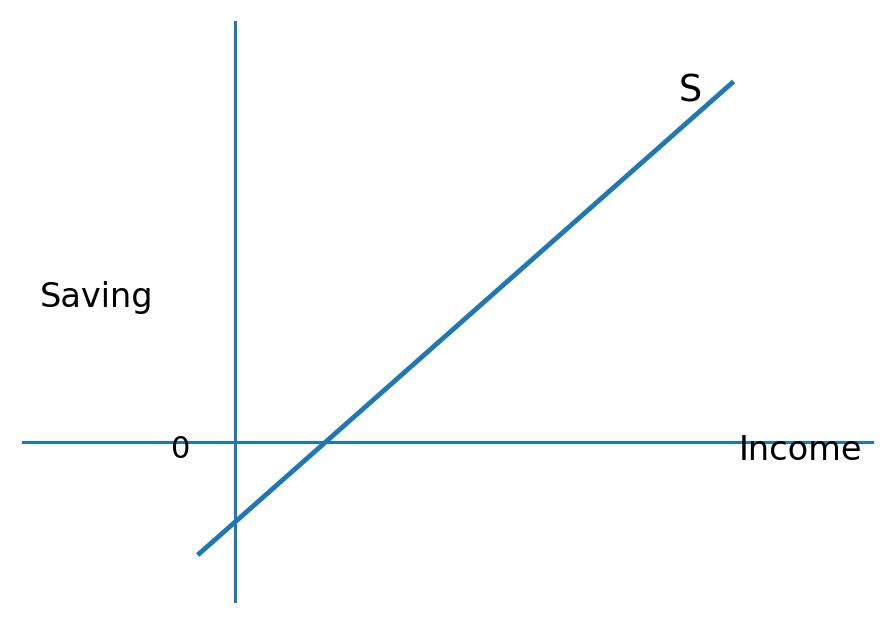
AOnly (i)
B(ii) and (iii)
C(i) and (iv)
DOnly (iii)
Answer:(C) (i) and (iv)
Explanation
Statements (i) and (iv) are correct because Average Fixed Cost (AFC) forms a rectangular hyperbola where total fixed cost remains constant as output expands.
AFC is expressed as:
AFC = TFC / Q = k / Q
Evaluating the statements:
Statement (i) is correct: The derivative d(AFC)/dQ = -k / Q^2 is strictly negative for all positive output levels, meaning its slope is always downward sloping.
Statements (ii) and (iii) are incorrect: The absolute slope k / Q^2 varies with output, approaching zero at high output and becoming very large at low output levels.
Statement (iv) is correct: The elasticity of AFC with respect to output equals |- (d(AFC)/dQ) * (Q / AFC)| = |(-k / Q^2) * (Q^2 / k)| = 1 everywhere.
Sign in to read the full explanation
Question 4
The presumption that costly new knowledge would be undersupplied by the private sector is based on the essential characteristic of new knowledge.
It is [A] ______ and [B] _______.
A[A] Non-rivalous, [B] Non-excludable
B[A] Non-rivalous, [B] Excludable
C[A] Rivalous, [B] Non-excludable
D[A] Rivalous, [B] Excludable
Answer:(A) [A] Non-rivalous, [B] Non-excludable
Explanation
Knowledge is characterized as a public good because it is both non-rivalous and non-excludable in production and consumption.
Non-rivalous: One person or firm utilizing an idea or formula does not reduce its availability to any other person.
Non-excludable: Without legal protections or institutional barriers, creators cannot prevent others from freely copying and using the knowledge once revealed.
Because private producers cannot capture the full social returns from non-rivalous and non-excludable ideas, competitive private markets systematically undersupply research and new knowledge.
Sign in to read the full explanation
Question 5
If for the constant elasticity of substitution production function, the value of the substitution parameter (ρ) is = -1, the elasticity of substitution will be
AZero
BInfinite
CUnity
DIndeterminate
Answer:(B) Infinite
Explanation
The elasticity of substitution in a Constant Elasticity of Substitution (CES) production function is given by the relation between sigma and the substitution parameter rho.
The standard elasticity of substitution formula is:
sigma = 1 / (1 + rho)
Substituting rho = -1 gives:
sigma = 1 / (1 - 1) = 1 / 0 = infinity
An infinite elasticity of substitution represents a linear production function where capital and labour are perfect substitutes.
A. Zero — occurs when rho approaches infinity, representing a Leontief fixed-proportions function.
B. Infinite — correct. Evaluates to 1 / (1 - 1) = infinity.
C. Unity — occurs when rho approaches 0, yielding the Cobb-Douglas function.
D. Indeterminate — incorrect because the limit is well defined as infinity.
Sign in to read the full explanation
Question 6
The problem of adverse selection arises due to
AAsymmetric information
BNo information
CFull information
DWrong information
Answer:(A) Asymmetric information
Explanation
Adverse selection is a market failure that stems directly from asymmetric information prior to entering into a contract or transaction.
When one party holds private information about an unobservable quality or risk type that the other party lacks, market prices reflect average quality.
A. Asymmetric information — correct. Unequal information distribution leads low-quality goods or high-risk buyers to dominate the market.
B. No information — incorrect because parties typically possess general market distributions even when specific types are hidden.
C. Full information — incorrect because symmetric information yields Pareto efficient outcomes with no adverse selection.
D. Wrong information — incorrect because the issue is hidden information rather than misinformation.
Sign in to read the full explanation
Question 7
Consider the following statements about the law of variable proportions:
(i) Input ratio remains unchanged
(ii) Ultimately the marginal and average product of variable input becomes negative
(iii) Effect of technological change is visible on output
Choose the correct answer from the code given below:
A(i) and (ii) are correct
BOnly (ii) is correct
C(ii) and (iii) are correct
DNone of the above statements is correct
Answer:(D) None of the above statements is correct
Explanation
All three statements are incorrect under the classical assumptions of the law of variable proportions.
Evaluating each statement:
Statement (i) is incorrect: The law applies when variable input units are added to fixed inputs, which continually changes the factor input ratio.
Statement (ii) is incorrect: In Stage III, only marginal product becomes negative. Average product declines steadily toward the horizontal axis but remains strictly positive as long as total output is positive.
Statement (iii) is incorrect: A constant state of technology is a foundational assumption. If technology improves, production shifts upward and invalidates the static law.
Sign in to read the full explanation
Question 8
The Inada conditions are applicable to
AA well-behaved investment function
BA well-behaved consumption function
CA well-behaved production function
DA well-behaved technical progress function
Answer:(C) A well-behaved production function
Explanation
The Inada conditions are essential mathematical criteria applied to neoclassical production functions to guarantee a stable and unique steady-state growth equilibrium.
Introduced by Ken-Ichi Inada in 1963, they require a production function F(K, L) to satisfy:
F(0, L) = 0 and F(K, 0) = 0
lim_(K -> 0) (dF / dK) = infinity
lim_(K -> infinity) (dF / dK) = 0
These boundary conditions ensure that capital accumulation begins when capital is scarce and levels off as capital becomes abundant.
Sign in to read the full explanation
Question 9
Which of the following statements is/are correct about normal profit?
AIt is earned in the long period only.
BIt is earned in the short period only.
CIt is earned in both the long period and the short period.
DIt is earned only in perfect competition.
Answer:(C) It is earned in both the long period and the short period.
Explanation
Normal profit represents the implicit opportunity cost of entrepreneurship and can be earned in both the short period and the long period.
Normal profit is included in total economic costs as the minimum payment needed to keep resources in their current employment.
A. It is earned in the long period only — incorrect because competitive and imperfectly competitive firms can break even in the short run as well.
B. It is earned in the short period only — incorrect because normal profit is the benchmark long-run outcome in competitive equilibrium.
C. It is earned in both the long period and the short period — correct. Whenever total revenue equals total economic cost, a firm earns normal profit regardless of time horizon.
D. It is earned only in perfect competition — incorrect because firms in monopolistic competition also earn normal profit in the long run.
Sign in to read the full explanation
Question 10
Which one of the statements about Pareto optimality is incorrect?
AConsumers maximise their satisfaction.
BAll the factors are used in production of all the commodities.
CThere is perfect competition in the factor and commodity markets.
DConsumers have cardinal utility functions.
Answer:(D) Consumers have cardinal utility functions.
Explanation
Pareto optimality is rooted firmly in ordinal utility theory and does not require cardinal measurement of consumer satisfaction.
Vilfredo Pareto developed his welfare criteria specifically to overcome the unmeasurable nature of cardinal utility, relying instead on ordinal preference orderings and marginal rates of substitution.
A. Consumers maximise their satisfaction — a valid assumption where consumers reach their highest attainable indifference curves.
B. All the factors are used in production of all the commodities — standard assumption ensuring full employment and interior factor allocation.
C. There is perfect competition in the factor and commodity markets — a standard institutional condition under which market equilibrium achieves Pareto efficiency.
D. Consumers have cardinal utility functions — incorrect statement and hence the correct choice, because Pareto efficiency requires only ordinal utility.
Sign in to read the full explanation
Question 11
An economic region of production consists of
AThe positively sloped portions of all isoquants
BThe negatively sloped portions of all isoquants
CThe middle of all isoquants
DThe highest points of all isoquants
Answer:(B) The negatively sloped portions of all isoquants
Explanation
The economic or rational region of production comprises the downward-sloping portions of isoquants bounded by the upper and lower ridge lines.
Inside the ridge lines, the marginal products of both inputs are positive:
MP_L > 0 and MP_K > 0
Consequently, the marginal rate of technical substitution is positive and the isoquant slope is negative:
dK / dL = - (MP_L / MP_K) < 0
Outside the ridge lines, marginal product of one factor becomes negative, causing isoquants to bend backward with positive slopes and leading to inefficient factor combinations.
Sign in to read the full explanation
Question 12
Which of the following statements about rational expectations is false?
AIt assumes that people take account of all information.
BIt assumes that on an average the forecasts made by the public are correct.
CIt implies that the expected changes in demand have no effect on unemployment.
DIt implies that unexpected changes in demand have long lasting effect on both unemployment and price level.
Answer:(D) It implies that unexpected changes in demand have long lasting effect on both unemployment and price level.
Explanation
Rational expectations theory maintains that unexpected demand shocks exert only transitory effects on real output and employment, not long-lasting effects.
In the New Classical framework developed by Lucas and Sargent, market clearing ensures that once the price surprise is revealed, employment promptly returns to its natural rate.
A. It assumes that people take account of all information — true because agents process all available historical and current policy data.
B. It assumes that on an average the forecasts made by the public are correct — true because forecast errors are random noise with an expected value of zero.
C. It implies that the expected changes in demand have no effect on unemployment — true according to the policy ineffectiveness proposition.
D. It implies that unexpected changes in demand have long lasting effect on both unemployment and price level — false statement and therefore the correct option.
Sign in to read the full explanation
Question 13
Who amongst the following economists treated nature to be niggardly?
(i) J. S. Mill
(ii) David Ricardo
(iii) Karl Marx
(iv) Thomas Robert Malthus
Choose the correct answer from the code given below:
A(i), (ii) and (iii)
B(ii) and (iv)
C(iii) and (iv)
D(ii) and (iii)
Answer:(B) (ii) and (iv)
Explanation
David Ricardo and Thomas Robert Malthus prominently characterized nature as niggardly or stingy due to the universal operation of diminishing returns in agriculture.
Ricardo argued that population growth forces cultivation onto increasingly inferior lands, raising rents and lowering profits until the economy reaches a stationary state.
Malthus similarly posited that food production expands arithmetically due to nature's limitations, while population multiplies geometrically.
Karl Marx explicitly rejected this view, arguing that resource limits were artificial products of capitalist social relations rather than inherent natural scarcity.
Sign in to read the full explanation
Question 14
Which amongst the following is/are correct for the Keynesian model?
AIt assumes full employment of resources.
BIt ignores the money market.
CIt is supply determined.
DNone of the above
Answer:(D) None of the above
Explanation
None of the first three options correctly describes the Keynesian macroeconomic model.
Evaluating the options:
A. It assumes full employment of resources — incorrect because Keynes introduced underemployment equilibrium as the typical state of a market economy.
B. It ignores the money market — incorrect because money demand through liquidity preference plays a vital role in determining the interest rate and investment.
C. It is supply determined — incorrect because the Keynesian system is demand-determined, where effective demand dictates output and employment.
D. None of the above — correct choice since statements A, B, and C are all inaccurate.
Sign in to read the full explanation
Question 15
According to New Classical Economics, Real Business Cycles are the result of which of the following?
(i) Innovations
(ii) Bad Weather
(iii) Tax Policy
(iv) Debt Policy
Choose the correct answer from the code given below:
A(i) and (ii)
B(i) and (iii)
C(iii) and (iv)
D(ii) and (iv)
Answer:(A) (i) and (ii)
Explanation
Real Business Cycle (RBC) models attribute macroeconomic fluctuations to exogenous real supply shocks such as technological innovations and natural disruptions like bad weather.
Developed by Kydland and Prescott, RBC theory rejects monetary shocks as the driver of business cycles, focusing instead on real factors:
Innovations (i) — provide positive total factor productivity shocks that shift the production frontier outward.
Bad weather (ii) — causes negative real supply shocks that diminish agricultural yields and aggregate output.
Tax policy (iii) and debt policy (iv) are nominal fiscal variables rather than the core technology and climate shocks that characterize standard RBC models.
Sign in to read the full explanation
Question 16
Consider the diagram and the statements:
(i) Saving is positively related to income
(ii) Marginal propensity to save is positive, but less than 1
Choose the correct answer from the code given below:
Linear saving function intersecting the horizontal income axis
AOnly (i)
BBoth (i) and (ii)
COnly (ii)
DNeither (i) nor (ii)
Answer:(B) Both (i) and (ii)
Explanation
Both statements correctly describe the linear saving schedule depicted in the diagram.
The saving function exhibits the standard linear form:
S = -a + sY
Statement (i) is correct: The upward slope of schedule S confirms that aggregate saving rises continuously as income increases, moving from negative dissaving to positive saving.
Statement (ii) is correct: The slope of the saving line is the Marginal Propensity to Save (s = MPS = dS / dY). Since the Marginal Propensity to Consume satisfies 0 < MPC < 1, MPS must be positive and strictly less than 1 (0 < MPS < 1).
Sign in to read the full explanation
Question 17
An increase in the level of government spending, other things being equal, will in the IS-LM model
AIncrease interest rates, shifting the LM curve to the left
BIncrease the level of equilibrium income at all interest rates, shifting the IS curve right
CLower interest rates, shifting the LM curve to the right
DAlways move an economy to full employment
Answer:(B) Increase the level of equilibrium income at all interest rates, shifting the IS curve right
Explanation
In the IS-LM model, an expansionary fiscal policy through increased government spending shifts the IS curve rightward by the fiscal multiplier times the expenditure change.
Government spending enters aggregate demand in the goods market equilibrium equation:
Y = C(Y - T) + I(r) + G
An increase in G directly raises planned expenditure, requiring higher income Y to restore goods market balance at each given interest rate r.
The LM curve remains unaffected by fiscal spending because the money supply and liquidity preference function have not changed.
Consequently, the economy moves along the existing LM curve toward a higher equilibrium income and higher interest rate.
Sign in to read the full explanation
Question 18
In a hypothetical economy, the rate of growth of nominal GDP is 15% per annum, the annual rate of growth of GDP deflator is 5%. If the population is growing at the rate of growth of 2% per annum, what will be the annual rate of growth of per capita real GDP?
A8%
B10%
C3%
D7%
Answer:(A) 8%
Explanation
The growth rate of per capita real GDP is calculated by subtracting inflation and population growth from nominal GDP growth.
First, compute the real GDP growth rate:
g_real = g_nominal - g_deflator = 15% - 5% = 10%
Next, subtract the population growth rate to find the per capita real growth rate:
This yields an annual growth rate of 8% for per capita real GDP.
Sign in to read the full explanation
Question 19
In an economy with a linear homogeneous Cobb-Douglas production function, the share of capital and labour in total output are, respectively, 40% and 60%. The capital stock and labour force are growing, respectively, at 8% and 3% per annum. If the rate of growth of output is recorded as 7% per annum, then the rate of growth of Total Factor Productivity will be
A4%
B11%
C10%
D2%
Answer:(D) 2%
Explanation
The growth rate of Total Factor Productivity (TFP) is the Solow residual obtained after accounting for input growth weighted by their output shares.
The Solow growth accounting equation is:
dY / Y = dTFP / TFP + alpha * (dK / K) + beta * (dL / L)
Substituting the given parameters:
Output growth = 7%
Capital contribution = 0.40 * 8% = 3.2%
Labour contribution = 0.60 * 3% = 1.8%
Total input contribution = 3.2% + 1.8% = 5.0%
dTFP / TFP = 7.0% - 5.0% = 2%
Sign in to read the full explanation
Question 20
According to Bent Hansen, which amongst the following were treated as factors enhancing effective demand?
(i) Public expenditure
(ii) Rising population
(iii) Banking and financial system
Choose the correct answer from the code given below:
A(i) and (iii)
B(i) and (ii)
C(ii) and (iii)
D(i), (ii) and (iii)
Answer:(D) (i), (ii) and (iii)
Explanation
Bent Hansen identified fiscal spending, demographic expansion, and monetary credit institutions as key drivers that stimulate aggregate effective demand.
In his analysis of inflationary pressure and excess demand:
Public expenditure (i) — introduces an immediate fiscal injection into the goods market.
Rising population (ii) — increases basic consumer requirements and autonomous consumption demand.
Banking and financial system (iii) — facilitates credit creation and lowers borrowing constraints, fueling both investment and consumer demand.
All three factors operate jointly to enhance aggregate effective demand.
Sign in to read the full explanation
Question 21
Match List I with List II:
List I (Author)
List II (Book)
(a) Milton Friedman
(i) Das Kapital
(b) Joseph Schumpeter
(ii) Capitalism and Freedom
(c) Karl Marx
(iii) Capital in the 21st century
(d) Thomas Piketty
(iv) Capitalism, Socialism and Democracy
A(a)-(iii), (b)-(ii), (c)-(i), (d)-(iv)
B(a)-(ii), (b)-(iv), (c)-(i), (d)-(iii)
C(a)-(iv), (b)-(iii), (c)-(i), (d)-(ii)
D(a)-(iii), (b)-(i), (c)-(iv), (d)-(ii)
Answer:(B) (a)-(ii), (b)-(iv), (c)-(i), (d)-(iii)
Explanation
The correct pairing connects each prominent economist to their defining published work.
(a)-(ii), (b)-(iv), (c)-(i), (d)-(iii)
(a) Milton Friedman wrote Capitalism and Freedom (1962), advocating classical liberal economic policies.
(b) Joseph Schumpeter wrote Capitalism, Socialism and Democracy (1942), introducing the concept of creative destruction.
(c) Karl Marx wrote Das Kapital (1867), analyzing the political economy and contradictions of capitalism.
(d) Thomas Piketty wrote Capital in the Twenty-First Century (2013), tracking wealth inequality dynamics.
Sign in to read the full explanation
Question 22
On which of the following do Keynesians and Monetarists agree?
AThe most important cause of demand shocks is changes in supply.
BThe demand for money is interest elastic.
COutput deviates at times from the potential output because of demand shocks.
DWhen there is recessionary gap, flexible wages will retrieve the labour market to equilibrium quickly.
Answer:(C) Output deviates at times from the potential output because of demand shocks.
Explanation
Both Keynesians and Monetarists acknowledge that aggregate demand shocks cause short-run deviations of actual output from potential output.
While they disagree on policy remedies and transmission mechanisms, both agree that cyclical fluctuations occur:
A. Demand shocks caused by changes in supply — rejected by both, as demand shocks originate on the spending and monetary sides.
B. Demand for money is interest elastic — Keynesians emphasize high interest elasticity, whereas Monetarists view money demand as stable and primarily income-dependent.
C. Output deviates at times from the potential output because of demand shocks — correct. Both recognize short-run output gaps triggered by demand instability.
D. Flexible wages quickly retrieve equilibrium — Monetarists believe in rapid market clearing, whereas Keynesians emphasize downward wage rigidity.
Sign in to read the full explanation
Question 23
According to the cash-balance approach, the elasticity of demand for money
AIs less than one
BIs more than one
CIs equal to one
DFluctuates with the changes in the phases of inflation
Answer:(C) Is equal to one
Explanation
In the Cambridge cash-balance equation, the elasticity of demand for money with respect to the price level is unitary.
The Cambridge demand for nominal money balances is expressed as:
M_d = k * P * Y
Given a stable fraction k of real income Y that individuals choose to hold as money balances:
Choose the correct answer from the code given below:
A(i) and (iii)
BOnly (iv)
C(i) and (iv)
D(iii) and (iv)
Answer:(B) Only (iv)
Explanation
The Statutory Liquidity Ratio (SLR) creates a dedicated captive market for government debt securities, directly aiding government borrowing.
Under Section 24 of the Banking Regulation Act, 1949, commercial banks in India must invest a mandatory fraction of their Net Demand and Time Liabilities (NDTL) in approved securities, predominantly Central and State government bonds.
CRR (iii) — requires banks to maintain cash reserves with the RBI without financing fiscal expenditure.
Repo (i) and Reverse Repo (ii) — represent short-term liquidity adjustment tools rather than vehicles for sovereign borrowing.
Sign in to read the full explanation
Question 25
A rise in general price level may be caused by which amongst the following?
(i) An increase in the money supply
(ii) An increase in the aggregate level of output
(iii) An increase in the effective demand
Choose the correct answer from the code given below:
AOnly (iii)
B(i) and (ii)
C(i), (ii) and (iii)
D(i) and (iii)
Answer:(D) (i) and (iii)
Explanation
Inflationary increases in the price level are generated by monetary expansion and demand-pull pressures rather than output expansion.
Evaluating the factors:
Increase in the money supply (i) — expands nominal purchasing power and bids up commodity prices when velocity and output cannot adjust immediately.
Increase in the aggregate level of output (ii) — represents an outward shift in aggregate supply, which places downward pressure on the price level rather than raising it.
Increase in effective demand (iii) — shifts aggregate demand rightward against an upward-sloping supply curve, causing demand-pull inflation.
Therefore, only statements (i) and (iii) describe causes of rising price levels.
Sign in to read the full explanation
Question 26
The concept of Universal Banking in India was recommended by which of the following committee?
AAbid Hussain Committee
BR.H. Khan Committee
CS. Padmanabhan Committee
DY.H. Malegam Committee
Answer:(B) R.H. Khan Committee
Explanation
The concept of Universal Banking in India was recommended by the Working Group on Harmonising the Role and Operations of DFIs and Banks, chaired by S.H. Khan (R.H. Khan Committee) in 1998.
The committee advised transforming Development Financial Institutions (DFIs) into commercial banks to offer a comprehensive range of financial services under one roof.
A. Abid Hussain Committee — examined small-scale industries and trade policy reforms.
B. R.H. Khan Committee — correct. Recommended the progressive transition toward universal banking.
C. S. Padmanabhan Committee — focused on bank supervision and on-site examination systems.
D. Y.H. Malegam Committee — examined microfinance regulation and corporate governance issues.
Sign in to read the full explanation
Question 27
What is the required Capital Adequacy Ratio for a new bank to apply for a license, under the draft guidelines of RBI?
A9 percent
B10 percent
C11 percent
D12 percent
Answer:(D) 12 percent
Explanation
Under the Reserve Bank of India licensing guidelines for new private sector banks, the minimum Capital Adequacy Ratio (CAR/CRAR) is mandated at 12 percent of risk-weighted assets for an initial period of three years.
This requirement is higher than the standard 9 percent mandated for existing domestic scheduled commercial banks under Basel norms to provide an extra solvency cushion during the bank initial establishment phase.
A. 9 percent — the standard baseline requirement for established domestic commercial banks.
B. 10 percent — not the statutory threshold set for new bank licenses.
C. 11 percent — incorrect capital adequacy threshold.
D. 12 percent — correct. Prescribed by RBI for newly licensed banking entities.
Sign in to read the full explanation
Question 28
Which of the following is not an objective of Marginal Cost of funds based Lending Rate (MCLR)?
ATo improve the transmission of policy rates into the lending rates of banks
BTo ensure availability of bank credit at interest rates which are fair to borrowers are well as banks
CTo enable banks to become more competitive
DTo enable the RBI to achieve the inflation target
Answer:(D) To enable the RBI to achieve the inflation target
Explanation
Achieving the national inflation target is an economy-wide monetary policy mandate of the Reserve Bank of India, not an internal operational objective of bank-level MCLR pricing.
The RBI introduced the MCLR framework in 2016 with distinct micro-level banking objectives:
A. Improve policy rate transmission — ensures that repo rate cuts or hikes flow rapidly into bank lending rates.
B. Fair lending rates — prices credit transparently based on marginal funding costs.
C. Enhance competitiveness — allows banks to compete effectively with money and bond markets.
D. Enable RBI to achieve the inflation target — correct choice as it represents a macroeconomic monetary policy goal rather than a rule for bank loan pricing.
Sign in to read the full explanation
Question 29
Match List I with List II:
List I
List II
(a) n = Pk
(i) A.C. Pigou
(b) M = PkT
(ii) Keynes
(c) P = kR/M
(iii) Alfred Marshall
(d) M = kPY
(iv) D.H. Robertson
A(a)-(ii), (b)-(iv), (c)-(i), (d)-(iii)
B(a)-(i), (b)-(ii), (c)-(iii), (d)-(iv)
C(a)-(iv), (b)-(i), (c)-(ii), (d)-(iii)
D(a)-(iii), (b)-(ii), (c)-(i), (d)-(iv)
Answer:(A) (a)-(ii), (b)-(iv), (c)-(i), (d)-(iii)
Explanation
The correct mapping pairs each classical cash-balance formulation with its respective author.
(a)-(ii), (b)-(iv), (c)-(i), (d)-(iii)
(a) n = Pk — Keynes in A Tract on Monetary Reform (1923), where n is currency, P is the price level of consumption units, and k represents real consumption units held in cash.
(b) M = PkT — D.H. Robertson, expressing cash balances in relation to total transactions T.
(c) P = kR/M — A.C. Pigou, relating price level to real national income R and money stock M.
(d) M = kPY — Alfred Marshall, where money balances are held as a proportion k of nominal national income PY.
Sign in to read the full explanation
Question 30
The statement, "Too much money chasing too few goods" is based on which of the following theoretical concepts?
AQuantity theory of prices
BQuantity theory of money
CInventory theoretic approach to the demand for money
DReal balance effect
Answer:(B) Quantity theory of money
Explanation
The phrase "too much money chasing too few goods" expresses the core intuition of the Quantity Theory of Money.
In both the Fisherian transactions equation (MV = PT) and the Cambridge cash-balance approach (M = kPY), an expansion in the money supply without a corresponding increase in real output forces price levels upward to restore monetary equilibrium.
A. Quantity theory of prices — not a standard standalone economic doctrine.
B. Quantity theory of money — correct. Directly links price-level inflation to excess money growth relative to output.
C. Inventory theoretic approach — Baumol-Tobin model of transactions money demand optimization.
D. Real balance effect — Pigou effect where falling prices increase real wealth and stimulate consumption.
Sign in to read the full explanation
Question 31
Who among the following said that "Money is a temporary abode of purchasing power"?
AIrving Fisher
BMilton Friedman
CWilliam J. Baumol
DJames Tobin
Answer:(B) Milton Friedman
Explanation
Milton Friedman introduced the characterization of money as a "temporary abode of purchasing power" in his 1956 restatement of the Quantity Theory of Money.
Friedman treated money as an asset within capital theory, arguing that wealth holders choose to hold cash balances because money bridges the time interval between receipt of income and subsequent expenditure.
A. Irving Fisher — focused primarily on the transactions role of money as a medium of exchange in MV = PT.
B. Milton Friedman — correct. Coined the phrase to emphasize money function as a store of value.
C. William J. Baumol — developed the inventory-theoretic model of transactions cash holdings.
D. James Tobin — developed portfolio balance theory and risk aversion in liquidity preference.
Sign in to read the full explanation
Question 32
Which of the following is not part of the Peacock-Wiseman Hypothesis?
ADisplacement Effect
BInspection Effect
CConcentration Effect
DAnnouncement Effect
Answer:(D) Announcement Effect
Explanation
The Announcement Effect is a tax phenomenon describing behavioral responses to proposed taxes, rather than a component of the Peacock-Wiseman Hypothesis.
Jack Wiseman and Alan Peacock formulated three primary effects to explain the stepped growth of public expenditure during national crises:
Displacement Effect: Emergency conditions step public spending and tolerable tax rates up to a permanently higher level.
Inspection Effect: Crises compel both government and society to examine neglected social obligations.
Concentration Effect: Central government responsibilities expand relative to regional and local authorities.
The Announcement Effect belongs to general public finance theory rather than the Peacock-Wiseman model.
Sign in to read the full explanation
Question 33
An income tax will be progressive if
AMarginal rate of tax is greater than the average rate of tax.
BMarginal rate of tax is less than the average rate of tax.
CMarginal rate of tax is equal to the average rate of tax.
DMarginal rate of tax is zero.
Answer:(A) Marginal rate of tax is greater than the average rate of tax.
Explanation
A tax is progressive when the Average Tax Rate (ATR = T / Y) rises as income Y increases.
For the average tax rate to increase with income, the derivative must be strictly positive:
(1 / Y) * (MTR - ATR) > 0
MTR > ATR
Thus, the marginal tax rate must exceed the average tax rate at all income levels for the tax system to be progressive.
Sign in to read the full explanation
Question 34
The public expenditure in India is classified as capital and revenue. Which of the following is/are revenue expenditure?
(i) Subsidies
(ii) Interest payments on public debt
(iii) Wages and salaries
Choose the correct answer from the code given below:
A(i) and (ii)
B(i) and (iii)
C(ii) and (iii)
D(i), (ii) and (iii)
Answer:(D) (i), (ii) and (iii)
Explanation
All three items represent revenue expenditures because they do not lead to the creation of physical or financial assets, nor do they reduce public liabilities.
Evaluating each item:
Subsidies (i) — current transfer payments to support consumption and production without building public capital assets.
Interest payments on public debt (ii) — contractual servicing obligations on existing borrowings that do not reduce the outstanding principal liability.
Wages and salaries (iii) — recurrent administrative and operational expenses incurred to run government departments.
All three are classified under the revenue budget.
Sign in to read the full explanation
Question 35
Which of the following correctly describes the Musgrave and Thin's measure of tax progressivity?
where
Ga = Gini's coefficient after tax,
Gb = Gini's coefficient before tax.
AM = (1-Ga)/(1-Gb)
BM = Ga/Gb
CM = (1-Gb)/(1-Ga)
DM = Gb/Ga
Answer:(A) M = (1-Ga)/(1-Gb)
Explanation
Musgrave and Thin (1948) defined their measure of effective tax progression (M) as the ratio of post-tax equality to pre-tax equality.
Taking the Gini coefficient G as a measure of inequality, the degree of equality is expressed as (1 - G):
Equality before tax = 1 - Gb
Equality after tax = 1 - Ga
The effective progression index is therefore formulated as:
M = (1 - Ga) / (1 - Gb)
When M > 1, the tax system reduces income inequality and is classified as progressive.
Sign in to read the full explanation
Question 36
GST which came into effect from 1st July, 2017 has four (04) tax slabs applicable to the commodities and services in India. Which of the following tax slabs are correct?
A5%, 12%, 18% and 28%
B5%, 8%, 12% and 18%
C8%, 12%, 18% and 28%
D8%, 12%, 15% and 18%
Answer:(A) 5%, 12%, 18% and 28%
Explanation
The Goods and Services Tax (GST) implemented across India on 1 July 2017 instituted a four-tier standard rate structure.
The four official standard tax slabs are:
5%, 12%, 18%, and 28%
Essential commodities of daily consumption fall under 5 percent, standard goods and business services occupy the 12 percent and 18 percent slabs, while luxury and demerit goods are taxed at the peak rate of 28 percent.
Sign in to read the full explanation
Question 37
According to the Union Budget, which of the following Fiscal deficit targets for 2018 - 19 is correct?
A3.3% of the GDP
B4-3% of the GDP
C5.3% of the GDP
D4-5% of the GDP
Answer:(A) 3.3% of the GDP
Explanation
In the Union Budget 2018-19 presented by the Finance Minister, the central fiscal deficit target for financial year 2018-19 was projected at 3.3 percent of Gross Domestic Product (GDP).
The government revised the fiscal deficit for 2017-18 to 3.5 percent of GDP before targeting a reduction to 3.3 percent for 2018-19 as part of its fiscal consolidation glide path under the FRBM framework.
A. 3.3% of the GDP — correct budget target for FY 2018-19.
B, C, D — incorrect targets not matching the official budget estimates.
Sign in to read the full explanation
Question 38
Why are indirect taxes called regressive?
AThey are charged at higher rates than direct tax.
BThey are charged at the same rate for all income groups.
CBoth above are correct
DNone of the above are correct
Answer:(B) They are charged at the same rate for all income groups.
Explanation
Indirect taxes are levied at uniform commodity rates regardless of the consumer personal income, imposing a higher relative burden on poorer households.
Because lower-income households spend a significantly larger fraction of their total income on consumption goods compared to wealthy households, a uniform commodity tax rate takes a higher proportion of income from the poor than from the rich.
A. Charged at higher rates than direct tax — factually incorrect because tax rates vary across both systems.
B. Charged at the same rate for all income groups — correct. The lack of rate differentiation across income brackets produces the regressive outcome.
C and D — incorrect because statement B alone explains the regressive incidence.
Sign in to read the full explanation
Question 39
Consider the following:
(i) Fringe Benefits Tax
(ii) Capital Gains Tax
(iii) Securities Transaction Tax
Which of the above is/are Direct Tax/Taxes?
Choose the correct answer from the code given below:
A(ii) and (iii)
B(i), (ii) and (iii)
COnly (i)
D(i) and (iii)
Answer:(B) (i), (ii) and (iii)
Explanation
All three taxes are direct taxes because their initial impact and ultimate incidence fall upon the same legal entity.
Evaluating each tax:
Fringe Benefits Tax (i) — levied directly on employers for benefits provided to their workforce.
Capital Gains Tax (ii) — assessed directly on individuals or corporate entities on profits realized from the transfer of capital assets.
Securities Transaction Tax (iii) — charged directly on buyers and sellers executing taxable securities transactions on recognized stock exchanges.
None of these taxes can be legally shifted to other parties as indirect taxes are.
Sign in to read the full explanation
Question 40
Which of the following will result in the 'crowding in' effect in the economy?
(i) Public borrowings to finance spending on infrastructure
(ii) Public borrowings to finance spending on salaries and wages
(iii) Public borrowings to finance spending on health and education
(iv) Public borrowings to finance spending on skill development
Choose the correct answer from the code given below:
A(i), (ii) and (iii)
B(iii) and (iv)
C(i), (iii) and (iv)
D(i) and (ii)
Answer:(C) (i), (iii) and (iv)
Explanation
A crowding-in effect occurs when public capital formation and human capital development raise the marginal productivity of private capital, encouraging additional private investment.
Evaluating the spending categories:
Infrastructure spending (i) — reduces logistics and transport costs, directly raising private returns on investment.
Salaries and wages (ii) — constitutes recurrent consumption expenditure that diverts loanable funds without expanding productive capacity, leading to crowding out rather than crowding in.
Health and education (iii) and skill development (iv) — expand labor productivity and human capital, enhancing private economic returns.
Therefore, items (i), (iii), and (iv) foster crowding in.
Sign in to read the full explanation
Question 41
Development expenditure of the Central Government does not include
(i) Grant to States under Centrally sponsored schemes
(ii) Expenditure on social and community services
(iii) Expenditure on economic services
(iv) Defence expenditure
Choose the correct answer from the code given below:
A(i) and (ii)
B(ii) and (iii)
COnly (iv)
D(iii) and (iv)
Answer:(C) Only (iv)
Explanation
Defence expenditure is categorized as non-development expenditure in government accounts because it provides national security rather than directly generating social or economic capital.
In the classification of Central Government spending:
Development expenditure includes grants to States for development schemes (i), expenditure on social and community services like education and health (ii), and economic services like infrastructure, agriculture, and industry (iii).
Non-development expenditure includes defence outlays (iv), administrative services, police, pensions, and debt interest servicing.
Sign in to read the full explanation
Question 42
In the basic neo-classical growth model, where does the growth equilibrium occur?
AWhere investment per worker is equal to savings per worker.
BWhere investment per worker equals depreciation of capital for worker.
CWhere investment per worker equals capital per worker.
DWhere capital per worker equals output per worker.
Answer:(B) Where investment per worker equals depreciation of capital for worker.
Explanation
In the Solow-Swan neoclassical growth model, the steady-state equilibrium per worker is established where actual investment equals capital depreciation requirements.
The fundamental differential equation of the Solow model is:
dk / dt = s * f(k) - (n + delta) * k
In steady-state equilibrium, the capital-labor ratio stabilizes so that dk / dt = 0:
s * f(k) = (n + delta) * k
Assuming population growth n = 0, steady-state equilibrium requires investment per worker s * f(k) to equal depreciation of capital per worker delta * k.
Sign in to read the full explanation
Question 43
According to Schumpeter Theory of Development, which of the following statements is correct?
AThe expansion of economic output is limited by the real savings of the economy.
BDemocracy enhances the efficiency of an economic system.
CAll the above are correct
DNone of the above are correct
Answer:(D) None of the above are correct
Explanation
Neither statement correctly represents Joseph Schumpeter economic development and political theories.
Evaluating the statements:
Statement 1 is incorrect: Schumpeter explicitly rejected the classical premise that investment is constrained by prior voluntary savings, demonstrating that entrepreneurial innovation is funded by bank credit creation out of thin air.
Statement 2 is incorrect: In Capitalism, Socialism and Democracy, Schumpeter defined democracy procedurally as an institutional arrangement for selecting political leaders rather than a mechanism that enhances market efficiency.
Therefore, none of the proposed statements are correct.
Sign in to read the full explanation
Question 44
Which of the following statements is/are correct about Uzawa's theorem?
AThe growth rate of output per worker, consumption per worker and capital per worker are equal and constant over time.
BThe production function is linear homogeneous.
CThe technical progress is 'Harrod neutral' only.
DAll of the above
Answer:(D) All of the above
Explanation
Hirofumi Uzawa steady-state theorem (1961) establishes the exact mathematical conditions under which a neoclassical economy exhibits balanced growth.
Uzawa demonstrated that in a neoclassical model with a constant returns to scale (linear homogeneous) production function:
A steady-state balanced growth path exists with output, consumption, and capital per worker growing at equal, constant rates.
Technical progress must be exclusively labor-augmenting (Harrod-neutral).
Because all three conditions represent essential premises and conclusions of the theorem, all of the statements are correct.
Sign in to read the full explanation
Question 45
What is true for Neo-Classical growth model?
(i) Rate of interest and profit are flexible
(ii) Capital is heterogeneous
(iii) Perfect competition prevails
(iv) Capital and labour are substitutable
Choose the correct answer from the code given below:
Factor substitutability (iv) — capital and labor substitute smoothly along a convex isoquant.
Hence, only statements (i), (iii), and (iv) are true.
Sign in to read the full explanation
Question 46
Technological dualism means
APrevalence of different production functions in the industrial sector in underdeveloped countries
BPrevalence of different technologies in agricultural sector in underdeveloped countries
CPrevalence of different production functions in the advanced and traditional sectors in underdeveloped countries
DPrevalence of different production functions in domestic and export sectors of underdeveloped countries
Answer:(C) Prevalence of different production functions in the advanced and traditional sectors in underdeveloped countries
Explanation
Technological dualism, formulated by Benjamin Higgins, refers to the structural coexistence of modern and traditional sectors operating with fundamentally different production functions.
In developing economies:
Modern advanced sector: Capital-intensive processes with fixed factor proportions and low labor-absorptive capacity.
Traditional agricultural sector: Labor-intensive techniques with variable factor proportions and low labor productivity.
This structural disparity prevents surplus rural labor from being readily absorbed into the modern sector.
Sign in to read the full explanation
Question 47
Match List I with List II:
List I
List II
(a) Absorptive capacity of capital
(i) M. Kalecki
(b) Technological dualism
(ii) A.O. Hirschman
(c) Physical quality of life index
(iii) D. Morris
(d) Permissive and compulsive sequences of expanding industries
(iv) B. Higgins
A(a)-(iv), (b)-(iii), (e)-(ii), (d)-(i)
B(a)-(i), (b)-(ii), (c)-(iii), (d)-(iv)
C(a)-(ii), (b)-(iv), (c)-(iii), (d)-(i)
D(a)-(i), (b)-(iv), (c)-(iii), (d)-(ii)
Answer:(D) (a)-(i), (b)-(iv), (c)-(iii), (d)-(ii)
Explanation
The correct matching connects economic development concepts with their pioneering authors.
(a)-(i), (b)-(iv), (c)-(iii), (d)-(ii)
(a) Absorptive capacity of capital — Michal Kalecki analyzed limitations on the volume of investment an economy can productively absorb.
(b) Technological dualism — Benjamin Higgins formulated the dual production functions theory.
(c) Physical quality of life index — Morris David Morris developed the PQLI based on literacy, infant mortality, and life expectancy.
(d) Permissive and compulsive sequences of expanding industries — Albert O. Hirschman introduced backward and forward linkage investment sequences.
Sign in to read the full explanation
Question 48
The original interpretation of balanced growth relates to
AAll sectors growing at the same rate
BAbsence of shortages or excesses
CEqual amount to investment in all sectors
DLarge scale expansion of activities to overcome divergence between private and social benefits
Answer:(D) Large scale expansion of activities to overcome divergence between private and social benefits
Explanation
The doctrine of balanced growth, pioneered by Rosenstein-Rodan, emphasizes synchronized large-scale investment across multiple industries to capture external economies.
Rosenstein-Rodan argued that an isolated investment project often fails due to limited domestic market size and indivisibility of demand.
A coordinated "Big Push" across a wide range of complementary industries creates reciprocal markets for goods, overcoming divergence between private and social benefits.
A, B, C — narrow or mechanical definitions that overlook the core externality and market-widening rationale.
Sign in to read the full explanation
Question 49
T.W. Schultz has given the following ratios in relation to education for economic growth:
AEducation-income ratio
BEducation-labour ratio, education-income ratio and education-investment ratio
CEducation-labour ratio
DEducation-capital and labour ratio
Answer:(B) Education-labour ratio, education-income ratio and education-investment ratio
Explanation
Theodore W. Schultz formulated three key analytical ratios in human capital theory to measure the contribution of education to economic growth.
In The Economic Value of Education (1963), Schultz identified:
Education-labour ratio: Quantifies the educational stock embodied per worker in the labor force.
Education-income ratio: Relates the value of educational capital stock to aggregate national income.
Education-investment ratio: Compares annual expenditure on schooling to total gross physical capital formation.
Together, these three ratios provide a comprehensive framework for measuring human capital accumulation.
Sign in to read the full explanation
Question 50
Which of the following Concept - Economist pairs is not correctly matched?
AKnife-edge Problem - Harrod Domar
BTurnpike Conjecture - Dorfman, Samuelson and Solow
CSuper Multiplier - J.M. Keynes
DGolden Rule of Accumulation - E.S. Phelps
Answer:(C) Super Multiplier - J.M. Keynes
Explanation
The super multiplier concept was developed by J.R. Hicks in his 1950 trade cycle model, rather than by J.M. Keynes.
Hicks combined the investment multiplier with the accelerator principle to explain cyclical income fluctuations, terming this combined mechanism the super multiplier.
A. Knife-edge Problem - Harrod Domar — correctly matched. Describes instability when warranted and natural growth rates diverge.
B. Turnpike Conjecture - Dorfman, Samuelson and Solow — correctly matched. Describes optimal long-run capital accumulation paths.
C. Super Multiplier - J.M. Keynes — incorrectly matched pair and therefore the correct answer. Keynes introduced only the simple investment multiplier.
D. Golden Rule of Accumulation - E.S. Phelps — correctly matched. Identifies the capital-labor ratio that maximizes steady-state consumption.
Sign in to read the full explanation
Question 51
Which of the following is considered as the third stage in the Rostow's Stages of Economic Growth model?
AHigh mass consumption
BTraditional society
CPre-conditions for a take-off
DTake-off
Answer:(D) Take-off
Explanation
W.W. Rostow outlined five sequential stages of economic growth in his 1960 model, with the take-off stage occupying the third position.
The complete chronological order of Rostow stages comprises:
The traditional society
The preconditions for take-off
The take-off
The drive to maturity
The age of high mass consumption
The take-off stage is marked by a decisive transition where the investment rate rises sharply and self-sustaining industrial growth becomes permanent.
Sign in to read the full explanation
Question 52
Which of the following is/are true for Karl Marx's Theory of Economic Development?
ARelations in production change independently.
BMode of production changes independently.
CBoth above
DNone of the above
Answer:(D) None of the above
Explanation
In Karl Marx materialist conception of history, neither the relations of production nor the mode of production change independently of the productive forces.
According to historical materialism:
Development of material productive forces (technology, tools, labor competencies) forms the prime mover of economic transformation.
When productive forces outgrow the existing relations of production, the social relations become institutional fetters, precipitating class struggle and revolution.
Because relations of production and the overall mode of production depend fundamentally on the stage of material productive forces, neither evolves autonomously.
Sign in to read the full explanation
Question 53
In the year 2015-16, India has not been an importer of which of the following products?
(i) Apples
(ii) Rice
(iii) Pulses
Choose the correct answer from the code given below:
A(i), (ii) and (iii)
B(ii) and (iii)
C(i) and (iii)
DOnly (ii)
Answer:(D) Only (ii)
Explanation
India maintained a massive structural export surplus in rice during 2015-16, ranking as the leading global exporter rather than an importer.
Reviewing the agricultural trade flows for 2015-16:
Rice (ii) — India exported over 10 million tonnes of Basmati and non-Basmati rice, importing negligible quantities.
Apples (i) — India imported substantial commercial volumes from the United States, China, and Chile to meet domestic urban demand.
Pulses (iii) — India experienced severe domestic production shortfalls in 2015-16, importing nearly 5.8 million tonnes of pulses to stabilize domestic retail prices.
Therefore, only rice was not imported.
Sign in to read the full explanation
Question 54
Global Competitiveness Report is released by which of the following organisations?
AWorld Trade Organisation
BWorld Economic Forum
CEuropean Union
DWorld Bank
Answer:(B) World Economic Forum
Explanation
The Global Competitiveness Report is an authoritative annual assessment published by the World Economic Forum (WEF).
First introduced in 1979, the report evaluates national productivity and competitiveness across economies through the Global Competitiveness Index (GCI), combining statistical indicators with the Executive Opinion Survey.
A. World Trade Organisation — publishes World Trade Report and trade statistics.
B. World Economic Forum — correct. Publishes the Global Competitiveness Report annually.
C. European Union — regional intergovernmental organization.
D. World Bank — formerly published the Doing Business Report and World Development Indicators.
Sign in to read the full explanation
Question 55
'Round tripping' in international trade is a method
ATo boost foreign direct investment
BTo evade tax
CTo increase exports
Dof financing start-ups
Answer:(B) To evade tax
Explanation
Round tripping refers to the illicit routing of domestic capital abroad to return disguised as foreign direct investment, primarily used to evade domestic taxes.
By channeling untaxed domestic profits through offshore shell companies in low-tax jurisdictions or tax havens, entities take advantage of bilateral double-taxation avoidance agreements.
A. To boost foreign direct investment — capital flows are synthetic rather than genuine new productive capacity.
B. To evade tax — correct. Enables tax evasion and laundering of unaccounted domestic capital.
C and D — unrelated to the financial maneuver of round tripping.
Sign in to read the full explanation
Question 56
Balance of payments on capital account does not include
ABalancing foreign direct investment
BForeign portfolio investment
CNet income transfers
DGovernment loans to foreign governments
Answer:(C) Net income transfers
Explanation
Net income transfers are recorded strictly in the current account under secondary income, rather than in the capital account.
Under standard Balance of Payments accounting rules:
Current account records trade in merchandise goods, trade in services, primary factor income (profits, interest, dividends), and secondary income (unilateral transfers, worker remittances, gifts).
Capital and financial account records transactions involving international financial assets and liabilities, including Foreign Direct Investment (A), Foreign Portfolio Investment (B), external commercial loans, and bilateral government loans (D).
Thus, net income transfers are excluded from the capital account.
Sign in to read the full explanation
Question 57
Devaluation will be more effective when
(i) International capital is freely mobile
(ii) International capital is not freely mobile
(iii) Marginal propensity to import is high
Which of the above statements is/are correct?
Choose the correct answer from the code given below:
AOnly (ii)
BOnly (iii)
C(i) and (iii)
D(ii) and (iii)
Answer:(A) Only (ii)
Explanation
Devaluation is more effective in correcting a balance of payments trade deficit when international capital is not freely mobile.
When international capital flows freely across borders, speculative capital outflows and currency substitution can trigger destabilizing exchange rate volatility that negates the trade balance improvement.
When capital mobility is constrained, expenditure-switching policies alter the relative prices of exports and imports without triggering destabilizing financial arbitrage flows.
High marginal propensity to import causes large import expenditure leakage from domestic income, reducing the effectiveness of policy intervention.
Therefore, devaluation is most effective when international capital is not freely mobile.
Sign in to read the full explanation
Question 58
If (K/L)a > (K/L)b, then
ACountry A is labour abundant
BCountry A is having cheap labour
CCountry A is capital abundant
DCapital is dear in country A
Answer:(C) Country A is capital abundant
Explanation
In the Heckscher-Ohlin model of international trade, factor abundance defined in physical terms compares the aggregate capital-to-labor endowment ratios of two nations.
The physical endowment criterion states:
If (K / L)_A > (K / L)_B
Then Country A possesses a higher ratio of physical capital stock to labor force relative to Country B, making Country A capital abundant by definition.
A. Country A is labour abundant — incorrect because that would require (K/L)_A < (K/L)_B.
B and D — pertain to the price definition of factor abundance rather than the physical endowment ratio.
Sign in to read the full explanation
Question 59
Opportunity cost theory assumes that
ALabour is the only factor of production.
BLabour is homogeneous.
CCost of commodity is equal to labour cost only.
DNone of the above
Answer:(D) None of the above
Explanation
Gottfried Haberler developed the Opportunity Cost Theory in 1936 specifically to eliminate the restrictive assumptions of the classical labor theory of value.
The classical Ricardian framework rested on the assumptions that:
Labor is the sole factor of production.
Labor is completely homogeneous.
Commodity prices reflect only embodied labor hours.
Haberler reformulated trade theory using production possibility frontiers, demonstrating that the cost of commodity X is simply the quantity of commodity Y sacrificed, without assuming labor is the only or homogeneous factor.
Because statements A, B, and C describe classical labor theory, none of the above is the correct choice.
Sign in to read the full explanation
Question 60
Historically the terms of trade of the developing countries have been unfavourable due to the fact that when income in developed countries rises, the demand for primary goods declines because
AIncome elasticity of demand for primary goods is low.
BIncome elasticity of demand for primary goods is zero.
CIncome elasticity of demand for primary goods is high.
DPrice elasticity of demand for primary goods is high.
Answer:(A) Income elasticity of demand for primary goods is low.
Explanation
The Prebisch-Singer hypothesis explains the secular deterioration in the terms of trade of developing nations through Engel's Law and low income elasticity of demand for primary commodities.
As national income grows in industrial economies:
Consumer expenditure shifts proportionally toward manufactured goods and advanced services where income elasticity is high (e_y > 1).
Expenditure on basic agricultural produce and raw materials grows at a much slower rate because income elasticity is low (e_y < 1).
This structural asymmetry depresses primary commodity prices relative to manufactured imports over the long run.
Sign in to read the full explanation
Question 61
Consider the following statements in the context of the New Trade Theory:
(i) It explains why countries trade in similar goods
(ii) It assumes free trade
(iii) It assumes that trade takes place in monopolistic conditions
(iv) It exploits the economies of scale in production
Which of the above statements are correct?
Choose the correct answer from the code given below:
A(i), (iii) and (iv)
B(ii) and (iv)
C(i) and (iii)
D(i) and (ii)
Answer:(A) (i), (iii) and (iv)
Explanation
Paul Krugman New Trade Theory explains intra-industry trade among similar industrial nations using monopolistic competition and economies of scale.
Key pillars of the theory include:
Intra-industry trade (i) — explains why developed nations with similar factor endowments exchange differentiated varieties of similar goods.
Monopolistic competition (iii) — replaces the classical assumption of perfect competition with product differentiation and market power.
Economies of scale (iv) — internal increasing returns to scale allow firms to lower unit production costs as market size widens.
Statement (ii) is incorrect because the theory does not assume free trade and provides the analytical foundation for strategic trade intervention.
Sign in to read the full explanation
Question 62
Intellectual Property Rights include
APatents
BCopyrights
CTrademark
DAll of the above
Answer:(D) All of the above
Explanation
Intellectual Property Rights (IPRs) encompass legal monopoly protections granted to creators and inventors over intangible creations of the mind.
Core categories recognized internationally under the WTO TRIPS agreement include:
Patents: Protect novel technological inventions and industrial utility processes.
Copyrights: Protect original literary, musical, dramatic, and artistic creations.
Trademarks: Protect distinctive commercial brand identities, words, and symbols.
Because patents, copyrights, and trademarks are all principal forms of intellectual property, all of the above is correct.
Sign in to read the full explanation
Question 63
Which of the following is the appropriate measure of openness of the economy?
AExports/Imports
BExports - Imports
C(Exports + Imports)/GDP
D(Exports - Imports)/Population
Answer:(C) (Exports + Imports)/GDP
Explanation
The standard macroeconomic metric used to measure the trade openness of an economy is the trade-to-GDP ratio.
The index of openness is formulated as:
Openness = (Exports + Imports) / GDP
This ratio reflects the total volume of international commerce relative to the overall size of the domestic economy, capturing how deeply integrated a country is with international goods and services markets.
Sign in to read the full explanation
Question 64
The frequent farm loan waivers in India may give rise to the problem of
ADebt Overhang
BAdverse Selection
CRisk Aversion
DMoral Hazard
Answer:(D) Moral Hazard
Explanation
Repeated agricultural debt forgiveness programs generate moral hazard by altering borrower repayment incentives.
When borrowers observe that past defaults were written off by public policy, their expectation of future waivers encourages deliberate non-repayment even when they possess the financial capacity to service debt.
A. Debt Overhang — describes a condition where existing debt prevents new viable investment.
B. Adverse Selection — asymmetric information problem occurring before a contract is finalized.
C. Risk Aversion — behavioral preference for certain outcomes over uncertain gambles.
D. Moral Hazard — correct. Post-contractual behavioral change undermining credit discipline.
Sign in to read the full explanation
Question 65
Which of the following are the objectives of the Commission for Agricultural Costs and Prices (CACP)?
(i) To ensure meaningful real income levels to the farmers
(ii) To stabilise agricultural prices
(iii) To protect the interest of the consumers
Choose the correct answer from the code given below:
A(i) and (iii)
B(i) and (ii)
C(ii) and (iii)
DAll of the above
Answer:(D) All of the above
Explanation
The Commission for Agricultural Costs and Prices (CACP) operates under statutory terms of reference designed to balance producer incentives with consumer protection.
The primary objectives of CACP include:
Farmer income security (i) — recommending Minimum Support Prices (MSP) that guarantee remunerative returns over production costs.
Price stability (ii) — curbing seasonal price collapse during harvest gluts.
Consumer protection (iii) — ensuring that foodgrains remain accessible at reasonable prices through the public distribution network.
All three aspects form the tripartite mandate of the CACP price policy.
Sign in to read the full explanation
Question 66
Arrange the following events in chronological order regarding Indian Economy:
(i) First Phase of Nationalisation of Banks
(ii) Establishment of Narasimhan Committee on the Banking System
(iii) Enactment of FEMA Act in India
(iv) Establishment of EXIM Bank in India
Choose the correct answer from the code given below:
A(i), (iv), (ii), (iii)
B(i), (iii), (iv), (ii)
C(i), (iii), (ii), (iv)
D(i), (ii), (iii), (iv)
Answer:(A) (i), (iv), (ii), (iii)
Explanation
The correct chronological progression traces milestones in Indian economic and financial history.
(i), (iv), (ii), (iii)
(i) First Phase of Bank Nationalisation — July 1969, when 14 major commercial banks were nationalized.
(iv) Establishment of EXIM Bank — 1982, established under the Export-Import Bank of India Act 1981.
(ii) Narasimham Committee on Banking — August 1991, constituted to propose comprehensive financial sector reforms.
(iii) Enactment of FEMA — December 1999, replacing the regulatory FERA regime.
Sign in to read the full explanation
Question 67
To compute the 'Index of Sustainable Economic Welfare', which of the following corrections is/are made in the value of GDP ?
ASubtract the monetary value of depreciation
BSubtract the monetary value of loss due to floods and droughts
CSubtract the monetary value of expenditure on defence
DSubtract the costs of environmental degradation
Answer:(D) Subtract the costs of environmental degradation
Explanation
The Index of Sustainable Economic Welfare (ISEW), developed by Herman Daly and John Cobb in 1989, modifies GDP by deducting the social costs of environmental damage and natural resource depletion.
Unlike standard GDP which counts pollution cleanup expenditure as positive output, ISEW adjusts economic accounting for true welfare by:
Adding the imputed value of non-market household work
Adjusting for income distribution inequality
Subtracting defensive environmental expenditures and the direct costs of environmental degradation.
Deducting environmental degradation costs ensures that output growth is not mistaken for sustainable economic welfare.
Sign in to read the full explanation
Question 68
Arrange the following crop insurance schemes in the chronological order of their launch:
(i) Comprehensive Crop Insurance Scheme
(ii) National Agriculture Insurance Scheme
(iii) Modified National Agriculture Insurance Scheme
(iv) Pradhan Mantri Fasal Bima Yojana
Choose the correct answer from the code given below:
A(i), (ii), (iii), (iv)
B(ii), (iii), (i), (iv)
C(iii), (ii), (iv), (i)
D(i), (iii), (ii), (iv)
Answer:(A) (i), (ii), (iii), (iv)
Explanation
The evolution of agricultural risk insurance programs in India follows a direct chronological sequence.
(ii) National Agriculture Insurance Scheme (NAIS) — introduced in 1999-2000, broadening risk coverage to non-loanee farmers.
(iii) Modified NAIS (MNAIS) — introduced as an improved pilot scheme in 2010-11.
(iv) Pradhan Mantri Fasal Bima Yojana (PMFBY) — rolled out in 2016, unifying previous programs with uniform low premium rates.
Sign in to read the full explanation
Question 69
As per the SRS Bulletin of September 2017, the estimated death rate for Kerala is 7-6, while for Bihar it is 6. From these data which is the correct inference to draw?
AHealth condition of people in Bihar is better than that in Kerala.
BSuicide rate in Kerala is very high.
CLife Expectancy in Bihar is higher than that in Kerala.
DAgeing of population in Kerala is faster than in Bihar.
Answer:(D) Ageing of population in Kerala is faster than in Bihar.
Explanation
The Crude Death Rate (CDR) is heavily influenced by the age composition of the population.
Kerala has advanced through demographic transition, experiencing decades of low fertility and high life expectancy, which has resulted in a much higher proportion of elderly citizens.
Bihar has a much younger population pyramid, where the vast majority of citizens are children and young adults with low age-specific mortality risks.
Because mortality is concentrated in older age cohorts, Kerala older demographic profile yields a higher aggregate crude death rate (7.6 vs 6.0) despite superior healthcare infrastructure and longer life expectancy.
Thus, the data indicates that population ageing is more advanced in Kerala than in Bihar.
Sign in to read the full explanation
Question 70
The National Rural Health Mission was launched in the year
A2005
B2009
C1998
D1991
Answer:(A) 2005
Explanation
The National Rural Health Mission (NRHM) was launched on 12 April 2005 to address healthcare needs in rural India.
The mission established architectural corrections in public health delivery by introducing Accredited Social Health Activists (ASHAs), strengthening Sub-Centres and Primary Health Centres, and improving maternal and child healthcare outcomes.
A. 2005 — correct launch year for NRHM.
B, C, D — incorrect years that do not correspond to the mission rollout.
Sign in to read the full explanation
Question 71
Planning from below is known as
ACentralised planning
BFunctional planning
CDecentralised planning
DStructural planning
Answer:(C) Decentralised planning
Explanation
Planning from below is another term for decentralized planning, where plan formulation originates at grassroots levels.
In a decentralized planning framework:
Local authorities, Panchayati Raj Institutions, and District Planning Committees assess local needs and resource availability to formulate plans.
This bottom-up approach contrasts with centralized planning ("planning from above"), where targets and capital allocations are dictated by a central planning commission.
Therefore, planning from below represents decentralized planning.
Sign in to read the full explanation
Question 72
Which of the following is not included in the category of Bio-fuels?
ABioethanol
BBiodiesel
CGobar Gas
DCompressed Natural Gas
Answer:(D) Compressed Natural Gas
Explanation
Compressed Natural Gas (CNG) is a fossil fuel extracted from geological formations rather than a renewable fuel produced from contemporary biomass.
Biofuels are defined as energy carriers derived directly from biological material:
Bioethanol (A) — produced from alcoholic fermentation of corn, sugarcane, or biomass starch.
Biodiesel (B) — produced by transesterification of vegetable oils or animal fats.
Gobar Gas (C) — biogas generated via anaerobic digestion of animal dung and organic refuse.
CNG consists primarily of fossil methane and does not belong to the biofuel category.
Sign in to read the full explanation
Question 73
Who is the author of the book, 'I do what I do'?
AJagdish N. Bhagwati
BArvind Panagariya
CRaghuram G. Rajan
DAmartya Sen
Answer:(C) Raghuram G. Rajan
Explanation
The book I Do What I Do: On Reform, Rhetoric and Resolve (published in 2017) was written by Raghuram G. Rajan, the 23rd Governor of the Reserve Bank of India.
The volume brings together speeches, public addresses, and essays delivered during his tenure as central bank governor, explaining macroeconomic policy, banking cleanup, and inflation targeting.
A. Jagdish N. Bhagwati — renowned international trade theorist and author of In Defense of Globalization.
B. Arvind Panagariya — trade economist and former Vice Chairman of NITI Aayog.
C. Raghuram G. Rajan — correct author of I Do What I Do.
D. Amartya Sen — Nobel laureate economist and author of Development as Freedom.
Sign in to read the full explanation
Question 74
Arrange the following States in descending order according to Maternal Mortality Ratio (MMR) as per the Special Bulletin of SRS, May, 2018:
(i) Assam
(ii) Bihar
(iii) Madhya Pradesh
(iv) Uttar Pradesh
Choose the correct answer from the code given below:
A(i), (iv), (iii), (ii)
B(ii), (iv), (iii), (i)
C(iv), (i), (ii), (iii)
D(iii), (ii), (i), (iv)
Answer:(A) (i), (iv), (iii), (ii)
Explanation
The Special Bulletin on Maternal Mortality in India 2014-16 released by the SRS in May 2018 records the maternal mortality ratio across major states in descending order.
(i), (iv), (iii), (ii)
(i) Assam: 237 maternal deaths per 100,000 live births (highest MMR in the country)
(iv) Uttar Pradesh: 201 maternal deaths per 100,000 live births
(iii) Madhya Pradesh: 173 maternal deaths per 100,000 live births
(ii) Bihar: 165 maternal deaths per 100,000 live births
This data establishes (i), (iv), (iii), (ii) as the correct descending ranking.
Sign in to read the full explanation
Question 75
In the context of 'Transformation of Aspirational Districts' programme, consider the following statements:
(i) There are 115 districts in this programme
(ii) The core strategy of this programme is convergence, collaboration and competition
(iii) There are 49 key performance indicators to measure the progress of the districts
Choose the correct answer from the code given below:
A(i) and (ii)
B(i) and (iii)
C(ii) and (iii)
D(i), (ii) and (iii)
Answer:(D) (i), (ii) and (iii)
Explanation
All three statements accurately characterize the Aspirational Districts Programme launched by the Government of India in January 2018.
Evaluating the programme features:
115 districts (i) — selected from across states based on composite socio-economic deprivation metrics.
Core strategy (ii) — driven by Convergence (of Central and State schemes), Collaboration (between Central, State, and District administrations), and Competition (via real-time dynamic ranking on a public dashboard).
49 KPIs (iii) — tracked across five key developmental sectors (Health, Education, Agriculture, Financial Inclusion, and Basic Infrastructure).
Therefore, all three statements are correct.
Sign in to read the full explanation
Question 76
Consider the following statements:
(i) Minimum Support Price (MSP) policy of India covers only wheat, paddy and coarse cereals
(ii) Minimum Support Price (MSP) for Grade-A paddy is always higher than that of the common paddy
Choose the correct answer from the code given below:
AOnly (i)
BOnly (ii)
CBoth (i) and (ii)
DNeither (i) nor (ii)
Answer:(B) Only (ii)
Explanation
The Government of India agricultural price policy extends well beyond cereals, and Paddy Grade A receives a higher support price than Common Paddy.
Evaluating the statements:
Statement (i) is incorrect: The MSP framework covers 22 mandated agricultural crops plus FRP for sugarcane, including 7 cereals, 5 pulses (such as gram and tur), 7 oilseeds, and commercial crops like cotton and copra.
Statement (ii) is correct: In annual price determinations recommended by the CACP, Grade A paddy is consistently assigned a premium MSP over common paddy to compensate for higher milling quality and grain standards.
Sign in to read the full explanation
Question 77
Which of the following is not a macro economic challenge before Indian economy as of now ?
ADepreciation of Indian rupee
BWidening current account deficit
CRising protectionism in the world
DHigh imports of gold
Answer:(D) High imports of gold
Explanation
High imports of gold represent a specific commodity-level trade pattern rather than a systemic macroeconomic policy challenge.
The core macroeconomic challenges confronting the Indian economy include:
A. Depreciation of Indian rupee — broad exchange rate instability affecting external debt servicing and domestic inflation.
B. Widening current account deficit — structural external imbalance that threatens foreign exchange reserves and sovereign stability.
C. Rising global protectionism — tariff barriers and trade wars that restrict international export expansion.
D. High imports of gold — correct answer as it constitutes a sectoral import demand issue rather than an overarching macroeconomic imbalance.
Sign in to read the full explanation
Question 78
What is not true for the Third Stage of the Theory of Demographic Transition?
ABirth rate declines faster
BDeath rate declines but slowly
CPopulation growth becomes zero
DPopulation growth rate approximately stabilizes in a narrow range
Answer:(C) Population growth becomes zero
Explanation
In the third stage of demographic transition, population growth continues to increase at a decelerating rate rather than dropping to zero.
During the third (late expanding) stage:
Birth rates fall rapidly due to urbanization, widespread contraception, and changing social attitudes.
Death rates decline gradually toward their physiological minimum.
Population continues to expand because birth rates still exceed death rates.
Zero population growth or stabilization occurs only in the fourth (low stationary) or fifth stage of demographic transition.
Sign in to read the full explanation
Question 79
Which amongst the following is not an instrument of Money Market?
ATreasury Bill
BPreference Share
CCommercial Paper
DCertificate of Deposit
Answer:(B) Preference Share
Explanation
Preference shares are long-term equity capital instruments issued in the capital market, not instruments of the short-term money market.
Money market instruments are short-term debt assets with maturities up to one year:
Treasury Bills (A) — short-term sovereign debt issued by the Central Government through the RBI.
Preference Shares (B) — capital market securities representing hybrid equity ownership without fixed maturity.
Commercial Paper (C) — unsecured short-term promissory notes issued by highly rated corporations.
Certificate of Deposit (D) — negotiable money market deposits issued by commercial banks.
Sign in to read the full explanation
Question 80
Which of the following statements is true for the Indian economy according to the World Bank figures for 2017?
AIndia is now the world's sixth biggest economy.
BIndia's GDP amounted to $ 5 trillion at the end of 2017.
CBoth above
DNone of the above
Answer:(A) India is now the world's sixth biggest economy.
Explanation
According to World Bank gross domestic product data for 2017, India surpassed France to become the sixth largest economy in the world.
In calendar year 2017:
India nominal GDP reached 2.597 trillion dollars, marginally exceeding France 2.582 trillion dollars.
Statement 1 is therefore correct.
Statement 2 is incorrect because Indian GDP was approximately 2.6 trillion dollars, whereas five trillion dollars represents a subsequent medium-term target.
Sign in to read the full explanation
Question 81
Assertion (A): Business-cycles according to new classical economics are monetary in nature.
Reason (R): These are the result of the fall in real wage rates.
ABoth (A) and (R) are true and (R) is the correct explanation of (A).
BBoth (A) and (R) are true, but (R) is not the correct explanation of (A).
C(A) is true, but (R) is false.
D(A) is false, but (R) is true.
Answer:(D) (A) is false, but (R) is true.
Explanation
Assertion (A) is false because New Classical macroeconomics, through Real Business Cycle theory, models business cycles as equilibrium responses to real technology shocks rather than monetary disturbances.
Evaluating the statements:
Assertion (A) is false: In the New Classical RBC framework of Kydland and Prescott, money is neutral and business cycles originate from real productivity shocks and supply-side shifts.
Reason (R) is true: In New Classical labor market models, employment fluctuations occur via intertemporal labor substitution, where workers adjust their labor supply in response to perceived temporary movements in real wage rates.
Sign in to read the full explanation
Question 82
Assertion (A): India is a service sector driven economy.
Reason (R): Share of the service sector in total employment is highest.
ABoth (A) and (R) are true and (R) is the correct explanation of (A).
BBoth (A) and (R) are true, but (R) is not the correct explanation of (A).
C(A) is true, but (R) is false.
D(A) is false, but (R) is true.
Answer:(C) (A) is true, but (R) is false.
Explanation
Assertion (A) is true because services contribute over half of national value added, but Reason (R) is false because agriculture continues to employ the largest share of the workforce.
Evaluating the statements:
Assertion (A) is true: The tertiary (services) sector accounts for over 53 percent of India Gross Value Added (GVA), serving as the primary engine of macroeconomic output growth.
Reason (R) is false: Agriculture remains the largest employer in India, absorbing over 40 percent of total employment, while the services sector accounts for roughly one-third of the workforce.
Sign in to read the full explanation
Question 83
Assertion (A): A progressive income tax is based on equimarginal sacrifice.
Reason (R): Higher the income, lower will be the marginal utility of money for the tax payer.
ABoth (A) and (R) are true and (R) is the correct explanation of (A).
BBoth (A) and (R) are true, but (R) is not the correct explanation of (A).
C(A) is true, but (R) is false.
D(A) is false, but (R) is true.
Answer:(A) Both (A) and (R) are true and (R) is the correct explanation of (A).
Explanation
The principle of equimarginal sacrifice justifies progressive taxation because the marginal utility of income diminishes as individual income expands.
Under Edgeworth and Pigou principle of minimum aggregate sacrifice:
Total social sacrifice is minimized when the marginal utility of tax paid is identical across all taxpayers.
Because higher income individuals experience lower marginal utility from money, taxing an additional rupee from a wealthy taxpayer creates less utility loss than taxing a low-income individual.
Therefore, marginal tax rates must increase progressively with income to equalize marginal sacrifice across citizens.
Sign in to read the full explanation
Question 84
Assertion (A): In the P.N. Rosenstein-Rodan's model, the positive role of indivisibilities in production has been analysed.
Reason (R): Removal of indivisibilities leads to constant returns to scale in production.
ABoth (A) and (R) are true and (R) is the correct explanation of (A).
BBoth (A) and (R) are true, but (R) is not the correct explanation of (A).
C(A) is true, but (R) is false.
D(A) is false, but (R) is true.
Answer:(C) (A) is true, but (R) is false.
Explanation
Rosenstein-Rodan Big Push model analyzes production indivisibilities, but removing indivisibilities does not imply constant returns to scale.
Evaluating the statements:
Assertion (A) is true: In the 1943 Big Push theory, Rosenstein-Rodan identified indivisibility in the production function (social overhead capital) as a core obstacle that requires large-scale complementary investment.
Reason (R) is false: The elimination or overcoming of lumpiness in capital investments does not automatically convert production technology into a constant-returns-to-scale process, as returns to scale depend on overall production elasticity and market structure.
Sign in to read the full explanation
Question 85
Assertion (A): In an oligopolistic market, there is price rigidity.
Reason (R): Rival firms match price decrease but not price increase.
ABoth (A) and (R) are true and (R) is the correct explanation of (A).
BBoth (A) and (R) are true, but (R) is not the correct explanation of (A).
C(A) is true, but (R) is false.
D(A) is false, but (R) is true.
Answer:(A) Both (A) and (R) are true and (R) is the correct explanation of (A).
Explanation
In Paul Sweezy kinked demand curve model, asymmetric price responses by competitors explain why oligopoly prices remain rigid.
The behavioral mechanism operates through asymmetric expectations:
If an oligopolist raises price above the prevailing market level, rival firms do not follow, causing the firm to face highly elastic demand and lose significant sales.
If an oligopolist reduces price, rivals promptly match the price cut to protect market share, creating an inelastic demand segment below the prevailing price.
This asymmetry produces a sharp kink in the demand curve and a vertical gap in the marginal revenue curve, stabilizing price against cost fluctuations.
Sign in to read the full explanation
Question 86
For the diagram, which of the following is correct in terms of derivatives?
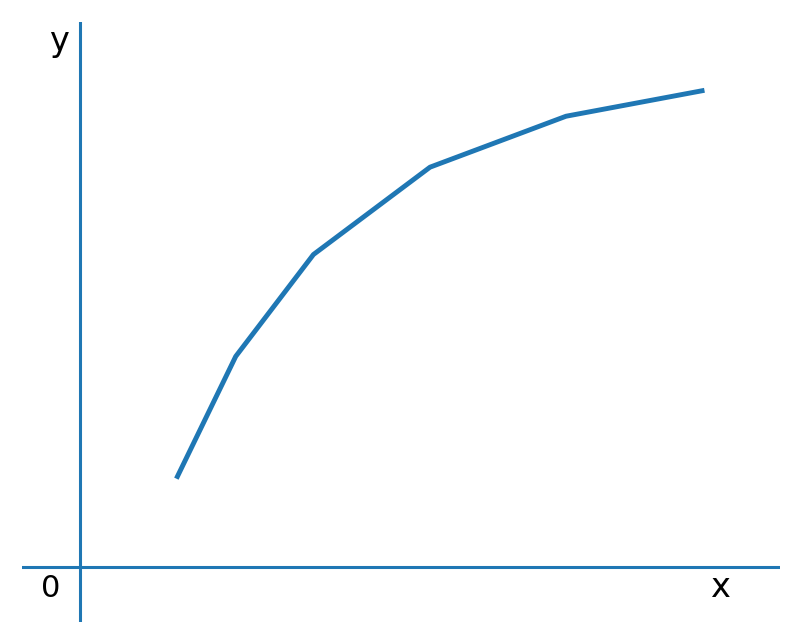
Curve showing y as a function of x in the first quadrant
Ady/dx > 0, d²y/dx² < 0
Bdy/dx > 0, d²y/dx² > 0
Cdy/dx < 0, d²y/dx² < 0
Ddy/dx < 0, d²y/dx² > 0
Answer:(A) dy/dx > 0, d²y/dx² < 0
Explanation
The curve in the diagram is upward sloping and strictly concave downward throughout the depicted range.
Interpreting the calculus derivatives:
First derivative (dy / dx > 0): The curve rises continuously from left to right, confirming a positive slope.
Second derivative (d^2y / dx^2 < 0): The slope becomes progressively flatter as x increases, demonstrating diminishing marginal changes and downward concavity.
Therefore, dy/dx is positive and d^2y/dx^2 is negative.
The price elasticity of demand for a good with the demand function q = kp^(-r) (here p is price, q is quantity demanded and k and r are positive constants) is
A1
Br
C1/r
DNot constant as the function is non-linear
Answer:(B) r
Explanation
For a constant elasticity power demand function, the price elasticity of demand is constant and equal to the exponent r.
Differentiating the demand function q = k * p^(-r) with respect to price p:
Taking the logarithmic derivative d(ln q) / d(ln p) directly confirms that the price elasticity is identically r at all price levels.
Sign in to read the full explanation
Question 92
A box contains 10 bulbs, 4 of which are defective. If 3 of the bulbs are drawn randomly without replacement, what is the probability that all three bulbs are defective?
A1/30
B3/4
C3/10
D4/10
Answer:(A) 1/30
Explanation
The probability of drawing three defective bulbs without replacement is found using combinations or sequential conditional probabilities.
Therefore, the rebased index number for 2016 is 105.
Sign in to read the full explanation
Question 94
Consider the following statements about a time series of annual observations on sales of a firm for ten years:
(i) The series will have seasonal variations
(ii) The series will have a secular trend
(iii) The series will have cyclical variations
Choose the correct answer from the code given below:
A(ii) and (iii)
B(i), (ii) and (iii)
C(i) and (ii)
D(i) and (iii)
Answer:(A) (ii) and (iii)
Explanation
Seasonal variations operate strictly within a twelve-month annual cycle and cannot appear in annual aggregate time series data.
Evaluating the time series components:
Seasonal variations (i) — recur within a single year (across seasons, months, or quarters). In an annual series, intra-year seasonal swings are completely aggregated and absent.
Secular trend (ii) — reflects smooth long-run growth or decline across the ten-year span.
Cyclical variations (iii) — capture multi-year business cycle expansions and contractions across decade-long intervals.
Thus, the annual observations contain only secular trend and cyclical variations.
Sign in to read the full explanation
Question 95
In a two-variable regression, the correlation coefficient between dependent and independent variables Y and X is 0-7. What is the percentage of variations in Y explained by X?
A49%
B7%
C0.7%
D70%
Answer:(A) 49%
Explanation
In a bivariate linear regression, the coefficient of determination (R^2) equals the square of the Pearson correlation coefficient (r).
Given the correlation coefficient r = 0.7:
R^2 = r^2 = (0.7)^2 = 0.49
Converting to percentage terms:
Explained variation = 0.49 * 100% = 49%
Thus, 49 percent of the total variation in the dependent variable Y is explained by independent variable X.
Sign in to read the full explanation
Question 96
Match List I with List II:
List I
List II
(a) Delphi Method
(i) Stationarity
(b) Dickey-Fuller Test
(ii) Autocorrelation
(c) Durbin-Watson Test
(iii) Testing significance of a regression coefficient
(d) Student's t-Test
(iv) Forecasting
A(a)-(iv), (b)-(i), (c)-(ii), (d)-(iii)
B(a)-(i), (b)(ii), (c)-(iii), (d)-(iv)
C(a)-(iv), (b)(ii), (c)-(i), (d)-(iii)
D(a)-(i), (b)-(iv), (c)-(iii), (d)-(ii)
Answer:(A) (a)-(iv), (b)-(i), (c)-(ii), (d)-(iii)
Explanation
The correct matching connects each econometric and statistical method to its primary analytical purpose.
(a)-(iv), (b)-(i), (c)-(ii), (d)-(iii)
(a) Delphi Method — structured qualitative consensus technique used for long-range forecasting.
(b) Dickey-Fuller Test — unit root test used to establish whether a time series exhibits stationarity.
(c) Durbin-Watson Test — diagnostic test for first-order autocorrelation among regression disturbances.
(d) Student's t-Test — hypothesis test evaluating the statistical significance of individual regression coefficients.
Sign in to read the full explanation
Question 97
By autocorrelation we mean that
AThe residuals of a regression model are not independent.
BThe residuals of a regression model are related with one or more of the regressors.
CThe square of the residuals of a regression model are not equally spread.
DThe variance of the residuals of a regression model is not constant for all observations.
Answer:(A) The residuals of a regression model are not independent.
Explanation
Autocorrelation refers to serial dependence among the disturbance terms of an econometric regression model.
The classical linear regression model assumes zero covariance between different error terms:
Cov(u_i, u_j) = 0 for all i != j
When autocorrelation occurs, this assumption is violated because error terms are serially correlated over time or across space, meaning the residuals are not mutually independent.
B describes endogeneity or regressor-error correlation.
C and D describe heteroscedasticity, where error variances differ across observations.
Sign in to read the full explanation
Question 98
In Regression Analysis, if a quantitative variable has 'm' categories, one can introduce
AOnly m + 1 dummy variables
BOnly m-1 dummy variables
COnly m dummy variables
DOnly 2 m variables
Answer:(B) Only m-1 dummy variables
Explanation
In a regression model with an intercept term, a qualitative variable with m distinct categories requires exactly (m - 1) dummy variables.
Introducing m dummy variables alongside the intercept constant causes perfect multicollinearity, known as the dummy variable trap:
Sigma[D_i] = 1 = Intercept Column
To avoid this singularity, one category is designated as the base or benchmark category, requiring exactly (m - 1) dummy regressors.
Sign in to read the full explanation
Question 99
Though two time series are individually non-stationary, their linear combination is stationary. This is an example of
ARandom walk
BSpurious regression
CCointegration
DTrend stationarity
Answer:(C) Cointegration
Explanation
Cointegration occurs when a linear combination of two or more non-stationary time series produces a stationary series.
Formulated by Robert Engle and Clive Granger (1987):
If series Y_t and X_t are both integrated of order one: Y_t, X_t ~ I(1)
But a linear combination u_t = Y_t - beta * X_t is integrated of order zero: u_t ~ I(0)
Then the series are cointegrated, proving the existence of a genuine long-run equilibrium relationship rather than a spurious regression artifact.
Sign in to read the full explanation
Question 100
In the context of simultaneous equations econometric models, consider the following statements:
(i) Both order and rank conditions for identification are to be satisfied before estimation
(ii) Order condition is a necessary but not a sufficient condition of identification
(iii) Two-stage least squares method is suitable for over-identified equations
Which of the above statements is/are correct?
Choose the correct answer from the code given below:
AOnly (i)
B(i), (ii) and (iii)
C(i) and (iii)
DOnly (ii)
Answer:(B) (i), (ii) and (iii)
Explanation
All three statements correctly articulate identification and estimation criteria in simultaneous equations systems.
Evaluating the principles:
Identification requirements (i) — both the order condition and the rank condition must be verified prior to parameters estimation to ensure unique structural solutions.
Order condition status (ii) — the order condition (K - M >= G - 1) is a necessary mathematical counting rule, but only the rank condition provides necessary and sufficient proof of identification.
Estimation method (iii) — Two-Stage Least Squares (2SLS) is designed specifically to produce consistent estimators for over-identified structural equations.
Spotted a shift or questions missing from this paper?
Frequently asked questions
How many questions were in the UGC NET Economics December 2018 exam?
Paper 1 had 50 questions and Paper 2 (Economics) had 100 questions, for 150 in total across 3 hours.
Is there negative marking in UGC NET?
No. Each correct answer earns 2 marks and there is no penalty for a wrong answer, so leaving a question blank is never better than attempting it.
Are the December 2018 answers on this page official?
Answers follow the official NTA answer key for this session. If you spot a discrepancy, use the report option inside the practice test and we will review it.
Can I attempt the December 2018 paper as a timed mock test?
Yes. Every paper on this page has an "Attempt this paper" button that opens the same questions in the timed test interface, with instant scoring and weak-area analysis afterwards.
Want the full mock experience?
Attempt Paper 1 + Paper 2 (Economics) together in a single timed session.