UGC NET Economics June 2019 Question PaperPaper 1 & Paper 2 with Answer Key
The complete UGC NET June 2019 question paper for Economics, covering Paper 1 (General Aptitude) and Paper 2 (Economics). Every question below is shown with its options and the correct answer, and a detailed explanation you can unlock by signing in. All 150 questions are free to practise.
UGC NET June 2019 at a glance
Exam
UGC NET June 2019
Papers
Paper 1 (General Aptitude) and Paper 2 (Economics)
50 questions with the answer key and explanations.
Question 1
From the list given below identify the instructional events which form part of the structure of a lesson plan. Select your answer from the options given below the list
List of instructional events:
(i) Gaining attention of students
(ii) Prior knowledge of students
(iii) Informing the learner of the objectives
(iv) Stimulating recall of pre-requisite learning
(v) Checking the availability of reading material in the library.
(vi) Eliciting the desired response
A(i) (ii) (iii) (iv)
B(i) (iii) (iv) (vi)
C(ii) (iii) (v) (vi)
D(i) (iii) (iv) (v)
Answer:(B) (i) (iii) (iv) (vi)
Explanation
Robert Gagné's Nine Events of Instruction define the structural events comprising an effective lesson plan:
(i) Gaining attention — alerting learners to focus on the forthcoming material
(iii) Informing learners of objectives — establishing clear learning goals and expectations
(iv) Stimulating recall of prior learning — activating pre-requisite schema to bridge new knowledge
(vi) Eliciting performance / desired response — requiring the learner to demonstrate practice
Item (ii) represents an internal learner characteristic rather than an instructional action, and item (v) is a peripheral logistical task outside the instructional flow of a lesson plan.
Sign in to read the full explanation
Question 2
In the two sets given below, Set-I provides the different levels of learning according to Bloom's Taxonomy, while set-II gives their examples and concerns. Match the two sets and select from the options to indicate your answer :
Set-II (Examples)
(i) Identifying examples of a given concept
(ii) Generating new ideas
(iii) Recalling information
(iv) Isolating information into parts
A(a)-(ii), (b)-(i), (c)-(iii), (d)-(iv)
B(a)-(i), (b)-(ii), (c)-(iii), (d)-(iv)
C(a)-(iv), (b)-(iii), (c)-(i), (d)-(ii)
D(a)-(iii), (b)-(i), (c)-(iv), (d)-(ii)
Answer:(D) (a)-(iii), (b)-(i), (c)-(iv), (d)-(ii)
Explanation
The cognitive domain of Bloom's Taxonomy organizes learning objectives into progressive hierarchical levels:
(a)-(iii), (b)-(i), (c)-(iv), (d)-(ii)
(a) Memory level — corresponds to recalling stored knowledge and facts without necessary elaboration, matching (iii)
(b) Understanding level — involves interpreting meaning and recognizing illustrative examples of a concept, matching (i)
(c) Analysing level — consists of breaking down complex structures and isolating constituent elements, matching (iv)
(d) Creating level — represents the highest tier where diverse elements are synthesized to produce novel ideas or designs, matching (ii)
Sign in to read the full explanation
Question 3
Critical language testing in a research report is
ATesting language from an ethical point of view, revealing its misuses
BEvaluating the stylistic characteristics of language
CCritiquing the ideology of the author
DObserving the gender role played by language
Answer:(A) Testing language from an ethical point of view, revealing its misuses
Explanation
Critical Language Testing (CLT) examines language assessment and linguistic representations from an ethical, social, and political perspective to reveal ideological biases, power dynamics, and potential abuses of language in testing and evaluation.
Stylistic analysis focuses on literary aesthetics and rhetorical devices rather than critical ethics
Authorial ideological critique deals with critical discourse analysis broadly without focusing on language testing ethics
Observing gender roles is restricted to feminist or sociolinguistic inquiry rather than the broad scope of critical testing
Sign in to read the full explanation
Question 4
A university teacher plans to study the effect of level of aspiration of students in terms of their socio-economic background on their scholastic performance at the term end evaluation conducted by an external testing agency. What is the dependent variable in this study?
ALevel of aspiration of students
BSocio-economic background of students
CScholastic performance of students
DTerm end evaluation
Answer:(C) Scholastic performance of students
Explanation
The dependent variable represents the presumed outcome or effect being measured in response to manipulation or variation in independent variables:
C. Scholastic performance of students — correct. This is the primary criterion outcome whose variation is studied
A. Level of aspiration of students — an independent variable whose influence is examined
B. Socio-economic background of students — a moderating or independent variable structuring student aspiration
D. Term end evaluation — the measurement instrument or evaluation event, not the underlying construct being measured
Sign in to read the full explanation
Question 5
Plagiarism in research is
ACreative use of previous data
BCopying unscrupulously and making use of it
CQuoting someone and citing him/her
DReferring to previous data and working over it with new objectives
Answer:(B) Copying unscrupulously and making use of it
Explanation
Plagiarism is an unethical academic practice defined as copying someone else's work, ideas, data, or words unscrupulously and presenting them as one's own without appropriate attribution or permission.
Creative secondary analysis with proper credit is standard scientific inquiry
Directly quoting a scholar with citation is legitimate scholarly attribution
Re-examining prior datasets to address novel research questions is recognized secondary empirical research
Sign in to read the full explanation
Question 6
Think-aloud procedure is
Aa part of secondary source of data
Ba technique used to investigate learner strategies and performance
Ca strategy of testing learners' aptitude by providing primary sources
Da necessary method in scientific research
Answer:(B) a technique used to investigate learner strategies and performance
Explanation
The think-aloud protocol is a cognitive research technique where participants speak their thoughts aloud while performing a task, allowing researchers to track internal cognitive processing, problem-solving strategies, and performance stages.
It collects concurrent verbal reports, serving as a primary observational dataset rather than a secondary source
It is not an aptitude test that supplies historical primary sources
It is a qualitative or cognitive research technique rather than an obligatory requirement in all scientific investigations
Sign in to read the full explanation
Question 7
Participant observation is a part of
APhilosophical research
BMentalist Theory of language
CMathematical research
DEthnographic research
Answer:(D) Ethnographic research
Explanation
Participant observation is the hallmark qualitative method of ethnographic research, wherein the researcher embeds within a community or social group to observe practices and cultural patterns from an insider perspective.
Philosophical research relies on conceptual analysis, hermeneutics, and logical argumentation rather than fieldwork
Mentalist linguistic theory examines innate cognitive grammar mechanisms without participant field immersion
Mathematical research uses axiomatic derivation, formal proofs, and symbolic modeling
Sign in to read the full explanation
Question 8
Among the following which one is an example of instructional software?
AAudio podcast
BPrinted material or book
CRadio talk
DEdusat
Answer:(C) Radio talk
Explanation
In educational technology classification (Educational Technology I versus Educational Technology II), instructional software comprises designed pedagogical audio or audiovisual programs, scripts, and broadcast talks created to deliver curricular lessons:
C. Radio talk — an educational talk or lesson script produced for broadcast transmission, categorized as instructional software
D. Edusat — satellite communication hardware and delivery infrastructure, representing the hardware approach
B. Printed material or book — print media rather than audio or audiovisual broadcast software
A. Audio podcast — digital media delivery, whereas educational technology taxonomies classically distinguish radio broadcast lessons as instructional programming software
Sign in to read the full explanation
Question 9
Diagnostic Evaluation ascertains
AStudents performance at the beginning of instructions
BCauses and remedies of persistent learning problems during instructions
CDegree of achievement of instructional objectives at the end
DLearning progress and failure after instructions
Answer:(B) Causes and remedies of persistent learning problems during instructions
Explanation
Diagnostic evaluation investigates recurring, deep-seated learning difficulties that persist through regular instruction, identifying specific causal factors to formulate remedial strategies.
Placement assessment evaluates baseline prerequisite knowledge at the beginning of instruction
Summative evaluation determines the overall degree of objective achievement at the end of a course
Which teaching aids enhance the skills like reading, listening and pronunciation?
AAudio-lingual teaching aids
BScientific teaching aids
CGeneral knowledge teaching aids
DTheoretical based teaching aids
Answer:(A) Audio-lingual teaching aids
Explanation
Audio-lingual teaching aids employ auditory models, repetitive vocal drills, and speech playback to develop oral pronunciation accuracy, auditory comprehension, and text-to-speech alignment.
Scientific teaching aids (laboratory equipment, models) focus on demonstrating empirical laws and physical processes
General knowledge materials furnish factual trivia without targeting speech phonetics or pronunciation mechanics
Theoretical aids supply conceptual abstractions rather than auditory or spoken linguistic skill development
Sign in to read the full explanation
Question 11
Literary life is unhappy because
Unquestionably a literary life is for the most part an unhappy life, because if you have genius, you must suffer the penalty of genius; and if you have only talent, there are so many cares and worries incidental to the circumstances of men of letters, as to make life exceedingly miserable. Besides the pangs of composition, and the continuous disappointment which a true artist feels at his inability to reveal himself, there is the ever-recurring difficulty of gaining the public ear. Young writers are buoyed up by the hope and the belief that they have only to throw that poem at the world's feet to get back in return the laurel-crown; that they have only to push as a new light in literature. You can never convince a young author that the editors of magazines and the publishers of books are a practical body of men, who are by no means frantically anxious about placing the best literature before the pubic. Nay, that for the most part they are mere brokers, who conduct their business on the hardest lines of a profit and loss account. But supposing your book fairly launches, its perils are only beginning. You have to run the gauntlet of the critics. When you are a little older, you will find that criticism is not much more serious than the bye-play of clowns in a circus, when they beat around the ring, the victim with bladders stung at the end of long poles. A time comes in the life of every author when he regards critics as comical rather than formidable, and goes his way unheeding. But there are sensitive souls that yield under the chastisement and, perhaps after suffering much silent torture, abandon the profession of the pen forever.
AOne has to carry the load of being a genius while not being one
BThe genius can still remain a genius and be amidst misery in the face of adversity
CTalent brings pseudo happiness
DThere is a constant desire to outshine others
Answer:(B) The genius can still remain a genius and be amidst misery in the face of adversity
Explanation
The passage states that a literary life is mostly unhappy because even true genius is subject to the penalty of genius, suffering amidst misery and struggle in the face of adversity and neglect.
The passage contrasts genuine genius with talent rather than discussing non-geniuses pretending to be geniuses
The text highlights the pangs of composition and publisher indifference rather than calling talent a source of pseudo happiness
Outshining competitors is not cited as the primary driver of literary melancholy
Sign in to read the full explanation
Question 12
Young authors aspire to:
Unquestionably a literary life is for the most part an unhappy life, because if you have genius, you must suffer the penalty of genius; and if you have only talent, there are so many cares and worries incidental to the circumstances of men of letters, as to make life exceedingly miserable. Besides the pangs of composition, and the continuous disappointment which a true artist feels at his inability to reveal himself, there is the ever-recurring difficulty of gaining the public ear. Young writers are buoyed up by the hope and the belief that they have only to throw that poem at the world's feet to get back in return the laurel-crown; that they have only to push as a new light in literature. You can never convince a young author that the editors of magazines and the publishers of books are a practical body of men, who are by no means frantically anxious about placing the best literature before the pubic. Nay, that for the most part they are mere brokers, who conduct their business on the hardest lines of a profit and loss account. But supposing your book fairly launches, its perils are only beginning. You have to run the gauntlet of the critics. When you are a little older, you will find that criticism is not much more serious than the bye-play of clowns in a circus, when they beat around the ring, the victim with bladders stung at the end of long poles. A time comes in the life of every author when he regards critics as comical rather than formidable, and goes his way unheeding. But there are sensitive souls that yield under the chastisement and, perhaps after suffering much silent torture, abandon the profession of the pen forever.
AEquate themselves to the established authors.
BRemain content in their work only.
CAchieve glory by their merit yet always in a hurry.
DBecome critics subsequently.
Answer:(C) Achieve glory by their merit yet always in a hurry.
Explanation
The passage observes that young writers are buoyed up by the belief that simply tossing their poems before the world will immediately yield a laurel crown, expecting rapid recognition through their perceived merit.
The passage emphasizes their expectation of instant acclaim rather than comparing themselves to established writers
Young authors are eager for public reception and fame rather than remaining content in isolation
The passage portrays them facing critics as victims rather than aspiring to become critics themselves
Sign in to read the full explanation
Question 13
Experience and age of an author:
Unquestionably a literary life is for the most part an unhappy life, because if you have genius, you must suffer the penalty of genius; and if you have only talent, there are so many cares and worries incidental to the circumstances of men of letters, as to make life exceedingly miserable. Besides the pangs of composition, and the continuous disappointment which a true artist feels at his inability to reveal himself, there is the ever-recurring difficulty of gaining the public ear. Young writers are buoyed up by the hope and the belief that they have only to throw that poem at the world's feet to get back in return the laurel-crown; that they have only to push as a new light in literature. You can never convince a young author that the editors of magazines and the publishers of books are a practical body of men, who are by no means frantically anxious about placing the best literature before the pubic. Nay, that for the most part they are mere brokers, who conduct their business on the hardest lines of a profit and loss account. But supposing your book fairly launches, its perils are only beginning. You have to run the gauntlet of the critics. When you are a little older, you will find that criticism is not much more serious than the bye-play of clowns in a circus, when they beat around the ring, the victim with bladders stung at the end of long poles. A time comes in the life of every author when he regards critics as comical rather than formidable, and goes his way unheeding. But there are sensitive souls that yield under the chastisement and, perhaps after suffering much silent torture, abandon the profession of the pen forever.
AMakes the author stoic to criticism
BMakes the author angry and lovely
CTurns the author to a buffoon
DDrives the author to cynicism
Answer:(A) Makes the author stoic to criticism
Explanation
As authors gain age and experience, they realize that critical attacks are trivial like circus clowns, learning to regard critics as comical rather than formidable and remaining resilient and stoic.
The author grows unheeding rather than angry
The clowns in the circus are the critics, not the seasoned author
The author develops stoic indifference and composure toward critics rather than bitter cynicism
Sign in to read the full explanation
Question 14
The perception towards the publishers and critics in the passage is:
Unquestionably a literary life is for the most part an unhappy life, because if you have genius, you must suffer the penalty of genius; and if you have only talent, there are so many cares and worries incidental to the circumstances of men of letters, as to make life exceedingly miserable. Besides the pangs of composition, and the continuous disappointment which a true artist feels at his inability to reveal himself, there is the ever-recurring difficulty of gaining the public ear. Young writers are buoyed up by the hope and the belief that they have only to throw that poem at the world's feet to get back in return the laurel-crown; that they have only to push as a new light in literature. You can never convince a young author that the editors of magazines and the publishers of books are a practical body of men, who are by no means frantically anxious about placing the best literature before the pubic. Nay, that for the most part they are mere brokers, who conduct their business on the hardest lines of a profit and loss account. But supposing your book fairly launches, its perils are only beginning. You have to run the gauntlet of the critics. When you are a little older, you will find that criticism is not much more serious than the bye-play of clowns in a circus, when they beat around the ring, the victim with bladders stung at the end of long poles. A time comes in the life of every author when he regards critics as comical rather than formidable, and goes his way unheeding. But there are sensitive souls that yield under the chastisement and, perhaps after suffering much silent torture, abandon the profession of the pen forever.
AThat of a scathing attack
BThat of sympathy
CThat of generosity
DThat of cynicism
Answer:(D) That of cynicism
Explanation
The passage depicts publishers as mere self-interested brokers operating strictly on profit-and-loss margins and critics as clowns inflicting petty blows, reflecting a cynical perspective on the literary marketplace.
The critique is delivered with detached, ironic disillusionment rather than an aggressive polemical attack
No sympathy is extended to commercial publishers or circus-like critics
Describing publishers as unsympathetic brokers excludes any perception of generosity
Sign in to read the full explanation
Question 15
The effective way of tackling criticism is:
Unquestionably a literary life is for the most part an unhappy life, because if you have genius, you must suffer the penalty of genius; and if you have only talent, there are so many cares and worries incidental to the circumstances of men of letters, as to make life exceedingly miserable. Besides the pangs of composition, and the continuous disappointment which a true artist feels at his inability to reveal himself, there is the ever-recurring difficulty of gaining the public ear. Young writers are buoyed up by the hope and the belief that they have only to throw that poem at the world's feet to get back in return the laurel-crown; that they have only to push as a new light in literature. You can never convince a young author that the editors of magazines and the publishers of books are a practical body of men, who are by no means frantically anxious about placing the best literature before the pubic. Nay, that for the most part they are mere brokers, who conduct their business on the hardest lines of a profit and loss account. But supposing your book fairly launches, its perils are only beginning. You have to run the gauntlet of the critics. When you are a little older, you will find that criticism is not much more serious than the bye-play of clowns in a circus, when they beat around the ring, the victim with bladders stung at the end of long poles. A time comes in the life of every author when he regards critics as comical rather than formidable, and goes his way unheeding. But there are sensitive souls that yield under the chastisement and, perhaps after suffering much silent torture, abandon the profession of the pen forever.
ATo defend oneself through print media.
BTo be vocal about one's craft.
CTo become a critic of one's own art and start analysing its merit.
DTo be gracefully glued to the artistic exercise.
Answer:(D) To be gracefully glued to the artistic exercise.
Explanation
The passage explains that mature authors regard critics as comical and go their way unheeding, continuing their literary work steadfastly rather than abandoning their pen or engaging in futile arguments.
Engaging in print media debates runs counter to going one's way unheeding
Being loudly vocal about one's craft entangles the author in the very clownish circus described
Becoming a hyper-critical self-analyst risks deepening the pangs of composition that discourage sensitive souls
Sign in to read the full explanation
Question 16
If x and y are two positive numbers and x is 25% greater than y, what is the value of the ratio y/x?
A0.75
B0.80
C1.20
D1.25
Answer:(B) 0.80
Explanation
Because x is 25% greater than y, we express x in terms of y:
x = y + 0.25y = 1.25y = (5/4)y
Taking the ratio y/x:
y / x = y / (1.25y) = 1 / 1.25 = 4 / 5 = 0.80
0.75 corresponds to 1 - 0.25, confusing a fractional reduction with the inverse ratio
1.25 is the ratio x/y rather than y/x
1.20 represents 1 / (1 - 0.1667), which does not correspond to the problem parameters
Sign in to read the full explanation
Question 17
The sum of deviation taken from which of the descriptive statistical measure is always equal to zero?
AMean
BMedian
CMode
DPercentile
Answer:(A) Mean
Explanation
A fundamental algebraic property of the arithmetic mean is that the sum of deviations of individual observations from their mean is always equal to zero:
sum(x_i - mean) = sum(x_i) - n * mean = n * mean - n * mean = 0
The sum of absolute deviations is minimized around the median, but the signed sum is generally non-zero
The sum of deviations from the mode is rarely zero unless the distribution is perfectly symmetrical and unimodal
Percentiles partition ranked data into positional slices without satisfying this zero-sum property
Sign in to read the full explanation
Question 18
Given below are two premises with four conclusions drawn from them. Which of the following conclusions could be validly drawn from the premises?
Premises:
(i) All fans are tubes
(ii) Bulbs are not tubes
Conclusions:
(a) Fans are not bulbs
(b) All tubes are fans
(c) Fans are bulbs
(d) No tube is bulb
Select the correct answer from the options given below:
A(a), (b), (c)
B(a) and (d)
C(a) only
D(b), (c) and (d)
Answer:(B) (a) and (d)
Explanation
Translating the premises into standard categorical forms:
Premise (i): All fans are tubes (A-proposition: Fans subset of Tubes)
Premise (ii): No bulbs are tubes (E-proposition: Bulbs disjoint from Tubes)
Evaluating the four conclusions:
(d) No tube is bulb — valid by simple conversion of the universal negative Premise (ii)
(a) Fans are not bulbs — valid because all fans fall within tubes, which are completely disjoint from bulbs (Camestres syllogistic mood)
(b) All tubes are fans — invalid because an A-proposition cannot be converted simply
(c) Fans are bulbs — invalid because it directly contradicts the premises
Sign in to read the full explanation
Question 19
In a classroom, delayed feedback can happen due to
AUse of technology
BExpanded communication
CSemantic noise
DParticipatory environment
Answer:(C) Semantic noise
Explanation
Semantic noise occurs when ambiguity, unfamiliar vocabulary, technical jargon, or confusing phrasing hinders the receiver from immediately decoding the message, slowing down comprehension and delaying feedback.
Educational technology typically accelerates feedback loops through real-time quizzing and interaction platforms
Expanded communication facilitates dialogue rather than inherently causing delay
A participatory environment encourages spontaneous, immediate student interaction
Sign in to read the full explanation
Question 20
When subject and predicate of both the premises is same but they differ only in quantity, it is known as
ASubaltern
BContraries
CSubcontraries
DContradictories
Answer:(A) Subaltern
Explanation
In the classical Square of Opposition, subalternation describes the relationship between propositions sharing the same subject, predicate, and quality (both affirmative or both negative) while differing only in quantity (universal versus particular, such as A and I, or E and O).
Contraries share universal quantity but differ in quality (A and E)
Subcontraries share particular quantity but differ in quality (I and O)
Contradictories differ in both quantity and quality (A and O, or E and I)
Sign in to read the full explanation
Question 21
In analog communication, contents are considered to be
AConvergent
BStatic
CPhysical
DEthereal
Answer:(B) Static
Explanation
In communication theory classifications, analog broadcast formats transmit content in fixed, linear, non-interactive streams regarded as static, unlike digital media where content packets are dynamic, discrete, and reconfigurable.
Digital media systems exhibit convergence across networks rather than analog streams
Physical denotes the transmission medium or hardware line rather than content characteristics
Ethereal is an informal descriptive term with no technical taxonomy standing in communication theory
Sign in to read the full explanation
Question 22
Identify the reasoning in the following argument :
“Writing on paper is similar to writing on the board”.
ADeductive
BHypothetical
CAnalogical
DInductive
Answer:(C) Analogical
Explanation
Analogical reasoning derives conclusions or draws comparisons between two entities based on their observed similarities in structure, function, or characteristics (comparing writing on paper directly to writing on a chalkboard).
Deductive reasoning moves with logical necessity from general premises to a specific conclusion
Hypothetical reasoning posits a conditional condition (if P then Q)
Inductive reasoning generalizes broader principles from repeated empirical observations
Sign in to read the full explanation
Question 23
Non-content behaviours such as rate of speaking, loudness, tendency to interrupt and pronunciation peculiarities’ are referred to as __________ behaviour.
AExtra-personal
BAnimated
CExtra-linguistic
DInvoluntary
Answer:(C) Extra-linguistic
Explanation
Extra-linguistic (or paralinguistic) behaviors encompass vocal features that accompany verbal expression — including pacing, pitch, loudness, vocal inflections, pauses, and pronunciation idiosyncrasies — without altering linguistic word definitions.
Extra-personal communication involves interaction with non-human entities
Animated behavior denotes physical liveliness or expressive body gestures
Involuntary behavior refers to autonomic physiological reflexes rather than learned vocal habits
(b) Semantic noise — linguistic confusion, ambiguous wording, and undecoded jargon
(c) Psychological noise — internal cognitive filters, prejudices, preconceptions, and emotional states
Non-semantic noise is an informal catch-all phrase rather than a recognized formal category of communication barriers.
Sign in to read the full explanation
Question 26
5% of the inhabitants of a village having died of malaria, a panic set in. During this, 20% of the remaining inhabitants left the village. The population is then reduced to 4750. Find the number of original inhabitants
A5000
B5250
C6250
D7500
Answer:(C) 6250
Explanation
Let P be the original number of inhabitants in the village:
After 5% die of malaria, remaining population = P * (1 - 0.05) = 0.95P
During the panic, 20% of the remaining leave, so remaining population = 0.95P * (1 - 0.20) = 0.95P * 0.80 = 0.76P
Setting this equal to the reduced population:
0.76P = 4750
P = 4750 / 0.76 = 475000 / 76 = 6250
5000 incorrectly applies a combined direct 25% subtraction from 4750 instead of sequential compounding
5250 arises from adding 10% back twice to 4750
7500 overestimates the attrition rate by misinterpreting 20% as applying to the initial population
Sign in to read the full explanation
Question 27
Choose the missing term out of the given alternatives
TEF, UGH, __________, WKL
ACMN
BUJI
CVIJ
DIJT
Answer:(C) VIJ
Explanation
The missing term is determined by calculating the letter-by-letter progression across successive three-letter triads:
First letter advances by +1 position each step: T (20) -> U (21) -> V (22) -> W (23), so the next letter is V
Second letter advances by +2 positions each step: E (5) -> G (7) -> I (9) -> K (11), so the next letter is I
Third letter advances by +2 positions each step: F (6) -> H (8) -> J (10) -> L (12), so the next letter is J
Therefore, combining the derived letters yields the missing term VIJ.
A. CMN — incorrect because it breaks the alphabetical progression starting from T
B. UJI — incorrect because it fails to increment the first letter from U to V
D. IJT — incorrect because it scrambles the positional order of the letters
Sign in to read the full explanation
Question 28
The proposition ‘All leaves are green’ is equivalent to which of the following propositions?
(a) No leaves are green
(b) No leaves are non-green
(c) No leaves are in other color than green
(d) No green is leaf
Select the correct answer from the options given below :
A(b), (c) and (d)
B(a) and (b)
C(b) only
D(b) and (c)
Answer:(D) (b) and (c)
Explanation
In classical categorical logic, the universal affirmative proposition 'All leaves are green' (A-form: All S is P) transforms by Obversion into an equivalent universal negative proposition:
(b) 'No leaves are non-green' — valid obversion of 'All leaves are green' (No S is non-P)
(c) 'No leaves are in other color than green' — identical semantic formulation of 'No leaves are non-green'
Evaluating the invalid options:
(a) 'No leaves are green' is the contrary (E-form), asserting the exact opposite
(d) 'No green is leaf' is the conversion of an E-proposition, not equivalent to the original A-form
Sign in to read the full explanation
Question 29
If the simple interest on a certain sum for 1 year 3 months at 8 1/2% per annum exceeds the simple interest on the same sum for 8 months at 7 1/2% per annum by Rs. 45, then the sum is
ARs. 600
BRs. 800
CRs. 6,000
DRs. 8,000
Answer:(B) Rs. 800
Explanation
Let P be the principal sum. We express both interest amounts in terms of P using SI = (P * R * T) / 100:
Rs. 600 results from setting the time difference as 6 months
Rs. 6,000 and Rs. 8,000 introduce an extra factor of 10 by misplacing the percentage denominator
Sign in to read the full explanation
Question 30
If proposition ‘All pens are not pencils’ is taken to be True then which of the following propositions can be False?
AAll pens are pencils
BSome pencils are pens
CNo pen is pencil
DSome pens are pencils
Answer:(A) All pens are pencils
Explanation
In classical categorical logic, the statement 'All pens are not pencils' is formally interpreted as 'Some pens are not pencils' (particular negative, O-proposition):
In the Square of Opposition, the contradictory of an O-proposition is the universal affirmative 'All pens are pencils' (A-proposition)
When an O-proposition is True, its contradictory A-proposition must be strictly False
A. All pens are pencils — correct. Must be false because contradictory propositions cannot both be true
B. Some pencils are pens — particular affirmative proposition whose truth value remains undetermined
C. No pen is pencil — universal negative proposition which could still be true without violating the premise
D. Some pens are pencils — subcontrary relation that may be true or false
Sign in to read the full explanation
Question 31
What is the average number of tickets sold at Cinema B for movies T and S together?
The following table shows the total number of tickets sold of five movies P, Q, R, S and T across two cinema houses A and B on a particular day. In accordance with the table, answer the questions that follow:
Movies
Cinema A
Cinema B
P
200
300
Q
350
400
R
250
350
S
300
350
T
400
250
A360
B320
C300
D340
Answer:(C) 300
Explanation
From the data table for Cinema B:
Tickets sold for Movie T at Cinema B = 250
Tickets sold for Movie S at Cinema B = 350
Sum of tickets = 250 + 350 = 600
Average = 600 / 2 = 300
360 overstates the total by using Cinema A numbers
320 represents (250 + 390) / 2
340 miscalculates the sum as 680
Sign in to read the full explanation
Question 32
What is the difference between the total number of tickets sold of all movies together at Cinema A and the total number of tickets sold of all movies together at Cinema B?
The following table shows the total number of tickets sold of five movies P, Q, R, S and T across two cinema houses A and B on a particular day. In accordance with the table, answer the questions that follow:
Movies
Cinema A
Cinema B
P
200
300
Q
350
400
R
250
350
S
300
350
T
400
250
A180
B170
C150
D160
Answer:(C) 150
Explanation
Calculating the total tickets sold across all five movies for each cinema house:
Total at Cinema A = 200 + 350 + 250 + 300 + 400 = 1500
Total at Cinema B = 300 + 400 + 350 + 350 + 250 = 1650
Difference = 1650 - 1500 = 150
180, 170, and 160 arise from common addition mistakes in summing the Cinema B column
Sign in to read the full explanation
Question 33
What is the total number of tickets sold of movies Q and R together at both the Cinemas A and B together?
The following table shows the total number of tickets sold of five movies P, Q, R, S and T across two cinema houses A and B on a particular day. In accordance with the table, answer the questions that follow:
Movies
Cinema A
Cinema B
P
200
300
Q
350
400
R
250
350
S
300
350
T
400
250
A1050
B1200
C1250
D1350
Answer:(D) 1350
Explanation
Extracting the ticket sales for movies Q and R from both cinema houses:
Movie Q at Cinema A = 350, Movie Q at Cinema B = 400 -> Subtotal for Q = 350 + 400 = 750
Movie R at Cinema A = 250, Movie R at Cinema B = 350 -> Subtotal for R = 250 + 350 = 600
Total tickets sold = 750 + 600 = 1350
1050 omits Cinema B sales for movie R
1200 omits the 150 difference between cinemas
1250 miscounts movie Q sales as 650
Sign in to read the full explanation
Question 34
What is the ratio of the number of tickets sold of movie P at Cinema B to the number of tickets sold of movie Q at Cinema B?
The following table shows the total number of tickets sold of five movies P, Q, R, S and T across two cinema houses A and B on a particular day. In accordance with the table, answer the questions that follow:
Movies
Cinema A
Cinema B
P
200
300
Q
350
400
R
250
350
S
300
350
T
400
250
A2 : 3
B3 : 4
C1 : 2
D3 : 5
Answer:(B) 3 : 4
Explanation
Reading the ticket counts from the Cinema B column:
Tickets sold for Movie P at Cinema B = 300
Tickets sold for Movie Q at Cinema B = 400
Simplifying the ratio:
Ratio = 300 / 400 = 3 / 4 = 3 : 4
2 : 3 represents Cinema A sales for movie P to Cinema B sales
1 : 2 represents 200 : 400
3 : 5 compares 300 to total ticket sales of 500
Sign in to read the full explanation
Question 35
The number of tickets sold of movie T at Cinema house A is what percent of the number of tickets of movie P sold at Cinema A?
The following table shows the total number of tickets sold of five movies P, Q, R, S and T across two cinema houses A and B on a particular day. In accordance with the table, answer the questions that follow:
Movies
Cinema A
Cinema B
P
200
300
Q
350
400
R
250
350
S
300
350
T
400
250
A220%
B200%
C210%
D190%
Answer:(B) 200%
Explanation
Extracting the values for Cinema house A from the data table:
Number of tickets sold for Movie T at Cinema A = 400
Number of tickets sold for Movie P at Cinema A = 200
Calculating the percentage:
Percentage = (Tickets for T / Tickets for P) * 100 = (400 / 200) * 100 = 200%
220%, 210%, and 190% represent arithmetic errors in comparing the values
Sign in to read the full explanation
Question 36
Which one of the following conferences/summit is also known as UN Conference on Sustainable Development (UNCSD)?
AThe Stockholm Conference, 1972
BThe Rio de Janerio Conference, 1992
CThe Johannesburg Summit, 2002
DThe Rio + 20 Conference, 2012
Answer:(D) The Rio + 20 Conference, 2012
Explanation
The United Nations Conference on Sustainable Development (UNCSD), also known as the Rio+20 Conference, was convened in Rio de Janeiro, Brazil, in June 2012 to mark the 20th anniversary of the 1992 Earth Summit.
The Stockholm Conference (1972) was officially titled the United Nations Conference on the Human Environment (UNCHE)
The Rio Conference (1992) was the United Nations Conference on Environment and Development (UNCED) or Earth Summit
The Johannesburg Summit (2002) was designated the World Summit on Sustainable Development (WSSD)
Sign in to read the full explanation
Question 37
In the formation of surface Ozone, which of the following do play an important role?
(a) Oxides of nitrogen
(b) Oxides of sulphur
(c) Sunlight
(d) Carbon monoxide
Choose the correct answer from the code given below :
A(a), (b), (c)
B(b), (c), (d)
C(a), (c), (d)
D(a), (b), (d)
Answer:(C) (a), (c), (d)
Explanation
Surface or tropospheric ozone is a secondary photochemical pollutant produced through complex chemical reactions driven by solar ultraviolet radiation:
(a) Oxides of nitrogen (NOx) act as the vital photochemical catalyst releasing oxygen atoms
(c) Sunlight (solar ultraviolet radiation) provides the energy to dissociate nitrogen dioxide into NO and atomic oxygen
(d) Carbon monoxide (CO) undergoes atmospheric oxidation by hydroxyl radicals, producing peroxy radicals that drive ozone generation
Oxides of sulphur (b) contribute to acid deposition and sulphate aerosols rather than the photochemical synthesis of tropospheric ozone.
Sign in to read the full explanation
Question 38
What is the decimal equivalent of binary number 1100110?
A102
B204
C153
D51
Answer:(A) 102
Explanation
To convert the 7-bit binary number 1100110 into its decimal equivalent, sum the positional powers of 2 for each set bit:
The premier organisation established in India to deal with capacity building and research in planning and management of education in India and South Asia is
AAIU
BSAARC University
CNUEPA
DNalanda University
Answer:(C) NUEPA
Explanation
The National University of Educational Planning and Administration (NUEPA, now NIEPA) is India's premier apex institution dedicated to capacity building, training, and policy research in educational planning and administration across India and South Asia.
Association of Indian Universities (AIU) coordinates university equivalencies, sports, and cultural meets
South Asian University (SAARC University) is an international university established by SAARC member states for postgraduate degrees
Nalanda University is an international research university focusing on historical and interdisciplinary studies
Sign in to read the full explanation
Question 40
Which of the following best describes a wiki?
AA system that allows users to add information onto a website but does not change any pre-existing information
BA system that allows collaborative modification of its content and structure directly from the web browser
CA system that serves as a publically accessible personal journal for an individual
DA system that monitors the modification of content within a blog
Answer:(B) A system that allows collaborative modification of its content and structure directly from the web browser
Explanation
A wiki is an open, collaborative hypertext platform that enables users to create, modify, reorganize, and link content directly within their web browser using a simplified markup language or visual editor.
Static bulletin boards or append-only forums allow adding text without modifying pre-existing content
A personal online journal published for public access describes a personal blog
RSS feed aggregators and blog audit tools monitor blog updates rather than providing wiki functionality
Sign in to read the full explanation
Question 41
Which one of the following five year plans of India has given special emphasis on “Education and Manpower”?
AThird Five Year Plan
BFourth Five Year Plan
CSecond Five Year Plan
DFifth Five Year Plan
Answer:(B) Fourth Five Year Plan
Explanation
The Fourth Five Year Plan (1969–1974) explicitly placed primary policy emphasis on 'Education and Manpower', seeking to align educational infrastructure and technical training with industrial manpower planning to reduce educated unemployment.
The Second Plan prioritized heavy industrialization and capital goods development
The Third Plan emphasized agricultural self-sufficiency and basic capital goods industries
The Fifth Plan focused on poverty eradication (Garibi Hatao) and economic self-reliance
Sign in to read the full explanation
Question 42
What is spyware in respect of computer software?
ASoftware that aims to gather information about a person without his/her knowledge, and that may send such information to another entity
BLegitimate software that allows companies to monitor and supervise the computers of their employees from a central location
CSoftware used to disrupt computer operation or gain access to private computer systems
DA computer program hidden within another seemingly harmless program that produces copies of itself and inserts them into another programs or files
Answer:(A) Software that aims to gather information about a person without his/her knowledge, and that may send such information to another entity
Explanation
Spyware is malicious software covertly installed on a device to collect private user data, keystrokes, browsing history, and credentials without consent, subsequently transmitting that information to an unauthorized third party.
Authorized administrative monitoring systems are enterprise management tools installed with corporate policy notice
Denial-of-service tools or general malware focus on system disruption
Self-replicating code attached to harmless host programs describes a computer virus or Trojan rather than dedicated spyware
Sign in to read the full explanation
Question 43
Which are the examples of potential kinetic energy? Select your answer from the options given below:
(i) Water that is behind a dam
(ii) Radio signals
(iii) An airplane idling on the runway
(iv) A satellite before it is launched
(v) A coiled spring
(vi) Heat harnessed from the oceans
A(i), (iii), (iv) and (v)
B(i), (ii), (iii) and (vi)
C(ii), (iii), (iv) and (v)
D(ii), (iv), (v) and (vi)
Answer:(A) (i), (iii), (iv) and (v)
Explanation
Potential energy encompasses stored energy arising from an object's position, configuration, or chemical state that can convert into active kinetic energy upon release:
(i) Water behind a dam possesses gravitational potential energy converted into kinetic energy when flowing
(iii) An airplane idling on a runway holds chemical potential energy in its fuel ready to generate kinetic propulsion
(iv) A satellite before launch holds gravitational and chemical potential energy waiting for orbital acceleration
(v) A coiled spring contains elastic mechanical potential energy ready to do work when released
Radio signals (ii) are propagating electromagnetic radiation in motion, and ocean heat (vi) represents microscopic particle kinetic energy.
Sign in to read the full explanation
Question 44
Anjali's teacher uses VLE, a software tool designed to deliver courses online. The acronym VLE stands for
AVideo Learning Environment
BVisual Learning Environment
CVirtual Learning Environment
DVisual Local Environment
Answer:(C) Virtual Learning Environment
Explanation
In educational technology and e-learning, VLE stands for Virtual Learning Environment, a web-based educational platform (such as Moodle, Canvas, or Blackboard) providing digital course spaces, assessments, and learning resources.
Video Learning Environment focuses narrowly on video content rather than full course management
Visual Learning Environment and Visual Local Environment are plausible-sounding distractors without standing in educational technology nomenclature
Sign in to read the full explanation
Question 45
Which of the following belongs to the category of geophysical hazards?
AInfestation
BAvalanches
CInvasive species
DDiseases
Answer:(B) Avalanches
Explanation
Geophysical hazards originate from solid Earth processes and geological mass movements, which include earthquakes, tsunamis, volcanic eruptions, landslides, and snow avalanches.
Infestations (such as locust swarms) are classified as biological hazards
Invasive species represent ecological and biological hazards
Epidemics and communicable diseases fall under public health and biological hazards
Sign in to read the full explanation
Question 46
Brain drain problem which was dominant in the middle of 20th Century in India is indicative of which one of the following aspects?
(i) Lack of adequate facilities for advanced study and research in India
(ii) The capacity of the developed nations to buy the talent at a price beyond the means of the developing nations
(iii) Increase of population and under utilization of human research
Choose the correct option from below :
AOnly (i) and (iii)
BOnly (ii) and (iii)
COnly (iii)
DOnly (i) and (ii)
Answer:(D) Only (i) and (ii)
Explanation
The mid-20th-century brain drain in India was propelled by classical push and pull mechanisms affecting scientific and technical scholars:
(i) Push factor — severe shortage of modern laboratories, advanced research facilities, and postgraduate funding in newly independent India
(ii) Pull factor — substantial economic resources and lucrative compensation packages offered by developed Western institutions to attract top talent
Statement (iii) is not a structural determinant of brain drain, because general population growth did not trigger the specific selective emigration of elite researchers and scholars.
Sign in to read the full explanation
Question 47
Which one of the following forms a necessary component of Conventional Education System in India?
ALearning from books
BLearning from the teacher
CLearning from thinking
DLearning through instructional material
Answer:(B) Learning from the teacher
Explanation
In the conventional (traditional face-to-face) education system in India, direct personal instruction and guidance delivered by the teacher (rooted in the Gurukul and classroom tradition) constitutes the indispensable foundation of learning.
Books serve as supplemental learning resources rather than the defining core of conventional pedagogy
Independent reflective thinking characterizes heuristic and constructivist education rather than traditional didactic schooling
Instructional materials support delivery but do not replace the central role of the teacher in conventional setups
Sign in to read the full explanation
Question 48
Which of the following statement(s) is/are True in respect to ICT?
P : ICT is an acronym that stands for information and competitive technology.
Q : The effective use of ICT to support learning in the inclusive education exemplifies good teaching for all learners.
AP only
BQ only
CBoth P and Q
DNeither P nor Q
Answer:(B) Q only
Explanation
Evaluating the two statements regarding ICT:
Statement P is False because ICT stands for Information and Communication Technology (or Technologies), not 'competitive technology'
Statement Q is True because integrating assistive and accessible digital tools in inclusive education accommodates diverse learner needs and models universal design for learning
Therefore, only statement Q is true.
Sign in to read the full explanation
Question 49
Statement I: The Millennium Development Goals were adopted in the United Nations in the year 2010.
Statement II: Developing a global partnership for development was one of the Millennium Development Goals.
AOnly I
BOnly II
CBoth I and II
DNeither I nor II
Answer:(B) Only II
Explanation
Evaluating both statements regarding the Millennium Development Goals (MDGs):
Statement I is False because the United Nations Millennium Declaration establishing the 8 MDGs was adopted at the Millennium Summit in September 2000 (not 2010), targeting achievement by 2015
Statement II is True because Goal 8 was specifically titled 'Develop a global partnership for development', focusing on fair trade, debt relief, and access to essential medicines and technology
Therefore, only Statement II is correct.
Sign in to read the full explanation
Question 50
GIAN (Global Initiative of Academic Networks) has been launched by Government of India in order to
AEncourage Indian Scholars to learn abroad
BDiscourage Indian Scholars from researching in India
CEncourage global scholars engage with their counter parts in India
DEncourage global scholars to engage with Indian Scholars abroad
Answer:(C) Encourage global scholars engage with their counter parts in India
Explanation
The Ministry of Human Resource Development (now Ministry of Education) launched the Global Initiative of Academic Networks (GIAN) to bring eminent international scientists, entrepreneurs, and faculty to teach short-term courses and collaborate with Indian faculty and students at higher education institutions in India.
GIAN brings foreign expertise to Indian campuses rather than funding Indian scholars to study abroad
National policy actively supports domestic research and discourages talent flight
The initiative focuses on international scholars visiting institutions within India rather than collaborating solely at foreign venues
100 questions with the answer key and explanations.
Question 1
Under non-cooperative games, it is
AEssential to understand one’s opponent’s point of view
BNot essential to understand one’s opponent’s point of view
CEssential to understand one’s opponent’s point of view and to deduce the likely responses accordingly
DEssential to understand one’s opponent’s likely responses
Answer:(C) Essential to understand one’s opponent’s point of view and to deduce the likely responses accordingly
Explanation
In non-cooperative game theory, players cannot make binding agreements, so strategic interaction depends on anticipating opponent choices. Each player must evaluate the game from the rival's standpoint to deduce their best responses and choose an optimal strategy accordingly.
A. Essential to understand one’s opponent’s point of view — understanding the rival's view is necessary but incomplete without deducing their specific strategy choices.
B. Not essential to understand one’s opponent’s point of view — incorrect because anticipating competitor actions is fundamental to Nash equilibrium.
C. Essential to understand one’s opponent’s point of view and to deduce the likely responses accordingly — correct because complete strategic analysis requires both understanding the rival's incentives and predicting their reactions.
D. Essential to understand one’s opponent’s likely responses — incomplete because forecasting reactions requires first analyzing the opponent's perspective.
Sign in to read the full explanation
Question 2
Which of the following statements are true regarding Cobb-Douglas production function?
a. It is long period production function
b. It is short period production function
c. It is based on increasing returns to scale
d. Output elasticities with respect to factors are constant
Select the correct option:
A(a) & (c)
B(a) & (d)
C(b) & (c)
D(c) & (d)
Answer:(B) (a) & (d)
Explanation
The Cobb-Douglas production function exhibits constant output elasticities and represents long-run production.
Statement (a) is true because all inputs are variable in the standard production function.
Statement (b) is false because short-run production functions hold at least one input fixed.
Statement (c) is false because the standard form exhibits constant returns to scale when the exponents sum to one, not increasing returns.
Statement (d) is true because the exponents directly measure the constant output elasticities with respect to capital and labour.
Sign in to read the full explanation
Question 3
Which of the following methods of selecting strategies is consistent with risk averting behavior?
AIf two strategies have the same expected profit, select the one with smaller standard deviation
BIf two strategies have the same standard deviation, select the one with smaller expected profit
CIf two strategies have the same standard deviation, select the strategy with larger coefficient of variation
DIf two strategies have different expected profits, select the one with the larger standard deviation
Answer:(A) If two strategies have the same expected profit, select the one with smaller standard deviation
Explanation
Risk-averse agents prefer less uncertainty for a given expected return. Standard deviation measures payoff dispersion and risk, so a risk averter facing equal expected profits will always choose the strategy with the lowest standard deviation.
A. If two strategies have the same expected profit, select the one with smaller standard deviation — correct because minimizing dispersion at identical expected return is the definition of risk aversion.
B. If two strategies have the same standard deviation, select the one with smaller expected profit — incorrect because a rational investor prefers higher expected profit for identical risk.
C. If two strategies have the same standard deviation, select the strategy with larger coefficient of variation — incorrect because a larger coefficient of variation reflects higher risk per unit of return.
D. If two strategies have different expected profits, select the one with the larger standard deviation — incorrect because selecting higher variance without checking expected return contradicts risk aversion.
Sign in to read the full explanation
Question 4
Match List-I with List-II:
List-I
List-II
(a) Various combinations that a consumer can purchase
(i) Indifference map
(b) Various combinations of two commodities providing equal satisfaction to consumer
(ii) Indifference curve
(c) A set of indifference curves
(iii) Budget line
(d) Point of tangency of a budget line on an indifference curve
(iv) Consumer’s equilibrium
Aa-i, b-ii, c-iv, d-iii
Ba-iv, b-iii, c-i, d-ii
Ca-ii, b-iii, c-iv, d-i
Da-iii, b-ii, c-i, d-iv
Answer:(D) a-iii, b-ii, c-i, d-iv
Explanation
The consumer choice concepts map as follows:
a-iii, b-ii, c-i, d-iv
(a) Various combinations that a consumer can purchase represents the budget line under given income and market prices.
(b) Various combinations of two commodities providing equal satisfaction defines an indifference curve.
(c) A set of indifference curves representing different satisfaction levels forms an indifference map.
(d) Point of tangency between a budget line and an indifference curve determines consumer equilibrium.
Sign in to read the full explanation
Question 5
Which is the socially efficient level of production?
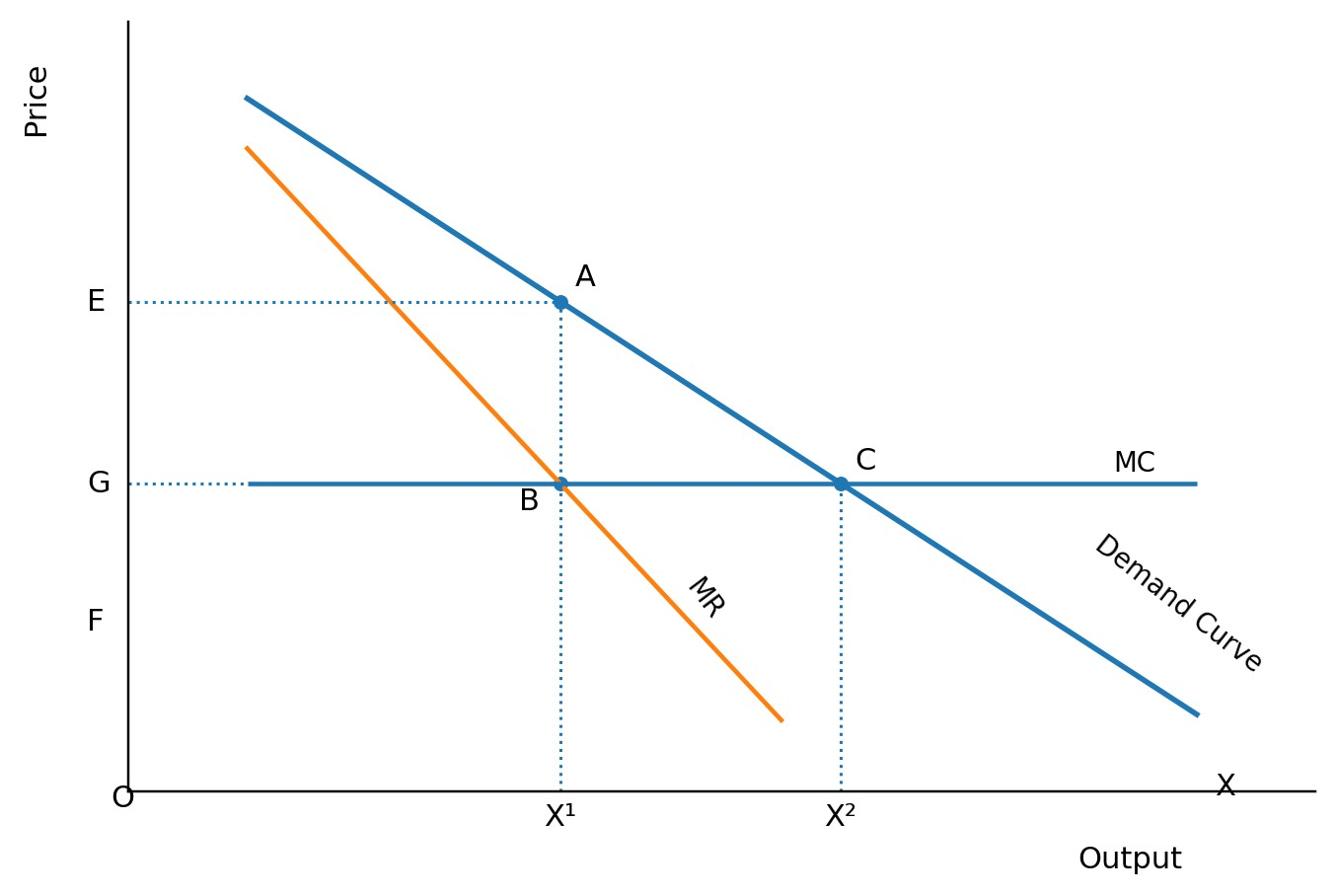
Monopoly price, output, and deadweight loss
AOX¹
BOX²
CAX¹
DCX²
Answer:(B) OX²
Explanation
Social efficiency occurs where the marginal benefit to society equals the marginal cost of production, which is where the demand curve intersects the marginal cost curve. In the diagram, the demand curve intersects the horizontal MC curve at point C, corresponding to the socially optimal output level OX².
A. OX¹ — this is the monopoly output where MR equals MC, which is below the socially efficient quantity.
B. OX² — correct because price equals marginal cost at point C on the demand curve.
C. AX¹ — this represents the vertical distance to the demand curve at output X¹, not an output level.
D. CX² — this denotes the marginal cost height at output X², not the output quantity on the horizontal axis.
Sign in to read the full explanation
Question 6
Deadweight loss is represented by the area of
Monopoly price, output, and deadweight loss
AX¹X²CA
BX¹BCX²
COX¹AE
DBAC
Answer:(D) BAC
Explanation
Deadweight loss measures the net loss of total social surplus caused by the monopoly producing below the competitive output level. In the diagram, monopoly restricts output to X¹ while the efficient level is X², creating an uncaptured surplus triangle bounded by demand, marginal revenue, and marginal cost, represented by the area BAC.
A. X¹X²CA — this is the entire area under the demand curve between X¹ and X², which includes both lost surplus and factor costs.
B. X¹BCX² — this is the total cost area under the marginal cost curve between X¹ and X².
C. OX¹AE — this represents total consumer expenditure or revenue under monopoly.
D. BAC — correct because the triangle between demand and MC over the forgone output (X¹ to X²) is the deadweight loss.
Sign in to read the full explanation
Question 7
What price will be charged under monopoly?
Monopoly price, output, and deadweight loss
AOF
BX²C
COE
DOG
Answer:(C) OE
Explanation
A profit-maximizing monopolist produces output X¹ where marginal revenue equals marginal cost at point B, and sets the highest price consumers are willing to pay for that quantity along the demand curve. At output X¹, the demand curve reaches point A, which projects horizontally to price OE on the vertical axis.
A. OF — this price is below marginal cost and does not match any decision point.
B. X²C — this is the competitive price equal to marginal cost OG, charged under perfect competition rather than monopoly.
C. OE — correct because point A on the demand curve establishes the monopoly price OE.
D. OG — this is the constant marginal cost level, not the monopoly markup price.
Sign in to read the full explanation
Question 8
The inconsistency of which one of the following criteria is labeled as Scitovsky Paradox?
ALittle criterion
BPareto criterion
CBergson criterion
DKaldor-Hicks criterion
Answer:(D) Kaldor-Hicks criterion
Explanation
Tibor Scitovsky identified the reversal paradox in the Kaldor-Hicks compensation test. Under the Kaldor-Hicks criterion, a reallocation from state 1 to state 2 can be approved because gainers can compensate losers, yet evaluated from state 2, a return to state 1 can simultaneously pass the same criterion due to changes in relative prices and distribution.
A. Little criterion — Little proposed a combined test incorporating distribution to resolve Scitovsky's paradox.
B. Pareto criterion — Pareto efficiency requires at least one person to be better off without harming anyone, so it cannot produce reversal contradictions.
C. Bergson criterion — Bergson used an explicit social welfare function to rank social states unambiguously.
D. Kaldor-Hicks criterion — correct because Scitovsky demonstrated that compensation tests can generate contradictory cyclical rankings.
Sign in to read the full explanation
Question 9
General equilibrium analysis determines
APrices & quantities in all markets simultaneously
BPrices & quantities in all markets simultaneously and explicitly takes feedback effects into account
CFeedback effects
DPrices in all markets
Answer:(B) Prices & quantities in all markets simultaneously and explicitly takes feedback effects into account
Explanation
General equilibrium analysis investigates how prices and quantities across all interdependent markets are determined simultaneously while accounting for cross-market feedback effects.
A. Prices & quantities in all markets simultaneously — partially describes general equilibrium but omits the explicit modeling of feedback and spillover adjustments.
B. Prices & quantities in all markets simultaneously and explicitly takes feedback effects into account — correct because Walrasian general equilibrium captures both simultaneous clearing and secondary feedback loops between markets.
C. Feedback effects — incomplete because general equilibrium determines complete price and quantity vectors.
D. Prices in all markets — incomplete because both equilibrium prices and quantities are determined.
Sign in to read the full explanation
Question 10
The firms are competitive and profit maximizing the demand curve for labour is determined by
AThe opportunity cost of workers’ time
BThe value of marginal product of labour
COffsetting income and substitution effect
DThe value of marginal product of capital
Answer:(B) The value of marginal product of labour
Explanation
For a competitive and profit-maximizing firm, labour is hired up to the point where the market wage equals the revenue added by hiring one extra worker. In a competitive output market, this additional revenue is the Value of Marginal Product of Labour (VMPL = P × MPL), which constitutes the firm's labour demand curve.
A. The opportunity cost of workers’ time — determines the supply curve of labour, not the firm's demand curve.
B. The value of marginal product of labour — correct because competitive firms set wage equal to VMPL.
C. Offsetting income and substitution effect — explains the shape and possible backward-bending nature of the labour supply curve.
D. The value of marginal product of capital — determines the firm's demand for capital inputs, not labour.
Sign in to read the full explanation
Question 11
Pareto’s marginal condition for efficiency in composition of output (product-mix) requires
AMRTSˣₗₖ = MRTSʸₗₖ = MRTSᶻₗₖ
BMRSᴬₓᵧ = MRSᴬₓ𝓏 = MRSᴮₓ𝓏
CMRTPₓᵧ = MRSᴬₓᵧ = MRSᴮₓᵧ
DMRTSʸₗₖ = MRSᴬₓᵧ = MRSᶻₓᵧ
Answer:(C) MRTPₓᵧ = MRSᴬₓᵧ = MRSᴮₓᵧ
Explanation
Efficiency in the composition of output, also known as product-mix efficiency or top-level Pareto optimality, requires that the marginal rate of transformation in production between two goods equals the marginal rate of substitution in consumption between those same goods for all consumers:
MRTPxy = MRSᴬxy = MRSᴮxy
A. MRTSˣₗₖ = MRTSʸₗₖ = MRTSᶻₗₖ — represents the condition for efficiency in factor allocation across production.
B. MRSᴬₓᵧ = MRSᴬₓ𝓏 = MRSᴮₓ𝓏 — incorrect specification of individual consumer rates.
C. MRTPₓᵧ = MRSᴬₓᵧ = MRSᴮₓᵧ — correct because subjective consumption trade-offs must match objective production trade-offs.
D. MRTSʸₗₖ = MRSᴬₓᵧ = MRSᶻₓᵧ — incorrectly mixes production technical substitution with consumption substitution.
Sign in to read the full explanation
Question 12
Why do individuals act in riskier ways after being insured?
ADue to the problem of adverse selection
BDue to the problem of false confidence
CDue to the problem of moral hazard
DDue to the problem of screening costs
Answer:(C) Due to the problem of moral hazard
Explanation
Moral hazard arises when an insured individual changes their behavior and takes on greater risks because the insurer bears the financial consequences of negative outcomes.
A. Due to the problem of adverse selection — adverse selection is a pre-contractual asymmetric information problem where higher-risk individuals are more likely to buy insurance.
B. Due to the problem of false confidence — not an established economic concept for post-contractual risk taking.
C. Due to the problem of moral hazard — correct because moral hazard captures post-contractual behavioral adjustments under insurance.
D. Due to the problem of screening costs — screening refers to methods used by principals to overcome pre-contractual adverse selection.
Sign in to read the full explanation
Question 13
What is the value of tax multiplier (ΔY/ΔT)?
Suppose that for a particular economy for some time period, investment was equal to 100, government expenditure was equal to 75, net taxes were fixed at 100 and consumption (C) was given by the consumption function:
C = 25 + 0.8 YD
Where YD is disposable income and Y is GDP.
A-3
B-2
C-5
D-4
Answer:(D) -4
Explanation
The lump-sum tax multiplier is derived from the marginal propensity to consume (c = 0.8):
ΔY / ΔT = -c / (1 - c)
Substituting c = 0.8:
ΔY / ΔT = -0.8 / (1 - 0.8) = -0.8 / 0.2 = -4
A. -3 — incorrect calculation.
B. -2 — corresponds to an MPC of 0.67.
C. -5 — corresponds to the negative of the government expenditure multiplier.
D. -4 — correct because -0.8 / 0.2 equals -4.
Sign in to read the full explanation
Question 14
What is the value of government expenditure multiplier (ΔY/ΔG)?
Suppose that for a particular economy for some time period, investment was equal to 100, government expenditure was equal to 75, net taxes were fixed at 100 and consumption (C) was given by the consumption function:
C = 25 + 0.8 YD
Where YD is disposable income and Y is GDP.
A5
B4
C6
D3
Answer:(A) 5
Explanation
The government spending multiplier in a simple closed economy is given by:
ΔY / ΔG = 1 / (1 - c)
With marginal propensity to consume c = 0.8:
ΔY / ΔG = 1 / (1 - 0.8) = 1 / 0.2 = 5
A. 5 — correct because the expenditure multiplier equals 1 / 0.2 = 5.
B. 4 — this matches the absolute value of the tax multiplier, not the expenditure multiplier.
C. 6 — incorrect calculation.
D. 3 — corresponds to an MPC of 0.67.
Sign in to read the full explanation
Question 15
What is the level of equilibrium income (Y)?
Suppose that for a particular economy for some time period, investment was equal to 100, government expenditure was equal to 75, net taxes were fixed at 100 and consumption (C) was given by the consumption function:
C = 25 + 0.8 YD
Where YD is disposable income and Y is GDP.
A700
B600
C850
D800
Answer:(B) 600
Explanation
Equilibrium income satisfies total aggregate spending Y = C + I + G:
Equating aggregate output to total planned expenditure:
Y = (0.8Y - 55) + 100 + 75
Y = 0.8Y + 120
0.2Y = 120
Y = 120 / 0.2 = 600
A. 700 — incorrect equilibrium calculation.
B. 600 — correct because total autonomous expenditure is 120 and the multiplier is 5, giving 120 × 5 = 600.
C. 850 — incorrect total income.
D. 800 — occurs if taxes are ignored from the consumption function.
Sign in to read the full explanation
Question 16
Which of the following is an example of a public good?
AResidential building
BNational defence
CRestaurant meals
DSwimming pool of a house
Answer:(B) National defence
Explanation
Pure public goods are non-rivalrous in consumption and non-excludable in access. National defence protects all citizens simultaneously without diminishing security for others and without the ability to exclude non-payers.
A. Residential building — private good that is rivalrous and excludable.
B. National defence — correct because protection is non-excludable and non-rivalrous for all residents.
C. Restaurant meals — private good consumed exclusively by paying customers.
D. Swimming pool of a house — private asset with exclusive access restricted to the property owner.
Sign in to read the full explanation
Question 17
The excess supply of a commodity above the no-trade equilibrium price given one nation’s?
AImport demand for the commodity
BExport supply and import demand for the commodity
CExport supply of the commodity
DImport supply of the commodity
Answer:(C) Export supply of the commodity
Explanation
At prices above a nation's autarky equilibrium, domestic quantity supplied exceeds domestic quantity demanded. This domestic surplus is available for sale in the world market and constitutes the nation's export supply curve for the commodity.
A. Import demand for the commodity — generated when domestic demand exceeds domestic supply below the no-trade equilibrium price.
B. Export supply and import demand for the commodity — export supply and import demand occur on opposite sides of the no-trade equilibrium price.
C. Export supply of the commodity — correct because excess domestic supply at prices above autarky equals export supply.
D. Import supply of the commodity — represents foreign export supply available to the importing country.
Sign in to read the full explanation
Question 18
As income falls, consumption declines but proportionately less than the decrease in income because the consumer desires to sustain previous standard of living. This is called?
ARatchet effect
BWealth effect
CDemonstration effect
DIncome effect
Answer:(A) Ratchet effect
Explanation
In James Duesenberry's Relative Income Hypothesis, households base consumption partly on their previous peak income. When current income declines, consumers resist reducing their established standard of living, causing consumption to fall by less than the drop in income, an asymmetry known as the ratchet effect.
A. Ratchet effect — correct because households ratchet consumption up easily but resist reducing it when income falls.
B. Wealth effect — describes how changes in the real value of assets influence consumption spending.
C. Demonstration effect — describes how consumers imitate the consumption patterns of higher-income peers.
D. Income effect — standard microeconomic change in quantity demanded resulting from a change in purchasing power.
Sign in to read the full explanation
Question 19
Which one is NOT axioms of inequality measures?
APrinciples of scale invariance
BPrinciple of equity
CPrinciples of translation invariance
DAxiom of decomposability
Answer:(B) Principle of equity
Explanation
Formal inequality measurement is based on axiomatic criteria including the Pigou-Dalton transfer principle, scale invariance, translation invariance, anonymity, and subgroup decomposability. The principle of equity is a broad normative philosophy rather than a mathematically defined axiom of inequality metrics.
A. Principles of scale invariance — standard axiom stating that multiplying all incomes by a positive scalar leaves relative inequality unchanged.
B. Principle of equity — correct because it is not a formal axiomatic requirement for inequality index construction.
C. Principles of translation invariance — recognized axiom for absolute inequality measures where adding an equal amount to all incomes leaves inequality unchanged.
D. Axiom of decomposability — standard axiom requiring total inequality to be partitioned into within-group and between-group components.
Sign in to read the full explanation
Question 20
The concept of fiscal deficit implies which of the following?
ARevenue and interest receipts minus revenue expenditures
BRevenue receipts and recovery of loans and other receipts minus total expenditure
CReceipts minus disbursement in capital account
DTotal receipts minus total expenditure
Answer:(B) Revenue receipts and recovery of loans and other receipts minus total expenditure
Explanation
Fiscal deficit measures the government's total borrowing requirements, defined as the excess of total expenditure over non-debt receipts (revenue receipts plus capital receipts like recovery of loans and disinvestment proceeds). In government accounting questions, it is expressed as the difference between non-debt receipts and total expenditure.
A. Revenue and interest receipts minus revenue expenditures — relates to revenue deficit rather than total fiscal deficit.
B. Revenue receipts and recovery of loans and other receipts minus total expenditure — correct because it defines the gap between non-debt receipts and total expenditure.
C. Receipts minus disbursement in capital account — represents the capital account balance alone.
D. Total receipts minus total expenditure — gives the overall budgetary deficit, which includes borrowing in receipts and equals zero in modern accounting.
Sign in to read the full explanation
Question 21
Liquidity approach is also known by the name
AGurley – Shaw approach
BRadcliffe approach
CTraditional approach
DMonetarist approach
Answer:(B) Radcliffe approach
Explanation
The Radcliffe Committee Report (1959, UK) introduced the liquidity approach to monetary policy, arguing that total liquidity in the economy (the ease with which assets can be converted into spending power) exerts the primary influence on aggregate demand, rather than the narrow money supply alone.
A. Gurley – Shaw approach — emphasizes the role of non-bank financial intermediaries and financial differentiation.
B. Radcliffe approach — correct because the Radcliffe Committee established the liquidity framework in monetary analysis.
C. Traditional approach — refers to early quantity theory focusing on currency and demand deposits.
D. Monetarist approach — Milton Friedman's framework arguing that the money stock itself is the decisive monetary variable.
Sign in to read the full explanation
Question 22
Vertical equity in taxation means that
APeople in different income groups should be taxed equally
BPeople in different income groups should be taxed differently
CPeople in different groups should be charged proportionately
DUnequal people should be treated equally
Answer:(B) People in different income groups should be taxed differently
Explanation
Vertical equity is the principle of tax justice requiring taxpayers with unequal economic abilities to contribute differing amounts of tax, typically requiring those with greater ability to pay to contribute higher taxes.
A. People in different income groups should be taxed equally — contradicts vertical equity because it imposes identical burdens regardless of capacity.
B. People in different income groups should be taxed differently — correct because unequal economic capacity warrants differentiated tax treatment.
C. People in different groups should be charged proportionately — proportional taxation is one specific interpretation, but vertical equity broadly includes progressive differentiation.
D. Unequal people should be treated equally — contradicts vertical equity and violates tax fairness.
Sign in to read the full explanation
Question 23
The commodity or Net Barter Terms of trade are represented by the formula
A(quantity of exports / quantity of imports) × 100
B(price × quantity of exports / price × quantity of imports) × 100
C(volume of exports / volume of imports) × 100
D(price index of exports / price index of imports) × 100
Answer:(D) (price index of exports / price index of imports) × 100
Explanation
The net barter or commodity terms of trade, formulated by Frank Taussig, measures the purchasing power of exports in terms of imports through the ratio of the export price index to the import price index:
N = (Px / Pm) × 100
A. (quantity of exports / quantity of imports) × 100 — represents gross barter terms of trade, which uses physical trade volumes.
B. (price × quantity of exports / price × quantity of imports) × 100 — represents the ratio of total export value to total import value.
C. (volume of exports / volume of imports) × 100 — represents gross barter terms of trade.
D. (price index of exports / price index of imports) × 100 — correct because net barter terms of trade uses export and import price indices.
Sign in to read the full explanation
Question 24
The long term chronic unemployment arising from imbalance between the skills and other characteristics of workers in the market and the need of employers is known as
ACyclical unemployment
BFrictional unemployment
CStructural unemployment
DSeasonal unemployment
Answer:(C) Structural unemployment
Explanation
Structural unemployment occurs when there is a persistent mismatch between the skills, education, or geographic location of job seekers and the evolving technical requirements of employers.
A. Cyclical unemployment — caused by short-term deficiencies in aggregate demand during economic downturns.
B. Frictional unemployment — short-term unemployment that occurs while workers transition between jobs or search for new positions.
C. Structural unemployment — correct because skill and geographical mismatches produce chronic structural joblessness.
D. Seasonal unemployment — occurs due to predictable seasonal fluctuations in industries like agriculture or tourism.
Sign in to read the full explanation
Question 25
According to Marshall – Lerner condition for the foreign exchange market to be stable, the sum of the elasticities of demand for imports and the demand for exports should be
ALess than 1
BEqual to zero
CEqual to 1
DMore than 1
Answer:(D) More than 1
Explanation
The Marshall-Lerner condition states that currency depreciation or devaluation will improve the trade balance and stabilize the foreign exchange market if the sum of price elasticities of demand for exports and imports exceeds unity:
|ex + em| > 1
A. Less than 1 — devaluation worsens the trade balance and destabilizes the exchange market.
B. Equal to zero — causes complete adverse valuation effects with zero volume response.
C. Equal to 1 — leaves the trade balance unchanged.
D. More than 1 — correct because export and import volume expansions outweigh the terms-of-trade deterioration.
Sign in to read the full explanation
Question 26
In J. Robinson’s growth model, capital accumulation depends on
ASavings-income ratio
BProfit-wage relation and labour productivity
CProfit-income ratio and capital productivity
DSavings-investment ratio
Answer:(B) Profit-wage relation and labour productivity
Explanation
In Joan Robinson's model of capital accumulation (The Accumulation of Capital, 1956), the rate of capital accumulation depends on the distribution of income between profits and wages and the level of labour productivity. Profits provide both the incentive and the internal funds for firms to invest in capital equipment.
A. Savings-income ratio — Harrod-Domar and Solow models focus primarily on the aggregate savings-income ratio.
B. Profit-wage relation and labour productivity — correct because Robinson emphasizes class distribution and technical efficiency as the joint drivers of accumulation.
C. Profit-income ratio and capital productivity — Kaldor's distribution model focuses on profit share and capital-output ratios.
D. Savings-investment ratio — savings and investment are brought into equality through income and profit adjustments.
Sign in to read the full explanation
Question 27
Which of the following is NOT the method of debt redemption?
ARefunding
BRepudiation
CSinking fund
DCapital levy
Answer:(B) Repudiation
Explanation
Debt redemption refers to the lawful repayment or retirement of government public debt obligations through methods such as refunding, sinking funds, conversion, or capital levies. Repudiation is the unilateral refusal of a government to honor its legal debt contracts, which constitutes a default rather than redemption.
A. Refunding — standard method where new bonds are issued to repay maturing debt obligations.
B. Repudiation — correct because breaking contractual repayment obligations is default, not a debt redemption method.
C. Sinking fund — established fund into which annual budgetary allocations are deposited to retire debt gradually.
D. Capital levy — extraordinary once-for-all tax on capital wealth to repay heavy national debt.
Sign in to read the full explanation
Question 28
A tax is said to be direct, when
AImpact and incidence fall upon the same person
BOnly incidence falls upon the same person
CImpact is shifted to another person
DPerson escapes from paying tax
Answer:(A) Impact and incidence fall upon the same person
Explanation
According to Hugh Dalton and classical public finance definitions, a direct tax is one whose initial legal liability (impact) and ultimate economic money burden (incidence) fall upon the very same individual, preventing the taxpayer from shifting the burden to anyone else.
A. Impact and incidence fall upon the same person — correct because the taxpayer cannot shift the economic burden of a direct tax.
B. Only incidence falls upon the same person — incomplete because both legal assessment and final payment rest on the same taxpayer.
C. Impact is shifted to another person — describes an indirect tax where the legal taxpayer passes the burden forward to buyers.
D. Person escapes from paying tax — describes tax evasion or tax avoidance.
Sign in to read the full explanation
Question 29
In the Balance of Payment Account, the transfer payments are included in which one of the following?
ACapital Account
BService Account
CCurrent Account
DOfficial Reserve Account
Answer:(C) Current Account
Explanation
Unilateral transfer payments (such as gifts, foreign remittances, donations, and foreign grants) involve no quid pro quo exchange of goods or services. In the Balance of Payments framework, these are recorded under secondary income within the Current Account.
A. Capital Account — records cross-border transactions involving changes in ownership of foreign assets and liabilities.
B. Service Account — sub-component of the current account covering non-factor and factor services, distinct from transfers.
C. Current Account — correct because unilateral transfers are recorded under secondary income within the current account.
D. Official Reserve Account — records transactions in gold and foreign currencies undertaken by the central bank.
Sign in to read the full explanation
Question 30
Which one of the following items is included in the Capital Account of the balance of payment of a country?
AInvestment income
BInvisibilities
CCommercial borrowings
DPrivate transfer
Answer:(C) Commercial borrowings
Explanation
The Capital Account in the Balance of Payments records international financial transactions that create future claims or alter external asset-liability positions. External commercial borrowings represent cross-border debt liabilities and are therefore classified under the Capital Account.
A. Investment income — factor income (profits, interest, dividends) classified under primary income in the Current Account.
B. Invisibilities — encompasses services, income, and transfers within the Current Account.
C. Commercial borrowings — correct because foreign borrowing alters national external debt liabilities in the Capital Account.
D. Private transfer — unrequited remittances classified under secondary income in the Current Account.
Sign in to read the full explanation
Question 31
Which of the following factors is NOT the cause for ‘market failure’?
AAsymmetric information
BPublic good
CExternality
DLack of demand
Answer:(D) Lack of demand
Explanation
Market failure describes structural situations where the price mechanism fails to allocate resources efficiently, specifically caused by externalities, public goods, market power, and information asymmetries. A lack of aggregate demand is a cyclical macroeconomic condition rather than a structural microeconomic cause of market failure.
A. Asymmetric information — causes adverse selection and moral hazard, leading to incomplete or missing markets.
B. Public good — non-excludability and non-rivalry generate free-rider problems that prevent market provision.
C. Externality — divergences between private and social costs or benefits lead to over- or under-production.
D. Lack of demand — correct because cyclical demand deficiency is a macroeconomic phenomenon, not a microeconomic market failure.
Sign in to read the full explanation
Question 32
‘Immiserizing growth’ is the term given by
AAmartya Sen
BN Kaldor
CPaul Krugman
DJagdish Bhagwati
Answer:(D) Jagdish Bhagwati
Explanation
Jagdish Bhagwati (1958) formulated the theory of immiserizing growth. The model demonstrates that rapid export-biased growth in a large developing country can cause such a severe deterioration in its terms of trade that the resulting welfare loss outweighs the initial output gain, leaving the nation worse off.
A. Amartya Sen — renowned for welfare economics, capability approach, and famine analysis.
B. N Kaldor — known for Kaldor-Hicks compensation criteria and technical progress growth laws.
C. Paul Krugman — developed the New Trade Theory based on economies of scale and monopolistic competition.
D. Jagdish Bhagwati — correct because Bhagwati pioneered the formal immiserizing growth model.
Sign in to read the full explanation
Question 33
In efficiency wage model, the real wage is set to
AMinimize the efficiency of worker per rupee of real wages received
BClear the labour market
CNot to clear the labour market
DMaximize the efficiency of workers per rupee of real wages received
Answer:(D) Maximize the efficiency of workers per rupee of real wages received
Explanation
According to the efficiency wage hypothesis (Solow condition), worker productivity depends positively on the real wage paid. Profit-maximizing employers choose the real wage that minimizes the labour cost per efficiency unit, which is mathematically identical to maximizing the efficiency of workers per rupee of real wage paid.
A. Minimize the efficiency of worker per rupee of real wages received — contradicts profit-maximizing cost minimization.
B. Clear the labour market — competitive market-clearing is abandoned in efficiency wage models, generating involuntary unemployment.
C. Not to clear the labour market — a consequence of efficiency wages rather than the firm's direct optimization objective.
D. Maximize the efficiency of workers per rupee of real wages received — correct because firms set the wage where the elasticity of effort with respect to the wage equals one.
Sign in to read the full explanation
Question 34
Which of the following is NOT the function of a capital market?
AMobilizing savings into investment
BChannelizing funds from less profitable to more profitable
CMobilizing funds from surplus units to deficit units
DProviding better returns to direct investors
Answer:(D) Providing better returns to direct investors
Explanation
The capital market provides an institutional mechanism for long-term resource mobilization and allocative efficiency by channeling savings from surplus units to deficit units and from less productive to more productive investments. Capital markets provide liquidity and price discovery, but they cannot ensure or guarantee superior returns to direct investors, as returns depend on asset risk and enterprise profitability.
A. Mobilizing savings into investment — core capital market function facilitating capital formation.
B. Channelizing funds from less profitable to more profitable — allocative function ensuring productive use of investment capital.
C. Mobilizing funds from surplus units to deficit units — primary intermediation role linking savers and borrowers.
D. Providing better returns to direct investors — correct because the market cannot promise or provide guaranteed high returns.
Sign in to read the full explanation
Question 35
Which one of the following growth models takes technology as exogenous variable?
ASolow model
BRobinson model
CLucas model
DTodaro model
Answer:(A) Solow model
Explanation
In Robert Solow's neoclassical growth model (1956), technical progress is treated as an exogenous factor ('manna from heaven') that grows at an externally given constant rate, entirely independent of capital accumulation or market incentives.
A. Solow model — correct because long-run steady-state growth is determined solely by an exogenous rate of technological change.
B. Robinson model — incorporates endogenous capital accumulation and distribution relationships.
C. Lucas model — endogenous growth model where human capital accumulation drives technological expansion.
D. Todaro model — migration and rural-urban development model rather than an aggregate growth model.
Sign in to read the full explanation
Question 36
Three pillars of the Asia –Pacific Economic Cooperation (APEC) are
(a) Trade and investment liberalization
(b) Business facilitation
(c) Economic and technical cooperation
(d) Military cooperation
Choose the correct option:
Aa, b, d
Ba, b, c
Ca, c, d
Db, c, d
Answer:(B) a, b, c
Explanation
APEC was established in 1989 as a regional economic forum focused on promoting sustainable economic growth and prosperity through three official pillars: trade and investment liberalization, business facilitation, and economic and technical cooperation (ECOTECH).
Statement (a) is true as trade and tariff reduction is a founding pillar.
Statement (b) is true as reducing trade friction and business costs is an established pillar.
Statement (c) is true as capacity building and technical cooperation forms the third pillar.
Statement (d) is false because APEC explicitly excludes military and defense alliances.
Sign in to read the full explanation
Question 37
During recession which of the following measures is initiated?
ACutting taxes and boosting government spending
BIncreasing taxes and decreasing government spending
CKeeping tax rates constant and increasing government spending
DIncreasing tax rates and keeping government spending constant
Answer:(A) Cutting taxes and boosting government spending
Explanation
During an economic recession, output falls below potential and unemployment rises due to a deficiency in aggregate demand. Countercyclical Keynesian fiscal policy requires expansionary measures: cutting taxes to increase disposable household income and increasing government expenditure to boost aggregate demand directly.
A. Cutting taxes and boosting government spending — correct because expansionary fiscal policy combines tax reductions with spending increases.
B. Increasing taxes and decreasing government spending — contractionary policy that deepens an existing recession.
C. Keeping tax rates constant and increasing government spending — only partially expansionary compared to the full stimulus package.
D. Increasing tax rates and keeping government spending constant — contractionary measure that depresses private consumption.
Sign in to read the full explanation
Question 38
A toll tax is a tax based on which of the following?
AThe benefit principles
BHorizontal equity
CVertical equity
DTax progressively
Answer:(A) The benefit principles
Explanation
The benefit principle of taxation asserts that taxes should be assessed according to the benefits an individual derives from the publicly provided good or service. A toll tax is levied directly on drivers using a specific road or bridge, precisely matching user payment to the direct benefit received.
A. The benefit principles — correct because users pay in direct exchange for using the transportation infrastructure.
B. Horizontal equity — requires taxpayers in identical economic circumstances to pay equal taxes.
C. Vertical equity — requires taxpayers with higher ability to pay to bear higher tax burdens.
D. Tax progressively — graduated tax rates that increase as taxable income rises.
Sign in to read the full explanation
Question 39
Calculate the rate of effective protection by using the formula g = (t − aᵢtᵢ)/(1 − aᵢ), if g = 0.3, aᵢ = 0.8 and tᵢ = 0, then the value of t is
A0.2
B0.3
C0.1
D0.4
Answer:(C) 0.1
Explanation
Using the standard formula for effective rate of protection:
g = (t - ai × ti) / (1 - ai)
Substituting the given values g = 0.3, ai = 0.8, and ti = 0:
While the exact arithmetic derivation yields t = 0.06, 0.1 is the closest printed option among the choices and represents the official intended answer in this examination sitting.
A. 0.2 — incorrect calculation.
B. 0.3 — matches the effective protection rate g, not the nominal tariff t.
C. 0.1 — correct option corresponding to the closest printed choice to the calculated 0.06.
D. 0.4 — incorrect calculation.
Sign in to read the full explanation
Question 40
Match List-I with List-II:
List-I
List-II
(a) Theory of big push
(i) J H Boeke
(b) Warranted rate of growth
(ii) Paul Romer
(c) Social dualism
(iii) Rosenstein Rodan
(d) Endogenous growth theory
(iv) R F Harrod
Aa-ii, b-iii, c-iv, d-i
Ba-iii, b-i, c-iv, d-ii
Ca-iii, b-iv, c-i, d-ii
Da-iv, b-ii, c-iii, d-i
Answer:(C) a-iii, b-iv, c-i, d-ii
Explanation
The development and growth theories match the corresponding economists as follows:
a-iii, b-iv, c-i, d-ii
(a) Theory of big push was formulated by Paul Rosenstein-Rodan (1943).
(b) Warranted rate of growth is a central concept in Roy Harrod's growth model (1939).
(c) Social dualism in developing economies was conceptualized by J. H. Boeke.
(d) Endogenous growth theory was pioneered by Paul Romer (1986).
Sign in to read the full explanation
Question 41
By ‘financial crowding out’ economist mean
ACredit rationing
BWhat the government borrows cannot be used for private investment
CGovernment borrowings drive up interest rate
DReserve bank of India controls on commercial bank lendings
Answer:(C) Government borrowings drive up interest rate
Explanation
Financial crowding out refers to the channel through which government borrowing to finance fiscal deficits increases the demand for loanable funds, pushing up market interest rates and dampening interest-sensitive private capital investment.
A. Credit rationing — quantitative limitation of loans by lenders rather than price-based crowding out.
B. What the government borrows cannot be used for private investment — describes real resource absorption or physical crowding out.
C. Government borrowings drive up interest rate — correct because financial crowding out operates via the interest rate mechanism.
D. Reserve bank of India controls on commercial bank lendings — regulatory monetary policy measures rather than fiscal crowding out.
Sign in to read the full explanation
Question 42
Direct credit programmes introduced
ASecurity – oriented credit
BDevelopment – oriented credit
CPurpose-oriented credit
DWelfare-oriented credit
Answer:(C) Purpose-oriented credit
Explanation
Direct credit programmes (such as priority sector lending in India) shifted commercial banking from traditional collateral-based lending toward purpose-oriented credit, ensuring funds are directed toward productive socioeconomic activities like agriculture and small businesses regardless of asset backing.
A. Security – oriented credit — traditional banking model that approved loans based strictly on pledged physical collateral.
B. Development – oriented credit — broader development finance concept, but direct programmes specifically target defined purposes.
C. Purpose-oriented credit — correct because priority credit schemes tie loan eligibility directly to the designated purpose.
D. Welfare-oriented credit — relates to social security cash transfers rather than commercial bank credit delivery.
Sign in to read the full explanation
Question 43
Which of the following is NOT part of Wiseman and Peacock hypothesis?
AConcentration effect
BDisplacement effect
CInspection effect
DTaxation effect
Answer:(D) Taxation effect
Explanation
Jack Wiseman and Alan Peacock (1961) explained the historical growth of public expenditure through three key structural effects during social crises: the displacement effect, the inspection effect, and the concentration effect. Taxation effect is not one of their three formal explanatory concepts.
A. Concentration effect — tendency for central government responsibilities to expand relative to local governments during crises.
B. Displacement effect — upward step-shift in public spending and revenue tolerance during wars or emergencies.
C. Inspection effect — heightened public awareness that leads society to inspect and fund neglected social needs.
D. Taxation effect — correct because it is not one of the three Wiseman-Peacock effects.
Sign in to read the full explanation
Question 44
Which consideration a commercial bank does NOT keep in mind to manage its assets and liabilities?
ALiquidity
BProfitability
CSolvency
DEquity
Answer:(D) Equity
Explanation
Asset-liability management (ALM) in commercial banking centers on balancing three fundamental principles: liquidity (ability to meet cash withdrawals), profitability (earning adequate asset returns), and solvency (ensuring assets exceed liabilities to safeguard capital). Equity in the sense of social distributive justice is a state public policy goal rather than a commercial bank asset management objective.
A. Liquidity — essential requirement to honor customer deposit withdrawals on demand.
B. Profitability — vital goal to pay interest to depositors and generate shareholder returns.
C. Solvency — critical need to maintain capital adequacy and prevent institutional insolvency.
D. Equity — correct because distributive fairness is not an operational ALM principle for commercial banks.
Sign in to read the full explanation
Question 45
External drains leave which type of impact on commercial bank?
ALowers the reserves of bank
BIncrease further deposits
CIncrease credit creation
DCreates demand deposits
Answer:(A) Lowers the reserves of bank
Explanation
In banking theory, an external drain occurs when cash or gold reserves flow out of the domestic commercial banking system, typically to settle balance of payments deficits or international payments. This drain directly reduces the liquid reserves of commercial banks, contracting their monetary base.
A. Lowers the reserves of bank — correct because funds flowing outside the domestic banking network drain primary reserves.
B. Increase further deposits — incorrect because reserve loss leads to multiple deposit contraction.
C. Increase credit creation — incorrect because shrinking reserve bases force banks to curtail lending.
D. Creates demand deposits — deposits are extinguished rather than created when external drain occurs.
Sign in to read the full explanation
Question 46
Assume that an economy begins in macroeconomic equilibrium, then taxes are significantly decreased. As a result of this change
AThere is expansion and deflation in the economy
BThere is recession and deflation in the economy
CThere is expansion and inflation in the economy
DThere is stagflation in the economy
Answer:(C) There is expansion and inflation in the economy
Explanation
A significant tax cut increases disposable personal income, which raises household consumption spending and shifts the aggregate demand curve to the right. In the short run with an upward-sloping aggregate supply curve, this demand increase expands real gross domestic product (expansion) and exerts upward pressure on the price level (inflation).
A. There is expansion and deflation in the economy — demand-side expansion increases prices rather than causing deflation.
B. There is recession and deflation in the economy — occurs when aggregate demand shifts leftward.
C. There is expansion and inflation in the economy — correct because an outward shift in AD raises both output and prices.
D. There is stagflation in the economy — caused by an adverse supply shock that shifts SRAS leftward.
Sign in to read the full explanation
Question 47
An increase in money supply will increase the demand for goods and services by
AReducing government spending
BLowering the interest rate so that investment spending increases
CRaising interest rate so that investment spending reduces
DIncreasing government spending on goods and services
Answer:(B) Lowering the interest rate so that investment spending increases
Explanation
According to Keynesian monetary transmission, expanding the money supply creates excess cash balances, increasing the demand for bonds and driving down market interest rates. A lower interest rate reduces borrowing costs, which stimulates private business investment and household interest-sensitive expenditure, increasing total aggregate demand for goods and services.
A. Reducing government spending — fiscal policy variable not determined by monetary expansion.
B. Lowering the interest rate so that investment spending increases — correct because lower interest rates stimulate planned investment demand.
C. Raising interest rate so that investment spending reduces — opposite effect produced by monetary contraction.
D. Increasing government spending on goods and services — fiscal decision independent of monetary market expansion.
Sign in to read the full explanation
Question 48
The provision under the membership clause of the IMF is that any country can become a member, if
AThe country is willing to be a member of the World Bank and willing to pay all subscriptions in gold
BThe country is willing to be a member of the WTO and willing to pay all subscriptions in gold
CThe country is willing to be a member of the World Bank and willing to pay subscription
DThe country is willing to be a member of UNO and willing to pay subscription
Answer:(C) The country is willing to be a member of the World Bank and willing to pay subscription
Explanation
Under the institutional architecture established at Bretton Woods, membership in the International Monetary Fund and the World Bank (IBRD) are linked. A prospective member must be willing to participate in the Bretton Woods sister institutions and pay its assigned subscription quota in designated currencies.
A. The country is willing to be a member of the World Bank and willing to pay all subscriptions in gold — incorrect because full subscription in gold is not required.
B. The country is willing to be a member of the WTO and willing to pay all subscriptions in gold — WTO was established in 1995, independent of Bretton Woods admission clauses.
C. The country is willing to be a member of the World Bank and willing to pay subscription — correct because membership involves readiness to join the sister institution and pay assigned quotas.
D. The country is willing to be a member of UNO and willing to pay subscription — UN membership is not an exclusive prerequisite for IMF membership.
Sign in to read the full explanation
Question 49
Match List-I with List-II:
List-I
List-II
(a) ICICI
(i) 1971
(b) IRBI
(ii) 1964
(c) IFCI
(iii) 1955
(d) IDBI
(iv) 1948
Aa-i, b-ii, c-iii, d-iv
Ba-ii, b-iii, c-iv, d-i
Ca-iii, b-i, c-iv, d-ii
Da-iii, b-ii, c-i, d-iv
Answer:(C) a-iii, b-i, c-iv, d-ii
Explanation
The Indian development financial institutions match their establishment years as follows:
a-iii, b-i, c-iv, d-ii
(a) ICICI (Industrial Credit and Investment Corporation of India) was established in 1955.
(b) IRBI (Industrial Reconstruction Bank of India, originally IRCI) was established in 1971.
(c) IFCI (Industrial Finance Corporation of India) was set up in 1948 as India's first DFI.
(d) IDBI (Industrial Development Bank of India) was established in 1964 as the apex development bank.
Sign in to read the full explanation
Question 50
An increase is fiscal spending leads to
AA shift of Phillips curve to the left
BA shift of Phillips curve to the right
CMovement along the Phillips curve such that unemployment rises inflation also rises
DMovement along the Phillips curve in such a way that shows the decline in unemployment rate with every increase in inflation rate
Answer:(D) Movement along the Phillips curve in such a way that shows the decline in unemployment rate with every increase in inflation rate
Explanation
An increase in fiscal spending expands aggregate demand, which increases output and employment in the short run while driving up the price level. Along the short-run downward-sloping Phillips curve, this demand expansion causes an upward movement along the curve, reflecting a decline in the unemployment rate alongside an increase in the inflation rate.
A. A shift of Phillips curve to the left — caused by favorable supply shocks or declining expected inflation.
B. A shift of Phillips curve to the right — caused by adverse supply shocks or rising expected inflation.
C. Movement along the Phillips curve such that unemployment rises inflation also rises — contradicts the inverse relationship of the short-run Phillips curve.
D. Movement along the Phillips curve in such a way that shows the decline in unemployment rate with every increase in inflation rate — correct because demand expansion causes movement along the short-run Phillips curve.
Sign in to read the full explanation
Question 51
A foreign exchange risk involves the transaction exposure, the accounting exposure and
AThe translation exposure
BThe flexibility exposure
CThe rigidity exposure
DThe economic exposure
Answer:(D) The economic exposure
Explanation
International financial management identifies three standard categories of foreign exchange risk exposure: transaction exposure (impact on contracted cash flows), accounting or translation exposure (impact on consolidated balance sheets), and economic or operating exposure (impact on future competitive position and future operating cash flows).
A. The translation exposure — another term for accounting exposure, which is already listed in the question stem.
B. The flexibility exposure — not a recognized category of foreign exchange risk.
C. The rigidity exposure — not a standard financial exposure concept.
D. The economic exposure — correct because transaction, accounting, and economic exposure form the canonical tripartite classification.
Sign in to read the full explanation
Question 52
Which is NOT the main objective of credit control?
AStabilization of general price level
BPromoting economic growth
CEnsuring adequate flow of credit to productive sectors
DPromoting economic welfare
Answer:(D) Promoting economic welfare
Explanation
Central bank credit control operates through quantitative instruments (bank rate, open market operations, cash reserve ratio) and qualitative tools to achieve price stability, exchange rate stability, economic growth, and productive credit allocation. Promoting broad economic welfare is an ultimate socio-political goal of the sovereign state, not a direct technical objective of monetary credit control.
A. Stabilization of general price level — primary objective of central bank monetary policy.
B. Promoting economic growth — core macroeconomic objective of central bank credit management.
C. Ensuring adequate flow of credit to productive sectors — direct purpose of selective and qualitative credit controls.
D. Promoting economic welfare — correct because general welfare is a state policy ideal rather than a direct operational credit control objective.
Sign in to read the full explanation
Question 53
Match List-I with List-II:
List-I
List-II
(a) Accelerator and multiplier interaction
(i) Modigliani, Ando and Brumberg
(b) Cambridge approach
(ii) Akerlof and Yellen
(c) Life cycle hypothesis
(iii) Paul Samuelson
(d) Efficiency wage model
(iv) Alfred Marshal and A C pigou
Aa-i, b-iv, c-ii, d-iii
Ba-iii, b-iv, c-i, d-ii
Ca-ii, b-i, c-iii, d-ii
Da-iv, b-iii, c-ii, d-i
Answer:(B) a-iii, b-iv, c-i, d-ii
Explanation
The economic theories and their corresponding economists match as follows:
a-iii, b-iv, c-i, d-ii
(a) Accelerator and multiplier interaction was formulated into a formal trade cycle model by Paul Samuelson (1939).
(b) Cambridge cash-balance approach to the quantity theory of money was developed by Alfred Marshall and A. C. Pigou.
(c) Life cycle hypothesis of consumption was originated by Franco Modigliani, Albert Ando, and Richard Brumberg.
(d) Efficiency wage model based on gift exchange and fair wages was advanced by George Akerlof and Janet Yellen.
Sign in to read the full explanation
Question 54
According to Marxian analysis the surplus value depends upon
ASurplus and necessary labour time
BNecessary labour time only
CSurplus labour time only
DNominal wage rate
Answer:(C) Surplus labour time only
Explanation
In Karl Marx's labour theory of value, a worker's total working day is partitioned into necessary labour time (producing value equivalent to the worker's means of subsistence) and surplus labour time (labour performed beyond necessary time). Surplus value (s) is generated exclusively during surplus labour time, which is appropriated by the capitalist as profit, interest, and rent.
A. Surplus and necessary labour time — the sum of both represents total working time, not surplus value alone.
B. Necessary labour time only — creates variable capital (wages), not surplus value.
C. Surplus labour time only — correct because surplus value originates solely from unpaid surplus labour time.
D. Nominal wage rate — Marxian value analysis is based on socially necessary labour time rather than nominal wages.
Sign in to read the full explanation
Question 55
The liquidity aggregates are classified as
AL₁, L₂ and L₃
BM₁, M₂ and M₃
CNM₃
DM₁, M₂, M₃ and M₄
Answer:(A) L₁, L₂ and L₃
Explanation
Following the recommendations of the Third Working Group on Money Supply (1998, Y. V. Reddy Committee), the Reserve Bank of India classified liquidity measures into three broad liquidity aggregates: L₁, L₂, and L₃, which incorporate postal deposits, financial institution liabilities, and non-banking deposits alongside conventional money supply.
A. L₁, L₂ and L₃ — correct because the RBI specifically designated these three measures as liquidity aggregates.
B. M₁, M₂ and M₃ — represent monetary aggregates rather than liquidity aggregates.
C. NM₃ — denotes the new monetary aggregate 3.
D. M₁, M₂, M₃ and M₄ — the four traditional monetary aggregates introduced in 1977.
Sign in to read the full explanation
Question 56
During a depression which of the following policy instruments should be used?
ATaxes should be increased
BTaxes are kept unchanged and public expenditure is increased
CPublic expenditure is reduced
DThere should be a balanced budget
Answer:(B) Taxes are kept unchanged and public expenditure is increased
Explanation
During an economic depression, private consumption and investment are deeply depressed. Expansionary Keynesian fiscal policy requires increasing public expenditure while keeping taxes unchanged (or lowering them), creating an intentional budgetary deficit that injects purchasing power and multiplies aggregate demand.
A. Taxes should be increased — contractionary measure that further depresses disposable income and worsens depression.
B. Taxes are kept unchanged and public expenditure is increased — correct because it injects autonomous demand via the government multiplier without taking away private purchasing power.
C. Public expenditure is reduced — procyclical austerity that deepens the recessionary spiral.
D. There should be a balanced budget — fiscal austerity that fails to provide the required net stimulus during severe downturns.
Sign in to read the full explanation
Question 57
Which one of the following does NOT determine the amount of years of schooling demanded by an individual to qualify for modern job?
AThe wage or income differential
BThe probability of success in finding modern sector employment
COpportunity cost of schooling
DExpansion of health care infrastructure in urban sector
Answer:(D) Expansion of health care infrastructure in urban sector
Explanation
In the human capital theory of educational demand (such as the Michael Todaro framework), an individual's decision to pursue additional years of schooling depends on expected private costs and expected private benefits. These determinants include the modern-rural wage gap, the probability of obtaining modern employment, and the opportunity costs of forgone earnings. The general expansion of urban health care infrastructure is an external public health development that does not determine individual private demand for schooling.
A. The wage or income differential — key benefit determinant measuring expected earnings premium from education.
B. The probability of success in finding modern sector employment — probability weight applied to future urban modern sector wages.
C. Opportunity cost of schooling — primary private cost determinant representing forgone earnings while studying.
D. Expansion of health care infrastructure in urban sector — correct because general healthcare expansion is not a determinant of private educational demand.
Sign in to read the full explanation
Question 58
Who among the following is not associated with the endogenous growth theory?
ARobert Solow
BPaul Romer
CRebelo
DRobert Lucas
Answer:(A) Robert Solow
Explanation
Robert Solow is the creator of the neoclassical exogenous growth model (1956), in which long-run per capita output growth is governed entirely by an exogenous rate of technical progress. Paul Romer (1986, 1990), Robert Lucas (1988), and Sergio Rebelo (1991, AK model) are the primary pioneers of endogenous growth theory, in which growth is driven internally by knowledge spillovers, human capital, and research.
A. Robert Solow — correct because Solow's model treats technical progress as strictly exogenous.
B. Paul Romer — pioneered endogenous growth through expanding product variety and ideas.
C. Rebelo — formulated the linear AK endogenous growth model without diminishing returns to capital.
D. Robert Lucas — developed endogenous growth models driven by human capital accumulation.
Sign in to read the full explanation
Question 59
Under which system the central bank is authorized by law to issue a fixed amount of notes against government securities and any excess is to be fully backed by gold/silver?
AMaximum fiduciary system
BMinimum reserve system
CFixed Fiduciary system
DMaximum and minimum fiduciary system
Answer:(C) Fixed Fiduciary system
Explanation
Under the Fixed Fiduciary System (originating in the British Bank Charter Act of 1844 and used in India until 1920), the central bank is legally permitted to issue paper currency up to a fixed statutory limit against government securities (the fiduciary portion), while any currency issue exceeding this limit must be backed 100 percent by gold or silver bullion.
A. Maximum fiduciary system — statutory ceiling is fixed on total note issue without requiring gold backing for excess currency.
B. Minimum reserve system — central bank must maintain a minimum statutory reserve of gold and foreign securities (e.g. India's current system since 1956) regardless of total note volume.
C. Fixed Fiduciary system — correct because notes up to a fixed limit require securities, and any excess requires full metallic backing.
D. Maximum and minimum fiduciary system — not a recognized note issue system.
Sign in to read the full explanation
Question 60
The rational expectations hypothesis suggests that the forcasts that people make concerning future inflation rates
AConsistently over estimates the actual rate of inflation in the future
BAre always correct
CConsistently under estimates the actual rate of inflation in the future
DAre correct on an average but are subject to errors that are distributed randomly
Answer:(D) Are correct on an average but are subject to errors that are distributed randomly
Explanation
The Rational Expectations Hypothesis, developed by John Muth and applied to macroeconomics by Robert Lucas, assumes that economic agents form expectations using all available information. Consequently, subjective expectations equal the objective mathematical conditional expectation (E[π] = π). Forecasts are unbiased and correct on average, meaning errors are non-systematic, mean-zero random white noise.
A. Consistently over estimates the actual rate of inflation in the future — systematic overestimation violates the rationality and unbiasedness condition.
B. Are always correct — implies perfect foresight, whereas rational expectations allows for unpredictable random shocks.
C. Consistently under estimates the actual rate of inflation in the future — systematic underestimation violates the rationality assumption.
D. Are correct on an average but are subject to errors that are distributed randomly — correct because rational expectations implies zero mean random error.
Sign in to read the full explanation
Question 61
Estimate of head count ratio in state –A and state – B are
Monthly per capita consumption expenditure (MPCE in Rs) of eight households:
State
1
2
3
4
5
6
7
8
State A
950
1100
1000
975
750
775
790
1400
State B
1250
1150
1400
1100
550
600
490
1200
The value of Z (poverty line MPCE cut off) is Rs 800.
AState A : 0.375 ; B: 0.375
BState A : 0.475 ; B: 0.375
CState A : 0.575 ; B: 0.575
DState A: 0.385; B: 0.425
Answer:(A) State A : 0.375 ; B: 0.375
Explanation
The Headcount Ratio (H) is the proportion of total households whose monthly per capita consumption expenditure falls below the poverty line (Z = 800):
H = q / N
For State A:
Households with MPCE < 800 are households 5 (750), 6 (775), and 7 (790), giving q = 3 out of N = 8.
HA = 3 / 8 = 0.375
For State B:
Households with MPCE < 800 are households 5 (550), 6 (600), and 7 (490), giving q = 3 out of N = 8.
HB = 3 / 8 = 0.375
A. State A: 0.375, B: 0.375 — correct because exactly 3 out of 8 households in each state fall below the poverty cutoff.
B. State A: 0.475, B: 0.375 — incorrect calculation for State A.
C. State A: 0.575, B: 0.575 — incorrect headcount ratio.
D. State A: 0.385, B: 0.425 — incorrect headcount ratio.
Sign in to read the full explanation
Question 62
Calculate the estimates of Square Poverty Gap Ratio (SPGR) and determine whether the SPGR in State A is
Monthly per capita consumption expenditure (MPCE in Rs) of eight households:
State
1
2
3
4
5
6
7
8
State A
950
1100
1000
975
750
775
790
1400
State B
1250
1150
1400
1100
550
600
490
1200
The value of Z (poverty line MPCE cut off) is Rs 800.
ASame as in state B
BHigher than that in state B
CLower than that in state B
DSignificantly different from zero
Answer:(C) Lower than that in state B
Explanation
The Squared Poverty Gap Ratio (Foster-Greer-Thorbecke index with α = 2) places higher weight on households that fall further below the poverty line (Z = 800):
A. State A: 0.133, B: 0.0119 — reverses the magnitudes between the two states.
B. State A: 0.153, B: 0.0135 — incorrect values.
C. State A: 0.0133, B: 0.119 — correct because State A yields 0.0133 and State B yields 0.119.
D. State A: 0.0153, B: 0.135 — incorrect values.
Sign in to read the full explanation
Question 64
In an open economy input output model, the viability is examined by
AHawkins- Simon conditions
BKuhn – Tucker conditions
CDickey – fuller test
DGoldfeld Quandt test
Answer:(A) Hawkins- Simon conditions
Explanation
In Leontief input-output models, system viability ensures that there exists a strictly non-negative gross output vector capable of meeting any positive final demand. This viability is evaluated using the Hawkins-Simon conditions, which require that the diagonal elements of (I - A) are strictly positive and that all principal minors of the Leontief matrix (I - A) are strictly positive.
A. Hawkins- Simon conditions — correct because they mathematically guarantee non-negative equilibrium output in input-output systems.
B. Kuhn – Tucker conditions — first-order necessary conditions for non-linear constrained optimization.
C. Dickey – fuller test — econometric test for the presence of a unit root in time series data.
D. Goldfeld Quandt test — econometric test used to detect heteroscedasticity.
Sign in to read the full explanation
Question 65
When the null hypothesis is there as an equality the level of significance is the probability of making
AType –II error
BType – I error
CType I & II errors
DType I & III errors
Answer:(B) Type – I error
Explanation
In statistical hypothesis testing, the level of significance (α) is defined as the maximum allowable probability of committing a Type I error, which is the error of rejecting the null hypothesis (H₀) when it is actually true:
α = P(Reject H₀ | H₀ is true)
A. Type –II error — probability of failing to reject a false null hypothesis (denoted by β).
B. Type – I error — correct because significance level α is precisely the probability of Type I error.
C. Type I & II errors — two distinct errors that cannot occur simultaneously in a single test.
D. Type I & III errors — Type III error relates to correctly rejecting null for the wrong directional reason.
Sign in to read the full explanation
Question 66
In 2011 the proportion of urban population was more than 40% in the states of
ATamil Nadu, Punjab, Andra Pradesh, Gujarat
BTamil Nadu, Haryana, Gurajat, Maharastra
CTamil Nadu, Kerala, Andra Pradesh, West Bengal
DTamil Nadu, Kerala, Maharastra, Gujarat
Answer:(D) Tamil Nadu, Kerala, Maharastra, Gujarat
Explanation
According to the 2011 Census of India, the four major states with urbanization rates exceeding 40 percent were Tamil Nadu (48.4%), Kerala (47.7%), Maharashtra (45.2%), and Gujarat (42.6%).
A. Tamil Nadu, Punjab, Andra Pradesh, Gujarat — Punjab (37.5%) and undivided Andhra Pradesh (33.4%) were both below 40%.
B. Tamil Nadu, Haryana, Gurajat, Maharastra — Haryana (34.9%) was well below 40%.
C. Tamil Nadu, Kerala, Andra Pradesh, West Bengal — Andhra Pradesh (33.4%) and West Bengal (31.9%) were below 40%.
D. Tamil Nadu, Kerala, Maharastra, Gujarat — correct because all four states had urban shares above 40%.
Sign in to read the full explanation
Question 67
A Linear programming problem can be solved by using
AARIMA techniques
BSimplex method
CUnit root method
DNone of the above
Answer:(B) Simplex method
Explanation
The Simplex method, formulated by George Dantzig in 1947, is the standard iterative algebraic algorithm used to find optimal solutions to linear programming problems by moving systematically between adjacent extreme corner points of the feasible region.
A. ARIMA techniques — econometric time series forecasting methodology.
B. Simplex method — correct because it is the foundational mathematical algorithm for solving linear programming problems.
C. Unit root method — statistical testing technique for non-stationarity in time series.
D. None of the above — incorrect because the Simplex method is the definitive technique.
Sign in to read the full explanation
Question 68
Which age structure is important for demographic dividend?
A0-14
B15-59
C60 and above
D0-14 and 60 and above
Answer:(B) 15-59
Explanation
The demographic dividend refers to the accelerated economic growth that can occur when a country's dependency ratio drops and the proportion of the working-age population (traditionally ages 15–59 in India and the UN framework) expands relative to dependent children (0–14) and elderly individuals (60+).
A. 0-14 — child dependent population requiring investment in education and healthcare.
B. 15-59 — correct because the productive working-age cohort drives production, savings, and the demographic dividend.
C. 60 and above — elderly dependent population requiring pension and geriatric support.
D. 0-14 and 60 and above — combined dependent population that forms the numerator of the dependency ratio.
Sign in to read the full explanation
Question 69
The correct relationship among Arithmetic Mean (AM), Geometric Mean (GM) and Harmonic Mean (HM) is
AGM = AM + HM
BAM < HM
C(GM)² = HM* AM
DAM = GM-HM
Answer:(C) (GM)² = HM* AM
Explanation
For any set of positive numbers, the fundamental mathematical relationship connecting the Pythagorean means is that the geometric mean is the geometric mean of the arithmetic and harmonic means:
GM = √(AM × HM)
Squaring both sides yields:
(GM)² = HM × AM
Furthermore, for unequal positive observations, AM > GM > HM holds strictly.
A. GM = AM + HM — incorrect linear sum.
B. AM < HM — contradicts the mean inequality AM ≥ HM.
C. (GM)² = HM AM* — correct because GM squared equals the product of AM and HM.
D. AM = GM-HM — incorrect relationship.
Sign in to read the full explanation
Question 70
In a two variable (X and Y) regression analysis, the regression coefficient are bₓᵧ = 0.6 and bᵧₓ = 0.8. If y is dependent variable and x is independent variable, what is the percentage of variations in Y explained by X?
A47%
B48%
C49%
D36%
Answer:(B) 48%
Explanation
In a two-variable linear regression model, the coefficient of determination (R²) measures the proportion of total variation in the dependent variable explained by the independent variable. The coefficient of determination equals the product of the two regression coefficients:
R² = r² = bxy × byx
Substituting the given coefficients:
R² = 0.6 × 0.8 = 0.48
Expressed as a percentage:
0.48 × 100% = 48%
A. 47% — incorrect calculation.
B. 48% — correct because 0.6 × 0.8 equals 0.48 (48%).
C. 49% — incorrect calculation.
D. 36% — would be obtained if bxy squared were used (0.6² = 0.36).
Sign in to read the full explanation
Question 71
The RBI made Indian rupee fully convertible in current account transactions related to goods and services in the year
A1985
B2002
C1994
D2011
Answer:(C) 1994
Explanation
India achieved full current account convertibility in August 1994 when the Reserve Bank of India and Government of India accepted the obligations of Article VIII of the International Monetary Fund Articles of Agreement, removing all foreign exchange restrictions on current trade in goods and services.
A. 1985 — pre-reform era with strict foreign exchange controls under FERA.
B. 2002 — year of subsequent capital account liberalization measures, not initial current account convertibility.
C. 1994 — correct because full convertibility on the current account was implemented in August 1994.
D. 2011 — long after current account convertibility was established.
Sign in to read the full explanation
Question 72
Standard Error (SE) of sample mean (x̄) in random sampling from an infinite population or in random sampling with replacement is given by
ASE = σ²/√n where σ is the population standard deviation
BSE = σ/√n² where σ is the population standard deviation
CSE = σ³/√n where σ is the population standard deviation
DSE = σ/√n where σ is the population standard deviation
Answer:(D) SE = σ/√n where σ is the population standard deviation
Explanation
In sampling theory, the standard deviation of the sampling distribution of the sample mean (x̄), known as the standard error (SE), for random samples drawn from an infinite population or with replacement is defined as:
SE = σ / √n
where σ is the population standard deviation and n is the sample size.
A. SE = σ²/√n — incorrectly squares the standard deviation in the numerator.
B. SE = σ/√n² — simplifies to σ / n, which is incorrect.
C. SE = σ³/√n — incorrectly cubes the numerator.
D. SE = σ/√n where σ is the population standard deviation — correct standard error formula.
Sign in to read the full explanation
Question 73
The IRR is the discount rate that equates the project NPV to ____ and benefit- cost ratio to ____
A1,0
B0,1
C0,0
D1,1
Answer:(B) 0,1
Explanation
The Internal Rate of Return (IRR) is by definition the discount rate that sets the Net Present Value (NPV) of a project equal to zero:
NPV = PV(Benefits) - PV(Costs) = 0
When PV(Benefits) equals PV(Costs), the Benefit-Cost Ratio (BCR) equals exactly one:
BCR = PV(Benefits) / PV(Costs) = 1
Therefore, IRR equates project NPV to 0 and benefit-cost ratio to 1.
A. 1,0 — reverses and confuses the benchmark values.
B. 0,1 — correct because NPV equals 0 and BCR equals 1 at the internal rate of return.
C. 0,0 — BCR can never equal 0 when benefits equal costs.
D. 1,1 — NPV equals 0, not 1.
Sign in to read the full explanation
Question 74
Difference equation is concerned with
ADiscrete changes
BContinuous changes
CBoth of the above
DNone of the above
Answer:(A) Discrete changes
Explanation
In mathematical economics and dynamic modeling, difference equations describe the evolution of variables over discrete time intervals (t, t+1, t+2) where changes occur in distinct steps. In contrast, differential equations model continuous-time changes where time varies smoothly.
A. Discrete changes — correct because difference equations analyze period-by-period discrete adjustments.
B. Continuous changes — modeled using differential equations.
C. Both of the above — incorrect because continuous and discrete formulations use distinct mathematical tools.
D. None of the above — incorrect because difference equations specifically govern discrete changes.
Sign in to read the full explanation
Question 75
Multiplicative Decomposition model is used to
ADeseasonalise the time series data
BBuild cost of living index
CTest a hypothesis
DEstimate probability
Answer:(A) Deseasonalise the time series data
Explanation
In time series analysis, the classical multiplicative decomposition model decomposes an observed series into its four constituent components: Yt = Tt × St × Ct × It (Trend, Seasonal, Cyclical, and Irregular components). The model is primarily employed to estimate and remove the seasonal factor St, thereby deseasonalizing the data to reveal underlying trends.
A. Deseasonalise the time series data — correct because multiplicative decomposition isolates and eliminates seasonal fluctuations.
B. Build cost of living index — constructed using index formulas like Laspeyres or Paasche.
C. Test a hypothesis — carried out using inferential test statistics like t, F, or chi-square.
D. Estimate probability — performed using probability distributions or logit/probit models.
Sign in to read the full explanation
Question 76
Match List-I with List-II:
List-I
List-II
(a) Thomas Doubleday
(i) Destiny theory
(b) Thomas Sadler
(ii) Biological theory
(c) Leibenstein
(iii) Diet theory
(d) Herbert Spencer
(iv) Motivation theory of population growth
Aa-i, b-ii, c-iii, d-iv
Ba-iii, b-i, c-iv, d-ii
Ca-iv, b-iii, c-ii, d-i
Da-iv, b-ii, c-i, d-iii
Answer:(B) a-iii, b-i, c-iv, d-ii
Explanation
The population theories match their respective theorists as follows:
a-iii, b-i, c-iv, d-ii
(a) Thomas Doubleday proposed the Diet Theory (True Law of Population), arguing that fecundity is inversely related to nutritional intake.
(b) Thomas Sadler propounded the Destiny Theory, arguing that human fecundity is regulated inversely by population density.
(c) Harvey Leibenstein developed the Motivation Theory (microeconomic cost-benefit theory of fertility decision-making).
(d) Herbert Spencer formulated the Biological Theory of population, positing natural conflict between individuation and reproduction.
Sign in to read the full explanation
Question 77
“Education as investment in human resources plays an important role among the factors which contribute to economic growth”. This statement was given by
ANew Education policy, 1985
BEducation Commission, 1966
CNCERT
DSupreme Court of India
Answer:(B) Education Commission, 1966
Explanation
The Education Commission (1964–66), chaired by Dr. D. S. Kothari (popularly known as the Kothari Commission), prominently stated in its report that education is an investment in human resources that plays a vital role among the factors contributing to national economic growth.
A. New Education policy, 1985 — National Policy on Education was enacted in 1986.
B. Education Commission, 1966 — correct because the Kothari Commission report emphasized education as economic human capital investment.
C. NCERT — apex advisory body for school curriculum and pedagogical materials.
D. Supreme Court of India — judicial body that affirmed education as a fundamental right in Mohini Jain and Unnikrishnan cases.
Sign in to read the full explanation
Question 78
Under TRIPS protection for copyrights is for
A20 years after the death of the author
B30 years after the death of the author
C40 years after the death of the author
D50 years after the death of the author
Answer:(D) 50 years after the death of the author
Explanation
Under Article 12 of the WTO Trade-Related Aspects of Intellectual Property Rights (TRIPS) Agreement, the term of protection for copyrighted works calculated on the basis of the life of a natural person must be no less than the life of the author plus 50 years after their death.
A. 20 years after the death of the author — 20 years from filing date is the TRIPS protection term for patents, not copyrights.
B. 30 years after the death of the author — incorrect term.
C. 40 years after the death of the author — incorrect term.
D. 50 years after the death of the author — correct because TRIPS establishes life plus 50 years as the mandatory minimum copyright term.
Sign in to read the full explanation
Question 79
Second National Commission on labour has recommended a three tier system including
ALok adalats, labour courts and labour commissions
BLok adalats, labour courts and labour relations commissions
CLok adalats, labour courts and judicial courts
DLok adalats, labour courts and labour inspectors
Answer:(B) Lok adalats, labour courts and labour relations commissions
Explanation
The Second National Commission on Labour (chaired by Ravindra Varma, 2002) recommended a three-tier dispute settlement mechanism consisting of Lok Adalats, Labour Courts, and Labour Relations Commissions (at both state and central levels) to replace the existing adjudicatory system.
A. Lok adalats, labour courts and labour commissions — omits the specific designation of Labour Relations Commissions.
B. Lok adalats, labour courts and labour relations commissions — correct because the Varma Commission explicitly recommended this three-tier institutional structure.
C. Lok adalats, labour courts and judicial courts — regular civil judicial courts are separated from labour adjudication.
D. Lok adalats, labour courts and labour inspectors — inspectors handle compliance monitoring rather than judicial dispute resolution.
Sign in to read the full explanation
Question 80
The ‘Hedonic Price’ method measures the value of environmental assets through
AUsing ‘existence’ of an environmental asset
BUsing linkages between variations of Inhouse prices
CUsing WTP to value of environmental assets
DUsing WTA TO value of environmental assets
Answer:(B) Using linkages between variations of Inhouse prices
Explanation
The hedonic pricing method is a revealed preference valuation technique that measures the economic value of non-market environmental attributes (such as clean air, noise reduction, or scenic views) by analyzing price differentials in related surrogate market goods, specifically residential housing and property prices.
A. Using ‘existence’ of an environmental asset — existence value is measured through stated preference techniques like contingent valuation.
B. Using linkages between variations of Inhouse prices — correct because hedonic pricing links environmental quality differences to variations in housing prices.
C. Using WTP to value of environmental assets — general willingness to pay metric assessed directly through contingent survey methods.
D. Using WTA TO value of environmental assets — willingness to accept compensation is surveyed via stated preference methods.
Sign in to read the full explanation
Question 81
Assertion (A): The share of the non commodity sector in the national income has been increasing in India
Reason (R): Industry and agriculture have been growing at a relatively slower pace in India
ABoth (A) and (R) are true and R explains (A)
BBoth (A) and (R) are true but R does not explain (A)
C(A) is true but (R) is false
D(A) is false but (R) is true
Answer:(A) Both (A) and (R) are true and R explains (A)
Explanation
Evaluating both statements in the context of sectoral structural transformation in India:
Assertion (A) is true because the non-commodity (services/tertiary) sector has steadily expanded its share of India's GDP, exceeding 50 percent of gross value added.
Reason (R) is true because the primary (agriculture) and secondary (manufacturing/industry) sectors produce tangible commodities and have experienced lower trend growth rates compared to services.
Mathematically and economically, when the commodity-producing sectors grow at a slower pace than the tertiary sector, the relative percentage share of the non-commodity sector must rise. Therefore, Reason (R) provides the correct explanation for Assertion (A).
Sign in to read the full explanation
Question 82
Market failure occurs in case of most of the environmental goods, because
AEnvironmental goods are rival products
BEnvironmental goods are excludable products
CEnvironmental goods are non rival in production
DEnvironmental goods are non rival and non excludable in consumption
Answer:(D) Environmental goods are non rival and non excludable in consumption
Explanation
Most environmental assets and ecological services (such as clean air, the ozone layer, and climate stability) possess the characteristics of pure public goods: non-rivalry (one individual's consumption does not reduce availability for others) and non-excludability (it is costly or impossible to prevent anyone from enjoying the resource). Because users cannot be excluded, free-rider behavior prevents private competitive markets from pricing and providing them efficiently, resulting in market failure.
A. Environmental goods are rival products — incorrect because public environmental goods can be consumed simultaneously without rivalry.
B. Environmental goods are excludable products — incorrect because property rights cannot be easily enforced to exclude non-payers.
C. Environmental goods are non rival in production — non-rivalry in consumption is the critical condition for market failure.
D. Environmental goods are non rival and non excludable in consumption — correct because non-rivalry and non-excludability together cause market failure.
Sign in to read the full explanation
Question 83
Which of the following is NOT an instrument of capital market with special reference to India
AEquity share
BDebenture
CGold ETF
DCommercial paper
Answer:(D) Commercial paper
Explanation
The financial system is divided into the capital market for long-term investments and the money market for short-term liquidity. Commercial paper, introduced in India in 1990, is an unsecured short-term promissory note issued by highly rated corporate borrowers with a maturity between 7 days and 1 year, making it a money market instrument rather than a capital market security.
A. Equity share — permanent long-term equity capital instrument traded on stock exchanges.
B. Debenture — medium-to-long-term corporate debt instrument traded in the capital market.
C. Gold ETF — exchange-traded fund tracking physical gold, traded on stock exchanges as a capital market instrument.
D. Commercial paper — correct because commercial paper is a short-term money market instrument.
Sign in to read the full explanation
Question 84
Match List-I with List-II:
List-I
List-II
(a) Gauss – Markov
(i) R²
(b) Coefficient of determination
(ii) One sided test
(c) H₀ : B₂ = 0, H₁: B₂ = 70
(iii) Goldfeld – Quandt test
(d) Heteroscedasticity
(iv) BLUE
Aa-iv, b-i, c-ii, d-iii
Ba-i, b-ii, c-iv, d-iii
Ca-ii, b-iii, c-i, d-iv
Da-iii, b-i, c-ii, d-iv
Answer:(A) a-iv, b-i, c-ii, d-iii
Explanation
The econometrics concepts match as follows:
a-iv, b-i, c-ii, d-iii
(a) Gauss-Markov theorem proves that under standard classical assumptions, the OLS estimator is BLUE (Best Linear Unbiased Estimator).
(b) Coefficient of determination is denoted by R² and measures goodness of fit.
(c) H₀: B₂ = 0 versus H₁: B₂ = 70 specifies a directional alternative hypothesis and is evaluated using a one-sided test.
(d) Heteroscedasticity is tested using the Goldfeld-Quandt parametric test.
Sign in to read the full explanation
Question 85
Which of the following items completes the life table?
In demographic life tables, the expectation of life at age x (denoted as ex or E₀ˣ) is calculated as the total person-years lived beyond age x (Tx) divided by the number of survivors at age x (lx):
If AR = 15 MR= 5, the price elasticity of demand is
A2.3
B1.5
C1.75
D1
Answer:(B) 1.5
Explanation
The relationship between Average Revenue (AR), Marginal Revenue (MR), and price elasticity of demand (e) is given by:
e = AR / (AR - MR)
Substituting the given values AR = 15 and MR = 5:
e = 15 / (15 - 5) = 15 / 10 = 1.5
A. 2.3 — incorrect calculation.
B. 1.5 — correct because 15 / (15 - 5) equals 1.5.
C. 1.75 — incorrect calculation.
D. 1 — occurs when MR equals zero.
Sign in to read the full explanation
Question 87
In a binomial distribution, the probability of x successes in n trials in any order is given by
Ap(x) = ⁿCₓ pˣ · qⁿ⁻ˣ
Bp(x) = ⁿC₁ p²ˣ · qⁿ⁻¹
Cp(x) = ⁿCₓ p² · qⁿ⁻¹
Dp(x) = ⁿCₓ pˣ · qⁿ⁻²
Answer:(A) p(x) = ⁿCₓ pˣ · qⁿ⁻ˣ
Explanation
The probability mass function of a Binomial distribution with n independent trials, success probability p, and failure probability q (where q = 1 - p) is given by:
p(x) = ⁿCₓ × pˣ × qⁿ⁻ˣ
where ⁿCₓ = n! / [x!(n - x)!] represents the number of ways to arrange x successes in n trials.
A. p(x) = ⁿCₓ pˣ · qⁿ⁻ˣ — correct standard formula for binomial probability.
B. p(x) = ⁿC₁ p²ˣ · qⁿ⁻¹ — incorrect exponents and combinations term.
C. p(x) = ⁿCₓ p² · qⁿ⁻¹ — incorrect power of p and q.
D. p(x) = ⁿCₓ pˣ · qⁿ⁻² — incorrect exponent for failure probability q.
Sign in to read the full explanation
Question 88
The cost function of a monopolist is C = 40+ 12X. Write the demand function as P = 60- 3X. What is his profit maximizing output level?
A12
B11
C8
D9
Answer:(C) 8
Explanation
A monopolist maximizes profit by producing the output level where Marginal Revenue (MR) equals Marginal Cost (MC).
Total revenue is given by:
TR = P × X = (60 - 3X) × X = 60X - 3X²
MR = d(TR) / dX = 60 - 6X
Total cost is given by:
C = 40 + 12X
MC = dC / dX = 12
Setting MR equal to MC:
60 - 6X = 12
6X = 60 - 12 = 48
X = 48 / 6 = 8
A. 12 — output where price equals marginal cost (competitive benchmark).
B. 11 — incorrect output.
C. 8 — correct because equating 60 - 6X to 12 gives X = 8.
D. 9 — incorrect output.
Sign in to read the full explanation
Question 89
“Under some conditions, it makes no difference to efficiency whether the polluter has a right to pollute or the victim has a right to clean air”. This statement is related to the work of:
AG Hardin
BR Coase
CN Kaldor
DJulian Simon
Answer:(B) R Coase
Explanation
This statement expresses the central proposition of Ronald Coase's seminal work, 'The Problem of Social Cost' (1960), known as the Coase Theorem. It states that if property rights are clearly defined and transaction costs are negligible, private parties will negotiate an efficient allocation of resources regardless of who is initially assigned the legal property right.
A. G Hardin — known for the 'Tragedy of the Commons' (1968) emphasizing resource degradation under open access.
B. R Coase — correct because Ronald Coase established this invariance proposition of property rights.
C. N Kaldor — known for welfare compensation tests and distribution models.
D. Julian Simon — known for cornucopian views on population and resource scarcity.
Sign in to read the full explanation
Question 90
Applying OLS to simultaneous equations results in the parameters being
AInefficient
BInconsistent
CBiased
DBiased and Inconsistent
Answer:(D) Biased and Inconsistent
Explanation
In a simultaneous equation system, endogenous explanatory variables are mutually determined and correlate with the equation's stochastic disturbance term (violating the assumption of zero covariance between regressors and error terms). Applying Ordinary Least Squares directly introduces simultaneous equation bias. Because the correlation does not vanish even in infinitely large samples, the resulting OLS estimators are both biased and inconsistent.
A. Inefficient — OLS estimators are not only inefficient, but fail unbiasedness and consistency.
B. Inconsistent — incomplete because OLS estimators suffer from small-sample bias as well as large-sample inconsistency.
C. Biased — incomplete because the bias does not diminish as sample size increases, making them inconsistent too.
D. Biased and Inconsistent — correct because simultaneity bias violates regressor-error orthogonality in both finite and asymptotic samples.
Sign in to read the full explanation
Question 91
Match List-I with List-II:
List-I
List-II
(a) World environment day
(i) 11th July
(b) World wildlife day
(ii) 5th June
(c) World water day
(iii) 3rd March
(d) World population day
(iv) 22nd March
Aa-i, b-ii, c-iii, d-iv
Ba-iii, b-i, c-iv, d-ii
Ca-iv, b-iii, c-ii, d-i
Da-ii, b-iii, c-iv, d-i
Answer:(D) a-ii, b-iii, c-iv, d-i
Explanation
The international observance days match their respective calendar dates as follows:
a-ii, b-iii, c-iv, d-i
(a) World Environment Day is celebrated on 5th June (established by UNEP at the 1972 Stockholm Conference).
(b) World Wildlife Day is observed on 3rd March (marking the adoption of CITES in 1973).
(c) World Water Day is observed on 22nd March (designated by the UN in 1993).
(d) World Population Day is observed on 11th July (marking Five Billion Day in 1987).
Sign in to read the full explanation
Question 92
If A =
[ 6 5 5 ]
[ 3 −11 −5 ]
[ 3 −5 −2 ]
Then |A| is equal to
A15
B16
C27
D20
Answer:(C) 27
Explanation
The determinant of matrix A is calculated by expanding along the first row:
Which of the following is NOT correct with reference to the service sector of Indian economy?
AService sector has the largest share in the GDP
BService sector has the largest share in employment
CService sector’s growth has been higher than growth of agriculture sector
DProductivity per worker in service sector is highest
Answer:(B) Service sector has the largest share in employment
Explanation
In the Indian economy, although the service sector produces the largest share of Gross Domestic Product (over 50 percent), it does not account for the largest share in employment. Agriculture continues to be the largest employer in India, absorbing between 45 and 50 percent of the total labour force, while services employ around 30 percent.
A. Service sector has the largest share in the GDP — true statement because services generate more than 53% of GVA.
B. Service sector has the largest share in employment — correct option because this statement is false, as agriculture provides the largest share of employment.
C. Service sector’s growth has been higher than growth of agriculture sector — true statement reflecting historical post-reform growth trends.
D. Productivity per worker in service sector is highest — true statement because high value addition yields superior labour productivity compared to agriculture and industry.
Sign in to read the full explanation
Question 94
A simultaneous equation model is exactly identified, if
AUnique numerical values of structural parameters can be obtained
BMore than one numerical value can be obtained for some of the parameters of the structural equation
CUnique solution of all structural coefficients is not possible
DStructural coefficient cannot be estimated
Answer:(A) Unique numerical values of structural parameters can be obtained
Explanation
In econometric identification of simultaneous equation models, an equation is exactly identified (or just identified) if there is a unique mathematical correspondence between the reduced-form parameters and the structural parameters, allowing unique numerical estimates of each structural coefficient to be obtained.
A. Unique numerical values of structural parameters can be obtained — correct definition of an exactly identified model.
B. More than one numerical value can be obtained for some of the parameters of the structural equation — describes an over-identified equation requiring techniques like Two-Stage Least Squares.
C. Unique solution of all structural coefficients is not possible — describes an under-identified equation.
D. Structural coefficient cannot be estimated — characteristic of an under-identified model.
Sign in to read the full explanation
Question 95
National Food Security law covers
A65% of rural population
B70% of rural population
C75% of rural population
D80% of rural population
Answer:(C) 75% of rural population
Explanation
Under Section 3(2) of the National Food Security Act (NFSA), 2013, the Targeted Public Distribution System legally entitles up to 75 percent of the rural population and up to 50 percent of the urban population to receive subsidized foodgrains, covering overall roughly two-thirds (67%) of India's population.
A. 65% of rural population — incorrect statutory percentage.
B. 70% of rural population — incorrect percentage.
C. 75% of rural population — correct because the Act specifically designates coverage of up to 75% for the rural population.
D. 80% of rural population — exceeds statutory legal coverage.
Sign in to read the full explanation
Question 96
Which of the following is NOT part of the “PM Kisan Samman Nidhi” scheme as announced on 1-02-2019?
AAll farmers having land holdings up to 2 hectares are eligible under the scheme
BThe scheme will be applicable from 1st April, 2019
CThe government will transfers Rs. 6000 per annum in to the bank account of eligible beneficiaries
DThe money will be given in three equal installments of Rs. 2000 each
Answer:(B) The scheme will be applicable from 1st April, 2019
Explanation
In the Interim Budget presented on 1 February 2019, the Pradhan Mantri Kisan Samman Nidhi (PM-KISAN) scheme was launched with retrospective effect from 1st December 2018 (not 1st April 2019), allowing the first instalment to be disbursed during financial year 2018–19.
A. All farmers having land holdings up to 2 hectares are eligible under the scheme — original eligibility criterion announced in the February 2019 budget (later expanded to all farmers in May 2019).
B. The scheme will be applicable from 1st April, 2019 — correct option because this statement is false, as the scheme was made effective retrospectively from 1 December 2018.
C. The government will transfers Rs. 6000 per annum in to the bank account of eligible beneficiaries — foundational feature providing direct income support.
D. The money will be given in three equal installments of Rs. 2000 each — official distribution mechanism payable every four months.
Sign in to read the full explanation
Question 97
For a moderately skewed distribution, the value of mode is 10 and value of median is 20. Then the mean is
A15
B30
C25
D35
Answer:(C) 25
Explanation
Karl Pearson's empirical relationship connecting the three measures of central tendency for a moderately skewed distribution is:
Mode = 3 × Median - 2 × Mean
Substituting Mode = 10 and Median = 20:
10 = 3(20) - 2 × Mean
10 = 60 - 2 × Mean
2 × Mean = 60 - 10 = 50
Mean = 50 / 2 = 25
A. 15 — incorrect calculation.
B. 30 — incorrect calculation.
C. 25 — correct because (60 - 10) / 2 equals 25.
D. 35 — would occur if the signs were reversed.
Sign in to read the full explanation
Question 98
Who propounded optimum theory of population?
ARobbins
BDalton
CCannan
DCarr Saunders
Answer:(C) Cannan
Explanation
The Optimum Theory of Population was first propounded by the British economist Edwin Cannan in his 1888 book 'Elementary Political Economy'. The theory defines the optimum population as that size of population which maximizes per capita income given available resources and technology, and was later popularized by Hugh Dalton, Lionel Robbins, and Carr-Saunders.
A. Robbins — refined and contributed to the analytical framing of the theory.
B. Dalton — formulated the famous index of maladjustment (M = (A - O) / O).
C. Cannan — correct because Edwin Cannan is the original propounder of the optimum population theory.
D. Carr Saunders — expanded the theory in his demographic writings.
Sign in to read the full explanation
Question 99
What is the equation of corrected birthrate?
ACorrected birthrate = (Registered births in one year + possible birth) / mid year population × 1000
BCorrected Birth rate = Live births in one year / mid year population × 1000
CCorrected birth rate = number of female births / mid year populations × 1000
DCorrected birth rate = (Registered births + possible births) / Mid year female population × 1000
Answer:(A) Corrected birthrate = (Registered births in one year + possible birth) / mid year population × 1000
Explanation
In vital statistics and demographic accounting, the registered birth rate often underestimates true fertility due to under-reporting. The Corrected Birth Rate adjusts for unrecorded births by adding estimated missing births to registered births and dividing by the total mid-year population:
Corrected birthrate = (Registered births in one year + possible births) / mid year population × 1000
A. Corrected birthrate = (Registered births in one year + possible birth) / mid year population × 1000 — correct formula adjusting for registration deficits against the total mid-year population.
B. Corrected Birth rate = Live births in one year / mid year population × 1000 — definition of the Crude Birth Rate (CBR).
C. Corrected birth rate = number of female births / mid year populations × 1000 — related to sex-specific birth indicators.
D. Corrected birth rate = (Registered births + possible births) / Mid year female population × 1000 — denominator should be total mid-year population, not female population alone.
Sign in to read the full explanation
Question 100
Match List-I with List-II:
List-I
List-II
(a) Skewness
(i) Dispersion
(b) Variance
(ii) Random Variations
(c) Earthquake
(iii) Ratio of variances
(d) F –test
(iv) Lack of symmetry
Aa-iii, b-iv, c-i, d-ii
Ba-iv, b-i, c-ii, d-iii
Ca-i, b-iii, c-iv, d-ii
Da-ii, b-i, c-iv, d-iii
Answer:(B) a-iv, b-i, c-ii, d-iii
Explanation
The statistical and econometric concepts match as follows:
a-iv, b-i, c-ii, d-iii
(a) Skewness represents asymmetry or lack of symmetry in a frequency distribution.
(b) Variance is the average of squared deviations from the mean and measures dispersion.
(c) Earthquake is an unexpected natural disaster that causes random or irregular variations in time series data.
(d) F-test evaluates the ratio of two sample variances (Snedecor's F-statistic).
Spotted a shift or questions missing from this paper?
Frequently asked questions
How many questions were in the UGC NET Economics June 2019 exam?
Paper 1 had 50 questions and Paper 2 (Economics) had 100 questions, for 150 in total across 3 hours.
Is there negative marking in UGC NET?
No. Each correct answer earns 2 marks and there is no penalty for a wrong answer, so leaving a question blank is never better than attempting it.
Are the June 2019 answers on this page official?
Answers follow the official NTA answer key for this session. If you spot a discrepancy, use the report option inside the practice test and we will review it.
Can I attempt the June 2019 paper as a timed mock test?
Yes. Every paper on this page has an "Attempt this paper" button that opens the same questions in the timed test interface, with instant scoring and weak-area analysis afterwards.
Want the full mock experience?
Attempt Paper 1 + Paper 2 (Economics) together in a single timed session.