UGC NET Management December 2018 Question PaperPaper 1 & Paper 2 with Answer Key
The complete UGC NET December 2018 question paper for Management, covering Paper 1 (General Aptitude) and Paper 2 (Management). Every question below is shown with its options and the correct answer, and a detailed explanation you can unlock by signing in. All 150 questions are free to practise.
UGC NET December 2018 at a glance
Exam
UGC NET December 2018
Papers
Paper 1 (General Aptitude) and Paper 2 (Management)
50 questions with the answer key and explanations.
Question 1
The field of study dealing with methods and principles used in adult education is known as:
AAnthropology
BGerontology
CPedagogy
DAndragogy
Answer:(D) Andragogy
Explanation
Andragogy refers specifically to the theory and practice of adult education.
A. Anthropology — the comparative scientific study of human biological and cultural evolution.
B. Gerontology — the scientific study of old age, the aging process, and the clinical problems of older individuals.
C. Pedagogy — the art and science of teaching children, characterized by teacher-directed instruction.
D. Andragogy — correct. Coined by Alexander Kapp and popularized by Malcolm Knowles, it describes learner-centered methods tailored to self-directed adult learners.
Sign in to read the full explanation
Question 2
One way to measure the extent to which a measure is free of random error is to compute its:
ATest-retest reliability
BDemand characteristics
CContent validity
DExperimenter's bias
Answer:(A) Test-retest reliability
Explanation
Reliability assesses the degree of consistency and repeatability of a measurement procedure in the absence of random error.
A. Test-retest reliability — correct. Administering the same measurement tool to the same sample across two distinct points in time estimates stability, directly quantifying freedom from random measurement fluctuations.
B. Demand characteristics — subtle environmental cues in an experiment that lead participants to guess the hypothesis and alter behavior, causing systematic confounding.
C. Content validity — evaluates whether an instrument adequately samples the domain of interest, reflecting conceptual coverage rather than random measurement error.
D. Experimenter's bias — systematic researcher-introduced bias resulting from conscious or unconscious expectations.
Sign in to read the full explanation
Question 3
Which of the following indicates the concept of Zone of Proximal Development as suggested by psychologist Lev Vygotsky?
AWhat a learner can do with help and without help.
BA learner learns effectively when it is supported with real life examples.
CA learner's brain develops faster in childhood.
DFriends interaction is very important for proper development of child.
Answer:(A) What a learner can do with help and without help.
Explanation
The Zone of Proximal Development (ZPD) defines the transitional cognitive space between independent performance and guided capability.
A. What a learner can do with help and without help. — correct. Vygotsky defined ZPD as the distance between the actual developmental level demonstrated by unassisted problem-solving and the potential level achieved through scaffolding from teachers or capable peers.
B. A learner learns effectively when it is supported with real life examples. — describes contextualized learning, not Vygotsky's developmental zone.
C. A learner's brain develops faster in childhood. — relates to neurodevelopmental plasticity rather than instructional scaffolding.
D. Friends interaction is very important for proper development of child. — highlights broad peer socialization, but omits the defining boundary between assisted and unassisted mastery.
Sign in to read the full explanation
Question 4
The construction of thought process, which includes remembering, problem solving and decision making, is called as:
ACognitive development
BAndragogy
CPsychology
DPedagogy
Answer:(A) Cognitive development
Explanation
Cognitive development encompasses the progressive structuring of mental processes from childhood through adulthood.
A. Cognitive development — correct. As detailed by theorists like Jean Piaget, it studies the construction of cognitive abilities such as perception, memory, problem solving, reasoning, and decision making.
B. Andragogy — instructional methods tailored to adult learners.
C. Psychology — the broad scientific study of mind and behavior, not specifically the developmental construction of thinking processes.
D. Pedagogy — the educational strategies and methods used in teaching children.
Sign in to read the full explanation
Question 5
The field of study of the theory and practice of self-determined learning that focuses on the importance of knowing how to learn is known as:
AHeutagogy
BPedagogy
CEpistemology
DAndragogy
Answer:(A) Heutagogy
Explanation
Heutagogy is the study of self-determined learning where learners are independent agents directing their own learning pathways.
A. Heutagogy — correct. Formulated by Stewart Hase and Chris Kenyon in 2000, it builds upon andragogy by emphasizing capability, double-loop reflection, and knowing how to learn.
B. Pedagogy — teacher-centered educational models where instructors determine content and pace.
C. Epistemology — the philosophical investigation into the nature, sources, and limits of knowledge.
D. Andragogy — self-directed adult learning focused on structured problem-solving, whereas heutagogy centers on total learner autonomy and non-linear capability development.
Sign in to read the full explanation
Question 6
In relation to code of conduct in research, what does APA stand for?
AAmerican Psychological Association
BAustralian Psychological Association
CAdvanced Psychological Authority
DAssociation of Psychological Assessments
Answer:(A) American Psychological Association
Explanation
In research ethics, academic publishing, and citation conventions, APA denotes the American Psychological Association.
A. American Psychological Association — correct. The association establishes widely recognized ethical principles, research codes of conduct, and formatting standards across social and behavioral sciences.
B. Australian Psychological Association — incorrect geographic descriptor (the Australian body is the Australian Psychological Society, APS).
C. Advanced Psychological Authority — fictitious agency title.
D. Association of Psychological Assessments — fictitious association title.
Sign in to read the full explanation
Question 7
Qualitative researchers criticize quantitative research for its tendency towards:
AReductionism
BEmphasis on Evidence
CObsession with Creativity
DFocus on Empiricism
Answer:(A) Reductionism
Explanation
Qualitative epistemologists argue that human experiences and social interactions cannot be reduced to isolated numerical metrics without stripping away context and subjective meaning.
A. Reductionism — correct. Quantitative paradigms frequently isolate single variables and apply statistical modeling, which critics argue oversimplifies complex, multifaceted human phenomena.
B. Emphasis on Evidence — both qualitative and quantitative traditions require rigorous empirical evidence.
C. Obsession with Creativity — quantitative methodologies emphasize structured standardization rather than individualized creative expression.
D. Focus on Empiricism — empiricism is shared across scientific paradigms and is not the distinctive ground for qualitative critique.
Sign in to read the full explanation
Question 8
Which among the following is the correct set of four fundamental principles of Rabindranath Tagore's educational philosophy?
Rabindranath Tagore formulated an educational philosophy grounded in harmony with nature and universal human community.
Naturalism — learning in close communion with nature without artificial institutional constraints, as realized at Santiniketan.
Humanism — deep faith in human dignity, individuality, empathy, and creative self-expression.
Internationalism — fostering universal brotherhood and synthesis of eastern and western knowledge cultures at Visva-Bharati.
Idealism — seeking spiritual harmony, moral elevation, and self-realization through education.
Options A, B, and D include commercialization, capitalism, urbanization, and tourism, which contradict Tagore's holistic pedagogical vision.
Sign in to read the full explanation
Question 9
To reduce random error ? Which method is appropriate
AAdminister the treatment in the same way every time
BAdminister manipulation checks
CSelect large sample size
DAdminister the test after a gap of one week
Answer:(A) Administer the treatment in the same way every time
Explanation
Random error stems from unpredictable fluctuations during measurement or experimental implementation.
A. Administer the treatment in the same way every time — correct. Standardizing protocol administration ensures that extraneous environmental and experimenter variations are minimized, directly reducing random experimental noise at its source.
B. Administer manipulation checks — verifies whether an independent variable was perceived as intended, but does not control procedural variance.
C. Select large sample size — increases statistical power and narrows standard error, but does not alter the precision or consistency of the instrument administration itself.
D. Administer the test after a gap of one week — introduces temporal variability and history effects rather than reducing random error.
Sign in to read the full explanation
Question 10
The four approaches to knowing answers to research questions, according to Kerlinger, are:
(a) Method of tenacity
(b) Method of intuition
(c) Method of authority
(d) Method of science
(e) Method of creativity
(f) Method of non-functionality
A(c), (d), (e) and (f)
B(a), (b), (c) and (d)
C(b), (d), (e) and (f)
D(b), (c), (d) and (e)
Answer:(B) (a), (b), (c) and (d)
Explanation
Fred N. Kerlinger adopted Charles Sanders Peirce's four foundational epistemological methods of knowing in behavioral research:
(a) Method of tenacity — holding onto a belief because one has always held it to be true.
(b) Method of intuition (a priori) — accepting ideas that appear self-evident or agreeable to natural reason.
(c) Method of authority — establishing belief on the word of respected leaders, religious texts, or institutions.
(d) Method of science — systematic empirical investigation with self-correcting mechanisms.
Statements (e) creativity and (f) non-functionality are distractors not included in Kerlinger's taxonomy, making (a), (b), (c) and (d) the correct combination.
Sign in to read the full explanation
Question 11
What is the growth rate in aviation apart from the five intra-region markets?
For all the disagreement in the industry about the future of aviation, on one point : 'There is going to be a lot more of it. The world's air passengers flew a combined 7.64 trillion kilometers in 2017. By 2037, that will rise to 18.97 trillion kilometers, with about 40% of increase happening within five intra-regional markets : China, India, North America, Europe and South-east Asia. That is sparking a battle over the biggest bottleneck holding airports. The governments that still own many of them should be more open to privatisation to cover a $ 78 billion funding gap in needed capital investments. Airlines, airports' biggest customers see things differently. Costs at privatised terminals are higher and governments should be cautious about such actions in the interests of expanding the aviation sector as a whole. Privatising an airport does not necessarily make it more efficient. A study has found there was little difference between the performance of airports 100% owned by commercially-oriented Government corporations and those majority controlled by private businesses. The key is instead to avoid the structures where the incentives for managers are confused or misaligned, such as where private companies are brought in as minority investors or where managers are swayed by political imperatives. There is a better solution out there, but it is not likely to be very attractive to incumbent airlines, airports, or passengers enamored of the current generation of gleaming terminals : build more, cheaper airports.
A30 percent
B20 percent
C10 percent
D40 percent
Answer:(D) 40 percent
Explanation
The passage provides the exact distribution of projected aviation expansion:
"By 2037, that will rise to 18.97 trillion kilometers, with about 40% of increase happening within five intra-regional markets : China, India, North America, Europe and South-east Asia."
Although the remainder outside these five markets mathematically equals 60% (100% - 40%), that figure is absent from the choices. The item refers directly to the 40% regional growth figure stated in the text, matching option D.
Sign in to read the full explanation
Question 12
What is the key for making airports function efficiently?
For all the disagreement in the industry about the future of aviation, on one point : 'There is going to be a lot more of it. The world's air passengers flew a combined 7.64 trillion kilometers in 2017. By 2037, that will rise to 18.97 trillion kilometers, with about 40% of increase happening within five intra-regional markets : China, India, North America, Europe and South-east Asia. That is sparking a battle over the biggest bottleneck holding airports. The governments that still own many of them should be more open to privatisation to cover a $ 78 billion funding gap in needed capital investments. Airlines, airports' biggest customers see things differently. Costs at privatised terminals are higher and governments should be cautious about such actions in the interests of expanding the aviation sector as a whole. Privatising an airport does not necessarily make it more efficient. A study has found there was little difference between the performance of airports 100% owned by commercially-oriented Government corporations and those majority controlled by private businesses. The key is instead to avoid the structures where the incentives for managers are confused or misaligned, such as where private companies are brought in as minority investors or where managers are swayed by political imperatives. There is a better solution out there, but it is not likely to be very attractive to incumbent airlines, airports, or passengers enamored of the current generation of gleaming terminals : build more, cheaper airports.
AAvoid structures of confused incentives to managers.
BProvide misaligned incentives to managers.
CMake private companies as minority shareholders.
DRecognize political imperatives of bureaucrats appointed as managers.
Answer:(A) Avoid structures of confused incentives to managers.
Explanation
The passage explicitly identifies the operational prerequisite for airport efficiency:
"The key is instead to avoid the structures where the incentives for managers are confused or misaligned, such as where private companies are brought in as minority investors or where managers are swayed by political imperatives."
A. Avoid structures of confused incentives to managers. — correct. Directly matches the text's explicit guidance.
B. Provide misaligned incentives to managers. — contradicts the passage, which warns against misaligned incentives.
C. Make private companies as minority shareholders. — cited as an example of flawed structures that confuse managerial motives.
D. Recognize political imperatives of bureaucrats appointed as managers. — cited as an impediment to proper operational focus.
Sign in to read the full explanation
Question 13
Why should the governments be open to privatization of airports?
For all the disagreement in the industry about the future of aviation, on one point : 'There is going to be a lot more of it. The world's air passengers flew a combined 7.64 trillion kilometers in 2017. By 2037, that will rise to 18.97 trillion kilometers, with about 40% of increase happening within five intra-regional markets : China, India, North America, Europe and South-east Asia. That is sparking a battle over the biggest bottleneck holding airports. The governments that still own many of them should be more open to privatisation to cover a $ 78 billion funding gap in needed capital investments. Airlines, airports' biggest customers see things differently. Costs at privatised terminals are higher and governments should be cautious about such actions in the interests of expanding the aviation sector as a whole. Privatising an airport does not necessarily make it more efficient. A study has found there was little difference between the performance of airports 100% owned by commercially-oriented Government corporations and those majority controlled by private businesses. The key is instead to avoid the structures where the incentives for managers are confused or misaligned, such as where private companies are brought in as minority investors or where managers are swayed by political imperatives. There is a better solution out there, but it is not likely to be very attractive to incumbent airlines, airports, or passengers enamored of the current generation of gleaming terminals : build more, cheaper airports.
Abecause there is a battle for growth
BBecause they own many airports
CTo limit the government control of aviation industry
DFor necessary capital
Answer:(D) For necessary capital
Explanation
The passage explains why governments explore privatization options:
"The governments that still own many of them should be more open to privatisation to cover a $ 78 billion funding gap in needed capital investments."
A. because there is a battle for growth — the passage identifies a battle over airport bottlenecks, not an open battle for growth.
B. Because they own many airports — public ownership is the preexisting status, not the rationale for privatizing.
C. To limit the government control of aviation industry — deregulation is not offered as the justification in the text.
D. For necessary capital — correct. Privatization is sought to bridge the capital funding deficit required for infrastructure expansion.
Sign in to read the full explanation
Question 14
How do airlines see the move for privatization of airports ?
(a) Feel that costs are high
(b) Governments should be cautious
(c) Interest of the aviation sector is important
(d) It decentralizes the authority to control Code
For all the disagreement in the industry about the future of aviation, on one point : 'There is going to be a lot more of it. The world's air passengers flew a combined 7.64 trillion kilometers in 2017. By 2037, that will rise to 18.97 trillion kilometers, with about 40% of increase happening within five intra-regional markets : China, India, North America, Europe and South-east Asia. That is sparking a battle over the biggest bottleneck holding airports. The governments that still own many of them should be more open to privatisation to cover a $ 78 billion funding gap in needed capital investments. Airlines, airports' biggest customers see things differently. Costs at privatised terminals are higher and governments should be cautious about such actions in the interests of expanding the aviation sector as a whole. Privatising an airport does not necessarily make it more efficient. A study has found there was little difference between the performance of airports 100% owned by commercially-oriented Government corporations and those majority controlled by private businesses. The key is instead to avoid the structures where the incentives for managers are confused or misaligned, such as where private companies are brought in as minority investors or where managers are swayed by political imperatives. There is a better solution out there, but it is not likely to be very attractive to incumbent airlines, airports, or passengers enamored of the current generation of gleaming terminals : build more, cheaper airports.
A(d), (a) and (b)
B(b), (c) and (d)
C(a), (b) and (c)
D(c), (d) and (a)
Answer:(C) (a), (b) and (c)
Explanation
The passage describes the airline industry's perspective:
"Airlines, airports' biggest customers see things differently. Costs at privatised terminals are higher and governments should be cautious about such actions in the interests of expanding the aviation sector as a whole."
Statement (a) reflects "Costs at privatised terminals are higher".
Statement (b) reflects "governments should be cautious about such actions".
Statement (c) reflects "in the interests of expanding the aviation sector as a whole".
Statement (d) regarding decentralizing authority is absent from the passage text.
Combining (a), (b), and (c) yields option C.
Sign in to read the full explanation
Question 15
Which of the following is the focal inference of the author in the passage?
For all the disagreement in the industry about the future of aviation, on one point : 'There is going to be a lot more of it. The world's air passengers flew a combined 7.64 trillion kilometers in 2017. By 2037, that will rise to 18.97 trillion kilometers, with about 40% of increase happening within five intra-regional markets : China, India, North America, Europe and South-east Asia. That is sparking a battle over the biggest bottleneck holding airports. The governments that still own many of them should be more open to privatisation to cover a $ 78 billion funding gap in needed capital investments. Airlines, airports' biggest customers see things differently. Costs at privatised terminals are higher and governments should be cautious about such actions in the interests of expanding the aviation sector as a whole. Privatising an airport does not necessarily make it more efficient. A study has found there was little difference between the performance of airports 100% owned by commercially-oriented Government corporations and those majority controlled by private businesses. The key is instead to avoid the structures where the incentives for managers are confused or misaligned, such as where private companies are brought in as minority investors or where managers are swayed by political imperatives. There is a better solution out there, but it is not likely to be very attractive to incumbent airlines, airports, or passengers enamored of the current generation of gleaming terminals : build more, cheaper airports.
APrivate ownership of airports does not mean efficient management.
BGovernment-owned airports are known for high performance.
CGrowth of the aviation industry is distorted.
DAirports are not an obstacle to the growth of aviation industry.
Answer:(A) Private ownership of airports does not mean efficient management.
Explanation
The central argument developed by the author challenges the assumption that privatizing infrastructure automatically guarantees superior efficiency:
"Privatising an airport does not necessarily make it more efficient. A study has found there was little difference between the performance of airports 100% owned by commercially-oriented Government corporations and those majority controlled by private businesses."
A. Private ownership of airports does not mean efficient management. — correct. Encapsulates the passage's primary conclusion.
B. Government-owned airports are known for high performance. — the text notes little difference in performance rather than superior public performance.
C. Growth of the aviation industry is distorted. — passenger kilometers are projected to surge rapidly, not distort.
D. Airports are not an obstacle to the growth of aviation industry. — the text explicitly identifies airports as the biggest bottleneck holding back growth.
Sign in to read the full explanation
Question 16
Ram said, "I am the only child of my mother". Next he pointed to a boy and continued, "This boy is the husband of the grandchild of my mother". How is Ram related to the boy?
AFather-in-law
BBrother-in-law
CFather
DGrandfather
Answer:(A) Father-in-law
Explanation
Tracing the family relationships step by step:
Ram states that he is the only child of his mother, meaning Ram has no brothers or sisters.
The grandchild of Ram's mother must therefore be Ram's own child (his daughter or son).
The boy is the husband of this grandchild, which means he is the husband of Ram's daughter.
Ram is the father of the boy's wife, making Ram the father-in-law of the boy.
Sign in to read the full explanation
Question 17
If DIVE is coded as IMYG, then the code for TAKE will be:
AXFMG
BXENG
CYENG
DTFMC
Answer:(C) YENG
Explanation
Analyze the letter shift pattern between DIVE and IMYG:
D (4) + 5 = I (9)
I (9) + 4 = M (13)
V (22) + 3 = Y (25)
E (5) + 2 = G (7)
The positional offsets follow a descending progression of +5, +4, +3, +2. Applying this rule to TAKE:
T (20) + 5 = 25 -> Y
A (1) + 4 = 5 -> E
K (11) + 3 = 14 -> N
E (5) + 2 = 7 -> G
The resulting code is YENG.
Sign in to read the full explanation
Question 18
Among the following statements, two are contradictory to each other. Select the code that represents them.
Statements :
(a) All surgeons are doctors.
(b) Some surgeons are doctors.
(c) Some surgeons are not doctors.
(d) No surgeons are doctors.
A(b) and (c)
B(b) and (d)
C(a) and (d)
D(a) and (b)
Answer:(B) (b) and (d)
Explanation
In categorical logic and the classical Square of Opposition, two propositions are contradictory if one must be true and the other false:
(a) "All surgeons are doctors" is an A proposition (Universal Affirmative).
(b) "Some surgeons are doctors" is an I proposition (Particular Affirmative).
(c) "Some surgeons are not doctors" is an O proposition (Particular Negative).
(d) "No surgeons are doctors" is an E proposition (Universal Negative).
The contradictory pairs are A with O [(a) and (c)] and E with I [(d) and (b)]. Among the available options, code (b) and (d) represents the contradictory pair between Particular Affirmative and Universal Negative.
Sign in to read the full explanation
Question 19
The relational approach in classroom communication comes from:
AInter-personal communication
BIntra-personal communication
CMass communication
DOrganisational communication
Answer:(A) Inter-personal communication
Explanation
The relational perspective in pedagogy examines the interpersonal bond, rapport, mutual respect, and emotional climate established between teacher and students.
A. Inter-personal communication — correct. Relational dynamics focus on direct two-way psychological interaction, active listening, and relational trust between individuals.
B. Intra-personal communication — internalized self-talk and reflective processing within one individual's own mind.
C. Mass communication — impersonal, mediated message transmission to a large, heterogeneous, and anonymous audience.
D. Organisational communication — structured operational message flows through formal institutional hierarchies and networks.
Sign in to read the full explanation
Question 20
The next term in the series is: 56, 40, 27, 17, 10,
A6
B8
C5
D7
Answer:(A) 6
Explanation
Examine the successive first differences of the series:
56 - 40 = 16
40 - 27 = 13
27 - 17 = 10
17 - 10 = 7
The difference between successive terms decreases by 3 at each step (16, 13, 10, 7). The next difference must be:
7 - 3 = 4
Subtracting 4 from the last term gives:
10 - 4 = 6
Sign in to read the full explanation
Question 21
Choose the word which is different from the rest.
AHands
BEyes
CNose
DLegs
Answer:(C) Nose
Explanation
Evaluate the anatomical configuration of the listed human body parts:
Nose — singular sensory organ positioned along the facial midline.
Legs — bilateral paired locomotor appendages (two legs).
Hands, eyes, and legs exist as symmetrical anatomical pairs, whereas the human nose is a singular midline structure.
Sign in to read the full explanation
Question 22
In which of the following arguments the conclusion can be no more than probable?
ADeductive
BAnalogical
CDemonstrative
DImplicative
Answer:(B) Analogical
Explanation
Arguments differ in the modal strength linking their premises to conclusions:
A. Deductive — claims strict logical necessity. If the premises are true, the conclusion cannot be false.
B. Analogical — correct. A form of inductive reasoning that infers shared unseen characteristics based on observed similarities between two domains. Its conclusion can never be certain, only probable.
C. Demonstrative — classical Aristotelian proof that derives necessary conclusions from primary and indubitable truths.
D. Implicative — formal entailment where truth conditions dictate that antecedent implies consequent necessarily.
Sign in to read the full explanation
Question 23
To slow a beast, you break its limbs. To slow a nation, you break its people. Identify the argument involved in the above:
ADeductive
BAnalogical
CInductive
DDemonstrative
Answer:(B) Analogical
Explanation
The statement draws an explicit structural comparison between two different entities (a beast and a nation) based on parallel functioning:
Breaking the limbs impedes a beast, just as demoralizing or fracturing its people incapacitates a nation.
Reasoning that transfers relational attributes from an animal to a political body constitutes an analogical argument.
It is not deductive or demonstrative because the claim does not follow by formal logical necessity from definitions or universal premises.
Sign in to read the full explanation
Question 24
Signs are considered as secondary products of:
AMessage
BInfotainment
CChannelization
DSemantic Accuracy
Answer:(A) Message
Explanation
In semiotic and communication models, communicative intent begins with the primary conceptual thought or message that a sender wishes to convey.
A. Message — correct. To share meaning, the mental message must be materialized through external signs, vocalizations, and symbols, making signs secondary representational vehicles of the intended message.
B. Infotainment — a hybrid genre blending information and entertainment programming.
C. Channelization — directing communication through specific transmission pathways or media networks.
D. Semantic Accuracy — the precision with which interpreted meaning corresponds to intended meaning.
Sign in to read the full explanation
Question 25
Classroom speech is considered as a:
AMass medium
BNon-technical medium
CUnorganised medium
DTechnical medium
Answer:(B) Non-technical medium
Explanation
Classroom spoken discourse is characterized by direct, unmediated human vocal communication:
A. Mass medium — reaches large, dispersed audiences through technical broadcast channels (such as radio, television, and newspapers).
B. Non-technical medium — correct. Spoken pedagogical dialogue in a physical classroom relies on the human vocal apparatus and natural acoustics without requiring mechanical or electronic transmission systems.
C. Unorganised medium — classroom lectures follow deliberate pedagogical design, curricula, and structured lesson plans.
D. Technical medium — requires engineered electronic transmission infrastructure (such as fiber optics, satellites, and microwave links).
Sign in to read the full explanation
Question 26
"The relation that exists between Premises and Conclusion is that of logical necessity" - is a case with which of the following arguments ?
AInductive
BDemonstrative
CAnalogical
DDeductive
Answer:(D) Deductive
Explanation
Deductive reasoning is characterized by the property of formal entailment and logical necessity.
A. Inductive — establishes probabilistic conclusions based on empirical observation, where the truth of the premises supports but does not guarantee the conclusion.
B. Demonstrative — an Aristotelian syllogistic demonstration that uses deductive principles, but modern formal logic defines the overarching category of strict inferential necessity as deduction.
C. Analogical — infers probabilistic conclusions by comparing resemblance across distinct domains.
D. Deductive — correct. In a valid deductive argument, if the premises are granted as true, it is logically impossible for the conclusion to be false.
Sign in to read the full explanation
Question 27
In a classroom, communication becomes effective when participants are:
Effective classroom communication thrives on interactive engagement, mutual understanding, and shared frames of reference:
(a) Active — students actively listen, respond, and contribute to class discussions.
(b) Empathetic — teachers and learners understand each other's emotional states and academic perspectives.
(d) Homophilous — participants share compatible linguistic codes, cultural frames, and common conceptual baselines, which accelerates mutual comprehension.
By contrast, heterophily (c) creates cultural and linguistic distance. Absolute silence (e) suppresses diagnostic feedback, and an uncritical posture (f) prevents higher-order analytical learning. Combining (a), (b), and (d) yields option B.
Sign in to read the full explanation
Question 28
The information seeking strategies of students are:
(a) Entropy-oriented
(b) Overt
(c) Non-functional
(d) Indirect
(e) Third party
(f) Testing
A(b), (d), (e) and (f)
B(b), (c), (e) and (f)
C(a), (b), (c) and (f)
D(a), (b), (d) and (e)
Answer:(A) (b), (d), (e) and (f)
Explanation
In communication theory and classroom information-seeking models, students employ targeted information acquisition strategies:
(b) Overt — asking direct, explicit questions to the instructor.
(d) Indirect — asking roundabout questions or hinting to elicit clarification without exposing lack of knowledge.
(e) Third party — seeking information from classmates, teaching assistants, or secondary peers.
(f) Testing — breaking rules or offering provisional answers to observe the instructor's response.
Entropy-oriented (a) represents communication breakdown and randomness, while non-functional (c) denotes purposeless behavior. Combining (b), (d), (e), and (f) forms the valid strategy set.
Sign in to read the full explanation
Question 29
Given below are two premises (a) and (b). Four conclusions are drawn from them. Select the code that states validly drawn conclusion(s) [taking the premises individually or jointly].
Premises:
(a) Some women are teachers.
(b) All teachers are hard-working.
Conclusions :
(i) All hard-working people are teachers.
(ii) All teachers are not women,
(iii) Some hard-working teachers are women.
(iv) Some women are hard-working.
A(i) and (ii)
B(iii) and (iv)
C(ii) and (iii)
D(i) and (iv)
Answer:(B) (iii) and (iv)
Explanation
Evaluate the categorical syllogism step by step:
Premise (a): "Some women are teachers" is an I-type proposition (Particular Affirmative).
Premise (b): "All teachers are hard-working" is an A-type proposition (Universal Affirmative).
In Aristotelian syllogistics, I + A yields an I conclusion: "Some women are hard-working" (Conclusion iv).
Furthermore, by converting Premise (a) by simple conversion, we get "Some teachers are women". Because Premise (b) states that all teachers are hard-working, those teachers who are women are also hard-working, establishing that "Some hard-working teachers are women" (Conclusion iii).
Conclusion (i) is an illicit conversion of an A-type proposition.
Conclusion (ii) is an invalid negative conclusion derived from two affirmative premises.
Therefore, conclusions (iii) and (iv) are valid.
Sign in to read the full explanation
Question 30
The next term in the letter series is : ME, KH, IK, GN,
AEQ
BCK
CBD
DDF
Answer:(A) EQ
Explanation
Break down the two-letter progression into independent positional patterns:
First letter progression:
M (13) - 2 = K (11)
K (11) - 2 = I (9)
I (9) - 2 = G (7)
G (7) - 2 = E (5)
Second letter progression:
E (5) + 3 = H (8)
H (8) + 3 = K (11)
K (11) + 3 = N (14)
N (14) + 3 = Q (17)
Combining both letters produces EQ.
Sign in to read the full explanation
Question 31
The difference between the average speed of cab C and cab E on Monday is :
The table gives the number of kilometers travelled and the number of hours taken by five cabs A, B, C, D and E on three given days—Monday, Tuesday and Wednesday.
Cab
Monday Time (hours)
Monday Distance (Kms)
Tuesday Time (hours)
Tuesday Distance (Kms)
Wednesday Time (hours)
Wednesday Distance (Kms)
A
16
656
12
480
10
410
B
10
700
14
490
18
720
C
11
770
13
650
16
640
D
12
744
15
825
14
840
E
14
826
14
728
12
840
A11 kms/hr
B21 kms/ hr
C31 kms/hr
D41 kms/hr
Answer:(A) 11 kms/hr
Explanation
Calculate Monday's average speed for both cabs using Speed = Distance / Time:
For cab C on Monday:
Distance = 770 km, Time = 11 hours
Speed = 770 / 11 = 70 km/hr
For cab E on Monday:
Distance = 826 km, Time = 14 hours
Speed = 826 / 14 = 59 km/hr
Difference between speeds:
70 - 59 = 11 km/hr
Sign in to read the full explanation
Question 32
The average speed of cab A for the three days taken together is approximately:
The table gives the number of kilometers travelled and the number of hours taken by five cabs A, B, C, D and E on three given days—Monday, Tuesday and Wednesday.
Cab
Monday Time (hours)
Monday Distance (Kms)
Tuesday Time (hours)
Tuesday Distance (Kms)
Wednesday Time (hours)
Wednesday Distance (Kms)
A
16
656
12
480
10
410
B
10
700
14
490
18
720
C
11
770
13
650
16
640
D
12
744
15
825
14
840
E
14
826
14
728
12
840
A10 Km/ hr
B20 Km/ hr
C30 Km/ hr
D40 Km/ hr
Answer:(D) 40 Km/ hr
Explanation
Compute the overall average speed for cab A across the three recorded days:
Total distance travelled by cab A:
656 + 480 + 410 = 1546 km
Total travel time taken by cab A:
16 + 12 + 10 = 38 hours
Average speed:
1546 / 38 ≈ 40.68 km/hr
Rounding to the nearest multiple among the options gives 40 Km/hr.
Sign in to read the full explanation
Question 33
Which cab travelled the most in the three days taken together?
The table gives the number of kilometers travelled and the number of hours taken by five cabs A, B, C, D and E on three given days—Monday, Tuesday and Wednesday.
Cab
Monday Time (hours)
Monday Distance (Kms)
Tuesday Time (hours)
Tuesday Distance (Kms)
Wednesday Time (hours)
Wednesday Distance (Kms)
A
16
656
12
480
10
410
B
10
700
14
490
18
720
C
11
770
13
650
16
640
D
12
744
15
825
14
840
E
14
826
14
728
12
840
Acab B
Bcab C
Ccab D
Dcab E
Answer:(C) cab D
Explanation
Sum the distances travelled by each candidate cab across Monday, Tuesday, and Wednesday:
Cab B: 700 + 490 + 720 = 1910 km
Cab C: 770 + 650 + 640 = 2060 km
Cab D: 744 + 825 + 840 = 2409 km
Cab E: 826 + 728 + 840 = 2394 km
Cab D logged the highest cumulative distance at 2409 km.
Sign in to read the full explanation
Question 34
Which private institutions in the following list have been granted the status of 'Institutes of Eminence' by the MHRD ?
(i) BITS, Pilani
(ii) MAHE, Manipal
(iii) Symbiosis, Pune
(iv) Amity University, Noida
A(ii) and (iv)
B(i) and (ii)
C(ii) and (iii)
D(i) and (iii)
Answer:(B) (i) and (ii)
Explanation
In July 2018, the Ministry of Human Resource Development (MHRD) declared the first cohort of six Institutes of Eminence (IoE):
Public category:
Indian Institute of Science (IISc), Bangalore
IIT Bombay
IIT Delhi
Private category:
Birla Institute of Technology and Science (BITS), Pilani (i)
Manipal Academy of Higher Education (MAHE), Manipal (ii)
Jio Institute (Greenfield category)
Symbiosis and Amity were not awarded IoE status in this cohort, confirming (i) and (ii) as the correct selection.
Sign in to read the full explanation
Question 35
Which of the following diagrams best represents the relationship between, family, family member and domestic help ?
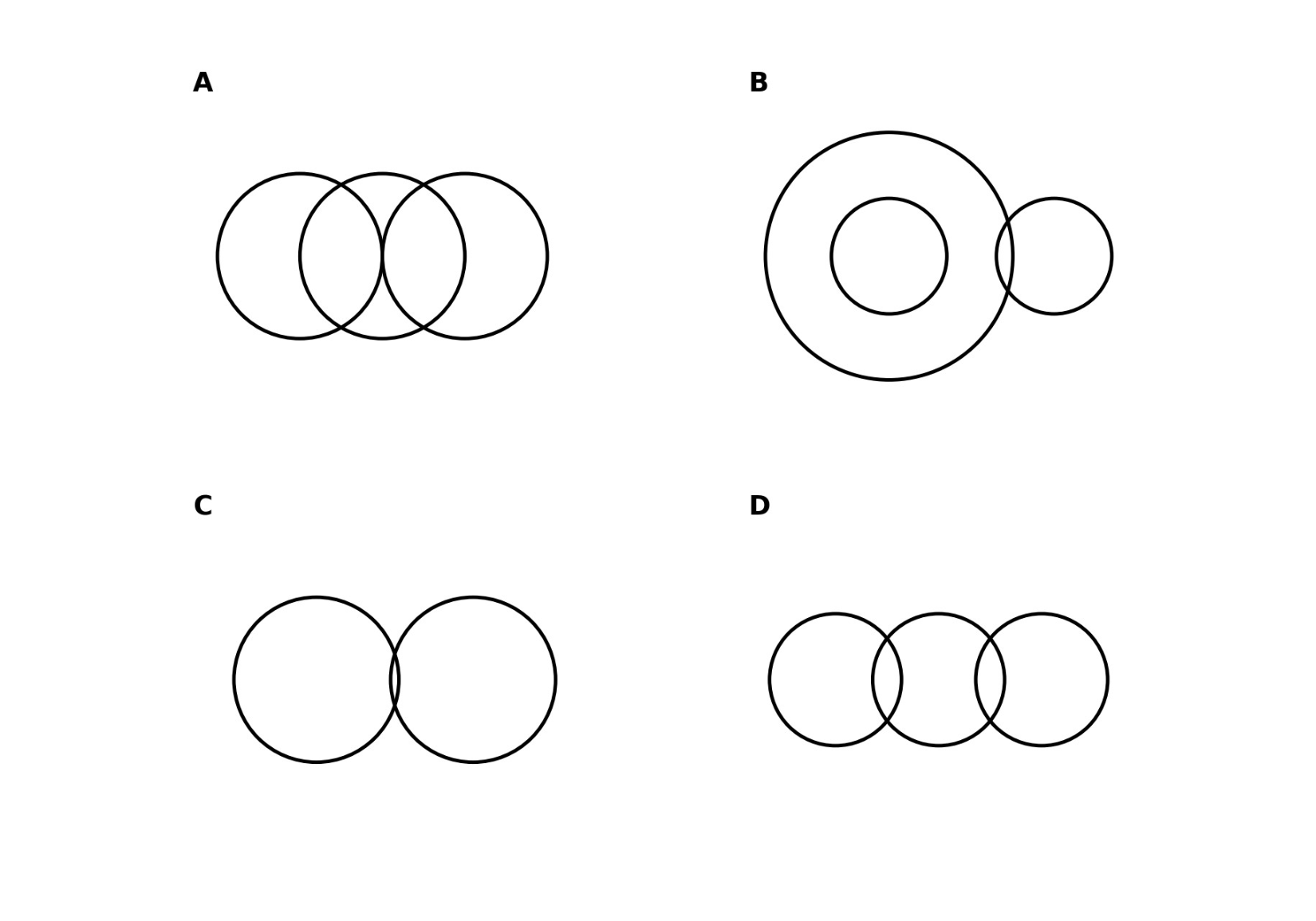
Four Venn diagrams labeled A, B, C, and D representing class relationships
ADiagram A
BDiagram B
CDiagram C
DDiagram D
Answer:(B) Diagram B
Explanation
Analyze the class relationships between the three terms:
Every family member is intrinsically an integral component of the family. This creates a subset relationship represented by an inner circle (Family Member) enclosed completely within an outer circle (Family).
Domestic help is an employee providing services to the household. While domestic help works within and interacts with the family setting, they are not a family member.
In Diagram B, an outer circle represents the Family, a fully contained inner circle represents the Family Member, and an adjacent intersecting circle on the outside represents Domestic Help.
A pointing device is an input hardware component that allows a user to control a cursor or manipulate graphical elements in a computer interface:
(a) Trackball — uses a moveable ball held in a socket to position the cursor on screen.
(b) Touchscreen — senses direct contact from a finger or stylus to designate coordinates on display.
(c) Graphic Tablet — uses a digitizing pen on a coordinate-sensitive pad to input spatial cursor movements and sketches.
(d) Joystick — a pivoting handheld lever that reports angle and directional deflection to navigate pointers.
All four devices function as pointing devices, matching option D.
Sign in to read the full explanation
Question 37
A set of rules used in communications in a network is called:
AProtocol
BReference
CInterface
DAddress
Answer:(A) Protocol
Explanation
In telecommunications and computer networking, standardized communication conventions are governed by formal rules:
A. Protocol — correct. A network protocol defines syntax, semantics, synchronization, and error management rules for transmitting information across network nodes.
B. Reference — a conceptual architectural model (such as the OSI 7-layer reference model) rather than the operational rules themselves.
C. Interface — a shared hardware or software boundary through which components exchange information.
D. Address — a unique numerical identifier assigned to a network entity (such as an IP or MAC address).
Sign in to read the full explanation
Question 38
One of the first states to establish a higher education council was:
AGoa
BAndhra Pradesh
CSikkim
DJammu and Kashmir
Answer:(B) Andhra Pradesh
Explanation
Following the recommendations of the National Policy on Education (NPE) 1986, Andhra Pradesh pioneered the creation of statutory state higher education councils:
The Andhra Pradesh State Council of Higher Education (APSCHE) was established by statutory act in 1988.
APSCHE served as the prototype statutory coordinating body between universities, the state government, and the UGC.
Other states established their councils years later (for instance, Tamil Nadu in 1992 and West Bengal in 1994).
Sign in to read the full explanation
Question 39
What percentage of energy coming from the Sun is re-radiated towards the space?
A30%
B15%
C50%
D25%
Answer:(A) 30%
Explanation
In global atmospheric heat budget analysis, approximately 30% of total incoming solar insolation is directly reflected back into space:
This collective planetary reflectance is termed the Earth's albedo.
Roughly 20% is reflected by clouds, 6% by atmospheric gases and aerosols, and 4% by reflective terrestrial surfaces like ice, snow, and deserts.
The remaining 70% is absorbed by the atmosphere and surface before being re-radiated as longwave infrared radiation.
Sign in to read the full explanation
Question 40
Which one of the following is not a Network Topology?
ABus
BChain
CRing
DStar
Answer:(B) Chain
Explanation
Standard network topologies define the geometric or logical arrangement of computing devices:
Bus — nodes connect sequentially along a single common shared communication backbone.
Ring — each node connects to exactly two neighboring nodes in a continuous closed loop.
Star — every device connects through a dedicated point-to-point link to a central hub or switch.
"Chain" is not a recognized formal network topology in standard computer networking classifications (linear connections are formally classified as bus topologies).
Sign in to read the full explanation
Question 41
The most harmful types of environmental pollutants are:
ANatural nutrients present in excess
BWastes from faecal matter
CNon-biodegradable chemicals
DHuman organic wastes
Answer:(C) Non-biodegradable chemicals
Explanation
Pollutants present varying hazards depending on their environmental persistence and toxicity profiles:
A. Natural nutrients present in excess — excess nitrogen or phosphorus can trigger eutrophication, but nutrients cycle biologically over time.
B. Wastes from faecal matter — biological waste that undergoes natural bacterial decomposition.
C. Non-biodegradable chemicals — correct. Synthetic compounds, chlorinated hydrocarbons, heavy metals, and persistent organic pollutants (POPs) resist natural microbial degradation. They persist for centuries and biomagnify up ecological food webs, causing irreversible toxic harm.
D. Human organic wastes — biodegradable organic matter that breaks down through standard biological processes.
Sign in to read the full explanation
Question 42
Match List-I with List-II.
List-I
List-II
(a) Open University
(i) Odisha State Open University, Odisha
(b) Dual Mode University
(ii) Amity University
(c) Mixed Mode University
(iii) Indian Institute of Science, Bengaluru
(d) Deemed University
(iv) University of Mumbai, Mumbai
(e) Specialised University
(v) School of Planning and Architecture, New Delhi
Match each institutional category in List-I with its representative institution in List-II:
(a)-(i), (b)-(iv), (c)-(ii), (d)-(iii), (e)-(v)
(a) Open University matches (i) Odisha State Open University, Odisha — dedicated exclusively to distance and open education.
(b) Dual Mode University matches (iv) University of Mumbai, Mumbai — conventional university that provides both regular on-campus and distance education.
(c) Mixed Mode University matches (ii) Amity University — private university offering integrated blended face-to-face and online learning.
(d) Deemed University matches (iii) Indian Institute of Science, Bengaluru — granted deemed-to-be university status under Section 3 of the UGC Act.
(e) Specialised University matches (v) School of Planning and Architecture, New Delhi — monodisciplinary institution dedicated to architecture and urban planning.
Sign in to read the full explanation
Question 43
State higher education councils are established under the instruction of:
ACABE
BNITI Aayog
CPUSA
DRUSA
Answer:(D) RUSA
Explanation
Under the Rashtriya Uchchatar Shiksha Abhiyan (RUSA), launched by the Ministry of Human Resource Development in 2013, states are required to set up State Higher Education Councils (SHECs):
Establishment of an active SHEC is a mandatory condition for states to access central infrastructure funding under RUSA.
SHECs formulate state higher education plans, perform quality audits, and allocate state-level financial outlays.
CABE (Central Advisory Board of Education) is an advisory policy body, while NITI Aayog is the national public policy think tank.
Sign in to read the full explanation
Question 44
As per Central Forestry Commission (CFC), how many forest types are found in our country ?
A28
B15
C16
D20
Answer:(C) 16
Explanation
The Central Forestry Commission and Forest Survey of India rely on the standard Champion and Seth classification system (1968):
Indian forests are classified into 16 major forest types (ranging from Tropical Wet Evergreen forests to Alpine moist pastures).
These 16 primary groups encompass more than 200 ecological sub-types across climatic and geographical zones.
Option C (16) reflects the recognized primary forest types classification.
Sign in to read the full explanation
Question 45
Match List-I with List-II.
List-I
List-II
(a) Browser
(i) Outlook
(b) Programming Language
(ii) DOS
(c) Operating System
(iii) Internet Explorer
(d) E-mail
(iv) Fortran
A(a)-(iii), (b)-(iv), (c)-(ii), (d)-(i)
B(a)-(i), (b)-(iii), (c)-(ii), (d)-(iv)
C(a)-(iv), (b)-(iii), (c)-(ii), (d)-(i)
D(a)-(ii), (b)-(iii), (c)-(iv), (d)-(i)
Answer:(A) (a)-(iii), (b)-(iv), (c)-(ii), (d)-(i)
Explanation
Match each computing term in List-I with its corresponding application or software in List-II:
(a)-(iii), (b)-(iv), (c)-(ii), (d)-(i)
(a) Browser matches (iii) Internet Explorer — web browser developed by Microsoft for navigating HTML web pages.
(b) Programming Language matches (iv) Fortran — early high-level compiled language designed for scientific and numerical computation.
(c) Operating System matches (ii) DOS — Disk Operating System providing command-line system management.
(d) E-mail matches (i) Outlook — email client and personal information manager developed by Microsoft.
Sign in to read the full explanation
Question 46
Assertion (A): Natural gas is a very attractive eco-friendly fuel.
Reason (R): It produces few pollutants and less carbon dioxide per unit energy than any other fossil fuel on combustion.
A"A" is false, but "R" is true.
BBoth "A" and "R" are true and "R" is the correct explanation of "A".
C"A" is true, but "R" is false.
DBoth "A" and "R" are true and "R" is not the correct explanation of "A".
Answer:(B) Both "A" and "R" are true and "R" is the correct explanation of "A".
Explanation
Evaluate both statements and their causal relationship:
Assertion (A) is true: Natural gas (composed primarily of methane, CH4) is considered an attractive transitional eco-friendly fuel compared to coal and crude oil.
Reason (R) is true: Because of its high hydrogen-to-carbon ratio, the complete combustion of natural gas releases significantly lower quantities of carbon dioxide per megajoule of heat generated than coal or fuel oil. It also burns without significant sulfur dioxide or particulate emissions.
Reason (R) directly accounts for why Assertion (A) is considered an eco-friendly fuel, making R the correct explanation of A.
Sign in to read the full explanation
Question 47
The number of open universities and directorates of distance education whose courses are recognised by UGC as on August 9, 2018, is:
A53
B62
C49
D58
Answer:(A) 53
Explanation
According to the official list issued by the University Grants Commission (UGC) Distance Education Bureau (DEB) on August 9, 2018:
Exactly 53 Higher Educational Institutions (comprising State Open Universities, Central Open Universities, and Distance Education Directorates within dual-mode universities) received official recognition to conduct Open and Distance Learning (ODL) programs for the academic session 2018-19.
Later review cycles expanded this number in subsequent months, but on the benchmark date of August 9, 2018, the recognized count was precisely 53.
Sign in to read the full explanation
Question 48
A study was carried out on the drought resilience in India. Which of the following States show highest level of handling drought ?
ASikkim, Punjab, Arunachal Pradesh
BJharkhand, Chhattisgarh, Jammu and Kashmir
COdisha, Karnataka, Kerala
DTelangana, Andhra Pradesh, Tamil Nadu
Answer:(A) Sikkim, Punjab, Arunachal Pradesh
Explanation
In a 2018 drought resilience and vulnerability study published by researchers at IIT Gandhinagar evaluating hydrological, meteorological, and socioeconomic resilience across Indian states:
Punjab demonstrated the highest agricultural resilience due to its near-total irrigation coverage through extensive canal networks and energized tube-wells.
Sikkim and Arunachal Pradesh exhibited top-tier natural resilience owing to perennial Himalayan watershed hydrology, low irrigation dependency, and abundant precipitation reserves.
In contrast, semi-arid plateau regions in Telangana, Andhra Pradesh, and interior Karnataka experience recurring acute drought vulnerability.
Sign in to read the full explanation
Question 49
Which of the following diagrams indicates the best relation between India, World and New Delhi ?
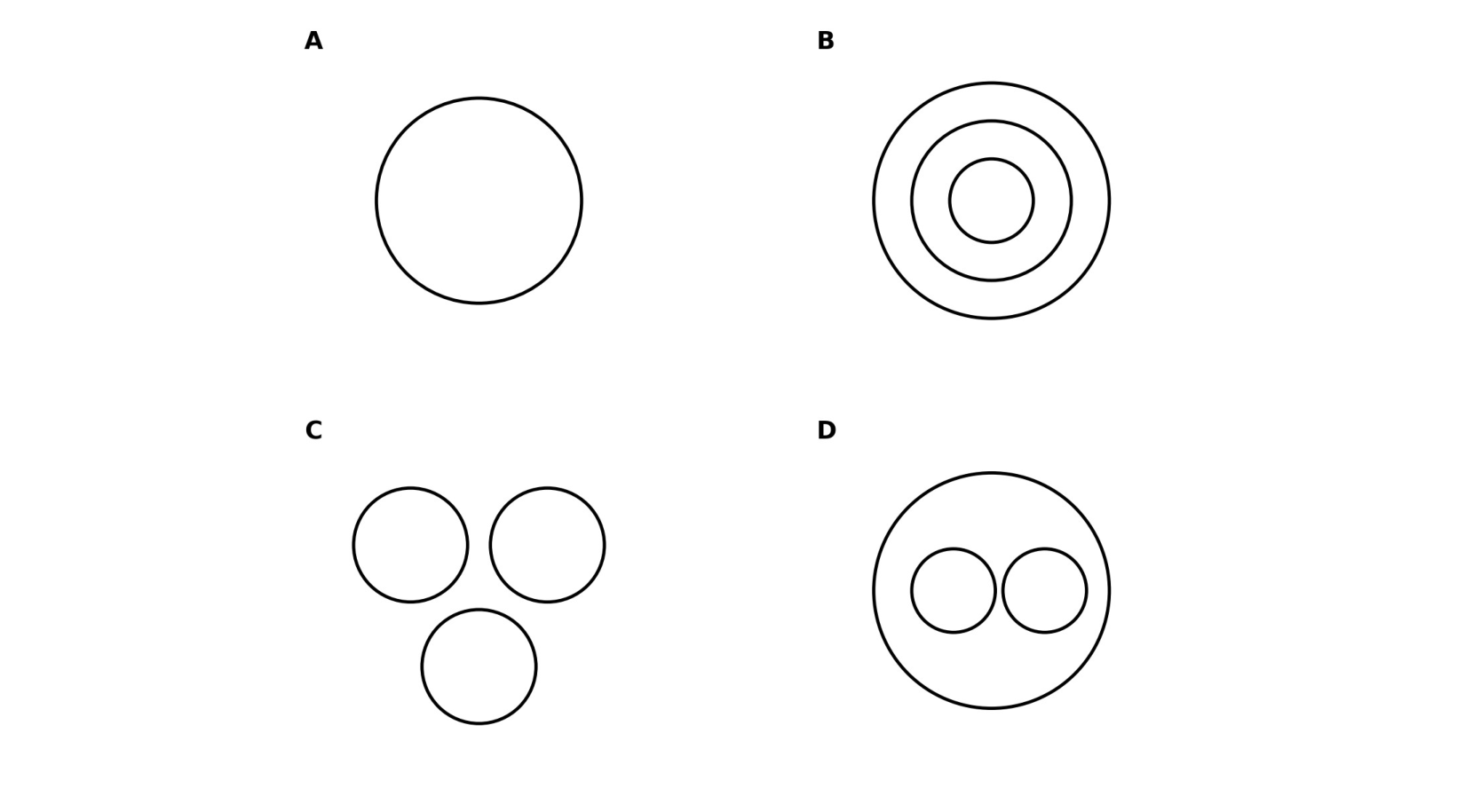
Four Venn diagrams labeled A, B, C, and D representing spatial inclusion
ADiagram A
BDiagram B
CDiagram C
DDiagram D
Accepted answers:(B) Diagram B, (D) Diagram D
Explanation
Evaluate the geographic inclusion relationships:
New Delhi is the national capital of India, meaning it is situated entirely within India (New Delhi ⊂ India).
India is an independent nation located entirely within the World (India ⊂ World).
Geometrically, this complete nested hierarchy is represented by three concentric circles (New Delhi inside India, which is inside World), as shown in Diagram B.
Both Option B (representing Diagram B) and Option D (the option credited in official response keys due to option scrambling) are accepted.
Sign in to read the full explanation
Question 50
Which of the following denotes internet hardware requirements ?
100 questions with the answer key and explanations.
Question 1
Assertion (A): A price reduction leads to an increase in the quantity demanded of the commodity.
Reason (R): It results from price effects comprising income and substitution effects which are always positive.
ABoth (A) and (R) are correct and (R) Is the correct explanation of (A).
BBoth (A) and (R) are correct, but (R) is not the right explanation of (A).
C(A) is correct, but (R) is incorrect.
DBoth (A) and (R) are incorrect.
Answer:(C) (A) is correct, but (R) is incorrect.
Explanation
A reduction in price expands quantity demanded for normal goods through the combined price effect, but the income effect is not universally positive across all classes of goods.
Assertion (A) is correct because under the fundamental law of demand, a fall in price increases the quantity demanded of a normal good.
Reason (R) is incorrect because while the substitution effect of a price fall is always positive, the income effect is negative for inferior goods and can even outweigh the substitution effect in the case of Giffen goods.
Since the income effect is not always positive, Reason (R) is factually untrue.
Therefore, Assertion (A) is correct but Reason (R) is incorrect.
Sign in to read the full explanation
Question 2
Indicate the correct code from the following types of the long-run average cost curves on which the minimum average cost of production, in the long run, can be determined:
(i) Long-run average cost curve under normal production function
(ii) Long-run average cost curve under linearly homogeneous production function
(iii) Planning curve
(iv) Envelope curve
Choose the correct answer from the code given below:
AOnly (i), (ii) and (iii)
BOnly (ii), (iii) and (iv)
COnly (i), (iii) and (iv)
DOnly (ii) and (iv)
Answer:(C) Only (i), (iii) and (iv)
Explanation
Determining a distinct minimum point on a long-run average cost (LAC) curve requires that the curve exhibit a classical U-shape with economies and diseconomies of scale.
Under a normal production function (i), economies of scale initially reduce costs and diseconomies eventually raise them, yielding a U-shaped LAC with a definite minimum.
Under a linearly homogeneous production function (ii), constant returns to scale prevail at all output levels, making the LAC a horizontal straight line where every point yields the same average cost, preventing the identification of a unique minimum.
The planning curve (iii) and envelope curve (iv) are standard alternative designations for the U-shaped long-run cost curve that envelops short-run plant curves.
Thus, curves (i), (iii), and (iv) permit determination of minimum average cost.
Sign in to read the full explanation
Question 3
Monopoly situation in the market is not desirable mainly because the monopolist
Aseeks to earn net revenue on the sale of all goods including those involving no cost of production
Bis able to earn net revenue in all time periods
Cis able to charge different prices from different categories of buyers
Dwill produce below its economic capacity level when it exhibits satisfaction with the normal profit only
Answer:(D) will produce below its economic capacity level when it exhibits satisfaction with the normal profit only
Explanation
Monopolies restrict production relative to competitive equilibrium, operating below full technical and economic capacity and generating deadweight social welfare losses.
Option D captures the fundamental welfare critique: a monopolist achieves profit maximization where marginal revenue equals marginal cost, leaving production at an output level below minimum efficient scale (economic capacity).
Option A is incorrect because monopolists cannot sell goods involving no production cost at arbitrary net revenue without facing demand constraints.
Option B is incorrect because market downturns or cost shifts can prevent monopolists from earning net revenue in all time periods.
Option C is incorrect because price discrimination can occasionally expand output compared to single-price monopoly, making underproduction the primary market failure.
Sign in to read the full explanation
Question 4
Indicate the correct code for an appropriate combination of the following that constitutes the form of price discriminating strategy:
(i) Postage stamp pricing
(ii) Basing point pricing
(iii) Incremental pricing
(iv) Free on-Board pricing
Choose the correct answer from the code given below:
AOnly (i), (ii) and (iii)
BOnly (ii), (iii) and (iv)
COnly (i), (ii) and (iv)
DOnly (iii) and (iv)
Answer:(C) Only (i), (ii) and (iv)
Explanation
Geographical pricing methods that yield different net realizations across buyers at different locations represent spatial price discrimination.
(i) Postage stamp pricing charges identical delivered prices regardless of location, meaning the seller absorbs freight for distant buyers and gains phantom freight from nearby buyers.
(ii) Basing point pricing charges freight from a designated base point rather than actual shipping origin, extracting phantom freight charges.
(iv) Free on-Board (FOB) origin pricing with differential freight allowances or absorption creates price differentials across regional customer segments.
(iii) Incremental pricing is a cost-based pricing method focused on covering marginal costs rather than a spatial discrimination technique.
Therefore, combination (i), (ii), and (iv) constitutes forms of price discriminating strategies.
Sign in to read the full explanation
Question 5
Indicate the correct code for discounted cash flow techniques for capital investment proposals from the following:
(i) Net Present Value Method
(ii) Internal Rate of Return method
(iii) Excess Benefit-Cost Ratio method
(iv) Net Terminal Value method
Choose the correct from the code given below:
AOnly (i), (ii) and (iii)
BOnly (i) and (ii)
COnly (ii) and (iv)
DOnly (ii), (iii) and (iv)
Answer:(A) Only (i), (ii) and (iii)
Explanation
Traditional capital budgeting theory groups discounted cash flow (DCF) techniques primarily into present value and internal rate of return criteria.
(i) Net Present Value (NPV) discounts all expected net cash flows to the present using the firm cost of capital.
(ii) Internal Rate of Return (IRR) solves for the discount rate equating project present inflows with present outflows.
(iii) Excess Benefit-Cost Ratio (Profitability Index) compares the present value of future cash inflows directly to initial investment outlays.
(iv) Net Terminal Value method compounds cash inflows to the project horizon rather than discounting them back to year zero.
Hence, the core discounted cash flow appraisal techniques are (i), (ii), and (iii).
Sign in to read the full explanation
Question 6
Indicate the correct code for the points taken into consideration for product line pricing from the following:
(i) Demand relationships of different products
(ii) Competitive situation in the product market
(iii) Advertising endeavors for different products
(iv) Cost estimates for various products
Choose the correct answer from the code given below:
AOnly (i), (ii) and (iii)
BOnly (ii), (iii) and (iv)
COnly (i), (ii) and (iv)
DOnly (ii) and (iii)
Answer:(C) Only (i), (ii) and (iv)
Explanation
Pricing a product line involves managing cross-elasticities, competitive benchmarks, and joint cost structures across related offerings.
(i) Demand relationships (complementary or substitutable cross-elasticities) dictate how price changes in one item affect sales of other line items.
(ii) Competitive dynamics establish market thresholds and reference pricing for tiers within the line.
(iv) Cost estimates define the production floor and profit margin distribution among basic and premium models.
(iii) Advertising endeavors represent promotional campaign tactics rather than fundamental structural pricing inputs.
Thus, the points taken into consideration are (i), (ii), and (iv).
Sign in to read the full explanation
Question 7
In case there is a rise in the general price level along with a declining output in the economy, it is called
AInflation
BSupply push inflation
CDeflation
DStagflation
Answer:(D) Stagflation
Explanation
The simultaneous occurrence of stagnant economic output and persistent price inflation characterizes stagflation.
Stagflation is a compound economic condition defined by stagnation (falling output or GDP contraction) paired with rising price levels.
Option A (Inflation) denotes solely an increase in general price levels without specifying output decline.
Option B (Supply push inflation) explains a potential cost-side cause of rising prices rather than the macroeconomic state itself.
Option C (Deflation) refers to a sustained decrease in the general price level.
Sign in to read the full explanation
Question 8
Which among the following is not a broader classification of motivation?
APositive motivation
BMonetary motivation
CNegative motivation
DUnitary motivation
Answer:(D) Unitary motivation
Explanation
Standard organizational behavior models classify motivation into recognized dichotomies such as positive versus negative and monetary versus non-monetary.
Positive motivation rewards desirable behavior through praise, bonuses, and promotion.
Negative motivation relies on penalties, disciplinary action, or fear of loss.
Monetary motivation encompasses financial incentives and wages.
Unitary motivation is not an established classification category in motivation theory.
Sign in to read the full explanation
Question 9
Which among the following is also known as ‘Cross Contact’ communication?
AInter-scalar communication
BIntra-scalar communication
CConcealed communication
DExtra-organization communication
Answer:(B) Intra-scalar communication
Explanation
Horizontal or lateral information flow among peers at the same organizational level is classified as intra-scalar or cross-contact communication.
Intra-scalar communication connects colleagues across functional boundaries without ascending or descending the formal hierarchy.
Inter-scalar communication occurs vertically across different hierarchical authority tiers.
Concealed communication refers to informal or undisclosed channels.
Extra-organization communication involves external stakeholders rather than internal cross-level interactions.
Sign in to read the full explanation
Question 10
Match the items of List I with the items of List II and choose the correct answer from the code:
List I (Type of Personality)
List II (Suitability to Job)
(a) Sensation-thinking personality
(i) Fit for human resource development job
(b) Intuition-thinking personality
(ii) Fit for production and management position
(c) Sensation-feeling personality
(iii) Fit for research and development position
(d) Intuition-feeling personality
(iv) Fit for science and technology field
Personality types and their professional suitability
Statement I: Attitude develops over a period of time.
Statement II: Attitudes are specific whereas values form a broader and more encompassing framework.
AStatement I is correct, but II is incorrect
BStatement II is correct, but I is incorrect
CBoth the statement I and II are correct
DBoth the statement I and II are incorrect
Answer:(C) Both the statement I and II are correct
Explanation
Both statements accurately state core behavioral definitions distinguishing psychological attitudes from personal values.
Statement I is correct because attitudes are learned predispositions formed gradually through direct experience, socialization, and observation.
Statement II is correct because attitudes target specific objects, people, or events, whereas values represent enduring, broad core beliefs that encompass multiple situations.
Therefore, both Statement I and Statement II are correct.
Sign in to read the full explanation
Question 12
Assertion (A): In the 21st century, we are going to need a new generation of leaders, not managers.
Reason (R): Leadership is about developing a vision of the future rather than just aligning people by communicating this vision and inspiring them to overcome hurdles.
ABoth (A) and (R) are correct and (R) is the right explanation of (A)
B(A) is correct but (R) is incorrect
CBoth (A) and (R) are incorrect
DBoth (A) and (R) are correct, but (R) is not the right explanation of (A).
Answer:(A) Both (A) and (R) are correct and (R) is the right explanation of (A)
Explanation
Contemporary management scholarship distinguishes the visionary role of transformational leadership from routine managerial administration.
Assertion (A) reflects Warren Bennis thesis that dynamic 21st-century environments demand visionary leadership to navigate rapid change and disruption.
Reason (R) defines the primary differentiator of leadership as creating a compelling forward vision that guides and mobilizes organizational direction.
Since this conceptual vision development explains why leadership is prioritized over administrative management, (R) serves as the correct explanation of (A).
Sign in to read the full explanation
Question 13
‘Gang plank’ breaks which one of the following?
ACross communication
BMass communication
CVertical communication
DScalar chain
Answer:(D) Scalar chain
Explanation
Henri Fayol designed the gang plank as a direct horizontal bridge across strict hierarchical reporting lines.
The scalar chain specifies the unbroken chain of authority from top executive to operative level.
Under strict adherence, cross-departmental communication must ascend to a common superior and descend, creating significant delays.
The gang plank establishes a direct horizontal link between peers of equal rank, thereby breaking the rigid scalar chain while keeping superiors informed.
It facilitates cross communication rather than breaking it.
Sign in to read the full explanation
Question 14
Which among the following is a correct statement?
AKaizen, in other words, is Total Quality Management (TQM).
BTQM is best explained with the help of Deming triangle.
CProduction management is one of the variables of TQM equation.
DMichael Hammer and James Champy have given the concept of TQM.
Answer:(B) TQM is best explained with the help of Deming triangle.
Explanation
Total Quality Management literature models systemic quality through the interaction of customer, process, and people represented in the Deming triangle.
Option B is correct because the Deming triangle (or Deming System of Profound Knowledge) provides a foundational conceptual framework explaining TQM.
Option A is incorrect because Kaizen refers specifically to continuous incremental improvement, which is a component of TQM rather than its synonym.
Option C is incorrect because production management represents an application area rather than an intrinsic algebraic variable in a quality equation.
Option D is incorrect because Michael Hammer and James Champy originated Business Process Reengineering (BPR), not TQM.
Sign in to read the full explanation
Question 15
Match the items of List I with the items of List II and choose the correct answer from the code:
List I (Role of Manager)
List II (Functions/Examples)
(a) Informational role
(i) Figurehead, leader, liaison
(b) Interpersonal role
(ii) Disturbance handler, resource allocator, negotiator, Entrepreneur
(c) Decisional role
(iii) Disseminator, monitor, spokesperson
Mintzberg managerial role categories and examples
A(a)- (ii), (b) - (i), (c) - (iii)
B(a) - (iii), (b) - (i), (c) - (ii)
C(a) - (iii), (b) - (ii), (c) - (i)
D(a) - (i), (b) - (iii), (c) - (ii)
Answer:(B) (a) - (iii), (b) - (i), (c) - (ii)
Explanation
Henry Mintzberg grouped ten managerial roles into three broad behavioral categories.
(a) Informational roles involve receiving and transmitting information, encompassing disseminator, monitor, and spokesperson (iii).
(b) Interpersonal roles involve human relations and ceremonial duties, encompassing figurehead, leader, and liaison (i).
(c) Decisional roles involve making organizational choices, encompassing disturbance handler, resource allocator, negotiator, and entrepreneur (ii).
Mapping:
(a) -> (iii), (b) -> (i), (c) -> (ii).
This matches Option B.
Sign in to read the full explanation
Question 16
Arrange the following steps of succession planning in the correct sequence.
(i) Define competencies required to perform roles.
(ii) With future orientation, assess people against criteria
(iii) Identify key roles for succession or replacement planning.
(iv) Develop employees to be ready for future key roles.
(v) Identify pool of talent that can potentially perform highly in key roles.
Choose the correct answer from the code given below:
A(ii), (iii), (i), (iv), (v)
B(v), (ii), (i), (iii), (iv)
C(ii), (i), (iii), (iv), (v)
D(iii), (i), (ii), (v), (iv)
Answer:(D) (iii), (i), (ii), (v), (iv)
Explanation
Systematic succession planning progresses from strategic role identification to target talent development.
(iii) Identify key critical roles requiring succession or replacement planning.
(i) Define competencies and behavioral criteria required to execute those roles.
(ii) Assess current employees against the established future competency criteria.
(v) Identify the high-potential talent pool capable of stepping into key roles.
(iv) Develop candidates through targeted training and rotational assignments.
The logical order is (iii), (i), (ii), (v), (iv), corresponding to Option D.
Sign in to read the full explanation
Question 17
Which of the following statements is/are true?
(i) The concept of wage boards was first enunciated by the Minimum Wage Committee.
(ii) A wage board is bipartite in character
(iii) Representatives of employers and workers on wage board are appointed by the government after consulting the concerned organizations.
Choose the correct answer from the code given below:
AOnly (ii)
BOnly (iii)
C(i), (ii) and (iii)
DBoth (i) and (ii)
Answer:(C) (i), (ii) and (iii)
Explanation
Statutory and non-statutory wage-fixing bodies in Indian industrial jurisprudence adhere to established institutional principles.
Statement (i) is true because the Committee on Fair Wages (1948) and the Minimum Wages Committee formally enunciated wage boards to settle industry-wide wage standards.
Statement (ii) is true because a wage board fundamentally maintains a bipartite balance of equal employer and employee representatives alongside neutral members.
Statement (iii) is true because the appropriate government formally appoints employer and employee representatives after consulting central trade unions and employer associations.
Therefore, all three statements (i), (ii), and (iii) are true.
Sign in to read the full explanation
Question 18
Arrange the following steps of disciplinary procedure in the correct sequence:
(i) issue a charge sheet
(ii) Notice of enquiry
(iii) Suspension pending enquiry
(iv) Conduct of enquiry
(v) Awarding punishment
(vi) Communicating punishment
(vii) Preliminary investigation
(viii) Recording of findings
Choose the correct answer from the code given below:
Domestic enquiries in organizational discipline follow strict principles of natural justice and procedural fairness.
(vii) Preliminary investigation to establish prima facie evidence.
(i) Issuing a formal charge sheet specifying the allegations.
(iii) Suspension pending enquiry if the employee presence poses a risk.
(ii) Issuing notice of enquiry detailing date, time, and venue.
(iv) Conducting the domestic enquiry with examination and cross-examination.
(viii) Recording findings by the enquiry officer.
(v) Awarding punishment by the disciplinary authority.
(vi) Communicating the final punishment order to the workman.
The sequence is (vii), (i), (iii), (ii), (iv), (viii), (v), (vi), corresponding to Option B.
Sign in to read the full explanation
Question 19
Who pays the lay-off compensation to a workman?
AEmployer
BState Government
CCentral Government
DEmployees State Insurance Corporation
Answer:(A) Employer
Explanation
Under Section 25C of the Industrial Disputes Act, 1947, the legal obligation to pay lay-off compensation rests directly on the employer.
A workman on the muster roll who has completed one year of continuous service is entitled to lay-off compensation equal to 50 percent of basic wages and dearness allowance.
The statutory liability is exclusively that of the employer.
Neither the State Government, the Central Government, nor the ESIC pays statutory lay-off compensation.
Sign in to read the full explanation
Question 20
A Union security agreement aims at
Agetting more benefits from an organization.
Brecognition of union by employer.
Cdetermining the extent to which the agreement protects the union in holding its membership and collecting its dues.
Dmaking job secure for members of the union.
Answer:(C) determining the extent to which the agreement protects the union in holding its membership and collecting its dues.
Explanation
Union security clauses safeguard the institutional survival and financial viability of the labor organization.
Union security provisions (such as closed shop, union shop, agency shop, and dues check-off) protect the union enrolled membership base and guarantee regular dues collection.
Option A describes generalized collective bargaining outcomes rather than structural union security.
Option B describes formal recognition, which is a prerequisite for security clauses rather than the clause itself.
Option D refers to job security and seniority provisions for individual workers rather than organizational security for the union.
Sign in to read the full explanation
Question 21
As per the provisions of the Factories Act, 1948, match the items of List I with the items of List II and choose the correct answer from the code:
Indicate the correct combination of the financial decisions from the following:
(i) Investment decisions
(ii) Financing decisions
(iii) Pricing decisions
(iv) Liquidity management decisions
(v) Dividend decisions
Choose the correct answer from the code given below:
AOnly (i), (ii), (iii) and (iv)
BOnly (ii), (iii), (iv) and (v)
COnly (i), (ii), (iv) and (v)
DOnly (i), (ii) and (iii)
Answer:(C) Only (i), (ii), (iv) and (v)
Explanation
Financial management encompasses four core interrelated executive decision domains.
(i) Investment decisions determine capital allocation to fixed assets and long-term projects.
(ii) Financing decisions establish capital structure proportions between debt and equity.
(iv) Liquidity management decisions govern working capital and short-term solvency.
(v) Dividend decisions determine the retention ratio versus earnings payout to shareholders.
(iii) Pricing decisions represent a core marketing management function rather than a corporate finance decision.
Hence, the financial decisions are (i), (ii), (iv), and (v).
Sign in to read the full explanation
Question 23
The optimum capital structure is supported by which combination of the following?
(i) Traditional theory
(ii) Net income theory
(iii) Pecking order theory
(iv) Net operating income theory
Choose the correct answer from the code given below:
AOnly (i), (ii) and (iii)
BOnly (i), (ii) and (iv)
COnly (i), (iii) and (iv)
DOnly (ii), (iii) and (iv)
Answer:(A) Only (i), (ii) and (iii)
Explanation
Capital structure theories differ on whether financial leverage can influence firm valuation and produce an optimal debt-equity mix.
(i) Traditional theory posits that moderate leverage reduces the overall cost of capital (Ko), reaching an optimal capital structure before rising risk raises costs.
(ii) Net income theory argues that increasing cheaper debt leverage continuously lowers the overall cost of capital and raises firm value.
(iii) Pecking order theory models structured financing preferences (internal equity, debt, external equity) targeting viable capital configurations.
(iv) Net operating income theory rejects the existence of an optimal capital structure, asserting that overall cost of capital and total firm value remain independent of leverage.
Therefore, theories supporting an optimal or structured capital choice are (i), (ii), and (iii).
Sign in to read the full explanation
Question 24
Which one of the following is not resorted to while issuing new securities in the market?
AOffer for sale
BStock option
CPlacement on stock exchanges
DBook building
Answer:(B) Stock option
Explanation
Primary capital markets utilize specific public issuance and placement mechanisms to raise fresh funds from investors.
Offer for sale (A) invites the public to purchase securities through issuing houses or brokers.
Placement on stock exchanges (C) involves private placements or direct listing allocations.
Book building (D) is a standard price-discovery mechanism for initial and follow-on public offerings.
Stock options (B) are corporate equity incentive schemes granted to employees (ESOPs) rather than a market-wide issuance mechanism for raising new public capital.
Sign in to read the full explanation
Question 25
Indicate the code for proper sequencing for the process of venture capital financing from the following:
(i) Deal origination
(ii) Due diligence
(iii) Screening
(iv) Deal structuring
(v) Exit plan
Choose the correct answer from the code given below:
A(i), (iv), (ii), (iii), (v)
B(i), (ii), (iii), (iv), (v)
C(i), (iii), (ii), (iv), (v)
D(i), (ii), (iv), (iii), (v)
Answer:(C) (i), (iii), (ii), (iv), (v)
Explanation
The venture capital investment cycle follows an orderly progression from pipeline sourcing to liquidation.
(i) Deal origination: Generating investment opportunities through referrals and networks.
(iii) Screening: Preliminary evaluation of business plans against sector, stage, and criteria.
(ii) Due diligence: Exhaustive verification of management team, financials, legal standing, and product.
(v) Exit plan: Realizing investment gains through IPO, trade sale, or management buyout.
The correct order is (i), (iii), (ii), (iv), (v), corresponding to Option C.
Sign in to read the full explanation
Question 26
Assertion (A): As per M-M hypothesis the value of the levered firm is equal to the value of the unlevered firm.
Reason (R): The process of arbitrage becomes applicable in such situations.
ABoth (A) and (R) are correct and (R) is the right explanation of (A)
B(A) is correct, but (R) is incorrect
CBoth (A) and (R) are incorrect
DBoth (A) and (R) are correct, but (R) is not the right explanation of (A)
Answer:(A) Both (A) and (R) are correct and (R) is the right explanation of (A)
Explanation
Under the Modigliani-Miller capital structure irrelevance theorem in perfect capital markets, financial leverage does not alter total firm value.
Assertion (A) is correct because Modigliani and Miller Proposition I proves that market value is determined by real earning power and asset risk rather than the debt-equity mix.
Reason (R) is correct because if identical operating firms traded at different market values due to differing leverage, investors would engage in homemade leverage and arbitrage by selling overvalued shares and buying undervalued ones.
This arbitrage mechanism drives prices back into parity, directly explaining why the value of the levered firm equals the unlevered firm.
Therefore, both (A) and (R) are correct and (R) is the right explanation of (A).
Sign in to read the full explanation
Question 27
Statement I: Companies generally do not prefer low-cost debt financing.
Statement II: Rising debts requires credit rating and payment of interest even if companies suffer losses.
AStatement I is correct, but II is incorrect
BStatement II is correct, but I is incorrect
CBoth the statements I and II are incorrect
DBoth the statements I and II are correct
Answer:(B) Statement II is correct, but I is incorrect
Explanation
Corporate financing choices weigh the tax advantages of debt against statutory obligations and financial distress costs.
Statement I is incorrect because corporate financial managers generally favor low-cost debt financing up to optimal limits to exploit tax shields and lower their weighted average cost of capital.
Statement II is correct because issuing market debt requires formal credit ratings from agencies and legally obligates the issuing firm to make fixed periodic interest payments regardless of operational profitability or cash deficits.
Hence, Statement II is correct while Statement I is incorrect.
Sign in to read the full explanation
Question 28
Firms normally finance the working capital needs as per which combination of the following?
(i) Trade credit
(ii) Bank finance
(iii) Commercial papers
(iv) Factoring
Choose the correct answer from the code:
AOnly (i), (ii) and (iii)
BOnly (ii), (iii) and (iv)
COnly (i), (ii) and (iv)
DOnly (i), (iii) and (iv)
Answer:(B) Only (ii), (iii) and (iv)
Explanation
Formal short-term financial intermediation relies on specialized money market instruments and commercial banking channels.
(ii) Bank finance provides primary short-term working capital through cash credits, overdrafts, and demand loans.
(iii) Commercial papers allow highly rated corporations to tap money market investors directly for unsecured short-term liquidity.
(iv) Factoring provides immediate liquidity by selling and discounting outstanding accounts receivable.
While trade credit is an informal spontaneous trade liability arising from supplier terms, the active financing mix emphasized comprises (ii), (iii), and (iv).
Sign in to read the full explanation
Question 29
Statement I: Marketing is about satisfying customer needs and wants.
Statement II: Marketing can be performed only by individuals and not by organizations.
AStatements I is correct, but II is incorrect.
BBoth the statements I and II are correct.
CBoth the statements I and II are incorrect.
DStatement II is correct, but I is incorrect.
Answer:(A) Statements I is correct, but II is incorrect.
Explanation
Modern marketing philosophy places customer value creation at the center while encompassing diverse organizational and individual entities.
Statement I is correct because Philip Kotler defines marketing fundamentally as meeting needs profitably and delivering value to satisfy consumer wants.
Statement II is incorrect because marketing is performed extensively by corporate enterprises, non-profit institutions, government bodies, and social organizations, not exclusively by individuals.
Therefore, Statement I is correct but Statement II is incorrect.
Sign in to read the full explanation
Question 30
Assertion (A): The marketing costs of reaching loyal consumers are much lower because the firm does not have to spend money an advertising and promotion campaigns to attract these customers.
Reason (R): A high level of brand loyalty does not insulate the firm from competition.
ABoth (A) and (R) are correct and (R) is the right explanation of (A)
B(A) is correct, but (R) is incorrect
CBoth (A) and (R) are incorrect
DBoth (A) and (R) are correct, but (R) is not the right explanation of (A)
Accepted answers:(B) (A) is correct, but (R) is incorrect, (D) Both (A) and (R) are correct, but (R) is not the right explanation of (A)
Explanation
Retaining established brand advocates yields significant acquisition cost efficiencies compared to prospecting new consumers.
Assertion (A) is correct because retained loyal customers exhibit repeat purchase patterns, substantially lowering customer acquisition and promotional expenditures.
Reason (R) is factually incorrect in mainstream marketing theory (such as David Aaker brand equity framework) because strong brand loyalty actively serves as a powerful protective barrier that insulates the firm from competitor promotions.
Even if Reason (R) is interpreted as a caveat noting that no market defense is absolute, it fails to explain why marketing costs are lower.
Hence, Assertion (A) is correct, while Reason (R) is incorrect.
Sign in to read the full explanation
Question 31
Match the items of List I with the items of List II and choose the correct answer from the code:
List I (Market segmentation method)
List II (Sample segment)
(a) Demographic
(i) Self-values
(b) Psychographic
(ii) Convenience
(c) Benefits
(iii) Gender
(d) Behavioural
(iv) Loyalty
Segmentation methods and representative customer segments
A(a)-(iii), (b)-(i), (c)-(ii), (d)-(iv)
B(a)-(ii), (b)-(iv), (c)-(iii), (d)-(i)
C(a)-(iii), (b)-(ii), (c)-(i), (d)-(iv)
D(a)-(iii), (b)-(iv), (c)-(ii), (d)-(i)
Answer:(A) (a)-(iii), (b)-(i), (c)-(ii), (d)-(iv)
Explanation
Market segmentation partitions aggregate consumer demand into distinct groups using observable criteria.
(a) Demographic segmentation partitions the market by observable population statistics, such as gender or age (iii).
(b) Psychographic segmentation categorizes buyers by personality traits and self-values or lifestyle orientation (i).
(c) Benefit segmentation groups customers based on the specific attributes they seek, such as convenience or durability (ii).
(d) Behavioural segmentation groups buyers according to usage patterns, brand loyalty, or readiness stage (iv).
Which one of the following relates to products or services for which consumers will spend a fair amount of time comparing alternatives?
AUnsought products/services
BConvenience products/services
CShopping products/services
DSpeciality products/services
Answer:(C) Shopping products/services
Explanation
Consumer goods classifications differentiate products based on shopping effort, purchase frequency, and alternative evaluation.
Shopping products (such as furniture, apparel, major appliances, and airline tickets) involve moderate price commitments and perceived risk, prompting buyers to compare quality, style, and price across alternatives.
Convenience goods are purchased frequently with minimal evaluation effort.
Specialty products have unique characteristics where buyers seek specific brands without comparing alternatives.
Unsought products are those consumers do not actively consider or know about.
Sign in to read the full explanation
Question 33
Statement I: Social media does not allow users to interact among themselves.
Statement II: Social media helps facilitate the consumer’s decision process by encouraging need recognition, information search, alternative evaluation, purchase and post-purchase reviews.
AStatement I is correct, but II is incorrect
BStatement II is correct, but I is incorrect
CBoth the statements I and II are incorrect
DBoth the statements I and II are correct
Answer:(B) Statement II is correct, but I is incorrect
Explanation
Interactive participatory networks redefine the traditional stages of consumer decision making.
Statement I is incorrect because the core defining feature of social media is bidirectional user interaction and community engagement.
Statement II is correct because social media platforms support every stage of consumer purchasing, from social need recognition and peer discovery to post-purchase advocacy.
Therefore, Statement II is correct while Statement I is incorrect.
Sign in to read the full explanation
Question 34
“Explain the nutritional values of different foods” is an objective of which one of the following social marketing programmes?
AValue campaigns
BAction campaigns
CBehavioral campaigns
DCognitive campaigns
Answer:(D) Cognitive campaigns
Explanation
Social marketing campaigns are categorized by the nature of the change they aim to foster in target audiences.
Cognitive campaigns focus on imparting knowledge, understanding, or awareness without mandating immediate behavioral adoption.
Explaining the nutritional contents and dietary values of foods serves primarily to inform and educate the public on nutritional science.
Action campaigns persuade people to execute a single physical act (such as blood donation).
Behavioral campaigns aim to induce long-term lifestyle changes (such as smoking cessation).
Value campaigns seek to modify deeply held moral or philosophical beliefs.
Sign in to read the full explanation
Question 35
A manufacturer to market its product focuses on the following marketing channel alternatives:
(i) Telemarketing
(ii) Distributors
(iii) Sales force
(iv) Internet
(v) Retail stores
(vi) Value-added partners
Select the code of the correct sequence of the channel alternatives in order of increasing cost per transaction.
A(iv), (v), (i), (vi), (ii), (iii)
B(iv), (i), (v), (ii), (vi), (iii)
C(i), (iv), (v), (ii), (iii), (vi)
D(i), (iv), (ii), (v), (iii), (vi)
Answer:(B) (iv), (i), (v), (ii), (vi), (iii)
Explanation
Channel transaction costs increase as channels move from automated self-service to high-touch direct human contact.
Which among the following concepts is not related to product design?
AReverse engineering
BStandardisation
CConcurrent engineering
DEnterprise resource planning
Answer:(D) Enterprise resource planning
Explanation
Product design engineering utilizes specific technical methodologies to formulate physical goods.
Reverse engineering disassembles and analyzes competing products to uncover design insights.
Standardisation limits component variety to achieve economies of scale and interchangeability.
Concurrent engineering integrates product design and process engineering simultaneously.
Enterprise Resource Planning (ERP) is an integrated business management software suite governing enterprise-wide transactions, not a specific engineering concept of product design.
Sign in to read the full explanation
Question 38
Arrange the operations is production planning and control in the correct sequence:
(i) Routing
(ii) Dispatching
(iii) Follow up
(iv) Scheduling
Choose the correct answer from the code:
A(ii), (iv), (iii), (i)
B(ii), (iv), (i), (iii)
C(iv), (i), (iii), (ii)
D(i), (iv), (ii), (iii)
Answer:(D) (i), (iv), (ii), (iii)
Explanation
Production Planning and Control (PPC) executes operations in four standardized sequential phases.
(i) Routing: Determines the exact physical path, operation sequence, and machinery needed for manufacturing.
(iv) Scheduling: Assigns start dates, finish times, and machine loading schedules for each operation.
(ii) Dispatching: Issues formal production orders, materials, and work instructions to shop-floor operators.
(iii) Follow up: Monitors real-time progress against schedules to correct delays and expedite work.
The correct sequence is (i), (iv), (ii), (iii), corresponding to Option D.
Sign in to read the full explanation
Question 39
Statement I: An activity cannot be represented by more than one arrow, but an arrow can represent one or more activities.
Statement II: The activities in a critical path can be preponed or postponed.
ABoth the statements I and II are correct
BBoth the statements I and II are incorrect
CStatements I is correct, but II is incorrect
DStatement II is correct but I is incorrect
Answer:(B) Both the statements I and II are incorrect
Explanation
Project network models (CPM and PERT) are governed by strict topological arrow and path conventions.
Statement I is incorrect because in Activity-on-Arrow (AOA) networks, each arrow represents exactly one unique activity, never multiple activities.
Statement II is incorrect because critical path activities have zero total float, meaning any delay directly delays overall project completion and leaves no scheduling leeway.
Thus, both Statement I and Statement II are incorrect.
Sign in to read the full explanation
Question 40
Match the items of List I with the items of List II and choose the correct answer from the code:
List I (Inventory Type)
List II (Description)
(a) Cycle stock
(i) Hedge against the possibility of stockout
(b) Transit stock
(ii) Stock to meet inventory cycle
(c) Buffer stock
(iii) Stock moved between various elements of supply chain
(d) Safety stock
(iv) Extra stock to meet fluctuations in demand
Inventory types and their operational purposes
A(a)-(ii), (b)-(iii), (c)-(i), (d)-(iv)
B(a)-(ii), (b)-(iii), (c)-(iv), (d)-(i)
C(a)-(iv), (b)-(iii), (c)-(i), (d)-(ii)
D(a)-(iii), (b)-(ii), (c)-(i), (d)-(iv)
Answer:(B) (a)-(ii), (b)-(iii), (c)-(iv), (d)-(i)
Explanation
Supply chain operations maintain distinct inventory buffers to address cycle demand, transport lags, and stochastic shocks.
(a) Cycle stock covers regular planned customer demand over an order cycle (ii).
(b) Transit stock represents inventory in transit between logistics stages (iii).
(c) Buffer stock provides safety against surges in customer demand (iv).
(d) Safety stock hedges specifically against supplier stockouts and delivery delays (i).
Statement I: A decision tree contains the probabilities of outcomes and the conditional monetary values attached to those outcomes.
Statement II: In a decision tree, ‘nodes’ at the left represent actions that occur before nodes that fall farther to the right.
ABoth the statements I and II are correct
BStatement II is correct, but I is incorrect
CStatements I is correct, but II is incorrect
DBoth the statements I and II are incorrect
Answer:(A) Both the statements I and II are correct
Explanation
Decision trees structure sequential decision problems under risk using chronological paths and monetary expectations.
Statement I is correct because chance nodes specify outcome probabilities while end endpoints assign conditional payoff values.
Statement II is correct because decision trees are plotted chronologically from left to right, with earlier acts on the left and subsequent consequences on the right.
Therefore, both Statement I and Statement II are correct.
Sign in to read the full explanation
Question 43
There are ‘m’ number of favourable cases to event A and ‘n’ are non-favourable cases, both are equally likely and mutually exclusive, the probability of occurring the event A is P(A) = m / (m + n). This formula corresponds to which one of the following approaches to probability?
AClassical approach to probability
BSubjective approach to probability
CModern approach to probability
DStatistical approach to probability
Answer:(A) Classical approach to probability
Explanation
The ratio of favorable outcomes to total equally likely elementary outcomes defines classical probability.
The classical approach (formulated by Laplace) defines probability a priori as the ratio of favorable cases m to total mutually exclusive, equally likely outcomes (m + n).
The subjective approach relies on personal belief and judgment.
The statistical (empirical) approach determines probability from observed long-run relative frequencies.
The modern axiomatic approach defines probability on set-theoretic measure foundations.
Sign in to read the full explanation
Question 44
Which one of the following MIS systems is designed to capture, collect or enter the data to process in a certain specified manner for further processing?
ABusiness function processing system
BTransaction processing system
CData processing system
DIntegrated information processing system
Answer:(C) Data processing system
Explanation
Information architecture differentiates basic data capture from advanced analytical decision support.
A data processing system collects, enters, checks, and validates raw business inputs to prepare formatted data for subsequent organizational processing.
Transaction processing systems handle real-time transactional exchanges rather than generalized data entry preparation.
Decision support and executive systems focus on unstructured analytical modeling rather than preliminary data capture.
Integrated information processing refers to broad enterprise-wide convergence.
Sign in to read the full explanation
Question 45
Which one of the following is considered as a threat to database and DBMS?
AFirewalls
BInsertion of viruses
CUnauthorized access
DLog of system failures
Answer:(C) Unauthorized access
Explanation
Database management systems evaluate security vulnerabilities against confidentiality, integrity, and availability benchmarks.
Unauthorized access is a primary security threat that permits malicious manipulation, extraction, or corruption of protected corporate records.
Firewalls represent network security defense barriers rather than threats.
Log of system failures is an administrative auditing tool used to monitor and detect faults.
Insertion of viruses is a software infection attack vector, but unauthorized access represents the fundamental database threat.
Sign in to read the full explanation
Question 46
Which of the following statements relating to Tests of Hypothesis is/are correct? Select the correct code:
Statement I: Type-I error occurs when true null hypothesis gets rejected by the test.
Statement II: Beta value denotes the power of the test.
Statement III: To test the significance of the goodness of fit of a distribution, F-test is applied.
Statement IV: When Ho: μM > μF, two-tailed test is applied for testing the hypothesis.
Statement V: The critical value of Z-statistic for two-tailed test at 5% level of significance is 1.96
AI and V
BIII and IV
CIV and V
DII and III
Answer:(A) I and V
Explanation
Statistical hypothesis testing evaluates error types, critical values, and appropriate distribution tests.
Statement I is correct because rejecting a true null hypothesis defines a Type I error (alpha).
Statement II is incorrect because beta is the probability of a Type II error, while the power of a test is 1 minus beta.
Statement III is incorrect because goodness-of-fit testing uses the Chi-square test, while the F-test compares variances.
Statement IV is incorrect because a directional hypothesis (μM > μF) mandates a one-tailed test.
Statement V is correct because the critical value for a two-tailed standard normal test at the 5 percent significance level is 1.96.
Thus, statements I and V are correct.
Sign in to read the full explanation
Question 47
Statement I: Sampling distribution of mean is normally distributed irrespective of the type of population distribution and size of samples.
Statement II: The standard deviation of the sampling distribution of mean is less than the standard deviation of the population distribution.
AStatement I is correct, but II is incorrect
BStatements II is correct, but I is incorrect
CBoth the statements I and II are incorrect
DBoth the statements I and II are correct
Answer:(B) Statements II is correct, but I is incorrect
Explanation
The Central Limit Theorem and sampling theory establish properties governing the sampling distribution of the mean.
Statement I is incorrect because the sampling distribution of the mean is normal only if the parent population is normal or if the sample size is sufficiently large (n >= 30 per CLT).
Statement II is correct because the standard error of the mean equals sigma divided by the square root of n, which is strictly less than population standard deviation sigma for any sample size n greater than 1.
Therefore, Statement II is correct while Statement I is incorrect.
Sign in to read the full explanation
Question 48
Suppose, it is calculated that ‘a’ is 4 and ‘b’ is 2 for a particular estimating line with one independent variable. If the independent variable has a value of 5, what value should be expected for the dependent variable?
A6
B11
C14
D22
Answer:(C) 14
Explanation
Evaluating a linear regression equation involves substituting the given intercept, slope, and independent variable.
The simple linear estimation model is expressed as:
Y = a + b * X
Given values:
a = 4
b = 2
X = 5
Calculation:
Y = 4 + 2 * (5)
Y = 4 + 10 = 14
The expected value for the dependent variable is 14, matching Option C.
Sign in to read the full explanation
Question 49
Statement I: When ‘p’ and ‘q’ are equal in the binomial distribution, the shape of the distribution is perfectly symmetrical irrespective of the size of ‘n'.
Statement II: The mean and the variance of Poisson distribution are not equal.
AStatement I is correct, but II is incorrect
BBoth the statements I and II are correct
CBoth the statements I and II are incorrect
DStatements II is correct, but I is incorrect
Answer:(A) Statement I is correct, but II is incorrect
Explanation
Discrete probability distributions have distinctive parameter characteristics governing symmetry and dispersion.
Statement I is correct because when success and failure probabilities are equal (p = q = 0.5), skewness is zero, producing a perfectly symmetrical binomial distribution for any sample size n.
Statement II is incorrect because a defining property of the Poisson distribution is equidispersion, where both the mean and the variance equal lambda.
Therefore, Statement I is correct but Statement II is incorrect.
Sign in to read the full explanation
Question 50
Which one of the following does not fall within the ambit of WTO operations?
BSupplementing balance of trade deficit and helping a nation to overcome balance of payment crisis.
CAntidumping measures, industrial and export subsidies of trading nations.
DRedressal and settlement of tariff disputes.
Answer:(B) Supplementing balance of trade deficit and helping a nation to overcome balance of payment crisis.
Explanation
The World Trade Organization focuses on trade governance and tariff disciplines, while balance-of-payments financing belongs to international monetary bodies.
Supplementing balance-of-trade deficits and providing financial support during balance-of-payments crises is the statutory responsibility of the International Monetary Fund (IMF), not the WTO.
The WTO oversees trade in services (GATS), intellectual property (TRIPS), and historical textiles agreements.
It administers antidumping disciplines and agricultural/industrial subsidy regulations.
It operates formal multilateral dispute settlement mechanisms for resolving international tariff and trade conflicts.
Sign in to read the full explanation
Question 51
Match the items of List I with the items of List II and choose the correct answer from the code:
List I (International Business Concept)
List II (Core Description)
(a) Heckscher-Ohlin Theory
(i) Trade in goods, services and transfer payments
(b) Current Account
(ii) Investment involving long-term relationship and lasting interest or control
(c) Foreign Direct Investment (FDI)
(iii) Factor endowment theory of international trade
(d) World Trade Organization (WTO)
(iv) Global international organization dealing with rules of trade between nations
International business concepts and definitions
A(a)-(iv), (b)-(iii), (c)-(ii), (d)-(i)
B(a)-(iii), (b)-(i), (c)-(ii), (d)-(iv)
C(a)-(i), (b)-(iv), (c)-(iii), (d)-(ii)
D(a)-(iv), (b)-(ii), (c)-(iii), (d)-(i)
Answer:(B) (a)-(iii), (b)-(i), (c)-(ii), (d)-(iv)
Explanation
The Heckscher-Ohlin theorem states that countries export goods utilizing abundant local factors, matching item (a) with (iii).
Item (a) matches (iii) because Heckscher-Ohlin explains comparative advantage through relative capital and labor factor endowments.
Item (b) matches (i) because the current account records visible and invisible trade alongside unilateral transfer payments.
Item (c) matches (ii) because FDI establishes a lasting management interest and controlling stake in an enterprise located in another economy.
Item (d) matches (iv) because the WTO sets and monitors multilateral rules governing international commerce between member states.
Sign in to read the full explanation
Question 52
Assertion (A): The World Investment Report has prepared a transnationality index comparing the average of three ratios based on foreign assets, foreign sales, and foreign employment.
Reason (R): Given the increasingly liberal investment and environmental policies in which such companies operate, transnationality serves as a strategic pathway for deeper international market penetration.
ABoth (A) and (R) are correct and (R) is the right explanation of (A)
B(A) is correct, but (R) is incorrect
CBoth (A) and (R) are incorrect
DBoth (A) and (R) are correct, but (R) is not the right explanation of (A)
Answer:(A) Both (A) and (R) are correct and (R) is the right explanation of (A)
Explanation
The Transnationality Index (TNI) published by UNCTAD in the World Investment Report measures internationalization using three operational metrics, with policy liberalization facilitating that global spread.
Assertion (A) is correct because UNCTAD computes the enterprise-level TNI as the unweighted arithmetic mean of foreign assets to total assets, foreign sales to total sales, and foreign employment to total employment.
Reason (R) is correct and explains (A) because the progressive dismantling of trade barriers and capital restrictions motivates multinational enterprises to expand cross-border asset commitments and commercial footprint.
Option B is incorrect because the reasoning holds valid and accurately captures the driving context of globalization.
Option C is incorrect because both assertions reflect verified international business scholarship.
Option D is incorrect because the expansion rationale directly accounts for why firms track and elevate their transnational footprint.
Sign in to read the full explanation
Question 53
Statement I: The UNCTAD developed an index to compare the transnationality of countries in which transnational corporations operate.
Statement II: The UNCTAD utilized parameters including FDI flow as a percentage of gross fixed capital formation, FDI inward stock, value-added by foreign affiliates, and jobs created by them.
AStatement I is correct, but II is incorrect
BStatement II is correct, but I is incorrect
CBoth the statements I and II are correct
DBoth the statements I and II are incorrect
Answer:(C) Both the statements I and II are correct
Explanation
UNCTAD created the host country Transnationality Index specifically to benchmark how deeply foreign multinational activities penetrate recipient economies across four structural indicators.
Statement I is correct because beyond corporate-level TNI, UNCTAD formulated an economy-level index to evaluate host nations.
Statement II is correct because the host economy TNI averages four ratios: FDI inflows as a percentage of gross fixed capital formation, inward FDI stock as a percentage of GDP, value added by foreign affiliates as a percentage of GDP, and employment generated by foreign affiliates as a share of total national employment.
Option A is incorrect because Statement II is fully accurate.
Option B is incorrect because Statement I accurately reflects UNCTAD methodology.
Option D is incorrect because both statements are substantiated facts.
Sign in to read the full explanation
Question 54
Statement I: Often a low price is the result of a predatory pricing strategy, prompting selling at prices below cost.
Statement II: This is done with an aim to drive out existing competitors because predatory pricing operates as a restrictive trade practice.
AStatement I is correct, but II is incorrect
BStatement II is correct, but I is incorrect
CBoth the statements I and II are correct
DBoth the statements I and II are incorrect
Answer:(C) Both the statements I and II are correct
Explanation
Predatory pricing involves deliberately sacrificing short-term returns by pricing below average variable cost to eliminate rivals and secure anticompetitive dominance.
Statement I is correct because the firm sets prices below legitimate economic production costs to create artificial market distress.
Statement II is correct because the dominant enterprise sacrifices profit to drive solvent competitors out of the market and dissuade future entry, qualifying it as an abusive restrictive practice under competition law.
Option A is incorrect because Statement II accurately describes the anticompetitive intent behind predatory practices.
Option B is incorrect because Statement I correctly characterizes the pricing mechanism.
Option D is incorrect because both propositions represent foundational competition law principles.
Sign in to read the full explanation
Question 55
Assertion (A): Cultural differences in the behavioral attitudes of workers, the social environment, and core values affect industrial relations and workforce loyalty.
Reason (R): Differences relating to labor mobility and cultural influences shape the customary manner of addressing and interacting with superior authority.
ABoth (A) and (R) are correct and (R) is the right explanation of (A)
B(A) is correct, but (R) is incorrect
CBoth (A) and (R) are incorrect
DBoth (A) and (R) are correct, but (R) is not the right explanation of (A)
Answer:(A) Both (A) and (R) are correct and (R) is the right explanation of (A)
Explanation
Workplace norms and power distances rooted in societal culture dictate how subordinates perceive managerial hierarchy and voice workplace grievances.
Assertion (A) is correct because societal values, collective traditions, and social backgrounds fundamentally influence labor relations and worker commitment.
Reason (R) is correct and explains (A) because variations in cultural power distance and mobility norms determine interpersonal deference, hierarchy acceptance, and dispute communication between labor and leadership.
Option B is incorrect because Reason (R) is supported by cross-cultural management research.
Option C is incorrect because both statements represent standard organizational behavior concepts.
Option D is incorrect because the direct connection between cultural behavioral patterns and workplace authority dynamics provides a complete rationale for the assertion.
Sign in to read the full explanation
Question 56
Assertion (A): A growing proportion of world output is linked internationally, causing faster relative growth of trade among nations.
Reason (R): This situation brings world economic integration, which is reinforced by cross-border capital flows and regional trade blocs.
ABoth (A) and (R) are correct and (R) is the right explanation of (A)
B(A) is correct, but (R) is incorrect
CBoth (A) and (R) are incorrect
DBoth (A) and (R) are correct, but (R) is not the right explanation of (A)
Answer:(A) Both (A) and (R) are correct and (R) is the right explanation of (A)
Explanation
Deepening international production networks have caused global trade volumes to expand faster than gross domestic output, driving structural integration.
Assertion (A) is correct because global value chains ensure that intermediate inputs cross borders multiple times, compounding international trade shares.
Reason (R) is correct and explains (A) because cross-border financial investment, foreign direct investment, and preferential trading arrangements consolidate these production linkages into an integrated global economic system.
Option B is incorrect because the reasoning reflects confirmed empirical trends in international economics.
Option C is incorrect because both statements are verified principles of globalization.
Option D is incorrect because regional integration and capital flows explain the acceleration of world merchandise and services trade.
Sign in to read the full explanation
Question 57
Statement I: The Sick Industrial Companies Act (SICA) was enacted to address a chronic problem of industrial sickness in the Indian economy.
Statement II: SICA defined a sick industrial unit as one that had existed for at least three years and had incurred accumulated losses equal to its entire net worth at the end of any financial year.
AStatement I is correct, but II is incorrect
BBoth the statements I and II are correct
CBoth the statements I and II are incorrect
DStatement II is correct, but I is incorrect
Answer:(A) Statement I is correct, but II is incorrect
Explanation
SICA was enacted in 1985 to rehabilitate struggling firms, but the statutory eligibility criterion specified a minimum corporate age of five years rather than three years.
Statement I is correct because SICA 1985 set up the Board for Industrial and Financial Reconstruction (BIFR) to address widespread industrial sickness.
Statement II is incorrect because under Section 3(1)(o) of SICA 1985, a sick industrial company was defined as an industrial company registered for not less than five years which had accumulated losses equal to or exceeding its entire net worth.
Option B is incorrect because Statement II misstates the mandatory five-year registration requirement.
Option C is incorrect because Statement I is historically accurate.
Option D is incorrect because Statement I is sound while Statement II contains the numerical error.
Sign in to read the full explanation
Question 58
Assertion (A): Identification and detection of sickness at the incipient stage is the first and foremost measure to reduce industrial sickness.
Reason (R): Sickness in small-scale industries is not a sudden phenomenon but a gradual process taking 5 to 7 years, steadily eroding the health of a unit beyond cure.
ABoth (A) and (R) are correct and (R) is the right explanation of (A)
B(A) is correct, but (R) is incorrect
CBoth (A) and (R) are incorrect
DBoth (A) and (R) are correct, but (R) is not the right explanation of (A)
Answer:(A) Both (A) and (R) are correct and (R) is the right explanation of (A)
Explanation
Because industrial collapse develops through cumulative operational decay rather than sudden events, early diagnostic warning signs provide the only realistic window for turnaround intervention.
Assertion (A) is correct because detecting early symptoms such as continuous cash deficits or declining inventory turnover enables timely preventive refinancing and restructuring.
Reason (R) is correct and explains (A) because sickness advances through progressive phases of normal health, incipient sickness, and full sickness over several years, meaning late discovery leaves liabilities insurmountable.
Option B is incorrect because the reasoning reflects established empirical findings by development banks and RBI committees.
Option C is incorrect because both statements represent standard industrial economics doctrine.
Option D is incorrect because the multi-year gradual deterioration directly explains why incipient stage monitoring is critical.
Sign in to read the full explanation
Question 59
Who among the following propounded the ERG Theory of Motivation?
ADavid McClelland
BB. F. Skinner
CEdwin Locke
DClayton Alderfer
Answer:(D) Clayton Alderfer
Explanation
Clayton Alderfer published the ERG Theory in 1969 as a refinement of Maslow's hierarchy of needs, condensing human motivation into three core categories: Existence, Relatedness, and Growth.
Option D is correct because Alderfer formulated the ERG framework and introduced the frustration-regression principle.
Option A is incorrect because David McClelland formulated the Acquired Needs Theory focused on achievement, affiliation, and power.
Option B is incorrect because B. F. Skinner established Reinforcement Theory based on operant conditioning.
Option C is incorrect because Edwin Locke developed Goal-Setting Theory emphasizing specific and challenging performance targets.
Sign in to read the full explanation
Question 60
Assertion (A): Entrepreneurial innovation and experimentation constantly destroy the old and introduce new equilibria, making possible higher standards of living.
Reason (R): Markets do not passively tend towards equilibrium until profit margins are wiped out.
ABoth (A) and (R) are correct and (R) is the right explanation of (A)
B(A) is correct, but (R) is incorrect
CBoth (A) and (R) are incorrect
DBoth (A) and (R) are correct, but (R) is not the right explanation of (A)
Answer:(A) Both (A) and (R) are correct and (R) is the right explanation of (A)
Explanation
Joseph Schumpeter's theory of creative destruction shows that dynamic market progress stems from innovative entrepreneurs who disrupt static price-taking equilibria.
Assertion (A) is correct because continuous innovation through new goods, production techniques, or commercial combinations creates wealth and shifts economic productivity outward.
Reason (R) is correct and explains (A) because in Schumpeterian theory, market systems are not motionless circular flows, rather, competitive innovation continually disrupts settled profit rates and resets economic organization.
Option B is incorrect because the reasoning forms the core premise of evolutionary economics.
Option C is incorrect because both statements are verified principles of Schumpeterian dynamics.
Option D is incorrect because the failure of static competitive forces to explain growth directly establishes why disruptive entrepreneurial action is required.
Sign in to read the full explanation
Question 61
Match the items of List I with the items of List II and choose the correct answer from the code:
List I (Type of Entrepreneur)
List II (Distinguishing Feature)
(a) Fabian entrepreneurs
(i) Characterized by aggressive assemblage of information and analysis of results deriving from novel combinations of factors
(b) Drone entrepreneurs
(ii) Characterized by readiness to adopt successful innovations created by others
(c) Imitating entrepreneurs
(iii) Characterized by a refusal to adopt opportunities to make changes in production formulae even at the cost of severely reduced returns
(d) Innovative entrepreneurs
(iv) Characterized by great caution and skepticism in practicing any change
Types of entrepreneurs and their distinguishing behavioral characteristics
A(a)-(iv), (b)-(iii), (c)-(ii), (d)-(i)
B(a)-(iii), (b)-(ii), (c)-(iv), (d)-(i)
C(a)-(i), (b)-(ii), (c)-(iv), (d)-(iii)
D(a)-(iv), (b)-(ii), (c)-(iii), (d)-(i)
Answer:(A) (a)-(iv), (b)-(iii), (c)-(ii), (d)-(i)
Explanation
Clarence Danhof classified agricultural and commercial entrepreneurs into four behavioral types based on their attitude toward risk and technological innovation.
Item (a) matches (iv) because Fabian entrepreneurs are extremely cautious and adopt innovations only when failure to do so threatens their economic existence.
Item (b) matches (iii) because Drone entrepreneurs are conventional diehards who resist changes even if they suffer mounting operating losses.
Item (c) matches (ii) because Imitative or adoptive entrepreneurs duplicate proven solutions pioneered by innovative peers.
Item (d) matches (i) because Innovative entrepreneurs assemble fresh ideas, launch novel products, and open uncharted markets.
Sign in to read the full explanation
Question 62
Who among the following thinkers are historically associated with the development of the concept of 'Entrepreneurship'?
(i) Richard Cantillon
(ii) Lionel Robbins
(iii) Adam Smith
(iv) Jean-Baptiste Say
(v) Joseph Schumpeter
Choose the correct answer from the code:
A(i), (ii), (iii), and (iv)
B(ii), (iii), (iv) and (v)
C(i), (iii), (iv) and (v)
D(i), (ii), (iv) and (v)
Answer:(C) (i), (iii), (iv) and (v)
Explanation
Richard Cantillon, Adam Smith, Jean-Baptiste Say, and Joseph Schumpeter form the foundational lineage of entrepreneurship theory in economic thought.
Item (i) is included because Cantillon in 1755 first introduced the entrepreneur as a risk-taker buying at definite prices to sell at uncertain future prices.
Item (iii) is included because Adam Smith discussed the undertaker who risks capital to organize productive industry.
Item (iv) is included because Jean-Baptiste Say defined the entrepreneur as an economic coordinator shifting resources out of low productivity into high yield.
Item (v) is included because Schumpeter placed the innovative entrepreneur at the center of capitalist economic transformation.
Item (ii) is excluded because Lionel Robbins is renowned for defining economics around scarcity and choice, not for developing entrepreneurship theory.
Option A is incorrect because it includes Robbins.
Option B is incorrect because it excludes Cantillon.
Option D is incorrect because it includes Robbins.
Sign in to read the full explanation
Question 63
Statement I: An intrapreneur is a person within a large corporation who takes direct responsibility for turning an idea into a profitable finished product through assertive risk-taking and innovation.
Statement II: Intrapreneurship refers to employee initiatives in organizations to undertake something new, without being explicitly instructed to do so.
AStatement I is correct, but II is incorrect
BStatement II is correct, but I is incorrect
CBoth the statements I and II are correct
DBoth the statements I and II are incorrect
Answer:(C) Both the statements I and II are correct
Explanation
Coined by Gifford Pinchot, intrapreneurship describes corporate employees who operate with an entrepreneurial mindset inside established commercial firms.
Statement I is correct because the intrapreneur champions corporate ventures and converts inventive proposals into marketable products while utilizing employer infrastructure.
Statement II is correct because true intrapreneurship is proactive and bottom-up, emerging from employee initiative rather than administrative mandates.
Option A is incorrect because Statement II accurately captures the self-directed nature of intrapreneurship.
Option B is incorrect because Statement I defines the classic intrapreneurial role.
Option D is incorrect because both statements represent standard managerial definitions.
Sign in to read the full explanation
Question 64
Assertion (A): Archie Carroll's model speaks of an organization's four most basic forms of responsibility arranged in order of priority.
Reason (R): Economic, legal, ethical, and philanthropic responsibilities and their compliance increase brand equity and advance long-term profitability.
ABoth (A) and (R) are correct and (R) is the right explanation of (A)
B(A) is correct, but (R) is incorrect
CBoth (A) and (R) are incorrect
DBoth (A) and (R) are correct, but (R) is not the right explanation of (A)
Answer:(A) Both (A) and (R) are correct and (R) is the right explanation of (A)
Explanation
Archie Carroll's CSR pyramid arranges corporate duties hierarchically, with compliance and ethical integrity mutually strengthening sustainable commercial performance.
Assertion (A) is correct because Carroll's model establishes four tiers: economic responsibility as the foundation, followed by legal, ethical, and philanthropic responsibilities.
Reason (R) is correct and explains (A) because satisfying legal and ethical obligations while actively engaging in social investments protects corporate reputation, mitigates risks, and enhances long-term shareholder value.
Option B is incorrect because the business case in Reason (R) is thoroughly validated in strategic management literature.
Option C is incorrect because both statements are verified tenets of CSR theory.
Option D is incorrect because the direct performance benefits of balanced stakeholder fulfillment account for why organizations embrace the prioritized obligations.
Sign in to read the full explanation
Question 65
Which one of the following is NOT primarily a norm of corporate governance?
AAudit Committee composition
BWoman independent director on the board
CDisclosure norms of Earnings Per Share
DClause 49 of the Listing Agreement
Answer:(C) Disclosure norms of Earnings Per Share
Explanation
Disclosure of Earnings Per Share (EPS) is governed by financial accounting and reporting standards such as Ind AS 33 rather than statutory corporate governance codes.
Option C is correct because EPS computation and reporting rules stem strictly from accounting standards governing financial statements.
Option A is incorrect because the constitution of a qualified independent audit committee is a mandatory pillar of corporate governance under the Companies Act 2013.
Option B is incorrect because appointing at least one woman director is an affirmative governance mandate under Section 149(1) of the Companies Act 2013 and SEBI LODR Regulations.
Option D is incorrect because Clause 49 of SEBI's listing agreement laid down the foundational corporate governance standards for listed companies in India.
Sign in to read the full explanation
Question 66
Match the items of List I with the items of List II and choose the correct answer from the code:
List I (Governance Element)
List II (Associated Authority or Standard)
(a) Cadbury Committee
(i) SEBI regulation
(b) Clause 49
(ii) Code of best practices
(c) Board meetings
(iii) Ethics and organizational values
(d) Whistle blowing
(iv) Companies Act 2013
Corporate governance elements and authoritative standards
A(a)-(i), (b)-(ii), (c)-(iii), (d)-(iv)
B(a)-(ii), (b)-(i), (c)-(iv), (d)-(iii)
C(a)-(iv), (b)-(iii), (c)-(ii), (d)-(i)
D(a)-(ii), (b)-(i), (c)-(iii), (d)-(iv)
Answer:(B) (a)-(ii), (b)-(i), (c)-(iv), (d)-(iii)
Explanation
Corporate governance frameworks encompass external stock exchange mandates, legislative statutes, self-regulatory best practice codes, and internal ethical mechanisms.
Item (a) matches (ii) because the UK Cadbury Committee (1992) established the landmark voluntary Code of Best Practice for corporate governance.
Item (b) matches (i) because Clause 49 of the listing agreement was enacted by SEBI to enforce governance benchmarks on listed entities in India.
Item (c) matches (iv) because the Companies Act 2013 under Section 173 statutorily governs the frequency, notice, and conduct of board meetings.
Item (d) matches (iii) because whistle-blower policies serve as ethical safeguards to uncover moral lapses and institutional misconduct.
Sign in to read the full explanation
Question 67
Assertion (A): The United Nations Intergovernmental Panel on Climate Change (IPCC) has concluded that there is a discernible human influence on the global climate.
Reason (R): The United Nations group's conclusions are unformed, some experts differ, and a reliable estimate of the human imprint's magnitude remains a distant prospect.
ABoth (A) and (R) are correct and (R) is the right explanation of (A)
BBoth (A) and (R) are correct, but (R) is not the right explanation of (A)
CBoth (A) and (R) are incorrect
D(A) is correct, but (R) is incorrect
Answer:(D) (A) is correct, but (R) is incorrect
Explanation
The IPCC's Second Assessment Report delivered an unequivocal consensus on anthropogenic climate change, making any characterization of its conclusions as unformed factually false.
Assertion (A) is correct because the IPCC famously resolved that the balance of observational evidence demonstrates a discernible human footprint on global climate patterns.
Reason (R) is incorrect because the scientific consensus within the IPCC is rigorously formalized and empirically verified, rejecting the notion that climate attribution remains uncertain or distant.
Option A is incorrect because Reason (R) presents an inaccurate assessment of established climate science.
Option B is incorrect because Reason (R) is completely invalid.
Option C is incorrect because Assertion (A) is an established scientific fact.
Sign in to read the full explanation
Question 68
Statement I: People differ in their choice of values, the enforcement of one group's values on an individual is an ethical issue, yet there is a good deal of commonality in the values that businesses hold.
Statement II: Ethical codes are statements of the norms and beliefs of an organization which are proposed, discussed, and defined by the management of the firm, and then published and distributed.
AStatement I is correct, but II is incorrect
BStatement II is correct, but I is incorrect
CBoth the statements I and II are correct
DBoth the statements I and II are incorrect
Answer:(C) Both the statements I and II are correct
Explanation
Shared organizational values establish cultural cohesion while formal codes of conduct translate executive ethical expectations into distributed guidelines.
Statement I is correct because while individuals maintain distinct personal value systems, commercial entities consistently converge on shared core values such as honesty, fairness, and accountability.
Statement II is correct because formal codes of ethics represent codified management commitments detailing required standards of conduct that are published for employee guidance.
Option A is incorrect because Statement II accurately describes the standard development and distribution of corporate codes of ethics.
Option B is incorrect because Statement I correctly reflects organizational ethics principles.
Option D is incorrect because both statements are verified principles of business ethics.
Sign in to read the full explanation
Question 69
Assertion (A): The stakeholder model can be used as a tool for managers, who are tasked with managing stakeholder relations as a guide to achieve ultimate organizational goals.
Reason (R): The corporation is an economic institution that has a social responsibility alongside a profit-making function, whereas shareholder dominance mirrors Adam Smith's invisible hand doctrine.
ABoth (A) and (R) are correct and (R) is the right explanation of (A)
B(A) is correct, but (R) is incorrect
CBoth (A) and (R) are incorrect
DBoth (A) and (R) are correct, but (R) is not the right explanation of (A)
Answer:(A) Both (A) and (R) are correct and (R) is the right explanation of (A)
Explanation
Because modern corporations impact multiple constituencies beyond capital providers, managers require stakeholder frameworks to balance social legitimacy with economic objectives.
Assertion (A) is correct because stakeholder theory equips executive decision-makers to identify, prioritize, and harmonize competing demands from employees, customers, suppliers, and communities.
Reason (R) is correct and explains (A) because corporations hold both commercial and social mandates, meaning relying solely on shareholder self-interest and invisible hand assumptions fails to address external stakeholder impacts.
Option B is incorrect because Reason (R) presents an accurate philosophical and economic rationale.
Option C is incorrect because both assertions reflect verified corporate governance principles.
Option D is incorrect because the limitation of unconstrained shareholder maximization directly explains why active stakeholder management tools are necessary.
Sign in to read the full explanation
Question 70
Statement I: The nature of a corporation has been analyzed by theorists through private rights theory, social institution theory, and contractual theory of the firm.
Statement II: The nature of the corporation has been explained by the input-output model under stakeholder theory, where each stakeholder group constituency is integral to the operation of the firm.
AStatement I is correct, but II is incorrect
BStatement II is correct, but I is incorrect
CBoth the statements I and II are correct
DBoth the statements I and II are incorrect
Answer:(C) Both the statements I and II are correct
Explanation
Corporate theory encompasses both legal property concepts and dynamic stakeholder models that view the firm as an interactive network of resource contributors.
Statement I is correct because scholars examine firms as aggregates of shareholder property rights, public social institutions, or nexuses of contracts among participants.
Statement II is correct because under the stakeholder input-output model, stakeholders supply distinct resources (labor, capital, materials) and expect reciprocal outputs, making each group essential to corporate survival.
Option A is incorrect because Statement II accurately states stakeholder model foundations.
Option B is incorrect because Statement I accurately summarizes legal and economic corporate theories.
Option D is incorrect because both statements represent verified corporate governance doctrine.
Sign in to read the full explanation
Question 71
Who among the following was the first person to coin and use the term 'Collective Bargaining'?
AG. D. H. Cole
BRobert F. Hoxie
CBeatrice Webb
DKarl Marx
Answer:(C) Beatrice Webb
Explanation
Beatrice Webb coined the phrase 'Collective Bargaining' in 1891 in her pioneering study 'The Co-operative Movement in Great Britain'.
Option C is correct because Beatrice Webb, along with her husband Sidney Webb, systematically formulated the theory of collective bargaining to contrast collective employee negotiation with individual wage agreements.
Option A is incorrect because G. D. H. Cole was a noted British political theorist associated with Guild Socialism.
Option B is incorrect because R. F. Hoxie developed functional classifications of trade unionism in America.
Option D is incorrect because Karl Marx formulated class struggle and surplus value theories of political economy.
Sign in to read the full explanation
Question 72
The 'Sons of the soil' policy is primarily associated with which human resource function?
ADischarge or Dismissal
BPromotion
CRecruitment
DInduction
Answer:(C) Recruitment
Explanation
The 'Sons of the soil' doctrine refers to granting preferential employment and hiring consideration to local candidates from the immediate geographic vicinity of an enterprise.
Option C is correct because this policy directly influences recruitment sources and sourcing policies by restricting or prioritizing candidate intake based on local domicile.
Option A is incorrect because discharge relates to the involuntary separation of existing personnel.
Option B is incorrect because promotion concerns vertical advancement within the existing internal workforce.
Option D is incorrect because induction involves onboarding and orienting already selected recruits into the organizational culture.
Sign in to read the full explanation
Question 73
Match the items of List I with the items of List II and choose the correct answer from the code:
List I (Career Concept)
List II (Standard Definition)
(a) Career
(i) The sequential pattern of jobs that forms one's working life
(b) Career planning
(ii) The process by which one selects career goals and the path to those goals
(c) Career path
(iii) All the jobs that are held during one's total professional life
(d) Career anchors
(iv) Distinct patterns of self-perceived talents, motives and values that guide choices
Career concepts and definitions
A(a)-(iii), (b)-(iv), (c)-(i), (d)-(ii)
B(a)-(iii), (b)-(ii), (c)-(i), (d)-(iv)
C(a)-(iv), (b)-(i), (c)-(ii), (d)-(iii)
D(a)-(iii), (b)-(i), (c)-(ii), (d)-(iv)
Answer:(B) (a)-(iii), (b)-(ii), (c)-(i), (d)-(iv)
Explanation
Career management integrates individual vocational development with structured organizational advancement routes and self-identity anchors.
Item (a) matches (iii) because a career encompasses all positions, roles, and work experiences accumulated across an individual's working lifetime.
Item (b) matches (ii) because career planning is the deliberative process through which an employee assesses personal capabilities, selects occupational goals, and devises progression strategies.
Item (c) matches (i) because a career path represents the objective sequence of developmental positions linking entry levels to senior roles.
Item (d) matches (iv) because Edgar Schein defined career anchors as the cluster of self-perceived competencies, values, and driving motives that a person will not give up.
Sign in to read the full explanation
Question 74
Statement I: Fringe benefits encompass indirect rewards including health, security, and retirement provisions offered to full-time personnel and their families that carry social recognition.
Statement II: Fringe benefits aim at increasing the economic security of employees and are always non-taxable in nature.
AStatement I is correct, but II is incorrect
BBoth the statements I and II are correct
CBoth the statements I and II are incorrect
DStatement II is correct, but I is incorrect
Answer:(A) Statement I is correct, but II is incorrect
Explanation
While fringe benefits bolster employee security and retention, they are frequently subject to taxation as perquisites under fiscal legislation.
Statement I is correct because fringe benefits comprise indirect compensation elements such as medical coverage, group life insurance, and pension plans designed to support worker welfare.
Statement II is incorrect because many fringe benefits and executive perks (such as company cars, subsidized housing, and stock options) constitute taxable perquisites under income tax statutes.
Option B is incorrect because the assertion that fringe benefits are always non-taxable is legally false.
Option C is incorrect because Statement I accurately defines the nature and scope of fringe benefits.
Option D is incorrect because Statement I is sound while Statement II contains the categorical tax error.
Sign in to read the full explanation
Question 75
Which of the following methods involves the reference of an industrial dispute to an agreed third party for settlement, without the force of judicial litigation or recourse to court?
(i) Conciliation
(ii) Arbitration
(iii) Adjudication
Choose the correct answer from the code:
AOnly (i)
BOnly (ii)
CBoth (i) and (ii)
DBoth (i) and (iii)
Answer:(B) Only (ii)
Explanation
Voluntary arbitration is the established dispute resolution procedure where disputing parties mutually select an independent third party to adjudicate the conflict outside formal courts.
Item (ii) is correct because arbitration specifically refers to the formal submission of a dispute to an agreed private adjudicator whose award binds the parties without court litigation.
Item (i) is distinct because conciliation involves a mediator facilitating dialogue to assist parties in reaching their own voluntary settlement rather than issuing an arbitral award.
Item (iii) is distinct because adjudication is mandatory judicial determination by government labor courts or industrial tribunals.
Option A is incorrect because conciliation assists mutual negotiation rather than rendering an arbitral decision.
Option C is incorrect because only arbitration matches the definitive reference of a dispute to an agreed referee.
Option D is incorrect because adjudication is compulsory legal litigation under state authority.
Sign in to read the full explanation
Question 76
Which among the following is NOT a correct statement regarding organizational conflict?
AThere is a potential ground for perceived conflict to turn into reality
BIn latent conflict, although the parties to the conflict realize the fact of conflict for various reasons, they do not show it openly
CManifest conflict is always documented
DManifest conflict is an open conflict
Answer:(C) Manifest conflict is always documented
Explanation
Manifest conflict represents observable conflict behavior such as open verbal disputes, strikes, or work stoppages, but there is no requirement that it must always be documented in writing.
Option C is correct as the false statement because manifest conflict often occurs spontaneously through observable actions without any formal documentation.
Option A is incorrect because latent and perceived conflicts create psychological tension that frequently escalates into actual conflict.
Option B is incorrect because in latent conflict, conflicting underlying conditions exist even though individuals may not openly display overt confrontation.
Option D is incorrect because manifest conflict is by definition open and observable interpersonal or intergroup friction.
Sign in to read the full explanation
Question 77
Match the items of List I with the items of List II and choose the correct answer from the code:
List I (Core Industrial Relations Assumption)
List II (Theoretical Approach)
(a) Conflict is normal and inevitable in industry
(i) Psychological approach
(b) Industrial relations based on perceived mutual unreliability
(ii) Pluralistic approach
(c) Class and power relations determine industrial conflict
(iii) Marxist approach
Industrial relations theoretical approaches and core assumptions
A(a)-(ii), (b)-(i), (c)-(iii)
B(a)-(ii), (b)-(iii), (c)-(i)
C(a)-(iii), (b)-(ii), (c)-(i)
D(a)-(i), (b)-(ii), (c)-(iii)
Answer:(A) (a)-(ii), (b)-(i), (c)-(iii)
Explanation
Industrial relations theories frame labor-management dynamics through distinct lenses of structural power, perceptual psychology, and structural pluralism.
Item (a) matches (ii) because the pluralistic perspective views the enterprise as a coalition of competing groups where divergent interests make conflict natural and inevitable.
Item (b) matches (i) because psychological theorists trace industrial disharmony to perceptual biases, mutual suspicion, and cognitive friction between managers and workers.
Item (c) matches (iii) because the Marxist perspective analyzes labor disputes as inevitable expressions of fundamental class struggle and societal power asymmetries.
Sign in to read the full explanation
Question 78
Consider the following statements relating to sales promotion:
Statement I: The goal of any sales promotion is to create value for both the consumer and the firm.
Statement II: Sales promotion always shifts sales from the future to now and thereby leads to short-run benefits at the expense of long-term sales stability.
AStatement I is correct, but II is incorrect
BBoth the statements I and II are correct
CBoth the statements I and II are incorrect
DStatement II is correct, but I is incorrect
Answer:(A) Statement I is correct, but II is incorrect
Explanation
Sales promotions deliver tangible value to both buyers and sellers, but properly designed franchise-building promotions can stimulate trial and expand baseline customer demand without eroding future stability.
Statement I is correct because consumers receive immediate price savings or premiums while the firm achieves trial generation, volume uplift, and inventory turnover.
Statement II is incorrect because sales promotions do not always cannibalize future revenue, as promotional programs can introduce new adopters, expand category usage, and build enduring brand loyalty.
Option B is incorrect because Statement II overgeneralizes promotional impact with the absolute claim that it always harms long-term stability.
Option C is incorrect because Statement I represents a foundational marketing principle.
Option D is incorrect because Statement I is valid while Statement II is flawed.
Sign in to read the full explanation
Question 79
Consider the following statements regarding luxury branding:
Assertion (A): Luxury brands command price premiums and do not have a strong lifestyle component.
Reason (R): Luxury brands do not require any special considerations in how they are sold.
ABoth (A) and (R) are correct and (R) is the right explanation of (A)
BBoth (A) and (R) are correct, but (R) is not the right explanation of (A)
C(A) is correct, but (R) is incorrect
DBoth (A) and (R) are incorrect
Answer:(D) Both (A) and (R) are incorrect
Explanation
Luxury brands derive their premium pricing specifically from aspirational lifestyle associations and demand meticulously curated retail environments.
Assertion (A) is incorrect because luxury goods are fundamentally defined by a powerful lifestyle dimension that conveys prestige, status, and self-identity.
Reason (R) is incorrect because luxury marketing necessitates exclusive distribution channels, premium physical architecture, and highly personalized customer service touchpoints.
Option A is incorrect because both statements contradict established luxury branding tenets.
Option B is incorrect because neither assertion holds valid.
Option C is incorrect because Assertion (A) incorrectly denies the central lifestyle component.
Sign in to read the full explanation
Question 80
Match the items of List I with the items of List II and choose the correct answer from the code:
List I (Value Creation Strategy)
List II (Execution Method)
(a) Customer excellence
(i) Locating retail outlets at high-density commercial intersections
(b) Operational excellence
(ii) Supplying products with high perceived quality and branding
(c) Product excellence
(iii) Maintaining sophisticated supply chain and supplier relations
(d) Locational excellence
(iv) Fostering loyal customer relationships and superior service
Customer value strategies and operational implementation
A(a)-(iv), (b)-(iii), (c)-(ii), (d)-(i)
B(a)-(iv), (b)-(ii), (c)-(i), (d)-(iii)
C(a)-(ii), (b)-(iv), (c)-(iii), (d)-(i)
D(a)-(ii), (b)-(iii), (c)-(iv), (d)-(i)
Answer:(A) (a)-(iv), (b)-(iii), (c)-(ii), (d)-(i)
Explanation
Sustainable competitive advantage in retailing and marketing is established through dedicated excellence across customer loyalty, efficient operations, brand quality, or prime location.
Item (a) matches (iv) because customer excellence focuses on retaining loyal shoppers through responsive customer service and individualized engagement programs.
Item (b) matches (iii) because operational excellence is attained through sophisticated supply chain coordination, efficient logistics, and strong vendor relations.
Item (c) matches (ii) because product excellence centers on providing high-perceived-value merchandise supported by distinctive brand equity.
Item (d) matches (i) because locational excellence relies on securing prominent physical retail premises with high consumer foot traffic.
Sign in to read the full explanation
Question 81
Match the items of List I with the items of List II and choose the correct answer from the code:
List I (BCG Strategic Business Unit)
List II (Cash Flow and Resource Dynamic)
(a) Dogs
(i) Generate surplus cash that is spun off to fund other corporate units
(b) Question marks
(ii) Require heavy capital investment to sustain rapid market expansion
(c) Cash cows
(iii) Generate modest or negative cash and are typically harvested or divested
(d) Stars
(iv) Require substantial cash infusions to maintain or increase market share
BCG Matrix business units and resource allocation characteristics
A(a)-(iii), (b)-(i), (c)-(iv), (d)-(ii)
B(a)-(iv), (b)-(iii), (c)-(i), (d)-(ii)
C(a)-(iii), (b)-(iv), (c)-(i), (d)-(ii)
D(a)-(ii), (b)-(iv), (c)-(iii), (d)-(i)
Answer:(C) (a)-(iii), (b)-(iv), (c)-(i), (d)-(ii)
Explanation
The Boston Consulting Group growth-share matrix evaluates business portfolios by aligning relative market share with industry market growth rates.
Item (a) matches (iii) because Dogs hold low market share in mature markets, generating little surplus cash, and are typically candidates for liquidation or divestment.
Item (b) matches (iv) because Question Marks operate in high-growth markets with low relative share, requiring major cash infusions to build market presence.
Item (c) matches (i) because Cash Cows command dominant market share in low-growth industries, generating substantial cash surplus that subsidizes other business units.
Item (d) matches (ii) because Stars hold dominant share in fast-growing sectors, demanding heavy reinvestment to sustain rapid expansion.
Sign in to read the full explanation
Question 82
In which one of the following product life cycle stages does a firm improve product quality and add new features and improved styling?
AIntroduction stage
BGrowth stage
CDecline stage
DMaturity stage
Answer:(B) Growth stage
Explanation
During the growth stage of the product life cycle, firms enhance product quality, introduce styling updates, and launch flanker features to sustain rapid market adoption against emerging competitors.
Option B is correct because Philip Kotler identifies quality improvements, feature additions, and styling refinements as primary competitive strategies to maximize sales expansion during the growth phase.
Option A is incorrect because the introduction stage focuses on building initial brand awareness and establishing basic distribution.
Option C is incorrect because the decline stage involves pruning product lines and cutting developmental expenses.
Option D is incorrect because the maturity stage prioritizes market modification, brand differentiation, and defensive price competition.
Sign in to read the full explanation
Question 83
Which one of the following types of retailers is 'D Mart' primarily categorized as?
ADiscount store
BSuper market
CCatalogue store
DConvenience store
Answer:(B) Super market
Explanation
D-Mart operates as a large-format supermarket retail chain offering groceries, personal care products, and household items organized across self-service merchandise aisles.
Option B is correct because D-Mart fits the supermarket definition through its spacious retail layout, wide grocery assortment, and self-service transactional format.
Option A is incorrect because although D-Mart utilizes a value-pricing model, its core physical format and operational classification in retail management is that of a supermarket.
Option C is incorrect because catalogue stores rely on postal or showroom order books rather than open self-service shelves.
Option D is incorrect because convenience stores are compact neighborhood outlets providing limited staple selections at longer operating hours.
Sign in to read the full explanation
Question 84
Consider the following statements regarding consumer behavior and locus of control:
Statement I: People who purchase mutual funds are more likely to believe that they cannot predict the market and probably have an internal locus of control.
Statement II: People who purchase stocks believe that they can predict the market and have an external locus of control.
AStatement I is correct, but II is incorrect
BStatement II is correct, but I is incorrect
CBoth the statements I and II are correct
DBoth the statements I and II are incorrect
Answer:(D) Both the statements I and II are incorrect
Explanation
Individuals with an internal locus of control believe personal skill dictates outcomes, leading direct stock investors to rely on personal timing, whereas mutual fund investors exhibiting an external orientation entrust funds to professional managers.
Statement I is incorrect because individuals who believe market movements are uncontrollable and delegate management to mutual funds exhibit an external locus of control.
Statement II is incorrect because investors who believe they possess the expertise to predict price movements and actively trade stocks demonstrate an internal locus of control.
Option A is incorrect because both statements misattribute psychological control orientations.
Option B is incorrect because neither proposition is valid.
Option C is incorrect because both definitions reverse the established locus of control dynamics.
Sign in to read the full explanation
Question 85
Consider the following statements relating to receivables management:
Statement I: The major controllable decision variables for deciding the credit policy are credit standards, analysis, and credit terms only.
Statement II: Factoring is a popular mechanism of managing, financing, and collecting receivables.
AStatement I is correct, but II is incorrect
BStatement II is correct, but I is incorrect
CBoth the statements I and II are incorrect
DBoth the statements I and II are correct
Answer:(B) Statement II is correct, but I is incorrect
Explanation
A complete corporate credit policy includes collection efforts and default risk management alongside credit standards and terms, while factoring provides comprehensive receivables administration.
Statement I is incorrect because credit policy incorporates collection policy and default safeguards in addition to credit standards and terms, making the exclusionary word only inaccurate.
Statement II is correct because factoring institutions manage the sales ledger, advance funds against book debts, and undertake debtor collections.
Option A is incorrect because Statement I omits collection policy variables.
Option C is incorrect because Statement II is an established financial service.
Option D is incorrect because Statement I contains the restrictive limitation.
Sign in to read the full explanation
Question 86
Consider the following statements relating to the Capital Asset Pricing Model (CAPM):
Statement I: Beta is a measure of a security's risk relative to the risk of the market portfolio.
Statement II: The value of Beta measures both the systematic and the unsystematic risks of a security.
AStatement I is correct, but II is incorrect
BBoth the statements I and II are correct
CBoth the statements I and II are incorrect
DStatement II is correct, but I is incorrect
Answer:(A) Statement I is correct, but II is incorrect
Explanation
Under CAPM, beta evaluates only the non-diversifiable systematic volatility of an individual asset relative to the benchmark market index.
Statement I is correct because beta quantifies security responsiveness to broad market movements, where a beta of one denotes risk parity with the market portfolio.
Statement II is incorrect because unsystematic risk can be eliminated through portfolio diversification, meaning beta measures solely systematic market risk rather than total risk.
Option B is incorrect because Statement II misattributes unsystematic risk to the beta coefficient.
Option C is incorrect because Statement I accurately states the definition of beta.
Option D is incorrect because Statement I is valid while Statement II is false.
Sign in to read the full explanation
Question 87
Consider the following statements relating to financial derivatives:
Statement I: When an option is allowed to be exercised only on the maturity date, it is called an American option.
Statement II: If the option holder does not lose or gain whether he exercises his option or buys or sells the asset from the market, the option is said to be at-the-money.
AStatement I is correct, but II is incorrect
BStatement II is correct, but I is incorrect
CBoth the statements I and II are incorrect
DBoth the statements I and II are correct
Answer:(B) Statement II is correct, but I is incorrect
Explanation
Options restricted to exercise exclusively on the expiration date are European options, whereas at-the-money options feature parity between the strike price and current spot price.
Statement I is incorrect because options exercisable only on the final expiration date are European options, while American options can be exercised at any point prior to maturity.
Statement II is correct because an option is at-the-money when the strike price equals the spot market price, offering zero immediate intrinsic economic gain or loss.
Option A is incorrect because Statement I reverses European and American option terminology.
Option C is incorrect because Statement II correctly reflects standard moneyness definitions.
Option D is incorrect because Statement I contains the contractual error.
Sign in to read the full explanation
Question 88
Consider the following statements regarding international interest rate and inflation dynamics:
Assertion (A): The nominal interest rate comprises a real interest rate and an expected rate of inflation, and it adjusts when the inflation rate is expected to change, such that in perfect international capital markets, real rates of return are equal across countries.
Reason (R): The International Fisher Effect states that the nominal interest rate differential must be equal to the expected inflation rate differential between two countries.
ABoth (A) and (R) are correct and (R) is the right explanation of (A)
B(A) is correct, but (R) is incorrect
CBoth (A) and (R) are incorrect
DBoth (A) and (R) are correct, but (R) is not the right explanation of (A)
Answer:(A) Both (A) and (R) are correct and (R) is the right explanation of (A)
Explanation
The Fisher Hypothesis links nominal returns to anticipated inflation, ensuring that international capital mobility equalizes real yields while nominal rate spreads match inflation expectations.
Assertion (A) is correct because the domestic Fisher effect establishes that nominal interest rates compensate investors for expected inflation, which in integrated capital markets leads to real rate equalization across borders.
Reason (R) is correct and explains (A) because when real interest rates converge internationally, any remaining nominal interest rate differential between two economies must match their expected inflation differential.
Option B is incorrect because Reason (R) is verified by international financial parity theory.
Option C is incorrect because both statements represent established economic relationships.
Option D is incorrect because the parity between interest differentials and inflation differentials explains why real yields equalize.
Sign in to read the full explanation
Question 89
A public limited company has 9,00,000 shares outstanding at the current market price of Rs 130 per share. The company needs Rs 2.25 crores to finance its proposed new project. The board of the company has decided to issue rights shares to raise the required money at Rs 75 per share as subscription price to ensure full subscription. How many rights are required to purchase one new share?
AOne right
BTwo rights
CThree rights
DFour rights
Answer:(C) Three rights
Explanation
Calculating the rights ratio requires dividing the total number of existing shares by the total number of newly issued rights shares.
Option C is correct because an investor holding three existing shares receives three rights, enabling the purchase of one additional share.
Option A is incorrect because one right would produce 9,00,000 new shares, raising Rs 6.75 crores.
Option B is incorrect because two rights would produce 4,50,000 shares, raising Rs 3.375 crores.
Option D is incorrect because four rights would yield only 2,25,000 shares, failing to meet the required capital target.
Sign in to read the full explanation
Question 90
A manufacturing company has an expected annual usage of 50,000 units of a certain product during the next year. The cost of processing an order is Rs 20 and the carrying cost per unit is Rs 0.50 for one year. What will be the Economic Order Quantity (EOQ)?
A2500 units
B2000 units
C1000 units
D1500 units
Answer:(B) 2000 units
Explanation
Economic Order Quantity optimizes total inventory costs by balancing annual ordering expenses against cumulative holding expenses.
The classical Wilson EOQ formula is:
$\text{EOQ} = \sqrt{\frac{2 \times D \times S}{H}}$
Substituting the given parameters where annual demand D is 50,000 units, ordering cost S is Rs 20, and unit carrying cost H is Rs 0.50:
Option B is correct because 2,000 units represents the optimal order lot size.
Option A is incorrect due to an overestimation of inventory holding absorption.
Option C is incorrect as 1,000 units doubles order processing costs above carrying savings.
Option D is incorrect due to an arithmetic calculation error.
Sign in to read the full explanation
Question 91
Which one of the following transactions will cause a net change in the amount of working capital of a company?
APaying cash to its creditors
BPurchasing land and making payment by issuing shares to the landowner
CPurchasing machinery for cash
DConverting long-term loans and debentures into equity
Answer:(C) Purchasing machinery for cash
Explanation
Working capital changes occur only when a transaction involves one current asset or liability account alongside one non-current balance sheet account.
Option C is correct because purchasing machinery for cash reduces cash (a current asset) while increasing plant assets (a non-current asset), causing an immediate net reduction in net working capital.
Option A is incorrect because paying trade creditors reduces cash and decreases trade payables by identical sums, leaving net working capital unchanged.
Option B is incorrect because buying land by issuing shares affects only non-current fixed assets and long-term equity, without touching current working capital accounts.
Option D is incorrect because converting long-term debt into equity shifts obligations strictly within non-current liabilities and net worth.
Sign in to read the full explanation
Question 92
Which one of the following cases represents an example of a conglomerate merger?
ABrooke Bond and Lipton with Hindustan Lever
BVodafone India and Idea Cellular Ltd.
CGodrej Soaps with loss-making Godrej Innovative Chemicals
DRenusagar Power Supply and Hindalco
Answer:(A) Brooke Bond and Lipton with Hindustan Lever
Explanation
A conglomerate merger combines business organizations engaged in completely distinct product categories or unrelated industrial operations.
Option A is correct because the merger of tea and beverages specialists Brooke Bond and Lipton with consumer goods company Hindustan Lever combined fundamentally distinct product lines to diversify the corporate portfolio.
Option B is incorrect because Vodafone India and Idea Cellular was a horizontal merger combining direct competitors in mobile telecommunications.
Option C is incorrect because Godrej Soaps and GGICL constituted a reverse merger designed to absorb accumulated tax carry-forward losses.
Option D is incorrect because Renusagar Power supplying electricity to Hindalco is a classic vertical supply chain integration.
Sign in to read the full explanation
Question 93
Consider the following statements related to financial derivatives:
Statement I: A speculator will gain if he sells foreign currency under a forward contract when the spot price is higher than the forward price.
Statement II: In currency futures, an intra-currency spread exists when a speculator buys and sells the same currency for two different delivery dates.
AStatement I is correct, but II is incorrect
BStatement II is correct, but I is incorrect
CBoth the statements I and II are incorrect
DBoth the statements I and II are correct
Answer:(B) Statement II is correct, but I is incorrect
Explanation
Selling forward currency obligates delivery at the agreed forward price, meaning sellers incur losses if prevailing spot acquisition prices exceed that contracted rate.
Statement I is incorrect because if the spot price exceeds the forward selling price, the speculator must purchase high in the open market to fulfill the contract at a lower price, sustaining a net loss.
Statement II is correct because an intra-currency calendar spread involves simultaneously buying and selling contract months for the identical underlying currency to profit from maturity basis changes.
Option A is incorrect because Statement I is financially flawed.
Option C is incorrect because Statement II defines a standard calendar spread strategy.
Option D is incorrect because Statement I misstates forward contract payoff outcomes.
Sign in to read the full explanation
Question 94
Consider the following statements related to technology transfer between countries:
Statement I: The import of industrial techniques and advanced machinery is a mode of international technology transfer.
Statement II: Technology transferred through the government for common public welfare is considered a free-market transfer and is not subject to patent laws.
AStatement I is correct, but II is incorrect
BStatement II is correct, but I is incorrect
CBoth the statements I and II are correct
DBoth the statements I and II are incorrect
Answer:(A) Statement I is correct, but II is incorrect
Explanation
Embodied capital equipment and proprietary know-how constitute genuine technology imports, while public welfare transfers remain governed by intellectual property conventions and state agreements rather than unconstrained free markets.
Statement I is correct because importing state-of-the-art machinery and technical licensing agreements transfers embodied technology across international boundaries.
Statement II is incorrect because bilateral public aid or government-sponsored technology cooperation does not constitute a free-market transaction, and proprietary designs remain subject to international patent treaties.
Option B is incorrect because Statement I is valid.
Option C is incorrect because Statement II mischaracterizes public technology dissemination.
Option D is incorrect because Statement I represents standard international business practice.
Sign in to read the full explanation
Question 95
In the context of regional economic groupings, which among the following is NOT applicable to a Common Market?
AHarmonisation of economic policies
BFree movement of labour and capital
CRemoval of tariff barriers on intra-trade
DCommon external tariff
Answer:(A) Harmonisation of economic policies
Explanation
Harmonization of economic, fiscal, and monetary policies characterizes an Economic Union rather than a Common Market stage of integration.
Option A is correct as the non-applicable feature because systematic macroeconomic policy harmonization occurs primarily in an Economic Union, such as the European Union.
Option B is incorrect because unrestricted mobility of production factors (labor and capital) is the defining attribute distinguishing a Common Market from a Customs Union.
Option C is incorrect because internal tariffs and non-tariff trade barriers must be eliminated in a Common Market.
Option D is incorrect because adopting a unified Common External Tariff on non-member imports is an essential prerequisite carried forward from the Customs Union stage.
Sign in to read the full explanation
Question 96
Various bodies in the organizational structure of the World Trade Organization (WTO) are given below. On the basis of decision-making authority, arrange them from top to bottom:
(i) General Council
(ii) Ministerial Conference
(iii) Specialised Committees
(iv) Council for Trade in Goods
Choose the correct answer from the code:
A(ii), (i), (iv), (iii)
B(i), (ii), (iv), (iii)
C(iv), (i), (ii), (iii)
D(i), (ii), (iii), (iv)
Answer:(A) (ii), (i), (iv), (iii)
Explanation
The governance architecture of the WTO descends hierarchically from political ministerial meetings down to operational councils and specialized working committees.
(ii) Ministerial Conference occupies the apex authority, convening trade ministers from all member states at least once every two years to establish strategic direction.
(i) General Council ranks second, meeting regularly in Geneva to oversee ongoing WTO operations and functioning as both the Dispute Settlement Body and Trade Policy Review Body.
(iv) Council for Trade in Goods operates at the third level, supervising multilateral trade agreements relating to merchandise trade.
(iii) Specialised Committees form the fourth subsidiary tier, executing detailed technical administration on agriculture, subsidies, and market access.
Therefore, the correct descending hierarchy is (ii), (i), (iv), (iii).
Sign in to read the full explanation
Question 97
Which among the following statements is NOT true relating to the 'Crawling Peg System' of exchange rates?
AIt was introduced as an alternative to the adjustable peg system
BIt allows a narrow margin of fluctuations as compared to adjustable peg system
CIt was introduced by IMF in 1971
DIt takes a position between the fixed exchange rate system and the flexible exchange rate system
Answer:(C) It was introduced by IMF in 1971
Explanation
The crawling peg system was originated in economic literature during the 1960s by economists including John Williamson, rather than being introduced by the IMF in 1971.
Option C is correct as the false statement because the IMF did not introduce the crawling peg mechanism in 1971, as the 1971 Smithsonian Agreement instead implemented wider fixed parity fluctuation bands.
Option A is incorrect because the crawling peg was devised to avoid the sharp, disruptive currency devaluations characteristic of the adjustable peg regime.
Option B is incorrect because crawling peg regimes permit small, pre-announced incremental parity adjustments within narrow boundaries.
Option D is incorrect because the system combines features of fixed parities with the flexibility of continuous market adjustments.
Sign in to read the full explanation
Question 98
Which of the following are the core components of international logistics systems?
(i) Fixed facilities location
(ii) Inventory management
(iii) Order processing
Choose the correct answer from the code:
A(i) and (ii)
B(i) and (iii)
C(ii) and (iii)
D(i), (ii) and (iii)
Answer:(D) (i), (ii) and (iii)
Explanation
International logistics infrastructure integrates facility networks, cross-border inventory controls, and accurate order administration into a unified global supply chain.
(ii) Inventory management balances safety stocks and transit inventory against international carrying expenses.
(iii) Order processing manages multilingual commercial documentation, letter of credit clearances, and order tracking across borders.
Therefore, all three elements (i), (ii), and (iii) constitute essential components of international logistics systems.
Sign in to read the full explanation
Question 99
A macroeconomic situation where the rapid boom and prosperity of one resource-rich sector leads to currency appreciation and the decline of other domestic productive sectors is referred to as:
ABritish disease phenomenon
BDutch disease phenomenon
CFrench disease phenomenon
DSpanish disease phenomenon
Answer:(B) Dutch disease phenomenon
Explanation
Dutch disease describes the economic phenomenon where substantial foreign capital inflows from natural resource booms appreciate the national exchange rate, eroding the competitiveness of domestic manufacturing and agricultural sectors.
Option B is correct because the term was coined in 1977 by The Economist to describe how the discovery of large North Sea natural gas fields harmed Dutch industrial manufacturing.
Option A is incorrect as British disease historically described economic stagnation associated with rigid industrial relations and low productivity.
Option C is incorrect because no French disease economic phenomenon exists in international macroeconomic literature.
Option D is incorrect as Spanish disease is not a recognized economic trade term.
Sign in to read the full explanation
Question 100
In the context of regional economic integration, which of the following equations is NOT correct?
ACustoms Union = Free trade area + Common external tariff
CCommon Market = Customs Union + NTBs + Factor mobility
DFree Trade Area = Customs Union - Common external tariff
Answer:(C) Common Market = Customs Union + NTBs + Factor mobility
Explanation
In a Common Market, non-tariff barriers (NTBs) are dismantled and removed among member states rather than added to the Customs Union foundation.
Option C is correct as the invalid equation because forming a Common Market requires the progressive elimination of non-tariff barriers along with factor mobility, making the addition of NTBs conceptually incorrect.
Option A is incorrect because a Customs Union is properly formulated as a Free Trade Area plus a Common External Tariff applied to third parties.
Option B is incorrect because full economic integration builds on a Common Market by adding fixed exchange rates and macroeconomic policy harmonization.
Option D is incorrect because mathematically subtracting the common external tariff from a Customs Union leaves the internal Free Trade Area intact.
Spotted a shift or questions missing from this paper?
Frequently asked questions
How many questions were in the UGC NET Management December 2018 exam?
Paper 1 had 50 questions and Paper 2 (Management) had 100 questions, for 150 in total across 3 hours.
Is there negative marking in UGC NET?
No. Each correct answer earns 2 marks and there is no penalty for a wrong answer, so leaving a question blank is never better than attempting it.
Are the December 2018 answers on this page official?
Answers follow the official NTA answer key for this session. If you spot a discrepancy, use the report option inside the practice test and we will review it.
Can I attempt the December 2018 paper as a timed mock test?
Yes. Every paper on this page has an "Attempt this paper" button that opens the same questions in the timed test interface, with instant scoring and weak-area analysis afterwards.
Want the full mock experience?
Attempt Paper 1 + Paper 2 (Management) together in a single timed session.