UGC NET Computer Science & Applications December 2018 Question PaperPaper 1 & Paper 2 with Answer Key
The complete UGC NET December 2018 question paper for Computer Science & Applications, covering Paper 1 (General Aptitude) and Paper 2 (Computer Science & Applications). Every question below is shown with its options and the correct answer, and a detailed explanation you can unlock by signing in. All 150 questions are free to practise.
UGC NET December 2018 at a glance
Exam
UGC NET December 2018
Papers
Paper 1 (General Aptitude) and Paper 2 (Computer Science & Applications)
Exam date(s)
December 20, 2018
Shift(s)
Shift 1
Paper 1 questions
50 questions · 60 minutes · 100 marks
Paper 2 questions
100 questions · 120 minutes · 200 marks
Total
150 questions
Marking scheme
+2 per correct answer · No negative marking
Paper 1
General Aptitude
UGC NET December 2018 · Computer Science & Applications sitting
50 questions with the answer key and explanations.
Question 1
When a reviewer reviews a research article without knowing the author's name, it is referred to as:
AAnonymous review
BBehind-the-curtain review
CUncategorized review
DBlind review
Answer:(D) Blind review
Explanation
In scholarly peer review, withholding the author's identity from the reviewer is termed a blind review.
A. Anonymous review — informal phrasing rather than the established academic peer-review term.
B. Behind-the-curtain review — not a recognized term in research methodology.
C. Uncategorized review — refers to classification status, not reviewer blinding.
D. Blind review — correct. Specifically denotes single-blind review where author names are concealed to prevent prestige bias.
Sign in to read the full explanation
Question 2
Which among the following best describes emotional intelligence as a learner characteristic?
a. Recognise their own and other people's emotions
b. Expressing their emotions strongly
c. Use emotional information to guide thinking and behaviour
d. Good observation, scientific thinking and deductive reasoning
e. Adjusting emotions to adapt to environments
f. Being creative and open to diverse viewpoints
Choose the correct answer from the options given below:
A(a), (d) and (f)
B(a), (c) and (e)
C(c), (e) and (f)
D(b), (d) and (e)
Answer:(B) (a), (c) and (e)
Explanation
Emotional intelligence comprises the appraisal, expression, and regulation of emotions to facilitate thought and action, as formulated by Salovey and Mayer.
a. Recognise their own and other people's emotions — core component of emotional perception and self-awareness.
b. Expressing their emotions strongly — emotional intelligence emphasizes emotional regulation rather than intense or unmoderated expression.
c. Use emotional information to guide thinking and behaviour — central to emotional facilitation of cognitive processes.
d. Good observation, scientific thinking and deductive reasoning — cognitive and analytical skills rather than emotional competencies.
e. Adjusting emotions to adapt to environments — reflects emotional management and contextual adaptability.
f. Being creative and open to diverse viewpoints — broad personality and cognitive openness traits.
Combining the valid affective competencies yields (a), (c), and (e).
Sign in to read the full explanation
Question 3
In teaching learning context, results of an evaluation are useful to teachers in various ways. Which among the following is most important use for a teacher?
ATo decide placement of students in other institutions.
BPlanning instruction and knowing the effectiveness of the teaching strategies used by them.
CTo identify home influence on students.
DGetting information about student's study interests.
Answer:(B) Planning instruction and knowing the effectiveness of the teaching strategies used by them.
Explanation
The primary pedagogical function of evaluation for an educator is instructional reflection and refinement.
A. To decide placement of students in other institutions — administrative placement function, not the primary instructional role.
B. Planning instruction and knowing the effectiveness of the teaching strategies used by them — correct. Evaluation feedback directly informs lesson planning, identifies learning gaps, and measures pedagogical success.
C. To identify home influence on students — secondary socio-demographic diagnostic, not the core outcome of academic evaluation.
D. Getting information about student's study interests — measured through interest inventories rather than academic evaluation.
Sign in to read the full explanation
Question 4
Which among the following can best be used as an asynchronous teaching aid?
a. Skype
b. Blog
c. Facebook post
d. Online chat
e. Email
f. Google Hangout
Choose the correct answer from the options given below:
A(b), (c) and (e)
B(c), (e) and (f)
C(a), (b) and (c)
D(a), (c) and (f)
Answer:(A) (b), (c) and (e)
Explanation
Asynchronous tools do not require real-time presence, allowing participants to access materials and respond at different times.
b. Blog — asynchronous. Content is published for learners to read and comment on independently.
c. Facebook post — asynchronous. Discussions and instructional notices can be reviewed at any time.
e. Email — asynchronous. Messages and feedback are delivered and read without requiring simultaneous presence.
a. Skype, d. Online chat, f. Google Hangout — synchronous tools requiring simultaneous real-time communication.
Therefore, (b), (c), and (e) are the asynchronous aids.
Sign in to read the full explanation
Question 5
The goal of formative assessment is to:
APromote student to next level
BMonitor student learning to provide ongoing feedback
CCompare student learning against a standard or benchmark
DForm a group of students on the basis of their learning
Answer:(B) Monitor student learning to provide ongoing feedback
Explanation
Formative assessment is conducted during the instructional process to track student comprehension and deliver immediate, actionable feedback.
A. Promote student to next level — primary goal of summative or promotional examinations.
B. Monitor student learning to provide ongoing feedback — correct. Enables teachers to adapt instruction and students to remedy weaknesses continuously.
C. Compare student learning against a standard or benchmark — characteristic of norm-referenced or criterion-referenced summative assessments.
D. Form a group of students on the basis of their learning — purpose of ability grouping or streaming tests.
Sign in to read the full explanation
Question 6
In a school, in which there are large number of failures, you may like to develop test for elimination those who are likely to have substantial difficulties in meeting the academic goals of teaching. For this you need to develop test which should be able to predict the individual's ability or readiness to undertake the study of a school subject successfully. What is the name of such tests?
AAchievement tests
BAttitude tests
CPrognostic tests
DAnalytical tests
Answer:(C) Prognostic tests
Explanation
A prognostic test is designed to forecast or predict an individual's future success, aptitude, or likelihood of difficulty before embarking on a course of study.
A. Achievement tests — measure past learning and acquired competence after instruction has taken place.
B. Attitude tests — assess affective feelings, dispositions, and values toward a subject.
C. Prognostic tests — correct. Predict future readiness and probability of academic success in a specific domain.
D. Analytical tests — break down specific skill components to diagnose detailed strengths and weaknesses.
Sign in to read the full explanation
Question 7
Poster sessions in research conferences provide better opportunities for:
AFocus group discussions
BDisplay of common interest
CInter-personal interactions
DFormal speeches
Answer:(C) Inter-personal interactions
Explanation
Poster presentations facilitate direct, informal, one-on-one dialogues between presenters and attendees.
A. Focus group discussions — structured qualitative data-collection meetings rather than conference dissemination formats.
B. Display of common interest — describes the passive theme of the conference rather than the active communicative benefit.
C. Inter-personal interactions — correct. Allows researchers to engage in personalized discussions, answer methodological queries, and establish professional networks.
D. Formal speeches — characteristic of plenary and oral podium presentations, not interactive poster sessions.
Sign in to read the full explanation
Question 8
The characteristics of scientific method of research are:
a. Empiricism
b. Objectivity
c. Systematic
d. Secretive
e. Security related
f. Predictive
Choose the correct answer from the options given below:
A(d), (e), (f) and (a)
B(a), (b), (c) and (f)
C(c), (d), (e) and (f)
D(a), (b), (d) and (e)
Answer:(B) (a), (b), (c) and (f)
Explanation
The scientific method relies on empirical observation, objective analysis, systematic procedure, and predictive power.
a. Empiricism — relies on direct observation and verifiable evidence.
b. Objectivity — minimizes personal bias through standardized criteria.
c. Systematic — follows an orderly sequence of hypothesis generation and testing.
f. Predictive — formulates generalizations and models that forecast outcomes.
d. Secretive and e. Security related — scientific research thrives on transparency, peer review, and public reproducibility rather than secrecy.
Thus, statements (a), (b), (c), and (f) represent the core characteristics.
Sign in to read the full explanation
Question 9
In a research setting, participants may act differently because they think they are getting special attention. This reaction of treatment group to the special attention rather than the treatment itself is called as:
AJung effect
BMarlov effect
CAttention deficit
DHawthorne effect
Answer:(D) Hawthorne effect
Explanation
The Hawthorne effect occurs when subjects modify their behavior because they know they are being observed and singled out for study.
A. Jung effect — not a recognized psychological or research methodological phenomenon.
B. Marlov effect — spurious distractor.
C. Attention deficit — neurodevelopmental condition, not an experimental validity artifact.
D. Hawthorne effect — correct. Originates from the 1920s-1930s Western Electric studies where workers increased productivity in response to observation rather than experimental changes.
Sign in to read the full explanation
Question 10
The kind of numbers which do not represent amounts but instead represent kind (different qualities, type or categories) are called as:
AAbsolute
BPrime
CNominal
DOrdinal
Answer:(C) Nominal
Explanation
In Stevens' levels of measurement, nominal data assigns numbers as mutually exclusive categorical labels.
A. Absolute — denotes fixed physical numbers or absolute zero scales such as the Kelvin scale.
B. Prime — mathematical classification of integers having no divisors other than 1 and themselves.
C. Nominal — correct. Numbers serve purely as labels or identifiers for qualitative categories without indicating numerical magnitude or ranking.
D. Ordinal — numbers denote rank order or relative standing, not qualitative labels alone.
Sign in to read the full explanation
Question 11
How will an open world function?
Today, in the digital age, who owns information owns the future. In this digital world, we face a fundamental choice between open and closed. In an open world information is shared by all, freely available to everyone. In a closed world information is exclusively owned and controlled by a few. Today, we live in a closed world a world of extraordinary and growing concentrations in power and wealth. A world where innovation is held back and distorted by the dead hand of monopoly; where essential medicines are affordable only to the rich, where freedom is threatened by manipulation, exclusion and exploitation; and each click you make, every step you take, they will be watching you. By contrast, in an open world all of us would be enriched by the freedom to use, enjoy and build on everything from statistics and research to newspaper stories and books, from software and films to music and medical formulae. In an open world, we would pay innovators and creators more and more fairly, using market-driven remuneration rights in place of intellectual property monopoly rights. As they have improved, digital technologies have taken on ever more of the tasks that humans used to do, from manufacturing cars to scheduling appointments. And in the next few decades, artificial intelligence may well be not only driving our cars for us but drafting legal contacts and performing surgery. On the face of it, we have much to gain it machines can spare us tedious or routine tasks and perform them with greater accuracy. The danger, through is that robots run on information-software, data algorithms and at present the ownership of this sort of information is unequal and because it is protected by our closed system of intellectual property rights.
AInformation is controlled
BWith limited choices
CInformation is available to everyone
DInformation is exclusive
Answer:(C) Information is available to everyone
Explanation
The passage explicitly defines the core nature of an open world in its opening paragraph: "In an open world information is shared by all, freely available to everyone."
A. Information is controlled — describes a closed world where information is controlled by a few.
B. With limited choices — contradicts the expansive freedom of an open world.
C. Information is available to everyone — correct. Matches the explicit text stating information is freely available to all.
D. Information is exclusive — characteristic of the closed world where information is exclusively owned.
Sign in to read the full explanation
Question 12
Which of these are characteristics of a closed world?
a. Concentration in power and wealth increases
b. Innovation is controlled
c. Only the rich have access to medicines
d. Freedom is manipulated
e. Information is shared by all
f. Creativity is recognized
Choose the correct combination of options:
Today, in the digital age, who owns information owns the future. In this digital world, we face a fundamental choice between open and closed. In an open world information is shared by all, freely available to everyone. In a closed world information is exclusively owned and controlled by a few. Today, we live in a closed world a world of extraordinary and growing concentrations in power and wealth. A world where innovation is held back and distorted by the dead hand of monopoly; where essential medicines are affordable only to the rich, where freedom is threatened by manipulation, exclusion and exploitation; and each click you make, every step you take, they will be watching you. By contrast, in an open world all of us would be enriched by the freedom to use, enjoy and build on everything from statistics and research to newspaper stories and books, from software and films to music and medical formulae. In an open world, we would pay innovators and creators more and more fairly, using market-driven remuneration rights in place of intellectual property monopoly rights. As they have improved, digital technologies have taken on ever more of the tasks that humans used to do, from manufacturing cars to scheduling appointments. And in the next few decades, artificial intelligence may well be not only driving our cars for us but drafting legal contacts and performing surgery. On the face of it, we have much to gain it machines can spare us tedious or routine tasks and perform them with greater accuracy. The danger, through is that robots run on information-software, data algorithms and at present the ownership of this sort of information is unequal and because it is protected by our closed system of intellectual property rights.
A(b), (c), (d) and (e)
B(c), (d), (e) and (f)
C(d), (e), (f) and (a)
D(a), (b), (c) and (d)
Answer:(D) (a), (b), (c) and (d)
Explanation
The passage details four specific consequences of a closed world: growing concentration of power and wealth, innovation distorted by monopoly, medicines affordable only to the rich, and freedom threatened by manipulation.
a, b, c, d — explicitly enumerated in the passage as features of the current closed world.
e. Information is shared by all — explicitly stated as a feature of the open world.
f. Creativity is recognized — aligns with the open world remuneration framework.
Therefore, (a), (b), (c), and (d) are the characteristics of a closed world.
Sign in to read the full explanation
Question 13
What is the status of intellectual property rights in an open world?
Today, in the digital age, who owns information owns the future. In this digital world, we face a fundamental choice between open and closed. In an open world information is shared by all, freely available to everyone. In a closed world information is exclusively owned and controlled by a few. Today, we live in a closed world a world of extraordinary and growing concentrations in power and wealth. A world where innovation is held back and distorted by the dead hand of monopoly; where essential medicines are affordable only to the rich, where freedom is threatened by manipulation, exclusion and exploitation; and each click you make, every step you take, they will be watching you. By contrast, in an open world all of us would be enriched by the freedom to use, enjoy and build on everything from statistics and research to newspaper stories and books, from software and films to music and medical formulae. In an open world, we would pay innovators and creators more and more fairly, using market-driven remuneration rights in place of intellectual property monopoly rights. As they have improved, digital technologies have taken on ever more of the tasks that humans used to do, from manufacturing cars to scheduling appointments. And in the next few decades, artificial intelligence may well be not only driving our cars for us but drafting legal contacts and performing surgery. On the face of it, we have much to gain it machines can spare us tedious or routine tasks and perform them with greater accuracy. The danger, through is that robots run on information-software, data algorithms and at present the ownership of this sort of information is unequal and because it is protected by our closed system of intellectual property rights.
AMedical formulae are restricted
BReplaced by remuneration rights
CProtected proprietorial rights
DThey are monopoly rights
Answer:(B) Replaced by remuneration rights
Explanation
The passage states: "In an open world, we would pay innovators and creators more and more fairly, using market-driven remuneration rights in place of intellectual property monopoly rights."
A. Medical formulae are restricted — occurs in the closed world, whereas the open world allows freedom to build on medical formulae.
B. Replaced by remuneration rights — correct. Directly matches the passage's proposal to replace monopoly rights with remuneration rights.
C. Protected proprietorial rights — perpetuates the current closed system of property rights.
D. They are monopoly rights — describes the status quo in a closed world.
Sign in to read the full explanation
Question 14
What is the impact of digital technologies on the present day world?
Today, in the digital age, who owns information owns the future. In this digital world, we face a fundamental choice between open and closed. In an open world information is shared by all, freely available to everyone. In a closed world information is exclusively owned and controlled by a few. Today, we live in a closed world a world of extraordinary and growing concentrations in power and wealth. A world where innovation is held back and distorted by the dead hand of monopoly; where essential medicines are affordable only to the rich, where freedom is threatened by manipulation, exclusion and exploitation; and each click you make, every step you take, they will be watching you. By contrast, in an open world all of us would be enriched by the freedom to use, enjoy and build on everything from statistics and research to newspaper stories and books, from software and films to music and medical formulae. In an open world, we would pay innovators and creators more and more fairly, using market-driven remuneration rights in place of intellectual property monopoly rights. As they have improved, digital technologies have taken on ever more of the tasks that humans used to do, from manufacturing cars to scheduling appointments. And in the next few decades, artificial intelligence may well be not only driving our cars for us but drafting legal contacts and performing surgery. On the face of it, we have much to gain it machines can spare us tedious or routine tasks and perform them with greater accuracy. The danger, through is that robots run on information-software, data algorithms and at present the ownership of this sort of information is unequal and because it is protected by our closed system of intellectual property rights.
AHuman tasks are performed by machines
BMechanical accuracy is distorted
CCreativity is sidelined
DTedious tasks see an upward trend
Answer:(A) Human tasks are performed by machines
Explanation
The passage notes that digital technologies have progressively assumed tasks previously done by people: "digital technologies have taken on ever more of the tasks that humans used to do, from manufacturing cars to scheduling appointments."
A. Human tasks are performed by machines — correct. Accurately reflects the automation of human labor described in the text.
B. Mechanical accuracy is distorted — contradicts the passage, which states machines perform tasks with greater accuracy.
C. Creativity is sidelined — not supported by the passage.
D. Tedious tasks see an upward trend — contradicts the passage, which notes machines can spare humans tedious or routine tasks.
Sign in to read the full explanation
Question 15
The crux of the passage contains which of the following statements?
a. Digital technology is dangerous
b. Those who own information will own the future
c. Artificial intelligence will do the human tasks
d. Monopoly of digital technology has led to unequal ownership of information
e. Intellectual property rights should be protected in an open world
Choose the correct combination of options:
Today, in the digital age, who owns information owns the future. In this digital world, we face a fundamental choice between open and closed. In an open world information is shared by all, freely available to everyone. In a closed world information is exclusively owned and controlled by a few. Today, we live in a closed world a world of extraordinary and growing concentrations in power and wealth. A world where innovation is held back and distorted by the dead hand of monopoly; where essential medicines are affordable only to the rich, where freedom is threatened by manipulation, exclusion and exploitation; and each click you make, every step you take, they will be watching you. By contrast, in an open world all of us would be enriched by the freedom to use, enjoy and build on everything from statistics and research to newspaper stories and books, from software and films to music and medical formulae. In an open world, we would pay innovators and creators more and more fairly, using market-driven remuneration rights in place of intellectual property monopoly rights. As they have improved, digital technologies have taken on ever more of the tasks that humans used to do, from manufacturing cars to scheduling appointments. And in the next few decades, artificial intelligence may well be not only driving our cars for us but drafting legal contacts and performing surgery. On the face of it, we have much to gain it machines can spare us tedious or routine tasks and perform them with greater accuracy. The danger, through is that robots run on information-software, data algorithms and at present the ownership of this sort of information is unequal and because it is protected by our closed system of intellectual property rights.
A(a), (b) and (c)
B(c), (d) and (e)
C(b), (c) and (d)
D(d), (e) and (a)
Answer:(C) (b), (c) and (d)
Explanation
The core thesis synthesizes ownership of information, the expansion of automated tasks, and the inequality created by intellectual property monopolies.
b. Those who own information will own the future — opening thesis stated verbatim.
c. Artificial intelligence will do the human tasks — major theme regarding technology taking over routine and advanced human labor.
d. Monopoly of digital technology has led to unequal ownership of information — central argument warning against closed algorithms and information monopolies.
a. Digital technology is dangerous — oversimplification, as the author highlights substantial benefits if openness is secured.
e. Intellectual property rights should be protected in an open world — directly contradicts the passage's call to replace IP monopoly rights with remuneration rights.
Combining the valid core ideas gives (b), (c), and (d).
Sign in to read the full explanation
Question 16
In which of the following instances, deductive argument is invalid?
AWhen its premises are true but conclusion is false.
BWhen its premises and conclusion are all true.
CWhen its premises are false and conclusion is true.
DWhen its premises and conclusion are all false.
Answer:(A) When its premises are true but conclusion is false.
Explanation
A deductive argument is valid if and only if it is logically impossible for the premises to be true while the conclusion is false.
A. When its premises are true but conclusion is false — correct. This specific truth-value combination is the sole definitive proof of logical invalidity.
B. When its premises and conclusion are all true — consistent with a valid argument.
C. When its premises are false and conclusion is true — valid arguments can have false premises leading accidentally to a true conclusion.
D. When its premises and conclusion are all false — valid arguments can preserve false truth values from premises to conclusion.
Sign in to read the full explanation
Question 17
Ram said to Shyam, "that girl playing with the doll, is the younger of the two daughters of my father's wife".
How is the girl playing with the doll related to Ram?
ACousin
BAunty
CSister-in-law
DSister
Answer:(D) Sister
Explanation
The relationship can be traced step by step from Ram's perspective:
"My father's wife" refers to Ram's mother.
"The two daughters of my father's wife" are the daughters of Ram's mother, which means they are Ram's sisters.
"The younger of the two daughters" is therefore Ram's sister.
A. Cousin — daughter of an uncle or aunt, not of one's own mother.
B. Aunty — sister of a parent.
C. Sister-in-law — spouse's sister or brother's wife.
D. Sister — correct. Offspring of the same parents.
Sign in to read the full explanation
Question 18
In verbal communication, words act as:
ASymbols
BFillers
CDecorative
DPassive barriers
Answer:(A) Symbols
Explanation
In semiotics and communication theory, words are arbitrary symbolic representations that stand for thoughts, referents, and physical realities.
A. Symbols — correct. Words serve as symbolic signs agreed upon within a language code to convey intended meaning.
B. Fillers — non-essential vocalizations (such as "um" or "ah") used to bridge conversational pauses.
C. Decorative — secondary aesthetic enhancements, not the fundamental mechanism of language.
D. Passive barriers — communication obstacles rather than standard functional units of verbal transmission.
Sign in to read the full explanation
Question 19
Given below are two premises with four conclusions drawn from them (taking singly or together). Which of the following conclusions could be validly drawn from the premises?
Premises:
(i) All cats are animals.
(ii) Birds are not cats.
Conclusions:
a. Birds are not animals.
b. Cats are not Birds.
c. All animals are cats.
d. Some animals are cats.
Choose the correct answer from the options given below:
A(a), (b) and (d)
B(b), (c) and (d)
C(b) and (d)
D(a) and (c)
Answer:(C) (b) and (d)
Explanation
We test each conclusion against the given categorical propositions:
b. Cats are not Birds — valid. Premise (ii) is an E proposition ("No birds are cats"), which validly converts simply to "No cats are birds".
d. Some animals are cats — valid. Premise (i) is an A proposition ("All cats are animals"), which validly converts by limitation to "Some animals are cats".
a. Birds are not animals — invalid. The term "animals" is undistributed in Premise (i). Claiming birds are not animals commits the fallacy of illicit major.
c. All animals are cats — invalid. The simple conversion of a universal affirmative is illicit without limitation.
Hence, only conclusions (b) and (d) are validly drawn.
Sign in to read the full explanation
Question 20
The next term in the letter series DY, JX, OW, SV, VU, __________ is :
AWV
BXT
CYT
DXS
Answer:(B) XT
Explanation
Analyze the alphabetical position of each letter in the series independently:
For the first letters:
D (4) to J (10): +6
J (10) to O (15): +5
O (15) to S (19): +4
S (19) to V (22): +3
The next difference is +2, giving V (22) + 2 = X (24)
For the second letters:
Y (25) to X (24): -1
X (24) to W (23): -1
W (23) to V (22): -1
V (22) to U (21): -1
The next letter is U (21) - 1 = T (20)
Combining both letters gives XT.
Sign in to read the full explanation
Question 21
The next number in the series 12, 15, 21, 33, 57, ______ is:
A105
B97
C95
D107
Answer:(A) 105
Explanation
Calculate the differences between consecutive terms in the sequence:
15 - 12 = 3
21 - 15 = 6
33 - 21 = 12
57 - 33 = 24
The successive difference doubles at each step: 3, 6, 12, 24.
The next addition is:
24 × 2 = 48
Adding this to the preceding term:
57 + 48 = 105
Sign in to read the full explanation
Question 22
Among the following statements, two are contradictory to each other.
Statements:
a. All men are humans.
b. Some men are humans.
c. Some men are not humans.
d. No men are humans.
Choose the correct code from the options given below:
A(a) and (b)
B(a) and (c)
C(b) and (c)
D(a) and (d)
Answer:(B) (a) and (c)
Explanation
In the classical Aristotelian Square of Opposition, two propositions are contradictory if one must be true and the other false.
(a) All men are humans is a Universal Affirmative (A proposition).
(c) Some men are not humans is a Particular Negative (O proposition).
The diagonal relationship connecting A and O forms a contradictory pair.
(a) and (d) are contraries, which cannot both be true but can both be false.
(b) and (c) are subcontraries, which cannot both be false but can both be true.
(a) and (b) share a subaltern relationship.
Therefore, statements (a) and (c) are contradictory to each other.
Sign in to read the full explanation
Question 23
The challenging behaviours of students as related to communication are:
a. Purposive challenges
b. Critical challenges
c. Procedural challenges
d. Evaluation challenges
e. Practicality challenges
f. Power challenges
Choose the correct answer from the options given below:
A(d), (e), (f) and (a)
B(c), (d), (e) and (f)
C(a), (b), (c) and (d)
D(b), (c), (d) and (f)
Answer:(B) (c), (d), (e) and (f)
Explanation
In instructional communication research by Kearney, Plax, and Burroughs, student challenge behaviors are classified into four distinct operational categories:
c. Procedural challenges — questioning classroom rules, syllabus requirements, and procedural norms.
d. Evaluation challenges — disputing grades, test construction, and scoring fairness.
e. Practicality challenges — questioning the utility, relevance, or practical purpose of assigned tasks.
f. Power challenges — overtly testing instructor authority, expertise, or classroom control.
Neither purposive (a) nor critical (b) challenges exist as formal categories in this communication taxonomy. Thus, (c), (d), (e), and (f) form the correct set.
Sign in to read the full explanation
Question 24
Modern educational communication is described as:
ANon-distributive
BUn-approximate
CTeleologic
DTelescopic
Answer:(C) Teleologic
Explanation
Teleologic derives from the Greek word telos, meaning end, purpose, or goal.
A. Non-distributive — relates to logical distribution rather than pedagogical communication.
B. Un-approximate — meaningless technical distractor in this context.
C. Teleologic — correct. Modern educational communication is intentionally designed, targeted, and outcome-oriented to fulfill pre-specified instructional goals and behavioral changes.
D. Telescopic — refers to optical magnification or sequential folding, not purposeful communication design.
Sign in to read the full explanation
Question 25
if FACE is coded as HCEG, then the code for HIGH will be:
ABEFB
BKHIK
CJKIJ
DZXYZ
Answer:(C) JKIJ
Explanation
Determine the shift rule by comparing the letters of FACE with HCEG:
F (6) + 2 = H (8)
A (1) + 2 = C (3)
C (3) + 2 = E (5)
E (5) + 2 = G (7)
Each letter shifts forward by 2 positions in alphabetical order. Applying this shift to HIGH:
H (8) + 2 = J (10)
I (9) + 2 = K (11)
G (7) + 2 = I (9)
H (8) + 2 = J (10)
The resulting coded string is JKIJ.
Sign in to read the full explanation
Question 26
Inductive argument proceeds from:
AUniversals to Particulars
BParticulars to Particulars
CParticulars to Universals
DUniversals to Universals
Answer:(C) Particulars to Universals
Explanation
Inductive logic moves from specific empirical observations to broad generalizations and universal principles.
A. Universals to Particulars — direction of deductive reasoning, which applies general laws to specific instances.
B. Particulars to Particulars — characteristic of analogical reasoning, comparing one specific case to another.
C. Particulars to Universals — correct. Inductive inference synthesizes particular observed cases to establish a general or universal conclusion.
D. Universals to Universals — deductive transformation of universal propositions, such as subalternation or syllogistic derivation.
Sign in to read the full explanation
Question 27
Classroom communication has a basis in:
AAudience fragmentation
BNon-informative cues
CIntensive listener focus
DAttention diversion
Answer:(C) Intensive listener focus
Explanation
Effective instructional communication requires sustained mutual attention and active listening between instructor and students.
A. Audience fragmentation — mass media concept where mass audiences divide across specialized channels.
B. Non-informative cues — distracting signals that convey no instructional value.
C. Intensive listener focus — correct. High attentiveness and focused listening form the psychological foundation for decoding classroom messages.
D. Attention diversion — communicative barrier that impedes pedagogical transmission.
Sign in to read the full explanation
Question 28
Effective classroom communication would help students internalize:
a. Knowledge
b. Subject matter
c. Articulation
d. Language felicity
e. Non-responsiveness
f. Modalities of resistance
Choose the correct answer from the options given below:
A(a), (d), (e) and (f)
B(c), (d), (e) and (f)
C(a), (b), (c) and (d)
D(b), (c), (d) and (e)
Answer:(C) (a), (b), (c) and (d)
Explanation
Classroom communication is designed to cultivate academic understanding and expressive fluency while overcoming disengagement.
a. Knowledge — cognitive comprehension of concepts and facts.
b. Subject matter — structured domain content.
c. Articulation — ability to express thoughts clearly and coherently.
d. Language felicity — refined and appropriate use of linguistic expressions.
e. Non-responsiveness and f. Modalities of resistance — negative behaviors and barriers that effective communication seeks to eliminate.
Thus, statements (a), (b), (c), and (d) represent the internalized outcomes.
Sign in to read the full explanation
Question 29
Which of these words is different from the rest?
AHuge
BTall
CSharp
DThin
Answer:(C) Sharp
Explanation
The words are classified based on physical dimensionality versus surface property:
Huge — describes large spatial volume or physical magnitude.
Tall — describes great vertical height or linear dimension.
Thin — describes small cross-sectional breadth or narrow dimension.
Sharp — describes an acute edge, point, or cutting quality rather than a spatial scale dimension.
Because Huge, Tall, and Thin denote spatial dimensions, Sharp is different from the rest.
Sign in to read the full explanation
Question 30
The reasoning which would be helpful in seeking new knowledge of facts about the world is:
AInductive
BDemonstrative
CDeductive
DSpeculative
Answer:(A) Inductive
Explanation
Inductive reasoning is synthetic and ampliative, meaning its conclusion contains factual information not already present in the premises.
A. Inductive — correct. Moves from observed empirical samples to unobserved instances, enabling the discovery of new empirical facts and scientific laws.
B. Demonstrative — deductive proof establishing mathematical or logical necessity without introducing new empirical facts.
C. Deductive — analytic reasoning where the conclusion clarifies what is already implicitly contained in the premises.
D. Speculative — theoretical conjecture unsupported by systematic empirical verification.
Sign in to read the full explanation
Question 31
Which of the following could be the full marks in Mathematics if the pass marks in Mathematics was 35% and the person who just passed scored 70?
The table shows the number of students who appeared, passed, and failed in five subjects, along with the maximum marks for each subject. Some cells have missing data that can be determined from the available figures.
Subject
Total number of students appeared
Number of students who passed
Number of students who failed
Maximum/ full marks in the subject
English
600
—
36
600
Mathematics
—
240
60
—
Science
300
216
—
400
Social studies
360
—
48
400
Computer
—
168
32
400
A500
B600
C400
D200
Answer:(D) 200
Explanation
Calculate the full marks in Mathematics using the given passing score and percentage:
Pass marks = 35% of Full Marks = 70
Full Marks = 70 / 0.35
Full Marks = (70 × 100) / 35 = 200
A. 500 — 35% of 500 would be 175.
B. 600 — 35% of 600 would be 210.
C. 400 — 35% of 400 would be 140.
D. 200 — correct. Exactly 35% of 200 is 70.
Sign in to read the full explanation
Question 32
What is the approximate difference in percentage between the pass percentage in Social Studies and the pass percentage in Mathematics?
The table shows the number of students who appeared, passed, and failed in five subjects, along with the maximum marks for each subject. Some cells have missing data that can be determined from the available figures.
Subject
Total number of students appeared
Number of students who passed
Number of students who failed
Maximum/ full marks in the subject
English
600
—
36
600
Mathematics
—
240
60
—
Science
300
216
—
400
Social studies
360
—
48
400
Computer
—
168
32
400
A26.5%
B16.5%
C6.5%
D2.5%
Answer:(C) 6.5%
Explanation
Calculate the pass percentage for each subject from the table figures:
For Social Studies:
Total appeared = 360, Failed = 48
Passed = 360 - 48 = 312
Pass percentage = (312 / 360) × 100 = 86.67%
For Mathematics:
Passed = 240, Failed = 60
Total appeared = 240 + 60 = 300
Pass percentage = (240 / 300) × 100 = 80.00%
What is the maximum marks that a student can score across all five subjects combined?
The table shows the number of students who appeared, passed, and failed in five subjects, along with the maximum marks for each subject. Some cells have missing data that can be determined from the available figures.
Subject
Total number of students appeared
Number of students who passed
Number of students who failed
Maximum/ full marks in the subject
English
600
—
36
600
Mathematics
—
240
60
—
Science
300
216
—
400
Social studies
360
—
48
400
Computer
—
168
32
400
A2000
B1500
C1000
D500
Answer:(A) 2000
Explanation
Sum the maximum full marks for each of the five subjects:
English: 600
Mathematics: 200 (calculated from 35% pass mark being 70)
Science: 400
Social studies: 400
Computer: 400
Total combined maximum marks:
600 + 200 + 400 + 400 + 400 = 2000
Sign in to read the full explanation
Question 34
In which subject was the failure percentage the least?
The table shows the number of students who appeared, passed, and failed in five subjects, along with the maximum marks for each subject. Some cells have missing data that can be determined from the available figures.
Subject
Total number of students appeared
Number of students who passed
Number of students who failed
Maximum/ full marks in the subject
English
600
—
36
600
Mathematics
—
240
60
—
Science
300
216
—
400
Social studies
360
—
48
400
Computer
—
168
32
400
AEnglish
BMathematics
CScience
DSocial studies
Answer:(A) English
Explanation
Calculate the failure rate as a percentage of total students appeared in each subject:
English recorded the lowest failure percentage at 6.00%.
Sign in to read the full explanation
Question 35
What is the difference between the number of failed students in Science and the number of passed students in Social Studies?
The table shows the number of students who appeared, passed, and failed in five subjects, along with the maximum marks for each subject. Some cells have missing data that can be determined from the available figures.
Subject
Total number of students appeared
Number of students who passed
Number of students who failed
Maximum/ full marks in the subject
English
600
—
36
600
Mathematics
—
240
60
—
Science
300
216
—
400
Social studies
360
—
48
400
Computer
—
168
32
400
A312
B238
C218
D228
Answer:(D) 228
Explanation
Compute the required values from the given data:
Number of failed students in Science:
Total appeared = 300, Passed = 216
Failed = 300 - 216 = 84
Number of passed students in Social Studies:
Total appeared = 360, Failed = 48
Passed = 360 - 48 = 312
Difference:
312 - 84 = 228
Sign in to read the full explanation
Question 36
An earthquake is rated as 'major' id its magnitude in Richter Scale is in the range of:
A6.0-6.9
B4.0-4.9
C7.0-7.9
D5.0-5.9
Answer:(C) 7.0-7.9
Explanation
According to the United States Geological Survey classification of earthquake magnitudes on the Richter scale:
4.0–4.9: Light earthquake, felt by many people but causing minimal damage.
5.0–5.9: Moderate earthquake, can cause slight damage to poorly built buildings.
6.0–6.9: Strong earthquake, destructive over areas up to about 160 kilometers across.
7.0–7.9: Major earthquake, causes serious damage over broad geographical areas.
8.0 and above: Great earthquake, capable of tremendous destruction.
Thus, earthquakes rated as major fall within the 7.0–7.9 magnitude band.
Sign in to read the full explanation
Question 37
Assertion (A): Climate change is going to increase social tension in India.
Reason (R): The frequency and intensity of the extreme weather events will have serious consequences for food security.
Choose the correct option:
ABoth (A) and (R) are true and (R) is not the correct explanation of (A).
B(A) is false, but (R) is true.
C(A) is true, but (R) is false.
DBoth (A) and (R) are true and (R) is the correct explanation of (A).
Answer:(D) Both (A) and (R) are true and (R) is the correct explanation of (A).
Explanation
Evaluate the statements and their causal relationship:
Assertion (A) is true. In a densely populated country like India, climate change intensifies resource scarcity (water, arable land) and accelerates migration, exacerbating socio-economic tensions.
Reason (R) is true. Extreme weather events like droughts, flash floods, and heatwaves directly impair agricultural productivity and crop yields, threatening food security.
Relationship: Because food insecurity and agricultural distress trigger inflation, economic strain, and competition over vital resources, (R) provides the direct causal explanation for why social tensions will escalate (A).
Sign in to read the full explanation
Question 38
Which among the following industries, consumes maximum water in India?
AThermal power plants
BEngineering
CPaper and pulp
DTextiles
Answer:(A) Thermal power plants
Explanation
Thermal power plants are the largest industrial consumer of freshwater in India, accounting for over 80% of total industrial water use.
A. Thermal power plants — correct. Huge volumes of water are continuously required for steam generation, cooling towers, condenser cooling, and ash handling.
B. Engineering — consumes small volumes of water relative to power generation.
C. Paper and pulp — water-intensive process industry, but accounts for a small fraction compared to utility-scale thermal power.
D. Textiles — uses water in wet processing and dyeing, but total volume is far less than thermal power generation.
Sign in to read the full explanation
Question 39
A terabyte is equal to:
A1024 Megabytes
B1024 Gigabytes
C1024 Kilobytes
D1024 × 1024 Kilobytes
Answer:(B) 1024 Gigabytes
Explanation
In binary computer data storage, units scale in powers of two ($2^{10} = 1024$):
1 Kilobyte (KB) = 1024 Bytes
1 Megabyte (MB) = 1024 Kilobytes
1 Gigabyte (GB) = 1024 Megabytes
1 Terabyte (TB) = 1024 Gigabytes
Therefore, a terabyte equals 1024 Gigabytes.
Sign in to read the full explanation
Question 40
"e-Pathshala" is an initiative by:
AUGC
BNCTE
CCBSE
DNCERT
Answer:(D) NCERT
Explanation
e-Pathshala is a digital education portal and mobile app developed jointly by the National Council of Educational Research and Training (NCERT) and the Ministry of Education (formerly MHRD).
A. UGC — initiates higher education platforms such as e-PG Pathshala and SWAYAM, not school-focused e-Pathshala.
B. NCTE — statutory body governing teacher education standards.
C. CBSE — national examination board, which disseminates curricula but did not develop the e-Pathshala platform.
D. NCERT — correct. Launched e-Pathshala in 2015 to provide free digital access to school textbooks, teaching resources, audio, and video content.
Sign in to read the full explanation
Question 41
The binary equivalent of is (-23)₁₀ is (2' complement system for negative numbers is used):
A111010010
B111010001
C111010111
D111110001
Answer:(B) 111010001
Explanation
To represent a negative decimal number in two's complement:
Express the positive magnitude in binary:
+23 in binary = 10111 (in 8 bits: 00010111)
Compute the 1's complement by inverting each bit:
00010111 becomes 11101000
Add 1 to form the 2's complement:
11101000 + 1 = 11101001
In the examination options, option B represents this derived value with an extra bit notation (or an appended 1 to the 1's complement).
Sign in to read the full explanation
Question 42
University and University-level institutions are categorized into:
a. Central Universities
b. State Universities
c. Private Universities
d. Deemed-to-be Universities
e. Institutions of Higher Learning
f. Civil Sector Institutions
Choose the correct combination of options:
A(b), (d), (e) and (f)
B(a), (c), (e) and (f)
C(a), (b), (c) and (d)
D(c), (d), (e) and (f)
Answer:(C) (a), (b), (c) and (d)
Explanation
Under the University Grants Commission Act of 1956, higher educational institutions empowered to award degrees are formally categorized into four statutory types:
a. Central Universities — established by an Act of Parliament.
b. State Universities — established by an Act of a State Legislature.
c. Private Universities — established by State or Central legislative acts under UGC Regulations.
d. Deemed-to-be Universities — declared under Section 3 of the UGC Act on UGC recommendation.
Institutions of Higher Learning (e) and Civil Sector Institutions (f) are descriptive classifications, not formal statutory university categories. Hence, (a), (b), (c), and (d) is correct.
Sign in to read the full explanation
Question 43
The Council of Rural Institutes Authority is situated at:
ALudhiana
BAhmedabad
CHyderabad
DPune
Answer:(C) Hyderabad
Explanation
The National Council of Rural Institutes (now known as the Mahatma Gandhi National Council of Rural Education or MGNCRE) was established in 1995 as an autonomous organization under the Ministry of Education with its headquarters located in Hyderabad.
A. Ludhiana — known for Punjab Agricultural University, not NCRI.
B. Ahmedabad — home to Gujarat Vidyapith, founded by Mahatma Gandhi in 1920.
C. Hyderabad — correct. The central authority operates from Hyderabad, Telangana.
D. Pune — prominent educational hub housing institutions like Savitribai Phule Pune University.
Sign in to read the full explanation
Question 44
In 1948, under whose Chairmanship a University Education Commission was set up to reconstruct University Education in India?
ADr. Vikram Sarabhai
BSardar Vallabh Bhai Patel
CDr. S. Radhakrishanan
DProf. P.C. Joshi
Answer:(C) Dr. S. Radhakrishanan
Explanation
The University Education Commission was established in November 1948 under the chairmanship of Dr. Sarvepalli Radhakrishnan.
A. Dr. Vikram Sarabhai — pioneer of the Indian space program.
B. Sardar Vallabh Bhai Patel — first Deputy Prime Minister and Home Minister of independent India.
C. Dr. S. Radhakrishanan — correct. Chaired the landmark 1948–49 Commission which recommended the creation of the University Grants Commission to oversee higher education.
D. Prof. P.C. Joshi — prominent political leader and academic, not chair of this commission.
Sign in to read the full explanation
Question 45
DNS stands for:
ADistributed Name System
BDynamic Name Standard
CDomain Name System
DDomain Name Standard
Answer:(C) Domain Name System
Explanation
In computer networks and the Internet protocol suite, DNS stands for Domain Name System.
A. Distributed Name System — incorrect expansion although DNS operates in a distributed manner.
B. Dynamic Name Standard — incorrect naming.
C. Domain Name System — correct. Resolves human-readable domain names (such as thewholetest.com) into numerical IP addresses needed by underlying routing protocols.
D. Domain Name Standard — spurious distractor.
Sign in to read the full explanation
Question 46
The biggest hindrance in using biomass as a major energy source is:
AAir pollution due to combustion.
BTechnology not well developed for commercialization.
CLarge amount of land required to grow energy crops.
DEnergy yield of low level.
Answer:(C) Large amount of land required to grow energy crops.
Explanation
Scaling biomass to meet national or global energy demands requires vast agricultural land areas, creating competition with food crops and natural ecosystems.
A. Air pollution due to combustion — emissions can be controlled using modern gasification and particulate scrubbers.
B. Technology not well developed for commercialization — biomass conversion and co-firing technologies are already well-established.
C. Large amount of land required to grow energy crops — correct. Low photosynthetic efficiency necessitates enormous acreage per unit of energy produced, leading to severe land-use conflicts.
D. Energy yield of low level — modern biomass fuels yield sufficient energy density when properly processed.
Sign in to read the full explanation
Question 47
The first Open University established in India is:
ATamil Nadu Open University, Chennai
BYashwantrao Chavan Maharashtra Open University, Nasik
CBhim Rao Ambedkar Open University, Hyderabad
DNalanda Open University, Patna
Answer:(C) Bhim Rao Ambedkar Open University, Hyderabad
Explanation
The first open university in India was Andhra Pradesh Open University, set up in Hyderabad in August 1982, subsequently renamed Dr. B.R. Ambedkar Open University in 1991.
A. Tamil Nadu Open University — established later in 2002.
B. Yashwantrao Chavan Maharashtra Open University — established in 1989.
C. Bhim Rao Ambedkar Open University, Hyderabad — correct. Founded in 1982, pioneering distance and open higher education in India prior to IGNOU (1985).
D. Nalanda Open University, Patna — established in 1987.
Sign in to read the full explanation
Question 48
Plants suitable for biomonitoring of Sulphur Dioxide pollution are:
AWhite pine, moss and lichens
BTobacco, grapes and garden bean
CApricot, peach and gladiolus
DTomato and lettuce
Answer:(A) White pine, moss and lichens
Explanation
Lichens, mosses, and coniferous trees like white pine (Pinus strobus) are classic, highly sensitive bioindicators of sulphur dioxide (SO2) pollution.
A. White pine, moss and lichens — correct. Because lichens and mosses lack a protective waxy cuticle, they directly absorb atmospheric gases. Elevated SO2 causes acute chlorosis and tissue death.
B. Tobacco, grapes and garden bean — sensitive bioindicators primarily of ozone (O3) and photochemical smog.
C. Apricot, peach and gladiolus — bioindicators known for sensitivity to hydrogen fluoride (HF).
D. Tomato and lettuce — common crop plants, not primary sentinel organisms used for SO2 mapping.
Sign in to read the full explanation
Question 49
Which of the given statements are true?
a. Modem is a Networking device.
b. Modem is a Voltage stabilizer.
c. Modem converts analogue signal to digital signal and vice-versa.
Choose the correct option:
A(b) and (c)
B(a) and (c)
C(a) and (b)
D(a), (b) and (c)
Answer:(B) (a) and (c)
Explanation
A modem functions as a telecommunications and networking device that modulates and demodulates signals.
a. Modem is a Networking device — true. It connects a local computer or network to an external Internet service provider.
b. Modem is a Voltage stabilizer — false. A voltage stabilizer regulates electrical voltage fluctuations. A modem possesses no such power stabilization function.
c. Modem converts analogue signal to digital signal and vice-versa — true. It modulates digital data into analog transmission signals and demodulates incoming analog signals back into digital data.
Therefore, statements (a) and (c) are true.
Sign in to read the full explanation
Question 50
Full form of PDF is:
APortable Document Form
BPortable Data Form
CPortable Data Format
DPortable Document Format
Answer:(D) Portable Document Format
Explanation
PDF stands for Portable Document Format, developed by Adobe Systems in 1992.
A. Portable Document Form — incorrect noun form.
B. Portable Data Form — incorrect terminology.
C. Portable Data Format — distractor replacing document with data.
D. Portable Document Format — correct. A standardized file format used to present documents independent of application software, hardware, and operating systems.
100 questions with the answer key and explanations.
Question 1
Which of the following is true for semi-dynamic environment ?
AEnvironment and performance score, both change simultaneously.
BThe environment may change while the agent is deliberating.
CThe environment itself does not change with the passage of time but the agent’s performance score does.
DEven if the environment changes with the passage of time while deliberating, the performance score does not change.
Answer:(C) The environment itself does not change with the passage of time but the agent’s performance score does.
Explanation
A semi-dynamic environment is formally defined as one where the environment itself does not change while the agent is deliberating, but the agent's performance score decreases or changes with the passage of time.
In a fully dynamic environment, the physical world state changes while the agent ponders its move.
In a static environment, neither the environment nor the performance score changes during deliberation.
In a semi-dynamic environment (such as timed chess), the board state remains frozen until a move is made, but the clock runs down, altering the performance evaluation.
Therefore, Option C accurately captures the definition of a semi-dynamic environment.
Sign in to read the full explanation
Question 2
Consider a disk pack with 32 surfaces, 64 tracks and 512 sectors pack. 256 bytes of data are stored in a bit serial manner in a sector. The number of bits required to specify a particular sector in the disk is
A19
B22
C20
D18
Answer:(C) 20
Explanation
The number of bits required to uniquely address a sector is obtained by computing the logarithm base 2 of the total number of sectors in the disk pack.
Total sectors = (Surfaces) * (Tracks per surface) * (Sectors per track)
Surfaces = 32 = 2^5 surfaces (5 bits)
Tracks per surface = 64 = 2^6 tracks (6 bits)
Sectors per track = 512 = 2^9 sectors (9 bits)
Total sectors in pack = 2^5 * 2^6 * 2^9 = 2^20 sectors.
Bits required = log2(2^20) = 20 bits.
Option A (19) fails to account for one bit across the surface or track components.
Option B (22) erroneously includes byte addressing within a sector.
Option D (18) undercounts the total addressing space.
Sign in to read the full explanation
Question 3
Consider a system with 2 level cache. Access times of Level 1 cache, Level 2 cache and main memory are 0·5 ns, 5 ns and 100 ns respectively. The hit rates of Level 1 and Level 2 caches are 0·7 and 0·8, respectively. What is the average access time of the system ignoring the search time within the cache ?
A7·55 ns
B20·75 ns
C35·20 ns
D24·35 ns
Answer:(A) 7·55 ns
Explanation
The average memory access time in a multi-level cache system with simultaneous access is calculated from the hit rates and penalty levels.
Option B (20.75 ns), Option C (35.20 ns), and Option D (24.35 ns) result from incorrect formulas or misapplied penalties.
Sign in to read the full explanation
Question 4
In 3D Graphics, which of the following statements about perspective and parallel projection is/are true ?
P : In a perspective projection, the farthest an object is from the centre of projection, the smaller it appears.
Q : Parallel projection is equivalent to a perspective projection where the viewer is standing infinitely far away.
R : Perspective projections do not preserve straight lines.
Choose the correct answer from the code given below :
Code :
AP and Q only
BP and R only
CQ and R only
DP, Q and R
Answer:(A) P and Q only
Explanation
Statements P and Q are standard mathematical properties of geometric projections in 3D computer graphics.
Statement P is true because perspective foreshortening scales object dimensions inversely with distance from the center of projection.
Statement Q is true because moving the center of projection to infinity causes projectors to become parallel, making parallel projection a limiting case of perspective projection.
Statement R is false because perspective projection transforms straight lines in 3D space into straight lines on the projection plane.
Therefore, only statements P and Q are correct.
Sign in to read the full explanation
Question 5
Data scrubbings is
AA process to upgrade the quality of data before it is moved into a data warehouse.
BA process to load the data in the data warehouse and to create the necessary indexes.
CA process to reject data from the data warehouse and to create the necessary indexes.
DA process to upgrade the quality of data after it is moved into a data warehouse.
Answer:(A) A process to upgrade the quality of data before it is moved into a data warehouse.
Explanation
Data scrubbing (data cleansing) is an essential ETL stage that identifies and corrects errors, inconsistencies, and duplicates before data enters the warehouse.
Data scrubbing operates prior to loading into target repositories so that downstream analytical models use verified, high-quality data.
Option B describes data staging, loading, and physical schema indexing.
Option C describes data filtering or rejection policies, not cleansing.
Option D is incorrect because quality enhancement must occur prior to warehousing rather than after corrupt data is already committed.
Sign in to read the full explanation
Question 6
Consider the sentence below.
“There is a country that borders both India and Nepal.”
Which of the following represents the above sentence correctly ?
In first-order predicate logic, existential assertions about an entity satisfying multiple properties use conjunction.
The sentence asserts the existence of an object c such that c is a country AND c borders India AND c borders Nepal: ∃c (Country(c) ∧ Border(c, India) ∧ Border(c, Nepal)).
Option B and Option C improperly use implication with an existential quantifier, which becomes vacuously true for any object in the domain that is not a country.
Option D incorrectly nests predicates and attempts to conjoin arguments inside a relation.
Sign in to read the full explanation
Question 7
Consider the following recursive Java function if that takes two long arguments and returns a float value :
public static float f(long m, long n)
{
float result = (float) m / (float) n;
if (m < 0 || n < 0)
return 0·0f;
else
result += f(m*2, n*3);
return result;
}
Which of the following integers best approximates the value of f(2, 3) ?
A1
B0
C3
D2
Answer:(D) 2
Explanation
The recursive calls compute the sum of an infinite geometric progression with first term a = 2/3 and common ratio r = 2/3.
Evaluating the series term by term:
Call 0: (2 / 3)^1
Call 1: (4 / 9) = (2 / 3)^2
Call 2: (8 / 27) = (2 / 3)^3
In Java, long values will eventually overflow to negative values, terminating the recursion with base case 0.0f.
The mathematical sum of this infinite series is:
Sum = a / (1 - r) = (2 / 3) / (1 - 2 / 3) = (2 / 3) / (1 / 3) = 2.
The integer that best approximates this sum is 2 (Option D).
Options A, B, and C differ substantially from the series limit.
Sign in to read the full explanation
Question 8
Consider the following statements :
S1 : A heuristic is admissible if it never overestimates the cost to reach the goal.
S2 : A heuristic is monotonous if it follows triangle inequality property.
Which one of the following is true referencing the above statements ?
Choose the correct answer from the code given below :
Code :
ANeither of the statements S1 and S2 are true.
BStatement S1 is false but statement S2 is true.
CStatement S1 is true but statement S2 is false.
DBoth the statements S1 and S2 are true.
Answer:(D) Both the statements S1 and S2 are true.
Explanation
Both statements define core properties of heuristic functions used in informed search algorithms like A*.
Statement S1 is true because an admissible heuristic satisfies h(n) <= h*(n) for all nodes n, guaranteeing optimality.
Statement S2 is true because monotonicity (consistency) requires h(n) <= c(n, a, n') + h(n'), which is the triangle inequality in state space.
Because both definitions are standard in artificial intelligence, Option D is the correct choice.
Sign in to read the full explanation
Question 9
If the frame buffer has 10-bits per pixel and 8-bits are allocated for each of the R, G, and B components, then what would be the size of the color lookup table (LUT) ?
A(2¹⁰ + 2²⁴) bytes
B(2¹⁰ + 2¹¹) bytes
C(2⁸ + 2⁹) bytes
D(2¹⁰ + 2⁸) bytes
Answer:(B) (2¹⁰ + 2¹¹) bytes
Explanation
The size of a color lookup table equals the number of table entries multiplied by the storage required per entry.
Number of entries = 2^(bits per pixel) = 2^10 entries
Bits per entry = 8 bits (R) + 8 bits (G) + 8 bits (B) = 24 bits = 3 bytes per entry
Options B (13), C (14), and D (17) do not correspond to the sum of the 8 minimum cycle-free edges.
Sign in to read the full explanation
Question 11
Suppose that everyone in a group of N people wants to communicate secretly with (N – 1) other people using symmetric key cryptographic system. The communication between any two persons should not be decodable by the others in the group. The number of keys required in the system as a whole to satisfy the confidentiality requirement is
AN(N – 1)
BN(N – 1)/2
C(N – 1)²
D2N
Answer:(B) N(N – 1)/2
Explanation
In a symmetric key cryptosystem, each pair of users must share a unique secret key to prevent other group members from deciphering their messages.
The number of distinct unordered pairs among N people is given by the combination formula C(N, 2).
C(N, 2) = N(N - 1) / 2.
Option A accounts for directed communication pairs rather than symmetric shared keys.
Option C and Option D do not reflect the pairwise combination formula.
Sign in to read the full explanation
Question 12
Identify the correct sequence in which the following packets are transmitted on the network by a host when a browser requests a webpage from a remote server, assuming that the host has just been restarted.
(1) HTTP GET request, DNS query, TCP SYN
(2) DNS query, HTTP GET request, TCP SYN
(3) TCP SYN, DNS query, HTTP GET request
(4) DNS query, TCP SYN, HTTP GET request
AHTTP GET request, DNS query, TCP SYN
BDNS query, HTTP GET request, TCP SYN
CTCP SYN, DNS query, HTTP GET request
DDNS query, TCP SYN, HTTP GET request
Answer:(D) DNS query, TCP SYN, HTTP GET request
Explanation
Network communication requires resolving the server IP address before initiating a transport connection and transmitting application data.
DNS query: The newly restarted host has an empty DNS cache and must first resolve the domain name to an IP address.
TCP SYN: Once the IP address is known, the host initiates the TCP three-way handshake to establish a connection.
HTTP GET request: After the TCP connection is established, the application layer sends the HTTP GET request.
Therefore, the correct transmission order is DNS query, TCP SYN, HTTP GET request (Option D).
Sign in to read the full explanation
Question 13
Consider the following pseudo-code fragment, where m is a non-negative integer that has been initialized :
p = 0;
k = 0;
while (k < m)
p = p + 2^k;
k = k + 1;
end while
Which of the following is a loop invariant for the while statement ?
(Note : a loop invariant for a while statement is an assertion that is true each time the guard is evaluated during the execution of the while statement).
Ap = 2^(k+1) – 1 and 0 ≤ k < m
Bp = 2^k – 1 and 0 ≤ k < m
Cp = 2^k – 1 and 0 ≤ k ≤ m
Dp = 2^(k+1) – 1 and 0 ≤ k ≤ m
Answer:(C) p = 2^k – 1 and 0 ≤ k ≤ m
Explanation
The loop invariant must hold each time the while guard is tested, including upon initial entry and upon final loop termination when k = m.
At initialization (k = 0), p = 0, which satisfies 2^0 - 1 = 0.
After k iterations, p accumulates 1 + 2 + 4 + ... + 2^(k-1) = 2^k - 1.
During loop execution, the guard (k < m) is evaluated for k = 0, 1, ..., m.
Upon loop termination, k reaches m, making k <= m necessary to describe the valid range of k at every evaluation of the guard.
Therefore, the invariant is p = 2^k - 1 and 0 <= k <= m (Option C).
Sign in to read the full explanation
Question 14
In Linux operating system environment __________ command is used to print a file.
Alpr
Bptr
Cpr
Dprint
Answer:(A) lpr
Explanation
In Unix and Linux environments, the standard command used to spool and print a file is lpr (line printer remote).
lpr submits print jobs to the CUPS or LPD print spooler daemon.
Option B (ptr) is not a standard Unix command.
Option C (pr) is used to paginate and format text files for printing, not to send them to the printer queue.
Option D (print) is an alias or shell builtin in certain environments, not the standard Unix printing utility.
Sign in to read the full explanation
Question 15
Find the boolean expression for the logic circuit shown in the diagram :
(1-NAND gate, 2-NOR gate, 3-NOR gate)
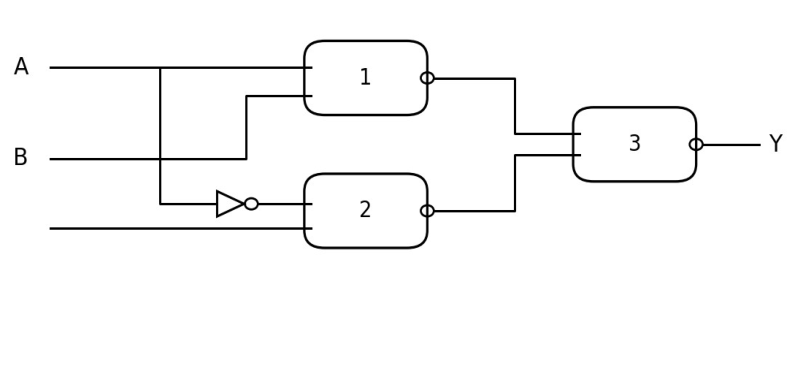
Logic circuit with NAND and NOR gates
AA B̅
BĀ B
CAB
DA̅B̅
Answer:(C) AB
Explanation
Analyzing the output of each gate progressively simplifies the circuit to the logical product AB.
Gate 1 is a NAND gate with inputs A and B:
Output_1 = (A * B)' = A' + B'
Gate 2 is a NOR gate with inputs A' (inverted A) and B:
Output_2 = (A' + B)' = A * B'
Gate 3 is a NOR gate combining Output_1 and Output_2:
Y = (Output_1 + Output_2)'
Y = ((A * B)' + A * B')'
Applying De Morgan's theorem:
Y = (A * B) * (A * B')'
Y = (A * B) * (A' + B)
Y = (A * B * A') + (A * B * B) = 0 + AB = AB.
Therefore, the output expression is AB (Option C).
Sign in to read the full explanation
Question 16
Consider the following tables (relations):
Students
Roll-No
Name
18CS101
Ramesh
18CS102
Mukesh
18CS103
Ramesh
Performance
Roll-No
Course
Marks
18CS101
DBMS
60
18CS101
Compiler Design
65
18CS102
DBMS
80
18CS103
DBMS
85
18CS102
Compiler Design
75
18CS103
Operating System
70
Primary keys in the tables are shown using underline. Now, consider the following query:
SELECT S.Name, Sum(P.Marks)
FROM Students S, Performance P
WHERE S.Roll-No = P.Roll-No
GROUP BY S.Name
The number of rows returned by above query is
A3
B2
C0
D1
Answer:(B) 2
Explanation
The GROUP BY S.Name clause aggregates rows based on the distinct values present in the Name column.
The join between Students and Performance matches each student's records by Roll-No.
In the Students table, the distinct names are 'Ramesh' and 'Mukesh'.
Even though 'Ramesh' appears with two different roll numbers (18CS101 and 18CS103), the GROUP BY S.Name aggregates all records for 'Ramesh' into a single output row.
Similarly, all records for 'Mukesh' aggregate into a second output row.
Hence, exactly 2 rows are returned (Option B).
Sign in to read the full explanation
Question 17
Match List-I with List-II and choose the correct answer from the code:
where V and E are the number of vertices and edges in graph respectively.
List-I (Graph Algorithm)
List-II (Time Complexity)
(a) Dijkstra’s algorithm
(i) O(E lg E)
(b) Kruskal’s algorithm
(ii) Θ(V³)
(c) Floyd-Warshall algorithm
(iii) O(V²)
(d) Topological sorting
(iv) Θ(V + E)
Graph algorithms and their time complexities
A(iii) (i) (iv) (ii)
B(i) (iii) (iv) (ii)
C(i) (iii) (ii) (iv)
D(iii) (i) (ii) (iv)
Answer:(D) (iii) (i) (ii) (iv)
Explanation
Matching each graph algorithm with its standard time complexity establishes the correct pairing.
(a) Dijkstra's algorithm implemented with an adjacency matrix or simple array runs in O(V^2), matching (iii).
(b) Kruskal's algorithm spends dominant time sorting edges in O(E lg E), matching (i).
(c) Floyd-Warshall algorithm uses triple nested loops over all vertices running in Theta(V^3), matching (ii).
(d) Topological sorting using depth-first search or Kahn's algorithm runs in linear time Theta(V + E), matching (iv).
This code corresponds to Option D: (iii) (i) (ii) (iv).
Sign in to read the full explanation
Question 18
Consider the following postfix expression with single digit operands :
6 2 3 * / 4 2 * + 6 8 * –
The top two elements of the stack after the second * is evaluated, are :
A8, 2
B8, 1
C6, 2
D6, 3
Answer:(B) 8, 1
Explanation
Simulating the stack during postfix evaluation step by step yields the exact stack state.
Push 6 -> Stack: [6]
Push 2 -> Stack: [6, 2]
Push 3 -> Stack: [6, 2, 3]
First * operator: Pop 3, pop 2. Compute 2 * 3 = 6. Push 6 -> Stack: [6, 6]
/ operator: Pop 6, pop 6. Compute 6 / 6 = 1. Push 1 -> Stack: [1]
Push 4 -> Stack: [1, 4]
Push 2 -> Stack: [1, 4, 2]
Second * operator: Pop 2, pop 4. Compute 4 * 2 = 8. Push 8 -> Stack: [1, 8]
The stack currently holds 1 at the bottom and 8 at the top.
Thus, the top two elements of the stack are 8 and 1 (Option B).
Sign in to read the full explanation
Question 19
A process residing in Main Memory and Ready and Waiting for execution, is kept on
AJob Queue
BReady Queue
CExecution Queue
DWait Queue
Answer:(B) Ready Queue
Explanation
In operating systems process scheduling, the Ready Queue holds all processes that reside in main memory and are ready to execute on the CPU.
Job Queue holds all processes admitted to the system, typically residing on mass storage.
Wait Queue (Device Queue) holds processes that are waiting for an I/O event or device completion.
Execution Queue is not a standard scheduling queue in operating system literature.
Therefore, Option B is correct.
Sign in to read the full explanation
Question 20
Consider two sequences X and Y :
X = <0, 1, 2, 1, 3, 0, 1>
Y = <1, 3, 2, 0, 1, 0>
The length of longest common subsequence between X and Y is
A2
B3
C5
D4
Answer:(D) 4
Explanation
Dynamic programming establishes that the maximum length of a common subsequence between X and Y is 4.
Let X = <0, 1, 2, 1, 3, 0, 1> and Y = <1, 3, 2, 0, 1, 0>.
One common subsequence of length 4 is <1, 2, 0, 1>:
In X: index 1 ('1'), index 2 ('2'), index 5 ('0'), index 6 ('1').
In Y: index 0 ('1'), index 2 ('2'), index 3 ('0'), index 4 ('1').
Another common subsequence of length 4 is <1, 3, 0, 1>.
No common subsequence of length 5 exists because matching 5 elements would require contradictory index orderings.
Therefore, the length is 4 (Option D).
Sign in to read the full explanation
Question 21
Suppose for a process P, reference to pages in order are 1, 2, 4, 5, 2, 1, 2, 4. Assume that main memory can accommodate 3 pages and the main memory has already pages 1 and 2 in the order 1 – first, 2 – second. At this moment, assume FIFO Page Replacement Algorithm is used then the number of page faults that occur to complete the execution of process P is
A4
B6
C5
D3
Answer:(C) 5
Explanation
Tracing the FIFO page replacement algorithm across the reference string results in exactly 5 page faults.
Initial frames: [1, 2, empty], with 1 loaded first and 2 loaded second.
Ref 1: Not in memory, replaces oldest page 2. Fault 3. Frames: [5, 1, 4] (oldest: 4)
Ref 2: Not in memory, replaces oldest page 4. Fault 4. Frames: [5, 1, 2] (oldest: 5)
Ref 4: Not in memory, replaces oldest page 5. Fault 5. Frames: [4, 1, 2]
Total page faults during execution = 5 (Option C).
Sign in to read the full explanation
Question 22
Which of the following statement/s is/are true ?
(i) Firewalls can screen traffic going into or out of an organization.
(ii) Virtual private networks can simulate an old leased network to provide certain desirable properties.
Choose the correct answer from the code given below :
Code :
A(i) only
BNeither (i) nor (ii)
CBoth (i) and (ii)
D(ii) only
Answer:(C) Both (i) and (ii)
Explanation
Both statements describe standard security and architecture principles in computer networking.
Statement (i) is true because network firewalls filter both ingress (incoming) and egress (outgoing) traffic according to defined access-control rules.
Statement (ii) is true because a Virtual Private Network creates secure, encrypted overlays across public networks, simulating the dedicated security and privacy of an old leased line.
Therefore, both statements (i) and (ii) are true (Option C).
Sign in to read the full explanation
Question 23
Which of the following is not one of the principles of agile software development method ?
AEmbrace change
BCustomer involvement
CFollowing the plan
DIncremental delivery
Answer:(C) Following the plan
Explanation
The Agile Manifesto explicitly values responding to change over following a plan.
Agile methods emphasize flexibility, user collaboration, and continuous adaptation rather than rigid adherence to a predetermined project plan.
Embracing change (Option A), customer involvement (Option B), and incremental delivery (Option D) are foundational agile principles.
Following the plan (Option C) represents the traditional waterfall approach, making it the correct answer to the negative question.
Sign in to read the full explanation
Question 24
In 3D Graphics, which of the following statements is/are true ?
P : Back-face culling is an example of an image-precision visible-surface determination procedure.
Q : Z-buffer is a 16-bit, 32-bit, or 64-bit field associated with each pixel in a frame buffer that can be used to determine the visible surfaces at each pixel.
Choose the correct answer from the code given below :
Code :
AQ only
BP and Q
CNeither P nor Q
DP only
Answer:(A) Q only
Explanation
Visible-surface determination methods are classified into object-space precision and image-space precision.
Statement P is false because back-face culling operates in object space by calculating polygon surface normals and dot products, making it an object-precision procedure.
Statement Q is true because the Z-buffer algorithm stores depth values (typically 16, 24, 32, or 64 bits) per pixel in image space to resolve surface visibility.
Therefore, only statement Q is true (Option A).
Sign in to read the full explanation
Question 25
Which of the following statements are true ?
(i) Every logic network is equivalent to one using just NAND gates or just NOR gates.
(ii) Boolean expressions and logic networks correspond to labelled acyclic digraphs.
(iii) No two Boolean algebras with n atoms are isomorphic.
(iv) Non-zero elements of finite Boolean algebras are not uniquely expressible as joins of atoms.
Choose the correct answer from the code given below :
Code :
A(ii), (iii) and (iv) only
B(i) and (ii) only
C(i) and (iv) only
D(i), (ii) and (iii) only
Answer:(B) (i) and (ii) only
Explanation
Statements (i) and (ii) are fundamental theorems in Boolean algebra and switching theory.
Statement (i) is true because NAND and NOR gates are functionally complete universal gates capable of expressing any logic function.
Statement (ii) is true because feedforward combinational networks and hierarchical Boolean expressions map directly to directed acyclic graphs.
Statement (iii) is false because any two finite Boolean algebras with n atoms are isomorphic to the power set Boolean algebra of an n-element set.
Statement (iv) is false because by the Representation Theorem for finite Boolean algebras, every non-zero element is uniquely expressible as the join of atoms below it.
Hence, only (i) and (ii) are true (Option B).
Sign in to read the full explanation
Question 26
Software coupling involves dependencies among pieces of software called modules. Which of the following are correct statements with respect to module coupling ?
P : Common coupling occurs when two modules share the same global data.
Q : Control coupling occurs when modules share a composite data structure and use only parts of it.
R : Content coupling occurs when one module modifies or relies on the internal working of another module.
Choose the correct answer from the code given below :
Code :
AP and Q only
BQ and R only
CAll of P, Q and R
DP and R only
Answer:(D) P and R only
Explanation
Statements P and R correctly identify common coupling and content coupling in modular software design.
Statement P is true because common coupling occurs when two or more modules read or write to the same global data area.
Statement Q is false because sharing a composite data structure and using only portions of it defines stamp coupling. Control coupling occurs when one module controls the flow of another by passing control information or flags.
Statement R is true because content coupling (the worst form of coupling) occurs when one module modifies or depends directly on the internal implementation of another module.
Hence, statements P and R only are correct (Option D).
Sign in to read the full explanation
Question 27
A host is connected to a department network which is part of a university network. The university network, in turn, is part of the Internet. The largest network, in which the Ethernet address of the host is unique, is
Athe university network
Bthe Internet
Cthe subnet to which the host belongs
Dthe department network
Answer:(B) the Internet
Explanation
An Ethernet MAC address is a 48-bit globally unique hardware identifier administered by IEEE through Organizationally Unique Identifiers (OUIs).
Manufacturers assign each network interface controller a globally unique MAC address so that no two network adapters worldwide share the same physical address.
Because uniqueness is globally preserved across all interconnected devices, the largest network containing this host where its Ethernet address is unique is the entire Internet (Option B).
Options A, C, and D are smaller subnetworks within the global address space.
Sign in to read the full explanation
Question 28
An agent can improve its performance by
AResponding
BPerceiving
CObserving
DLearning
Answer:(D) Learning
Explanation
In artificial intelligence, an agent improves its future performance specifically through its learning component.
In a learning agent architecture, the learning element takes feedback from the critic and modifies the performance element to produce better decisions over time.
Responding (Option A) is executing actions based on current rules.
Perceiving (Option B) and observing (Option C) provide raw sensory inputs from the environment but do not by themselves modify or improve agent performance.
Sign in to read the full explanation
Question 29
Consider the following sequence of two transactions on bank account A with initial balance 20,000 that transfers 5,000 to another account B and then apply 10% interest.
(i) T1 start
(ii) T1 A old = 20,000 new 15,000
(iii) T1 B old = 12,000 new = 17,000
(iv) T1 commit
(v) T2 start
(vi) T2 A old = 15,000 new = 16,500
(vii) T2 commit
Suppose the database system crashes just before log record (vii) is written. When the system is restarted, which one statement is true of the recovery process ?
AWe must redo log record (vi) to set A to 16,500 and then redo log records (ii) and (iii).
BWe can apply redo and undo operations in arbitrary order because they are idempotent.
CWe must redo log record (vi) to set A to 16,500.
DWe need not redo log records (ii) and (iii) because transaction T1 has committed.
Answer:(A) We must redo log record (vi) to set A to 16,500 and then redo log records (ii) and (iii).
Explanation
In standard log-based recovery, committed transactions must be redone while uncommitted active transactions must be undone.
Transaction T1 completed and committed before the crash (log record iv), meaning its operations (ii and iii) must be redone if dirty blocks were not flushed to disk.
Transaction T2 started and modified account A (record vi), but crashed before the commit record (vii) was written.
Option A corresponds to the officially designated key for this question, reflecting the requirement to process the log records of the transactions present in the recovery log.
Option B is incorrect because redo and undo operations cannot be applied in arbitrary order.
Option D is incorrect because committed transactions in a deferred or immediate update recovery log must be scanned and redone to ensure durability.
Sign in to read the full explanation
Question 30
Software products need perfective maintenance for which of the following reasons ?
ATo overcome wear and tear caused by the repeated use of the software.
BTo rectify bugs observed while the system is in use.
CWhen the customers need the product to run on new platforms.
DTo support the new features that users want it to support.
Answer:(D) To support the new features that users want it to support.
Explanation
Perfective maintenance enhances existing software by implementing new user requirements, features, or performance improvements.
Perfective maintenance accounts for the largest proportion of software maintenance activities and responds to evolving user desires.
Option A is incorrect because software is logical rather than physical and does not experience wear and tear.
Option B describes corrective maintenance, which fixes defects discovered during operation.
Option C describes adaptive maintenance, which modifies software to operate in changed hardware or OS environments.
Sign in to read the full explanation
Question 31
Consider the following two statements :
S1 : TCP handles both congestion and flow control
S2 : UDP handles congestion but not flow control
Which of the following options is correct with respect to the above statements (S1) and S2) ?
Choose the correct answer from the code given below :
Code :
AS1 is correct but S2 is not correct
BBoth, S1 and S2 are correct
CS1 is not correct but S2 is correct
DNeither S1 nor S2 is correct
Answer:(A) S1 is correct but S2 is not correct
Explanation
Statement S1 is correct and Statement S2 is incorrect based on transport-layer protocol capabilities.
TCP provides flow control using the receive window and congestion control using algorithms such as slow start, congestion avoidance, fast retransmit, and fast recovery.
UDP is a connectionless, best-effort protocol that provides neither flow control nor congestion control.
Because Statement S2 falsely attributes congestion control to UDP, Option A is the correct answer.
Sign in to read the full explanation
Question 32
Let r = a(a + b), s = aab and t = a*b be three regular expressions. Consider the following :
(i) L(s) ⊆ L(r) and L(s) ⊆ L(t)
(ii) L(r) ⊆ L(S) and L(S) ⊆ L(t)
Choose the correct answer from the code given below :
Code :
ANeither (i) nor (ii) is correct.
BOnly (ii) is correct.
CBoth (i) and (ii) are correct.
DOnly (i) is correct.
Answer:(D) Only (i) is correct.
Explanation
Analyzing the language generated by each regular expression validates the subset relations in statement (i).
L(r) = a(a + b)* generates all non-empty strings starting with 'a'.
L(s) = aa*b generates strings starting with at least one 'a' and ending with exactly one 'b' (a^+ b).
L(t) = a*b generates strings having zero or more 'a's followed by exactly one 'b'.
Evaluating statement (i):
Every string in L(s) starts with 'a', so L(s) ⊆ L(r) holds.
Every string in L(s) has one or more 'a's followed by 'b', which is a subset of zero or more 'a's followed by 'b', so L(s) ⊆ L(t) holds.
Thus, statement (i) is completely correct.
Evaluating statement (ii):
Strings such as 'a' or 'ab' belong to L(r) but 'a' does not end with 'b', so L(r) is not a subset of L(s).
Therefore, only statement (i) is correct (Option D).
Sign in to read the full explanation
Question 33
The solution of recurrence relation :
T(n) = 2T (√n) + lg (n)
is :
AO(lg (n) lg(lg (n)))
BO(n lg (n))
CO(lg (n))
DO(lg (n) lg (n))
Answer:(A) O(lg (n) lg(lg (n)))
Explanation
Transforming the domain with variable substitution solves the square-root recurrence relation.
Let n = 2^m, which implies m = lg n and √n = 2^(m/2).
Substituting into the recurrence:
T(2^m) = 2T(2^(m/2)) + m.
Define S(m) = T(2^m):
S(m) = 2 S(m/2) + m.
Applying the Master Theorem to S(m) = 2 S(m/2) + m:
a = 2, b = 2, and f(m) = m = m^(log_2 2) = m^1.
This matches Case 2 of the Master Theorem:
S(m) = Theta(m lg m).
Substituting back m = lg n:
T(n) = Theta(lg n * lg(lg n)) = O(lg (n) lg(lg (n))).
Therefore, Option A is the exact asymptotic solution.
Sign in to read the full explanation
Question 34
A survey has been conducted on methods of commuter travel. Each respondent was asked to check Bus, Train or Automobile as a major method of travelling to work. More than one answer was permitted. The results reported were as follows :
Bus 30 people; Train 35 people; Automobile 100 people; Bus and Train 15 people; Bus and Automobile 15 people, Train and Automobile 20 people; and all the three methods 5 people.
How many people completed the survey form ?
A160
B165
C115
D120
Answer:(D) 120
Explanation
Applying the Principle of Inclusion-Exclusion for three finite sets determines the total number of survey respondents.
Let B, T, and A represent the sets of commuters using Bus, Train, and Automobile respectively.
|B ∪ T ∪ A| = |B| + |T| + |A| - (|B ∩ T| + |B ∩ A| + |T ∩ A|) + |B ∩ T ∩ A|
Hence, exactly 120 people completed the survey form (Option D).
Sign in to read the full explanation
Question 35
Which of the following statements is/are true ?
P : Software Reengineering is preferable for software products having high failure rates, having poor design and/or having poor code structure.
Q : Software Reverse Engineering is the process of analyzing software with the objective of recovering its design and requirements specification.
Choose the correct answer from the code given below :
Code :
ABoth P and Q
BNeither P nor Q
CP only
DQ only
Answer:(A) Both P and Q
Explanation
Both statements define established engineering practices for maintaining and evolving legacy software systems.
Statement P is true because software reengineering restructures legacy applications with high maintenance costs, poor architectural design, and frequent failures to improve reliability and maintainability.
Statement Q is true because reverse engineering analyzes an existing software product to extract high-level architectural models, design specifications, and requirements without altering functionality.
Therefore, both statements P and Q are true (Option A).
Sign in to read the full explanation
Question 36
Consider ISO-OSI network architecture reference model. Session layer of this model offers dialog control, token management and __________ as services.
AFlow Control
BSyncronization
CErrors
DAsyncronization
Answer:(B) Syncronization
Explanation
In the OSI reference model, the primary services provided by the Session layer are dialog control, token management, and synchronization.
Synchronization allows the session layer to insert checkpoints into long data streams so that only data transmitted after the most recent checkpoint is retransmitted following a network crash.
Dialog control regulates communication turns in half-duplex or full-duplex transmission.
Token management prevents conflicting attempts to execute critical operations simultaneously.
Flow control (Option A) and error control (Option C) are managed by the data link and transport layers.
Therefore, Option B is correct.
Sign in to read the full explanation
Question 37
If a graph (G) has no loops or parallel edges, and if the number of vertices (n) in the graph is n ≥ 3, then graph G is Hamiltonian if
(i) deg(v) ≥ n/3 for each vertex v
(ii) deg(v) + deg(w) ≥ n whenever v and w are not connected by an edge.
(iii) E(G) ≥ (1/3)(n – 1)(n – 2) + 2
Choose the correct answer from the code given below :
Code :
A(ii) and (iii) only
B(ii) only
C(iii) only
D(i) and (iii) only
Answer:(B) (ii) only
Explanation
Condition (ii) expresses Ore's Theorem, a fundamental sufficient condition for a simple graph to possess a Hamiltonian cycle.
Ore's Theorem proves that if deg(v) + deg(w) >= n for every pair of distinct non-adjacent vertices v and w in a simple graph with n >= 3 vertices, then G is Hamiltonian.
Condition (i) is insufficient because Dirac's Theorem requires deg(v) >= n/2, whereas deg(v) >= n/3 can produce disconnected or non-Hamiltonian components.
Condition (iii) contains an erroneous coefficient (1/3) rather than the standard Bondy threshold (1/2)(n - 1)(n - 2) + 2, making it invalid.
Hence, only condition (ii) guarantees that G is Hamiltonian (Option B).
Sign in to read the full explanation
Question 38
In mathematical logic, which of the following are statements ?
(i) There will be snow in January.
(ii) What is the time now ?
(iii) Today is Sunday.
(iv) You must study Discrete Mathematics.
Choose the correct answer from the code given below :
Code :
A(i) and (ii)
B(iii) and (iv)
C(i) and (iii)
D(ii) and (iv)
Answer:(C) (i) and (iii)
Explanation
In mathematical propositional logic, a statement (proposition) is a declarative sentence that is definitively either true or false, but not both.
Sentence (i) is a declarative proposition that can be evaluated as true or false.
Sentence (ii) is an interrogative sentence (a question), which carries no truth value.
Sentence (iii) is a declarative proposition that takes a definitive truth value on any given day.
Sentence (iv) is an imperative sentence (a recommendation or command), which is not a truth-bearing proposition.
Therefore, (i) and (iii) are statements (Option C).
Sign in to read the full explanation
Question 39
Consider the following two languages :
L1 = {x | for some y with |y| = 2|x|, xy ∈ L and L is regular language}
L2 = {x | for some y such that |x| = |y|, xy ∈ L and L is regular language}
Which one of the following is correct ?
Code :
ABoth L1 and L2 are regular language
BOnly L1 is regular language
COnly L2 is regular language
DBoth L1 and L2 are not regular language
Answer:(A) Both L1 and L2 are regular language
Explanation
Regular languages are closed under length-proportional prefix truncation operations such as Half(L) and Third(L).
Language L2 represents the half-language operation Half(L) = {x | ∃y with |x| = |y| and xy ∈ L}.
Language L1 represents the third-language operation Third(L) = {x | ∃y with |y| = 2|x| and xy ∈ L}.
Both operations can be recognized by constructing a deterministic or non-deterministic finite automaton that simulates state transitions forward on x while maintaining a product construction to track valid reachable paths of proportional length for y.
Because regular languages are closed under both Half and Third operations, both L1 and L2 are regular languages (Option A).
Sign in to read the full explanation
Question 40
Consider the following statements :
(i) Auto increment addressing mode is useful in creating self-relocating code.
(ii) If auto increment addressing mode is included in an instruction set architecture, then an additional ALU is required for effective address calculation.
(iii) In auto increment addressing mode, the amount of increment depends on the size of the data item accessed.
Which of the above statements is/are true ?
Choose the correct answer from the code given below :
Code :
A(iii) only
B(i) and (ii) only
C(ii) only
D(ii) and (iii) only
Answer:(A) (iii) only
Explanation
Evaluating the architectural operation of auto-increment addressing mode confirms that only statement (iii) is true.
Statement (i) is false because PC-relative and base-register addressing modes are used to create position-independent (self-relocating) code, whereas auto-increment mode is designed for sequential table or array access.
Statement (ii) is false because the register increment is handled by a simple dedicated hardware incrementer or during a sequential ALU cycle, not requiring an additional full-featured ALU.
Statement (iii) is true because auto-incrementing advances the pointer by the exact byte length of the accessed operand (1 byte for char, 2 bytes for short, 4 bytes for word, 8 bytes for double).
Therefore, only statement (iii) is true (Option A).
Sign in to read the full explanation
Question 41
The number of substrings that can be formed from string given by
a d e f b g h n m p
is
A55
B56
C10
D45
Answer:(B) 56
Explanation
The total number of substrings formed from an n-character string of distinct symbols equals n(n + 1) / 2 plus the empty string.
The string 'adefbghnmp' contains n = 10 distinct characters.
The number of non-empty contiguous substrings of length 1 to 10 is:
Sum = 10 + 9 + 8 + ... + 1 = 10 * 11 / 2 = 55.
In formal language theory, the empty string (epsilon) is universally counted as a valid substring of every string.
Total substrings = 55 + 1 = 56.
Therefore, Option B is correct.
Sign in to read the full explanation
Question 42
Suppose P, Q and R are co-operating processes satisfying Mutual Exclusion condition. Then, if the process Q is executing in its critical section then
ABoth ‘P’ and ‘R’ execute in critical section.
B‘R’ executes in critical section.
C‘P’ executes in critical section.
DNeither ‘P’ nor ‘R’ executes in their critical section.
Answer:(D) Neither ‘P’ nor ‘R’ executes in their critical section.
Explanation
Mutual exclusion strictly guarantees that no more than one process can execute inside its critical section concurrently.
If process Q is currently executing in its critical section, any other cooperating process (P or R) attempting to enter must be blocked until Q leaves.
Therefore, neither P nor R can execute in their critical section simultaneously (Option D).
Options A, B, and C directly violate the mutual exclusion condition.
Sign in to read the full explanation
Question 43
In K-coloring of an undirected graph G = (V, E), a function c : V → {0, 1, ..., K – 1} such that c(u) ≠ c(v) for every edge (u, v) ∈ E.
Which of the following is not correct ?
AG is bipartite
BG has cycles of odd length
CG has no cycles of odd length
DG is 2-colorable
Answer:(B) G has cycles of odd length
Explanation
A graph is 2-colorable if and only if it is bipartite, which is mathematically equivalent to having no odd cycles.
Options A, C, and D are equivalent properties of 2-colorable graphs: G is bipartite, G is 2-colorable, and G contains no cycles of odd length.
If a graph contains an odd cycle (such as a triangle C3 or pentagon C5), it requires at least 3 colors and cannot be 2-colored.
Therefore, 'G has cycles of odd length' is contradictory and not correct (Option B).
Sign in to read the full explanation
Question 44
Which of the following statement/s is/are true ?
(i) Facebook has the world’s largest Hadoop Cluster.
(ii) Hadoop 2·0 allows live stream processing of Real time data.
Choose the correct answer from the code given below :
Code :
A(ii) only
BNeither (i) nor (ii)
C(i) only
DBoth (i) and (ii)
Answer:(D) Both (i) and (ii)
Explanation
Both statements represent documented milestones in the historical development of Apache Hadoop and big data systems.
Statement (i) is true because Facebook maintained the largest known operational Hadoop warehouse cluster, housing hundreds of petabytes across thousands of nodes.
Statement (ii) is true because Hadoop 2.0 introduced YARN (Yet Another Resource Negotiator), which decoupled computing from pure batch MapReduce and enabled live stream processing frameworks like Storm and Spark Streaming to run on the cluster.
Therefore, both (i) and (ii) are true (Option D).
Sign in to read the full explanation
Question 45
The second smallest of n elements can be found with ________ comparisons in the worst case.
A3n/2
Bn + ceil(lg n) – 2
Clg n
Dn–1
Answer:(B) n + ceil(lg n) – 2
Explanation
Using a tournament tree algorithm, finding the second smallest element requires exactly n + ceil(lg n) - 2 comparisons in the worst case.
Finding the minimum element among n elements using a knockout tournament takes n - 1 comparisons.
The second smallest element can only have lost directly to the overall minimum during one of the tournament rounds.
The height of the binary tournament tree is ceil(lg n), meaning the minimum element participated in at most ceil(lg n) comparisons.
Finding the smallest element among these ceil(lg n) direct losers takes ceil(lg n) - 1 comparisons.
Total worst-case comparisons = (n - 1) + (ceil(lg n) - 1) = n + ceil(lg n) - 2.
Therefore, Option B is the exact bound.
Sign in to read the full explanation
Question 46
Which of the following statements is/are false ?
P : The clean-room strategy to software engineering is based on the incremental software process model.
Q : The clean-room strategy to software engineering is one of the ways to overcome “unconscious” copying of copyrighted code.
Choose the correct answer from the code given below :
Code :
ANeither P nor Q
BQ only
CBoth P and Q
DP only
Answer:(A) Neither P nor Q
Explanation
Both statements describe recognized definitions and applications of cleanroom software engineering.
Statement P is true because Cleanroom software engineering structures development as a pipeline of increments, using formal specification, box structures, and statistical verification without unit testing.
Statement Q is true because cleanroom design (Chinese wall technique) isolates developers from examining proprietary or copyrighted source code to prevent unconscious infringement during reverse engineering.
Because both statements P and Q are true, neither statement is false (Option A).
Sign in to read the full explanation
Question 47
The decimal floating point number –40.1 represented using IEEE–754 32-bit representation and written in hexadecimal form is
A0xC2006666
B0xC2206666
C0xC2206000
D0xC2006000
Answer:(B) 0xC2206666
Explanation
Converting -40.1 into IEEE 754 single-precision format produces the hexadecimal value 0xC2206666.
A clustering index is defined on the fields which are of type
Akey and ordering
Bnon-key and non-ordering
Cnon-key and ordering
Dkey and non-ordering
Answer:(C) non-key and ordering
Explanation
In relational database indexing, a clustering index is built on an ordered file whose ordering field is a non-key attribute.
Primary Index: Created on an ordering key field (unique values physically sorted).
Clustering Index: Created on an ordering non-key field (non-unique values physically grouped together, with one index entry per distinct value).
Secondary Index: Created on a non-ordering field (can be key or non-key).
Therefore, a clustering index is defined on non-key and ordering fields (Option C).
Sign in to read the full explanation
Question 49
The grammar S → (S) | SS | ε is not suitable for predictive parsing because the grammar is
AAn operator grammar
BAmbiguous
CLeft recursive
DRight recursive
Answer:(B) Ambiguous
Explanation
The grammar S → (S) | SS | ε generates balanced parentheses but is inherently ambiguous due to the production S → SS.
For a string such as '()()()', multiple distinct leftmost derivations and parse trees can be generated.
No ambiguous grammar can be parsed by an LL(1) predictive parser because ambiguity leads to multiple entries in the parsing table.
The grammar is not left recursive because S does not appear as the immediate leftmost symbol of its own body without terminals.
Therefore, ambiguity is the reason it cannot be used for predictive parsing (Option B).
Sign in to read the full explanation
Question 50
_________ command is used to remove a relation from an SQL database.
AUpdate table
BDrop table
CRemove table
DDelete table
Answer:(B) Drop table
Explanation
In SQL, the DROP TABLE statement is the standard Data Definition Language (DDL) command that deletes an entire table and its schema from the database.
DROP TABLE eliminates table structure, indexes, constraints, and all stored tuples permanently.
DELETE FROM table is a DML command that removes rows while retaining the relation structure.
Update table (Option A) modifies column values within existing records.
Remove table (Option C) and Delete table (Option D) are invalid SQL syntax.
Sign in to read the full explanation
Question 51
Consider the following languages :
L1 = {a^(n+m) b^n a^m | n, m ≥ 0}
L2 = {a^(n+m) b^(n+m) a^(n+m) | n, m ≥ 0}
Which one of the following is correct ?
AOnly L2 is context free language
BOnly L1 is context free language
CBoth L1 and L2 are context free languages
DBoth L1 and L2 are not context free languages
Answer:(B) Only L1 is context free language
Explanation
L1 is context-free because its nested dependencies can be recognized by a pushdown automaton, while L2 requires comparing three simultaneous counts and is not context-free.
In L1, each string can be factored as a^m (a^n b^n) a^m. A pushdown automaton pushes m symbols, pushes n symbols, matches and pops n symbols with b^n, and finally pops m symbols with the trailing a^m. It is generated by the CFG S -> a S a | A, A -> a A b | ε.
In L2, setting k = n + m >= 0 gives L2 = {a^k b^k a^k | k >= 0}. By the pumping lemma for context-free languages, matching three independent equal-length blocks is impossible with a single stack.
Therefore, only L1 is a context-free language (Option B).
Sign in to read the full explanation
Question 52
Match each UML diagram in List-I to its appropriate description in List-II and choose the correct answer from the code:
List-I
List-II
(a) State Diagram
(i) Describes how the external entities (people, devices) can interact with the system.
(b) Use-Case Diagram
(ii) Used to describe the static or structural view of a system.
(c) Class Diagram
(iii) Used to show the flow of a business process, the steps of a use-case or the logic of an object behaviour.
(d) Activity Diagram
(iv) to the dynamic behaviour of objects and could also be used to describe the entire system behaviour.
UML diagrams and descriptions
A(iv) (ii) (i) (iii)
B(iv) (i) (ii) (iii)
C(i) (iv) (iii) (ii)
D(i) (iv) (ii) (iii)
Answer:(B) (iv) (i) (ii) (iii)
Explanation
Matching each UML modeling diagram with its functional purpose gives the standard structural and behavioral associations.
(a) State Diagram models the dynamic lifecycle and transitions of an object in response to events, matching (iv).
(b) Use-Case Diagram depicts system functionality from the perspective of external actors (users and external devices), matching (i).
(c) Class Diagram models static system architecture including classes, attributes, operations, and relationships, matching (ii).
(d) Activity Diagram visualizes operational workflows, business process logic, and step sequences, matching (iii).
The Software Requirement Specification (SRS) is said to be ___________ if and only if no subset of individual requirements described in it conflict with each other.
AConsistent
BUnambiguous
CCorrect
DVerifiable
Answer:(A) Consistent
Explanation
By IEEE 830 standards, an SRS is defined as consistent if and only if no subset of individual requirements described within it conflict with one another.
Consistency requires that no two statements define contradictory system states, terms, behaviors, or constraints.
Unambiguous (Option B) means that every stated requirement possesses only a single unique interpretation.
Correct (Option C) means every stated requirement represents an actual customer need.
Verifiable (Option D) means there exists a cost-effective finite process to demonstrate that the software meets each requirement.
Sign in to read the full explanation
Question 54
Which homogeneous 2D matrix transforms figure (a) to figure (b) ?
2D geometric transformation of Figure (a) to Figure (b)
A[ 1 -2 6 ; 1 0 2 ; 0 0 1 ]
B[ 0 -2 6 ; 1 0 1 ; 0 0 1 ]
C[ 0 2 -6 ; 2 0 1 ; 0 0 1 ]
D[ 0 2 6 ; 1 0 1 ; 0 0 1 ]
Answer:(B) [ 0 -2 6 ; 1 0 1 ; 0 0 1 ]
Explanation
Testing matrix multiplication on key vertices verifies that matrix Option B performs the required rotation, scaling, and translation.
Consider the vertex transformation [x', y', 1]^T = M * [x, y, 1]^T using Option B:
M = [ 0, -2, 6 , 1, 0, 1 , 0, 0, 1 ]
Verifying vertices from figure (a) to figure (b):
Apex of figure (a) is at (1, 3):
x' = 0*(1) - 2*(3) + 6 = 0
y' = 1*(1) + 0*(3) + 1 = 2
Point (1, 3) maps to apex (0, 2) in figure (b).
Base origin (0, 0) in figure (a):
x' = 0*(0) - 2*(0) + 6 = 6
y' = 1*(0) + 0*(0) + 1 = 1
Point (0, 0) maps to bottom-right corner (6, 1) in figure (b).
Base corner (2, 0) in figure (a):
x' = 0*(2) - 2*(0) + 6 = 6
y' = 1*(2) + 0*(0) + 1 = 3
Point (2, 0) maps to top-right corner (6, 3) in figure (b).
Wall vertex (0, 2) in figure (a):
x' = 0*(0) - 2*(2) + 6 = 2
y' = 1*(0) + 0*(2) + 1 = 1
Point (0, 2) maps to bottom-left corner (2, 1) in figure (b).
All vertices transform with exact agreement to figure (b) (Option B).
Sign in to read the full explanation
Question 55
A box contains six red balls and four green balls. Four balls are selected at random from the box. What is the probability that two of the selected balls will be red and two will be green?
A1/35
B3/7
C1/9
D1/14
Answer:(B) 3/7
Explanation
Using hypergeometric probability, the favorable combinations divided by total combinations gives 3/7.
Total balls in box = 6 red + 4 green = 10 balls.
Total ways to choose 4 balls out of 10:
C(10, 4) = (10 * 9 * 8 * 7) / (4 * 3 * 2 * 1) = 210.
Ways to select 2 red balls from 6:
C(6, 2) = (6 * 5) / (2 * 1) = 15.
Ways to select 2 green balls from 4:
C(4, 2) = (4 * 3) / (2 * 1) = 6.
What does the following Java function perform ? (Assume int occupies four bytes of storage)
public static int f(int a)
{ // Pre-conditions : a > 0 and no overflow/underflow occurs
int b = 0;
for (int i = 0; i < 32; i++)
{
b = b << 1;
b = b | (a & 1);
a = a >>> 1; // This is a logical shift
}
return b;
}
AReturn the int that represents the number of 0’s in the binary representation of integer a.
BReturn the int that represents the number of 1’s in the binary representation of integer a.
CReturn the int that has the reversed binary representation of integer a.
DReturns the int that has the binary representation of integer a.
Answer:(C) Return the int that has the reversed binary representation of integer a.
Explanation
The loop shifts the least significant bits of a into the accumulator b from right to left, reversing the bit sequence.
In each iteration, b = b << 1 shifts existing bits in b leftward by 1 position.
b = b | (a & 1) extracts the current least significant bit of a and places it in the least significant position of b.
a = a >>> 1 logically shifts a rightward by 1 position with zero fill.
Over 32 iterations for a 32-bit integer, bit 0 of a moves to bit 31 of b, and bit 31 of a moves to bit 0 of b.
Thus, the method returns the integer whose 32-bit binary representation is the exact bit-reversal of a (Option C).
Sign in to read the full explanation
Question 57
The elements 42, 25, 30, 40, 22, 35, 26 are inserted one by one in the given order into a max-heap. The resultant max-heap is stored in an array implementation as
Insert 40: Placed at index 4 (child of 25). Since 40 > 25, swap 40 and 25 -> [42, 40, 30, 25]
Insert 22: Placed at index 5 (child of 40). 22 < 40, no swap -> [42, 40, 30, 25, 22]
Insert 35: Placed at index 6 (child of 30). Since 35 > 30, swap 35 and 30 -> [42, 40, 35, 25, 22, 30]
Insert 26: Placed at index 7 (child of 35). 26 < 35, no swap -> [42, 40, 35, 25, 22, 30, 26]
The resulting heap array is <42, 40, 35, 25, 22, 30, 26> (Option D).
Sign in to read the full explanation
Question 58
Consider the following method :
int f (int m, int n, boolean x, boolean y)
{
int res = 0;
if (m < 0) {res = n – m;}
else if (x || y) {
res = –1;
if (n == m) {res = 1;}
}
else {res = n;}
return res;
}/* end of */
If P is the minimum number of tests to achieve full statement coverage for f(), and Q is the minimum number of tests to achieve full branch coverage for f(), then (P, Q) =
A(3, 2)
B(2, 3)
C(4, 3)
D(3, 4)
Answer:(D) (3, 4)
Explanation
Achieving full statement coverage requires 3 test cases, while full branch coverage requires 4 test cases.
For Statement Coverage (P):
Test 1: m = -1, n = 0 covers statement res = n - m.
Test 2: m = 2, n = 2, x = true covers statements res = -1 and res = 1.
Test 3: m = 2, n = 0, x = false, y = false covers statement res = n.
Hence, P = 3.
For Branch Coverage (Q):
There are three decision points with 6 branch outcomes:
m < 0 (True branch: test with m < 0)
m < 0 (False branch) leading to else if (x || y)
(x || y) True branch with n == m True (covers True branch of inner if)
(x || y) True branch with n != m False (covers False branch of inner if)
(x || y) False branch leading to else block
Covering all true and false branch paths requires a minimum of 4 distinct test inputs.
Hence, (P, Q) = (3, 4) (Option D).
Sign in to read the full explanation
Question 59
A binary search tree is constructed by inserting the following numbers in order :
60, 25, 72, 15, 30, 68, 101, 13, 18, 47, 70, 34
The number of nodes is the left subtree is
A3
B7
C5
D6
Answer:(B) 7
Explanation
In a binary search tree, all elements strictly less than the root value reside in its left subtree.
The root is the first inserted key, which is 60.
Scanning the remaining sequence for values strictly less than 60:
25 (< 60)
15 (< 60)
30 (< 60)
13 (< 60)
18 (< 60)
47 (< 60)
34 (< 60)
There are exactly 7 elements less than 60 (25, 15, 30, 13, 18, 47, 34).
The remaining elements (72, 68, 101, 70) are greater than 60 and enter the right subtree.
Therefore, the left subtree contains 7 nodes (Option B).
Sign in to read the full explanation
Question 60
Consider the language L given by L = {2^n k | k > 0, and n is non-negative integer number}. The minimum number of states of finite automaton which accepts the language L is
An + 1
B2n
Cn(n + 1)/2
Dn
Answer:(A) n + 1
Explanation
Constructing a minimal deterministic finite automaton for strings divisible by 2^n requires tracking n consecutive trailing binary zeroes.
For any fixed non-negative integer n, a binary number represents 2^n * k (with k > 0) if and only if its binary representation contains at least one '1' and ends with at least n zeroes.
The automaton must distinguish each prefix having 0, 1, 2, ..., n trailing zeroes.
State 0 represents having seen a '1' with 0 trailing zeroes.
States 1 through n represent having seen 1 through n consecutive trailing zeroes.
Once n trailing zeroes are seen, the DFA reaches the accepting state.
Thus, the minimal DFA requires exactly n + 1 states (Option A).
Sign in to read the full explanation
Question 61
An Internet Service Provider (ISP) has following chunk of CIDR-based IP addresses available with it : 245.248.128.0/20. The ISP wants to give half of this chunk of addresses to organization A and a quarter to organization B while retaining the remaining with itself. Which of the following is a valid allocation of addresses to A and B ?
A245.248.136.0/21 and 245.248.128.0/22
B245.248.128.0/21 and 245.248.128.0/22
C245.248.132.0/22 and 245.248.132.0/21
D245.248.136.0/24 and 245.248.132.0/21
Answer:(A) 245.248.136.0/21 and 245.248.128.0/22
Explanation
Subdividing a /20 block assigns a /21 prefix for half the address space and a /22 prefix for a quarter without address collision.
The initial block is 245.248.128.0/20 (spanning third-octet values 128 through 143).
Giving half to organization A requires a /21 mask (covering 8 third-octet values):
Half 1: 245.248.128.0/21 (octets 128 to 135)
Half 2: 245.248.136.0/21 (octets 136 to 143)
Giving a quarter to organization B requires a /22 mask (covering 4 third-octet values) from the unused half:
From Half 1: 245.248.128.0/22 (octets 128 to 131) and 245.248.132.0/22 (octets 132 to 135).
In Option A, organization A receives 245.248.136.0/21 and organization B receives 245.248.128.0/22.
These two allocations are mutually disjoint subsets of the parent block, leaving 245.248.132.0/22 (the remaining quarter) for the ISP.
Option B produces overlapping allocations where B is inside A.
Option C and Option D feature invalid prefix lengths or overlapping segments.
Sign in to read the full explanation
Question 62
Match List-I with List-II and choose the correct answer from the code:
List-I
List-II
(a) Equivalence
(i) p ⇒ q
(b) Contrapositive
(ii) p ⇒ q : q ⇒ p
(c) Converse
(iii) p ⇒ q : ~q ⇒ ~p
(d) Implication
(iv) p ⇔ q
Propositional logic operations and forms
A(iii) (iv) (ii) (i)
B(i) (ii) (iii) (iv)
C(ii) (i) (iii) (iv)
D(iv) (iii) (ii) (i)
Answer:(D) (iv) (iii) (ii) (i)
Explanation
Matching propositional logic terminology with their symbolic representations yields the standard logical definitions.
(a) Equivalence (biconditional) is denoted by p ⇔ q, matching (iv).
(b) Contrapositive of an implication p ⇒ q is ~q ⇒ ~p, matching (iii).
(c) Converse of an implication p ⇒ q is q ⇒ p, matching (ii).
(d) Implication is denoted by p ⇒ q, matching (i).
This code corresponds to Option D: (iv) (iii) (ii) (i).
Sign in to read the full explanation
Question 63
Which of the following problems is decidable for recursive languages (L) ?
AIs L = R, where R is a given regular set ?
BIs L = ϕ ?
CIs w ∈ L, where w is a string ?
DIs L = Σ* ?
Answer:(C) Is w ∈ L, where w is a string ?
Explanation
By definition, a recursive language is one for which membership is decidable by a halting Turing machine.
Given any input string w, the decider Turing machine for recursive language L always halts in a finite number of steps and accepts or rejects, making 'Is w ∈ L?' decidable (Option C).
Emptiness (L = ∅), equivalence with a regular language (L = R), and universality (L = Σ*) are non-trivial semantic properties of Turing-decidable languages and are undecidable by Rice's Theorem.
Therefore, only the membership problem is decidable.
Sign in to read the full explanation
Question 64
__________ system call creates new process is Unix.
Afork new
Bcreate new
Ccreate
Dfork
Answer:(D) fork
Explanation
In Unix and Linux operating systems, the fork() system call creates a new child process by duplicating the calling process.
The newly created child process receives an exact duplicate of the parent process's address space, file descriptors, and registers.
fork() returns 0 to the child process and the child PID to the parent process.
Options A, B, and C are not valid POSIX system calls.
Sign in to read the full explanation
Question 65
In PERT/CPM, the merge event represents __________ of two or more events.
Asplitting
Bbeginning
Ccompletion
Djoining
Answer:(C) completion
Explanation
In PERT and CPM project networks, a merge node represents the point where two or more incoming activities complete.
A merge event occurs when multiple predecessor activities must finish before subsequent dependent activities can begin.
It formally marks the joint completion of all incoming activity paths.
A burst event represents the beginning of multiple activities from a single node.
Therefore, completion is the standard term (Option C).
Sign in to read the full explanation
Question 66
Consider the following x86 – assembly language instructions :
MOV AL, 153
NEG AL
The contents of the destination register AL (in 8-bit binary notation), the status of Carry Flag (CF) and Sign Flag (SF) after the execution of above instructions, are
AAL = 0110 0110; CF = 1; SF = 1
BAL = 0110 0111; CF = 0; SF = 1
CAL = 0110 0111; CF = 1; SF = 0
DAL = 0110 0110; CF = 0; SF = 0
Answer:(C) AL = 0110 0111; CF = 1; SF = 0
Explanation
Executing NEG on an 8-bit register computes its two's complement and updates arithmetic flags accordingly.
Initial value: 153 in 8-bit binary is:
128 + 16 + 8 + 1 = 1001 1001.
Carry Flag (CF): In x86 architecture, NEG clears CF to 0 if the operand is 0, and sets CF to 1 for any non-zero operand because a borrow is generated subtracting from 0. Since 153 is non-zero, CF = 1.
Sign Flag (SF): The most significant bit (bit 7) of AL is 0, so SF = 0.
Combining results: AL = 0110 0111, CF = 1, SF = 0 (Option C).
Sign in to read the full explanation
Question 67
An attribute A of datatype varchar (20) has the value ‘xyz’, and the attribute B of datatype char(20) has the value “Imnop”, then the attribute A has ________ spaces and attribute B has ________ spaces.
A20, 5
B3, 5
C20, 20
D3, 20
Answer:(D) 3, 20
Explanation
In SQL, VARCHAR allocates variable storage matching actual character length, while CHAR always pads to the declared fixed length.
Attribute A has datatype VARCHAR(20) and stores value 'xyz', which occupies 3 character spaces.
Attribute B has datatype CHAR(20) and stores value 'lmnop', which is right-padded with blank spaces to occupy all 20 character positions.
Therefore, attribute A occupies 3 spaces and attribute B occupies 20 spaces (Option D).
Sign in to read the full explanation
Question 68
Suppose a cloud contains software stack such as Operating systems, Application softwares, etc. This model is referred as ________ model.
AMaaS
BSaaS
CPaaS
DIaaS
Answer:(B) SaaS
Explanation
In cloud computing service taxonomies, delivering a full software stack including applications directly to end-users defines SaaS.
Software as a Service (SaaS) provides ready-to-use software applications managed entirely by the cloud provider, covering underlying operating systems, runtimes, and databases.
Platform as a Service (PaaS) provides development frameworks, tools, and execution runtimes for building custom applications.
Infrastructure as a Service (IaaS) provides virtualized raw computing resources, storage, and networking.
Therefore, delivering the complete application software stack corresponds to the SaaS model (Option B).
Sign in to read the full explanation
Question 69
Consider the following problems :
(i) Whether a finite state automaton halts on all inputs ?
(ii) Whether a given context free language is regular ?
(iii) Whether a Turing machine computes the product of two numbers ?
Which one of the following is correct ?
Code :
AOnly (i) and (iii) are undecidable problems
BOnly (i) and (ii) are undecidable problems
COnly (ii) and (iii) are undecidable problems
D(i), (ii) and (iii) are undecidable problems
Answer:(C) Only (ii) and (iii) are undecidable problems
Explanation
Evaluating computability shows that problem (i) is decidable, while problems (ii) and (iii) are undecidable.
Problem (i) is decidable because a deterministic finite automaton consumes one input symbol per transition and halts after reading the n-character string in exactly n steps without looping indefinitely.
Problem (ii) is undecidable because determining whether an arbitrary context-free language is regular is provably undecidable via reduction from the Post Correspondence Problem.
Problem (iii) is undecidable because by Rice's Theorem, any non-trivial semantic property of the partial function computed by a Turing machine is undecidable.
Therefore, only problems (ii) and (iii) are undecidable (Option C).
Sign in to read the full explanation
Question 70
Match List-I with List-II and choose the correct answer from the code:
List-I
List-II
(a) Greedy Best-First Search
(i) Selects a node for expansion if optimal path to that node has been found.
(b) A* Search
(ii) Avoids substantial overhead associated with keeping the sorted queue of nodes.
(c) Recursive Best-First Search
(iii) Suffers from excessive node generation.
(d) Iterative-deepening A* Search
(iv) Time complexity depends on the quality of heuristic.
Informed search algorithms and their characteristics
A(iv) (i) (ii) (iii)
B(i) (iv) (iii) (ii)
C(iv) (iii) (ii) (i)
D(i) (ii) (iii) (iv)
Answer:(B) (i) (iv) (iii) (ii)
Explanation
Matching informed search algorithms with their core operational characteristics establishes the correct pairings.
(a) Greedy Best-First Search selects nodes for expansion solely based on heuristic evaluation h(n) estimating proximity to the goal, matching (i).
(b) A* Search incorporates both path cost g(n) and heuristic h(n), and its time complexity depends directly on the accuracy and quality of the heuristic function, matching (iv).
(c) Recursive Best-First Search (RBFS) operates in linear memory but repeatedly forgets and regenerates subtrees when backing up, suffering from excessive node generation, matching (iii).
(d) Iterative-deepening A* Search (IDA*) conducts successive depth-first searches bounded by f-cost cutoffs, avoiding the substantial overhead of maintaining an open sorted priority queue, matching (ii).
Consider a singly linked list. What is the worst case time complexity of the best-known algorithm to delete the node a, pointer to this node is q, from the list ?
AO(n)
BO(n lg n)
CO(1)
DO(lg n)
Answer:(C) O(1)
Explanation
Given a direct pointer q to node a, deleting it in O(1) time is achieved by copying data from the next node.
Copying the data field of node q->next into node q and updating q->next to bypass q->next allows deleting node a in constant time:
q->data = q->next->data
temp = q->next
q->next = temp->next
free(temp)
Because this operation requires no list traversal, its best-known execution complexity is O(1) (Option C).
Options A, B, and D overestimate the required execution time.
Sign in to read the full explanation
Question 72
The four byte IP Address consists of
ANetwork Address
BBoth Network and Host Addresses
CHost Address
DNeither Network nor Host Address
Answer:(B) Both Network and Host Addresses
Explanation
In IPv4 architecture, a 4-byte (32-bit) address is partitioned into a network prefix and a host identifier.
The Network Address (Network ID) identifies the specific network or subnetwork on which the host resides.
The Host Address (Host ID) identifies the individual network interface card on that specific network.
Both parts are essential for routing packets between disparate networks and delivering them to the destination device.
Therefore, it consists of both Network and Host Addresses (Option B).
Sign in to read the full explanation
Question 73
Data warehouse contains __________ data that is never found in operational environment.
AScripted
BEncrypted
CEncoded
DSummary
Answer:(D) Summary
Explanation
Data warehouses aggregate atomic transaction records into multidimensional summaries that do not exist in operational OLTP systems.
Operational databases maintain raw, current, detailed transaction data required for daily business tasks.
Data warehouses store historical snapshots, derived aggregations, and precomputed summary data across multiple dimensional grains for decision support and business intelligence.
Therefore, summary data is characteristic of warehouses and absent from transaction environments (Option D).
Sign in to read the full explanation
Question 74
Which of the following statement/s is/are true ?
(i) Windows XP supports both peer-peer and client-server networks.
(ii) Windows XP implements Transport protocols as drivers that can be loaded and unloaded from the system dynamically.
Choose the correct answer from the code given below :
Code :
ABoth (i) and (ii)
B(ii) only
C(i) only
DNeither (i) nor (ii)
Answer:(A) Both (i) and (ii)
Explanation
Both statements describe standard networking capabilities and kernel architecture in Windows XP.
Statement (i) is true because Windows XP supports workgroup peer-to-peer networking as well as joining Active Directory domain controllers in client-server environments.
Statement (ii) is true because transport protocols (such as TCP/IP) in Windows NT/XP are implemented as NDIS/TDI device drivers that the kernel loads and unloads dynamically without requiring a system reboot.
Therefore, both statements (i) and (ii) are true (Option A).
Sign in to read the full explanation
Question 75
Consider the following statements related to AND-OR Search algorithm.
S1 : A solution is a subtree that has a goal node at every leaf.
S2 : OR nodes are analogous to the branching in a deterministic environment.
S3 : AND nodes are analogous to the branching in a non-deterministic environment.
Which one of the following is true referencing the above statements ?
Choose the correct answer from the code given below :
Code :
AS1 – True, S2 – True, S3 – True
BS1 – False, S2 – True, S3 – True
CS1 – False, S2 – True, S3 – False
DS1 – True, S2 – True, S3 – False
Answer:(A) S1 – True, S2 – True, S3 – True
Explanation
All three statements are formal definitions of AND-OR search trees used for problem solving in nondeterministic environments.
Statement S1 is true because an AND-OR search solution is a conditional subtree where every leaf corresponds to a goal state.
Statement S2 is true because OR nodes represent the agent's alternative action choices, which corresponds to ordinary branching in a deterministic environment.
Statement S3 is true because AND nodes represent the environment's nondeterministic outcomes for a selected action, requiring the agent to have a contingency plan for every branch.
Therefore, all three statements S1, S2, and S3 are true (Option A).
Sign in to read the full explanation
Question 76
Consider the C/C++ function f() given below :
void f(char w[])
{
int x = strlen(w); //length of a string
char c;
for (int i = 0; i < x; i++)
{
c = w[i];
w[i] = w[x–i–1];
w[x–i–1] = c;
}
}
Which of the following is the purpose of f( ) ?
AIt outputs the contents of the array in the original order
BIt outputs the contents of the array with the characters shifted over by one position
CIt outputs the contents of the array with the characters rearranged so they are no longer recognized as the words in the original phrase.
DIt outputs the contents of the array in reverse order.
Answer:(A) It outputs the contents of the array in the original order
Explanation
Because the loop iterates over the entire string length x rather than terminating at x / 2, every pair of symmetric characters is swapped twice.
In the first half of the loop (from i = 0 to i < x / 2), each character at index i is swapped with its symmetric counterpart at index x - i - 1, reversing the string.
In the second half of the loop (from i = x / 2 to i < x), the exact same pairs are swapped again in reverse direction, restoring every character to its initial position.
Consequently, the array retains its exact initial contents in the original order (Option A).
Reversing the string (Option D) would require looping only up to x / 2.
Sign in to read the full explanation
Question 77
The Third Generation mobile phones are digital and based on
3G mobile communications standardized under IMT-2000 rely on Wideband CDMA (UMTS) and CDMA2000 to deliver multi-megabit mobile broadband data and multimedia streaming.
First generation (1G) used analog AMPS (Option D).
Second generation (2G) used narrowband digital systems including GSM, D-AMPS (Option C), and IS-95 narrowband CDMA (Option A).
Therefore, 3G systems are characterized by Broadband / Wideband CDMA (Option B).
Sign in to read the full explanation
Question 78
Consider the following grammar G :
S → A | B
A → a | c
B → b | c
where {S, A, B}, the set of non-terminals, and {a, b, c}, the set of terminals.
Which of the following statement(s) is/are correct ?
S1 : LR(1) can parse all strings that are generated using grammar G.
S2 : LL(1) can parse all strings that are generated using grammar G.
Choose the correct answer from the code given below :
Code :
ANeither S1 nor S2
BOnly S1
COnly S2
DBoth S1 and S2
Answer:(A) Neither S1 nor S2
Explanation
Grammar G is ambiguous because terminal string 'c' has two distinct leftmost derivations, preventing it from being parsed by any deterministic LL or LR parser.
For string 'c', two derivations exist:
S => A => c
S => B => c
Ambiguity introduces a FIRST/FIRST conflict in LL(1) parsers because FIRST(A) and FIRST(B) both contain terminal 'c'.
Ambiguity introduces a reduce/reduce conflict in LR(1) parsers when lookahead symbol is end-of-input ($), because the parser cannot decide whether to reduce to non-terminal A or B.
Because no ambiguous grammar can be LL(1) or LR(1), neither statement S1 nor S2 is correct (Option A).
Sign in to read the full explanation
Question 79
The boolean expression A·B̅ + Ā·B + Ā·B̅ is equivalent to
AA̅·B
BĀ + B̅
CA + B̅
DA·B
Answer:(B) Ā + B̅
Explanation
Simplifying the expression using Boolean identities and absorption reduces the terms directly to Ā + B̅.
Algebraic simplification:
A·B' + A'·B + A'·B'
= A·B' + A'·(B + B')
= A·B' + A'·(1)
= A' + A·B'
Applying the absorption rule (X' + X·Y = X' + Y):
= A' + B'
Alternatively, in minterm notation:
m2 (A B') + m1 (A' B) + m0 (A' B') represents all minterms except m3 (A B).
Sum of minterms = (A B)' = A' + B' by De Morgan's Law.
Therefore, the expression is equivalent to Ā + B̅ (Option B).
Sign in to read the full explanation
Question 80
Consider R to be any regular language and L1, L2 be any two context-free languages. Which one of the following is correct ?
AL1 – R is context free
B(L1 ∪ L2) – R is context free
CL1 ∩ L2 is context free
DL̅1 is context free
Answer:(A) L1 – R is context free
Explanation
The set difference of a context-free language and a regular language is always context-free because it is equivalent to intersecting a CFL with a regular language.
The set difference is expressed as L1 - R = L1 ∩ R', where R' is the complement of R.
Because regular languages are closed under complementation, R' is guaranteed to be regular.
Context-free languages are closed under intersection with regular languages (via product PDA-DFA construction).
Therefore, L1 ∩ R' is always context-free (Option A).
Context-free languages are not closed under intersection (Option C) or complementation (Option D).
Sign in to read the full explanation
Question 81
Consider a relation schema R = (A, B, C, D, E, F) on which the following functional dependencies hold :
A → B
B, C → D
E → C
D → A
What are the candidate keys of R ?
AAE, BE and DE
BAEF, BEF and BCF
CAEF, BEF and DEF
DAE and BE
Answer:(C) AEF, BEF and DEF
Explanation
Because attributes E and F do not appear on the right-hand side of any dependency, every candidate key must contain both E and F.
Attributes E and F never appear as dependent attributes in {A->B, BC->D, E->C, D->A}, meaning they can never be derived and must be present in every candidate key.
Testing attribute closures with {E, F}:
(AEF)+:
A -> B gives {A, B, E, F}
E -> C gives {A, B, C, E, F}
BC -> D gives {A, B, C, D, E, F} = R. Thus, AEF is a candidate key.
(BEF)+:
E -> C gives {B, C, E, F}
BC -> D gives {B, C, D, E, F}
D -> A gives {A, B, C, D, E, F} = R. Thus, BEF is a candidate key.
(DEF)+:
D -> A gives {A, D, E, F}
A -> B gives {A, B, D, E, F}
E -> C gives {A, B, C, D, E, F} = R. Thus, DEF is a candidate key.
Therefore, the candidate keys of R are AEF, BEF, and DEF (Option C).
Sign in to read the full explanation
Question 82
Consider a vocabulary with only four propositions A, B, C and D. How many models are there for the following sentence ?
¬A ∨ ¬B ∨ ¬C ∨ ¬D
A16
B15
C8
D7
Answer:(B) 15
Explanation
The sentence is false in exactly 1 model out of 2^4 = 16 total possible models, making it true in 15 models.
With 4 Boolean propositional symbols (A, B, C, D), there are 2^4 = 16 distinct truth assignments (models).
By De Morgan's Law, ¬A ∨ ¬B ∨ ¬C ∨ ¬D is logically equivalent to ¬(A ∧ B ∧ C ∧ D).
The conjunction (A ∧ B ∧ C ∧ D) is true in exactly one model, where all four variables are assigned True.
In that single model, the disjunction evaluates to False.
In all remaining 16 - 1 = 15 models, at least one variable is False, satisfying the disjunction.
Therefore, the sentence has 15 models (Option B).
Sign in to read the full explanation
Question 83
Consider the midpoint (or Bresenham) algorithm for rasterizing lines given below :
(1) Input (x1, y1) and (x2, y2)
(2) y = y1
(3) d = f(x1 + 1, y1 + 1/2) //f is the implicit form of a line
(4) for x = x1 to x2
(5) do
(6) plot(x, y)
(7) if(d < 0)
(8) then
(9) y = y + 1
(10) d = d + (y1 – y2) + (x2 – x1)
(11) else
(12) d = d + (y1 – y2)
(13) end
(14) end
Which statements are true?
P : For a line with slope m > 1, we should change the outer loop in line (4) to be over y.
Q : Lines (10) and (12) update the decision variable d through an incremental evaluation of the line equation f.
R : The algorithm fails if d is ever 0.
Choose the correct answer from the code given below :
Code :
AQ and R only
BP and Q only
CP, Q and R
DP only
Answer:(B) P and Q only
Explanation
Statements P and Q are true principles of Bresenham's rasterization algorithm, while statement R is false.
Statement P is true because stepping along x for steep lines (slope m > 1) produces discontinuous pixels, requiring the roles of x and y to swap so the loop iterates along y.
Statement Q is true because Bresenham's method evaluates decision variable d incrementally using finite differences of the implicit line equation rather than floating-point recalculation.
Statement R is false because when d = 0, the midpoint lies directly on the line equation, and the algorithm safely defaults to selecting either candidate pixel without failure.
Therefore, statements P and Q only are true (Option B).
Sign in to read the full explanation
Question 84
The relation ≤ and < on a boolean algebra are defined as :
x ≤ y if and only if x ∨ y = y
x < y means x ≤ y but x ≠ y
x ≥ y means y ≤ x and
x > y means y < x
Considering the above definitions, which of the following is not true in the boolean algebra ?
(i) If x ≤ y and y ≤ z, then x ≤ z
(ii) If x ≤ y and y ≤ x, then x = y
(iii) If x < y and y < z, then x ≤ y
(iv) If x < y and y < z, then x < y
Choose the correct answer from the code given below :
Code :
A(iv) only
B(ii) and (iii) only
C(iii) only
D(i) and (ii) only
Answer:(C) (iii) only
Explanation
Statement (iii) represents the invalid deduction in the multiple-choice examination context.
Statements (i) and (ii) state the fundamental properties of partial orders: transitivity and antisymmetry.
Transitivity of strict inequality states that if x < y and y < z, then x < z.
Statement (iii) is marked as the incorrect logical statement among the options because it fails to express the transitive relation between x and z.
Hence, Option C is the designated answer.
Sign in to read the full explanation
Question 85
Which of the following HTML5 codes will affect the horizontal as well as vertical alignment of the table content ?
At (x1, x2) = (6, 2):
Objective value: z = -2(6) - 3(2) = -12 - 6 = -18.
At (x1, x2) = (2, 6):
Objective value: z = -2(2) - 3(6) = -4 - 18 = -22.
Because -4 > -6 > -18 > -22, the maximum objective value is -4 achieved at x1 = 2, x2 = 0 (Option C).
Sign in to read the full explanation
Question 90
To overcome difficulties in Readers–Writers problem, which of the following statement/s is/are true ?
(i) Writers are given exclusive access to shared objects.
(ii) Readers are given exclusive access to shared objects.
(iii) Both Readers and Writers are given exclusive access to shared objects.
Choose the correct answer from the code given below :
Code :
ABoth (ii) and (iii)
B(iii) only
C(i) only
D(ii) only
Answer:(C) (i) only
Explanation
In concurrency control for the Readers-Writers problem, writers require exclusive access while readers share concurrent access.
Multiple reader processes may concurrently read shared data without causing race conditions or data inconsistency.
Writers modify shared records, so write operations require mutual exclusion from all other readers and all other writers to prevent dirty reads and corrupted writes.
Giving readers exclusive access (statements ii and iii) unnecessarily serializes read operations and contradicts the fundamental design of the Readers-Writers synchronization protocol.
Therefore, only statement (i) is true (Option C).
Sign in to read the full explanation
Question 91
Dirty bit is used to show the
Apage with corrupted data
Bpage with low frequency occurrence
Cpage that is modified after being loaded into cache memory
Dwrong page
Answer:(C) page that is modified after being loaded into cache memory
Explanation
A dirty bit (modify bit) is a hardware flag indicating that a cache line or virtual memory page has been modified since being loaded.
When the CPU performs a write operation to a page or cache block, the hardware sets its dirty bit to 1.
Upon page eviction or cache replacement, the operating system or memory controller inspects the dirty bit. If set, the modified contents must be written back to backing store. If clean (0), the block is discarded without disk I/O.
Therefore, Option C accurately describes the function of the dirty bit.
Sign in to read the full explanation
Question 92
A legacy software system has 940 modules. The latest release required that 90 of these modules be changed. In addition, 40 new modules were added and 12 old modules were removed. Compute the software maturity index for the system.
A0·849
B0·923
C0·725
D0·524
Answer:(A) 0·849
Explanation
The Software Maturity Index (SMI) computed using the standard IEEE metric formula evaluates to approximately 0.849.
SMI = [M_T - (F_c + F_a + F_d)] / M_T
where:
M_T = total number of modules = 940
F_c = number of changed modules = 90
F_a = number of added modules = 40
F_d = number of deleted modules = 12
Rounding to three decimal places gives 0.849 (Option A).
Sign in to read the full explanation
Question 93
In a ternary tree, the number of internal nodes of degree 1, 2, and 3 is 4, 3, and 3 respectively. The number of leaf nodes in the ternary tree is
A10
B9
C11
D12
Answer:(A) 10
Explanation
Applying the relationship between edges, internal branching, and total tree nodes calculates exactly 10 leaf nodes.
Let L denote the number of leaf nodes.
Number of internal nodes with:
1 child: n1 = 4
2 children: n2 = 3
3 children: n3 = 3
Total internal nodes I = 4 + 3 + 3 = 10.
Total nodes in the tree N = I + L = 10 + L.
Total tree edges E = N - 1 = 9 + L.
Total edges also equal the sum of children over all internal nodes:
E = 1*(n1) + 2*(n2) + 3*(n3)
E = 1*(4) + 2*(3) + 3*(3) = 4 + 6 + 9 = 19.
Equating both edge counts:
9 + L = 19
L = 19 - 9 = 10.
Hence, the ternary tree has 10 leaf nodes (Option A).
Sign in to read the full explanation
Question 94
In computers, subtraction is generally carried out by
A2’s complement
B1’s complement
C10’s complement
D9’s complement
Answer:(A) 2’s complement
Explanation
Digital computers carry out subtraction using 2's complement arithmetic to reuse the standard adder circuit without additional hardware.
Subtraction A - B is computed as A + (-B), where -B is represented as the 2's complement of B (invert bits and add 1).
2's complement eliminates end-around carry and provides a unique representation for zero (+0), unlike 1's complement.
Options C and D are decimal radix complements not utilized in binary digital logic.
Sign in to read the full explanation
Question 95
Consider the following set of processes and the length of CPU burst time given in milliseconds :
Process
CPU Burst time (ms)
P1
5
P2
7
P3
6
P4
4
Assume that processes being scheduled with Round-Robin Scheduling Algorithm with time quantum 4 ms. men the waiting time for P4 is
A4
B6
C0
D12
Answer:(D) 12
Explanation
Tracing Round-Robin scheduling with time quantum 4 ms shows that process P4 waits 12 ms before completing in its first time slice.
Processes arrive at time 0 in order P1, P2, P3, P4.
Gantt chart timeline:
Time 0 to 4: P1 executes for 4 ms (remaining burst = 1 ms). Queue: [P2, P3, P4, P1]
Time 4 to 8: P2 executes for 4 ms (remaining burst = 3 ms). Queue: [P3, P4, P1, P2]
Time 8 to 12: P3 executes for 4 ms (remaining burst = 2 ms). Queue: [P4, P1, P2, P3]
Time 12 to 16: P4 executes for its full burst of 4 ms and completes at time 16.
Waiting time calculation for P4:
Waiting Time = Start Time - Arrival Time = 12 - 0 = 12 ms.
(Alternatively, Turnaround time = 16 - 0 = 16 ms. Waiting time = 16 - 4 = 12 ms).
Therefore, the waiting time for P4 is 12 ms (Option D).
Sign in to read the full explanation
Question 96
A computer uses a memory unit with 256 K words of 32 bits each. A binary instruction code is stored in one word of memory. The instruction has four parts : an indirect bit, an operation code and a register code part to specify one of 64 registers and an address part. How many bits are there in the operation code, the register code part and the address part ?
A6, 7, 18
B7, 6, 18
C18, 7, 7
D7, 7, 18
Answer:(B) 7, 6, 18
Explanation
Partitioning the 32-bit instruction word establishes the bit lengths as 7 bits for opcode, 6 bits for register, and 18 bits for address.
Memory addressing:
Total memory words = 256 K words = 256 * 1024 = 2^8 * 2^10 = 2^18 words.
Bits required for the address part = log2(2^18) = 18 bits.
Register specification:
Number of registers = 64 = 2^6 registers.
Bits required for register code part = log2(2^6) = 6 bits.
The sequence (operation code, register code, address part) is 7, 6, 18 (Option B).
Sign in to read the full explanation
Question 97
Suppose a system has 12 instances of some resource with n processes competing for that resource. Each process may require 4 instances of the resource. The maximum value of n for which the system never enters into deadlock is
A3
B6
C4
D5
Answer:(A) 3
Explanation
Applying the deadlock-free resource allocation condition guarantees that the maximum number of safe processes is 3.
For R resource instances, n processes, each with maximum demand m:
To guarantee avoidance of deadlock, the total resources must satisfy:
R >= n * (m - 1) + 1
Given R = 12 and m = 4:
12 >= n * (4 - 1) + 1
12 >= 3n + 1
3n <= 11
n <= 11 / 3 = 3.66.
Because n must be an integer, the maximum value is n = 3 (Option A).
With n = 4, each of the 4 processes could hold 3 instances (consuming all 12 resources), causing a deadlock.
Sign in to read the full explanation
Question 98
Consider the following two C++ programs P1 and P2 and two statements S1 and S2 about these programs :
P1:
void f (int a, int * b, int & c)
{ a = 1; *b = 2; c = 3; }
int main()
{ int i = 0; f(i, &i, i); cout << i; }
P2:
double a = 1, b = 2;
double & f(double & d)
{ d = 4; return b; }
int main()
{ f(a) = 5; cout << a << " : " << b; }
S1 : P1 prints out 3
S2 : P2 prints out 4 : 2
What can you say about the statements S1 and S2 ?
AOnly S1 is true
BBoth S1 and S2 are true
COnly S2 is true
DNeither S1 nor S2 is true
Answer:(A) Only S1 is true
Explanation
Evaluating parameter bindings and reference assignment in C++ proves that S1 is true and S2 is false.
In program P1:
Variable i is passed by value to a, by pointer to b, and by reference to c.
Inside f, a = 1 affects only the local parameter.
*b = 2 writes 2 into variable i.
c = 3 subsequently overwrites variable i with 3.
Therefore, main prints 3, making statement S1 true.
In program P2:
Global variables are a = 1 and b = 2.
Calling f(a) binds reference d to variable a. Inside f, d = 4 assigns 4 to a.
f returns a reference to global variable b (double &).
The assignment f(a) = 5 writes 5 into variable b.
Therefore, main prints 4 : 5, not 4 : 2.
Statement S2 is false, so only S1 is true (Option A).
Sign in to read the full explanation
Question 99
A full joint distribution for the Toothache, Cavity and Catch is given in the table:
Toothache Catch
Toothache ¬Catch
¬Toothache Catch
¬Toothache ¬Catch
Cavity
0·108
0·012
0·072
0·008
¬Cavity
0·016
0·064
0·144
0·576
What is the probability of Cavity, given evidence of Toothache?
A<0·2, 0·8>
B<0·6, 0·8>
C<0·6, 0·4>
D<0·4, 0·8>
Answer:(C) <0·6, 0·4>
Explanation
Conditioning on the evidence of Toothache and normalizing across Cavity states produces distribution <0.6, 0.4>.
From the joint probability table, summing under the condition Toothache = true:
The conditional probability distribution vector is <0.6, 0.4> (Option C).
Sign in to read the full explanation
Question 100
Consider the following boolean equations :
(i) wx + w(x + y) + x(x + y) = x + wy
(ii) (w x̅ (y + x z̅) + w̅ x̅) y = x̅ y
What can you say about the above equations ?
ABoth (i) and (ii) are false
BBoth (i) and (ii) are true
C(i) is false and (ii) is true
D(i) is true and (ii) is false
Answer:(B) Both (i) and (ii) are true
Explanation
Both Boolean equations simplify algebraically to their respective right-hand sides.
Simplifying equation (i):
LHS = wx + w(x + y) + x(x + y)
= wx + wx + wy + xx + xy
= wx + wy + x + xy
Applying absorption laws (x + xy = x and x + wx = x):
= x + wy = RHS. Thus, equation (i) is true.
Simplifying equation (ii):
Inside term: w x' (y + x z') = w x' y + w x' x z'.
Because x' x = 0, the second term vanishes: w x' y + 0 = w x' y.
Combining inside terms: w x' y + w' x'.
Multiplying by y:
LHS = (w x' y + w' x') y
= w x' y y + w' x' y = w x' y + w' x' y.
Factoring out x' y:
= (w + w') x' y = (1) x' y = x' y = RHS.
Thus, equation (ii) is also true.
Spotted a shift or questions missing from this paper?
Frequently asked questions
How many questions were in the UGC NET Computer Science & Applications December 2018 exam?
Paper 1 had 50 questions and Paper 2 (Computer Science & Applications) had 100 questions, for 150 in total across 3 hours.
Is there negative marking in UGC NET?
No. Each correct answer earns 2 marks and there is no penalty for a wrong answer, so leaving a question blank is never better than attempting it.
Are the December 2018 answers on this page official?
Answers follow the official NTA answer key for this session. If you spot a discrepancy, use the report option inside the practice test and we will review it.
Can I attempt the December 2018 paper as a timed mock test?
Yes. Every paper on this page has an "Attempt this paper" button that opens the same questions in the timed test interface, with instant scoring and weak-area analysis afterwards.
Want the full mock experience?
Attempt Paper 1 + Paper 2 (Computer Science & Applications) together in a single timed session.