UGC NET Computer Science Database Management Systems Previous Year Questions (PYQs)
Practise 137 Database Management Systems questions asked in UGC NET Computer Science from 2018–2026. Questions cover Data models, Relational algebra, Integrity constraints, Functional dependencies and normalisation, Transaction processing and Locking protocols. Every question is shown with its options and the correct answer, free to read.
Practise Database Management Systems as timed sets
Focused 10-question sets with instant scoring, explanations, and weak-area analysis.
All 137 Database Management Systems PYQs
Ordered newest exam first. Each question links back to the full paper it came from.
Question 1
UGC NET June 2026Match List-I with List-II.
List-I List-II A. Wait-for graph
B. Precedence graph
C. Rigorous 2PL
D. Strict 2PLI. Holds all locks until it commits
II. Holds write-locks until it commits
III. Used to check deadlocks
IV. Used to check serializability- AA-III, B-IV, C-I, D-II
- BA-III, B-IV, C-II, D-I
- CA-IV, B-I, C-II, D-III
- DA-IV, B-III, C-II, D-I
Answer: (B) A-III, B-IV, C-II, D-I
Explanation
Sign in to read the full explanationQuestion 2
UGC NET June 2026What is the correct sequence of the database-design process?
A. Create conceptual schema
B. Data model mapping
C. Requirements collection and analysis
D. Physical design- AC, A, B, D
- BC, B, A, D
- CA, B, C, D
- DA, C, B, D
Answer: (A) C, A, B, D
Explanation
Sign in to read the full explanationQuestion 3
UGC NET June 2026For relation schema r(M, Y, P, MP, C), the functional dependencies are M → MP, {M, Y} → P, and MP → C. Which is a key?
- AM
- B{M, Y}
- C{M, C}
- DMP
Answer: (B) {M, Y}
Explanation
Sign in to read the full explanationQuestion 4
UGC NET June 2026Which relational-algebra expression is equivalent to the SQL query SELECT X FROM B WHERE Y?
- Aσᵧ(πₓ(B))
- Bπᵧ(σₓ(B))
- Cσₓ(πₓ(B))
- Dπₓ(σᵧ(B))
Answer: (D) πₓ(σᵧ(B))
Explanation
Sign in to read the full explanationQuestion 5
UGC NET June 2026Which of the following are true?
A. A database may have only one primary key.
B. Every key is a candidate key.
C. There can be multiple candidate keys.
D. There can be more than one superkey.
E. Every candidate key is a primary key.- AA, C, D only
- BA, D, E only
- CB, C, D only
- DB, D, E only
Answer: (A) A, C, D only
Explanation
Sign in to read the full explanationQuestion 6
UGC NET June 2026To define the relationship between two entity sets, which operation can be used?
- AConcatenation
- BAddition
- CCartesian product
- DUnion
Answer: (C) Cartesian product
Explanation
Sign in to read the full explanationQuestion 7
UGC NET June 2026A safe expression in relational calculus is guaranteed to yield:
- AA finite number of tuples
- BA finite number of attributes
- CA finite number of null values
- DA finite number of indices
Answer: (A) A finite number of tuples
Explanation
Sign in to read the full explanationQuestion 8
UGC NET January 2026Which of the following statements are correct?
A. The HAVING CLAUSE is an optional clause which tells Oracle to group rows based on distinct values that exist for specified columns.
B. Unions can be used in subqueries.
C. The intersect clause outputs only rows produced by both the queries intersected.
D. The statement containing a subquery is called a parent statement.
E. If a select statement is defined as a subquery, the innermost select statement gets executed first.- AA, B, C Only
- BC, D, E Only
- CB, C, E Only
- DA, B, D Only
Answer: (B) C, D, E Only
Explanation
Sign in to read the full explanationQuestion 9
UGC NET January 2026Arrange the following steps of the MapReduce framework.
A. Input Splitting
B. Reducing
C. Mapping
D. Shuffling & Sorting- AD, A, C, B
- BB, C, A, D
- CA, C, D, B
- DC, B, D, A
Answer: (C) A, C, D, B
Explanation
Sign in to read the full explanationQuestion 10
UGC NET January 2026Given below are two statements: one is labelled as Assertion A and the other is labelled as Reason R
Assertion (A): HDFS follows a master-slave architecture with Name Node and Data Nodes.
Reason (R): Name Node stores metadata, while Data Nodes store actual data blocks.- ABoth A and R are correct and R is the correct explanation of A
- BBoth A and R are correct but R is NOT the correct explanation of A
- CA is correct but R is not correct
- DA is not correct but R is correct
Answer: (A) Both A and R are correct and R is the correct explanation of A
Explanation
Sign in to read the full explanationQuestion 11
UGC NET January 2026In transactions, a write-item(X) command includes the following steps. Arrange the following steps in the correct sequence.
A. Copy item X from the program variable named X into its correct location in the buffer.
B. Store the updated block from the buffer back to disk.
C. Find the address of the disk block that contains item X.
D. Copy that disk block into a buffer in main memory.- AC, D, A, B
- BA, C, D, B
- CC, A, B, D
- DD, B, C, A
Answer: (A) C, D, A, B
Explanation
Sign in to read the full explanationQuestion 12
UGC NET January 2026If a transaction tₐ holds a lock on some data item d in shared and intention-exclusive (SIX) mode, then which of the following is true for another transaction tᵦ?
- Atᵦ can lock d in shared (S) mode
- Btᵦ can lock d in exclusive (X) mode
- Ctᵦ can lock d in intention-exclusive (IX) mode
- Dtᵦ can lock d in intention-shared (IS) mode
Answer: (D) tᵦ can lock d in intention-shared (IS) mode
Explanation
Sign in to read the full explanationQuestion 13
UGC NET January 2026Specialization process does not allow
- Adefining a set of subclasses of an entity type
- Bestablishing additional specific attributes with each subclass
- Cdefining a generalized entity type from the given entity types
- Destablishing additional specific relationship types between each subclass and other entity types or other subclasses
Answer: (C) defining a generalized entity type from the given entity types
Explanation
Sign in to read the full explanationQuestion 14
UGC NET January 2026Assertion (A): OLAP systems are optimized for complex queries and analysis.
Reason (R): OLTP systems are designed for transaction processing with large read-only queries.- ABoth A and R are correct and R is the correct explanation of A
- BBoth A and R are correct but R is NOT the correct explanation of A
- CA is correct but R is not correct
- DA is not correct but R is correct
Answer: (C) A is correct but R is not correct
Explanation
Sign in to read the full explanationQuestion 15
UGC NET January 2026In relation to Index structures for files which of the following are true?
A. An index is an integral part of the data file.
B. An index can be created in conjunction with virtually any primary record organization.
C. An index cannot be created dynamically.
D. An index can be used to enforce a key constraint on an attribute.
E. An index can be created dynamically.- AA, B, C Only
- BB, C, D Only
- CB, D, E Only
- DA, C, E Only
Answer: (C) B, D, E Only
Explanation
Sign in to read the full explanationQuestion 16
UGC NET January 2026Consider a B⁺ tree in which the maximum number of keys in a node is 5. What is the minimum number of keys in any non-root node?
- A1
- B2
- C3
- D4
Answer: (B) 2
Explanation
Sign in to read the full explanationQuestion 17
UGC NET June 2025Consider relation R with attributes A, B, C, D, and E, and dependencies C → F, E → A, EC → D, and A → B. Which option is a key for R?
- ACD
- BEC
- CAE
- DAC
Answer: (B) EC
Explanation
Sign in to read the full explanationQuestion 18
UGC NET June 2025Let T1 have attributes A, B, C, D, and E with dependencies {EB → C, D → E, EA → B}; T2 has attributes A, B, C, and D with dependencies {C → A, A → B, A → D}. Which statement is true?
- AT1 is in 3NF
- BT2 is in 3NF
- CT1 is not in 3NF
- DT1 is in 2NF
Answer: (C) T1 is not in 3NF
Explanation
Sign in to read the full explanationQuestion 19
UGC NET June 2025In a relational database, which statement is correct?
- AA relation with only two attributes is always in BCNF.
- BIf all attributes of a relation are prime attributes, then the relation is in BCNF.
- CEvery relation has at least one non-prime attribute.
- DBCNF decomposition preserves functional dependencies.
Answer: (A) A relation with only two attributes is always in BCNF.
Explanation
Sign in to read the full explanationQuestion 20
UGC NET June 2025Consider Employee(eid, eName), Comp(cid, cName), and Own(eid, cid). Which relational-algebra expression returns eid values for people who own every brand?
- Aπ_eid(π_eid,cid(Own) ÷ π_cid(Comp))
- Bπ_eid(π_eid(Own) × π_cid(Comp))
- Cπ_eid(π_eid,cid(Own) × π_cid(Comp))
- Dπ_eid(π_eid(Own) × (π_cid,cName(Own) ÷ π_cid(Comp)))
Answer: (A) π_eid(π_eid,cid(Own) ÷ π_cid(Comp))
Explanation
Sign in to read the full explanationQuestion 21
UGC NET June 2025Editorially repaired version of an ambiguous NTA item. In the broad Knowledge Discovery in Databases (KDD) process, consider these statements:
A. Data transformation is involved.
B. An online database can serve as a data source for a data warehouse.
C. Classification is a measure of accuracy.
D. K-means clustering minimizes within-cluster variance.
E. Pattern evaluation identifies knowledge using interestingness measures.Which statements are true?
- AA, B, D, and E only
- BB, D, and E only
- CA, C, and E only
- DA, C, and D only
Answer: (A) A, B, D, and E only
Explanation
Sign in to read the full explanationQuestion 22
UGC NET June 2025Which serializability statements are true: conflict serializability means conflict equivalence to a serial schedule; view serializability means view equivalence to a serial schedule; serial schedules interleave participating transactions; and every conflict-serializable schedule is view-serializable but not conversely?
- AA, B, C, and D
- BA, B, and C only
- CA, B, and D only
- DB, C, and D only
Answer: (C) A, B, and D only
Explanation
Sign in to read the full explanationQuestion 23
UGC NET January 2025Which table contains the primary information in a data warehouse?
- ADimension table
- BFact table
- CLookup table
- DPrimary table
Answer: (B) Fact table
Explanation
Sign in to read the full explanationQuestion 24
UGC NET January 2025Match List-I with List-II.
List-I List-II A. Project-join normal form
B. Lost-update problem
C. Discretionary access control
D. Data-manipulation languageI. Concurrency
II. Fifth normal form
III. SQL
IV. Security- AA-II, B-I, C-IV, D-III
- BA-I, B-II, C-IV, D-III
- CA-I, B-II, C-III, D-IV
- DA-IV, B-II, C-III, D-I
Answer: (A) A-II, B-I, C-IV, D-III
Explanation
Sign in to read the full explanationQuestion 25
UGC NET January 2025The degree of a relation in a database is
- Athe number of tuples in the relation
- Bthe number of attributes in the relation
- Cthe number of values in a domain
- Dthe number of keys in a relation
Answer: (B) the number of attributes in the relation
Explanation
Sign in to read the full explanation- Practise Database Management Systems in a timed set
Question 26
UGC NET January 2025What is the correct sequence of phases of database design?
A. Physical design
B. Conceptual design
C. Logical design
D. Requirement collection and analysis- AD, A, B, C
- BD, B, C, A
- CD, B, A, C
- DD, A, C, B
Answer: (B) D, B, C, A
Explanation
Sign in to read the full explanationQuestion 27
UGC NET January 2025An alternate key in a database table is also called
- APrimary key
- BCandidate key
- CSuper key
- DForeign key
Answer: (B) Candidate key
Explanation
Sign in to read the full explanationQuestion 28
UGC NET January 2025In concurrency control, a phantom problem may occur when
- Arecords are inserted
- Brecords are deleted
- Crecords are modified
- Drecords are indexed
Answer: (A) records are inserted
Explanation
Sign in to read the full explanationQuestion 29
UGC NET January 2025INSERT command is used to:
A. add a single tuple to a relation
B. add multiple tuples to a relation
C. add values to specific attributes
D. insert a new table- AA only
- BA and B only
- CA, B and C only
- DB, C and D only
Answer: (C) A, B and C only
Explanation
Sign in to read the full explanationQuestion 30
UGC NET January 2025Which of the following statements is/are false?
A. A relation having only key attributes is always in BCNF, since it has no functional dependencies.
B. If a relation is not in 4NF because of a non-trivial multivalued dependency, it should be decomposed.
C. Decomposition can remove redundancy caused by a multivalued dependency.
D. Third normal form is stronger than BCNF.- AA only
- BA and B only
- CD only
- DC only
Answer: (C) D only
Explanation
Sign in to read the full explanationQuestion 31
UGC NET January 2025Which of the following commands can be used to modify data in an SQL table?
A. INSERT
B. DELETE
C. UPDATE
D. SELECT- AA, B and D only
- BA, C and D only
- CB, C and D only
- DA, B and C only
Answer: (D) A, B and C only
Explanation
Sign in to read the full explanationQuestion 32
UGC NET January 2025Match List-I with List-II.
List-I List-II A. Hadoop Distributed File System
B. Veracity
C. Apache Pig
D. Apache HiveI. Trust
II. Facebook
III. NameNode
IV. Yahoo- AA-IV, B-III, C-I, D-II
- BA-III, B-I, C-II, D-IV
- CA-III, B-I, C-IV, D-II
- DA-II, B-III, C-I, D-IV
Answer: (C) A-III, B-I, C-IV, D-II
Explanation
Sign in to read the full explanationQuestion 33
UGC NET August 2024In a schema R(A, B, C, D, E, F, G, H), each field of R
contains only atomic values.
F= {CH→G, A →BC, B→CFH, E→A, F→EG} is a set
of functional dependencies F+ is exactly the set
of FDs that holds R. The relation R is :- AIn 1NF, but not in 2 NF
- BIn 2 NF , but not in 3 NF
- CIn 3NF, but not in BCNF
- DIn BCNF
Answer: (A) In 1NF, but not in 2 NF
Explanation
Sign in to read the full explanationQuestion 34
UGC NET August 2024Consider a relation schema R=(U, V, W, X, Y, Z), on
which the following functional dependencies
hold
{U→V, VW→X, Y→W; X→U}
The candidate keys of R are :- AUY, VY
- BUY, VY, XY
- CUYZ, VYZ, VWZ
- DUYZ, VYZ, XYZ
Answer: (D) UYZ, VYZ, XYZ
Explanation
Sign in to read the full explanationQuestion 35
UGC NET August 2024Match List-I with List-II.
List-I List-II (A) Representation of bits (I) Transport layer (B) Physical Address (II) Physical layer (C) Logical Address (III) Network layer (D) Segmentation and reassembly (IV) Data link layer - A(A)-(I), (B)-(II), (C)-(III), (D)-(IV)
- B(A)-(II), (B)-(IV), (C)-(III), (D)-(I)
- C(A)-(III), (B)-(II), (C)-(IV), (D)-(I)
- D(A)-(I), (B)-(IV), (C)-(III), (D)-(II)
Answer: (B) (A)-(II), (B)-(IV), (C)-(III), (D)-(I)
Explanation
Sign in to read the full explanationQuestion 36
UGC NET August 2024Consider a schema R(P, Q, R, S) and the following
functional dependencies P → Q, Q → R, R → S, S
→ Q. Then decomposition of R (P, Q), R (Q, R)
and R 3(Q, S) is :- ADependency Preserving and lossless join
- BLossless Join but not dependency preserving
- CDependency preserving but not lossless Join
- DNot dependency preserving and not lossless join
Answer: (A) Dependency Preserving and lossless join
Explanation
Sign in to read the full explanationQuestion 37
UGC NET August 2024What is SQL primarily used for in the context of
relational databases ?- ATo design user interfaces
- BTo create and manipulate databases
- CTo display data on web pages
- DTo format printed reports
Answer: (B) To create and manipulate databases
Explanation
Sign in to read the full explanationQuestion 38
UGC NET August 2024How does a relational database ensure data
integrity ?- ABy encrypting all data stored
- BBy enforcing rules defined in the schema
- CBy compressing data for efficient storage
- DBy allowing unrestricted access to all users
Answer: (B) By enforcing rules defined in the schema
Explanation
Sign in to read the full explanationQuestion 39
UGC NET August 2024Fifth normal form is concerned with :
- AJoin Dependency
- BDomain-Key
- CMultivalued dependency
- DFunctional dependency
Answer: (A) Join Dependency
Explanation
Sign in to read the full explanationQuestion 40
UGC NET August 2024Consider the transactions T₁, T₂, T₃, and the schedules S₁ and S₂ given below.
T₁: r₁(X); r₁(Z); w₁(X); w₁(Z)
T₂: r₂(Y); r₂(Z); w₂(Z)
T₃: r₃(Y); r₃(X); w₃(Y)S₁: r₁(X); r₃(Y); r₃(X); r₂(Y); r₂(Z); w₃(Y); w₂(Z); r₁(Z); w₁(X); w₁(Z)
S₂: r₁(X); r₃(Y); r₂(Y); r₃(X); r₁(Z); r₂(Z); w₃(Y); w₁(X); w₂(Z); w₁(Z)Which one of the following statements about the schedules is TRUE?
- AOnly S₁ is conflict-serializable
- BOnly S₂ is conflict-serializable
- CBoth S₁ and S₂ are conflict-serializable
- DNeither S₁ nor S₂ is conflict-serializable
Answer: (A) Only S₁ is conflict-serializable
Explanation
Sign in to read the full explanationQuestion 41
UGC NET August 2024Which of the following relations can not be
decomposed in to BCNF with a lossless join and
dependency-preserving decomposition?- AR (V,W,X,Y,Z) {VW→X, WX→V, VX→W, W→Y, Y→Z}
- BR (V,W,X,Y,Z) {VW→W, X→Y}
- CR (V,W,X,Y,Z) {VW→X,X→VY}
- DR (V,W,X,Y,Z) {VW→X, X→Y, Y→Z, Z→V}
Answer: (A) R (V,W,X,Y,Z) {VW→X, WX→V, VX→W, W→Y, Y→Z}
Explanation
Sign in to read the full explanationQuestion 42
UGC NET August 2024Which of the following best describes the
structure of a relational database ?- AData organized into tables with rows and columns
- BData organized into files and folders
- CData organized into a hierarchical tree structure
- DData organized into a network of interconnected nodes
Answer: (A) Data organized into tables with rows and columns
Explanation
Sign in to read the full explanationQuestion 43
UGC NET August 2024Match List-I with List-II.
List-I (operating system concepts) List-II (characteristics) (A) Paging (I) Evicts least recently used process (B) LRU (Least Recently Used) (II) Extends physical memory (C) C-SCAN (III) Logical to physical mapping (D) Virtual Memory (IV) Circular disk access - A(A)-(III), (B)-(IV), (C)-(I), (D)-(II)
- B(A)-(III), (B)-(I), (C)-(IV), (D)-(II)
- C(A)-(I), (B)-(III), (C)-(IV), (D)-(II)
- D(A)-(I), (B)-(IV), (C)-(III), (D)-(II)
Answer: (B) (A)-(III), (B)-(I), (C)-(IV), (D)-(II)
Explanation
Sign in to read the full explanationQuestion 44
UGC NET August 2024Arrange the following phases of database design
in the correct order :
A. Physical Design
B. Conceptual Design
C. Logical Design
D. Requirement Analysis- A(B), (D), (A), (C)
- B(C), (A), (B), (D)
- C(D), (B), (C), (A)
- D(A), (D), (C), (B)
Answer: (C) (D), (B), (C), (A)
Explanation
Sign in to read the full explanationQuestion 45
UGC NET December 2023The Hue of a colour is related to its :
- ALuminance
- BSaturation
- CIncandescence
- DWavelength
Answer: (D) Wavelength
Explanation
Sign in to read the full explanationQuestion 46
UGC NET December 2023Which of the statement are CORRECT ?
A. Constructors are invoked automatically when the objects are created.
B. Constructors do not have return types, not even void and therefore they cannot return values.
C. Constructors cannot be inherited though a derived class can call the base class constructors.
D. Constructors can be declared as virtual. Choose the correct answer from the options given below :- A(A), (B) and (D) Only
- B(A), (B) and (C) Only
- C(B), (C) and (D) Only
- D(A), (C) and (D) Only
Answer: (B) (A), (B) and (C) Only
Explanation
Sign in to read the full explanationQuestion 47
UGC NET December 2023Which one of the following statements are CORRECT ?
A. Granularity is the size of data item in a database.
B. Two operations in a schedule are said to be conflict if they belong to same transaction.
C. Two schedulers are said to be conflict equivalent if the order of any two conflicting operations is the same in both schedules.
D. Write operations which are performed without performing the write operation are known as Blind Writes. Choose the correct answer from the options given below :- A(A) and @) Only
- B(A), (B) and (C) Only
- C(A), (B) and (D) Only
- D(B) and (C) Only
Answer: (B) (A), (B) and (C) Only
Explanation
Sign in to read the full explanationQuestion 48
UGC NET December 2023Which of the following is/are NOT CORRECT statement ?
A. The first record in each block of the data file is known as actor record.
B. Dense index has index entries for every search key value in the data file.
C. Searching is harder in the B* tree than B— tree as the all external nodes linked to each other.
D. In extendible hashing the size of directory is just an array of 24—, where d is global depth. Choose the correct answer from the options given below :- A(A), (B) and (©) Only
- B(A), (©) and (D) Only
- C(A), (B) and (D) Only
- D(A), (B), ©) and (D) Only
Answer: (B) (A), (©) and (D) Only
Explanation
Sign in to read the full explanationQuestion 49
UGC NET December 2023Arrange the following in ascending order :
A. Remainder of 49!© when divided by 17
B. Remainder of 24° when divided by 9
C. Remainder of 155!" when divided by 17
D. Last digits of the number 74° Choose the correct answer from the options given below : Q)
A. @),.©,®) Q
A. 8,0), ©- AA, B, C, D
- BA, B, D, C
- CA, C, B, D
- DD, C, B, A
Answer: (C) A, C, B, D
Explanation
Sign in to read the full explanationQuestion 50
UGC NET December 2023In most general case, the computer needs to process each instruction with the following sequence of steps :
A. Calculate the effective address
B. Execute the instruction
C. Fetch the instruction from memory
D. Fetch the operand from memory
E. Decode the instruction Choose the correct answer from the options given below : @)
A. , ®), ©, 0), ©- AA, B, C, D, E
- BA, B, C, E, D
- CC, E, A, D, B
- DC, E, D, A, B
Answer: (C) C, E, A, D, B
Explanation
Sign in to read the full explanation- Practise Database Management Systems in a timed set
Question 51
UGC NET December 2023Match List-I with List-II.
Source matching prompt Source values See question stem See answer choices - A(D) Depth first search (IV) O(b' m) Choose the correct answer from the options given below :
- B(A)-C, B)-), (CCV), (D)-(Im)
- C(A), )-€V), (©), (P)-(Im)
- D(A)-(), (B)-(H), (C)-(D, (D)-@)
Answer: (A) (D) Depth first search (IV) O(b' m) Choose the correct answer from the options given below :
Explanation
Sign in to read the full explanationQuestion 52
UGC NET June 2023Which of the following concurrency control protocols ensures both conflict serializability and freedom from deadlock?
Statement I: Two phase locking
Statement II: Timestamp ordering- ABoth Statement I and Statement II are correct
- BBoth Statement I and Statement II are incorrect
- CStatement I is correct but Statement II is incorrect
- DStatement I is incorrect but Statement II is correct
Answer: (D) Statement I is incorrect but Statement II is correct
Explanation
Sign in to read the full explanationQuestion 53
UGC NET June 2023The total cost of retrieving records in sorted order using an unclustered B+ tree index is given by which of the following expressions?
(P = average number of records per data page, N = number of data pages, F = ratio of the size of a data entry to the size of a data record)- A(F × N) + P
- B(F + P) × N
- CF × N × P
- DF + P/N
Answer: (B) (F + P) × N
Explanation
Sign in to read the full explanationQuestion 54
UGC NET June 2023Consider the following statements regarding normal forms:
A. A database design is in BCNF if each member set of relation schemas constituting the design is in BCNF
B. A BCNF schema can have a transitive dependency
C. It is always possible to obtain a 3NF design without sacrificing a lossless join
D. There can be multivalued dependencies in a 4NF relationWhich of the following statements are correct?
- AA, B, C only
- BB, C, D only
- CA, B, D only
- DA, C, D only
Answer: (D) A, C, D only
Explanation
Sign in to read the full explanationQuestion 55
UGC NET June 2023Let R(A, B, C, D, E, F) be a relation with functional dependencies C → F, E → A, EC → D, A → B. Which of the following is a key for R?
- ACD
- BEC
- CAE
- DAC
Answer: (B) EC
Explanation
Sign in to read the full explanationQuestion 56
UGC NET June 2023Given the basic ER diagram and relational model, which of the following is incorrect?
- AAn attribute of an entity can have more than one value
- BAn attribute of an entity can be composite
- CIn a row of relational table, an attribute can have more than one value
- DIn a row of a relational table, an attribute can have exactly one value or a NULL value
Answer: (C) In a row of relational table, an attribute can have more than one value
Explanation
Sign in to read the full explanationQuestion 57
UGC NET June 2023Which of the following scenario may lead to an irrecoverable error in a database system?
- AA transaction writes a data item after it is read by an uncommitted transaction
- BA transaction reads a data item after it is read by an uncommitted transaction
- CA transaction reads a data item after it is written by a committed transaction
- DA transaction reads a data item after it is written by an uncommitted transaction
Answer: (D) A transaction reads a data item after it is written by an uncommitted transaction
Explanation
Sign in to read the full explanationQuestion 58
UGC NET June 2023Consider a relational schema R(A, B, C, D). It has functional dependencies A → B, B → C, C → D, and D → B. The decomposition of R into (A, B), (B, C), (B, D)
- Agives a lossless join, and is dependency preserving
- Bgives lossless join, but is not dependency preserving
- Cdoes not give a lossless join, but is dependency preserving
- Ddoes not give a lossless join and is not dependency preserving
Answer: (A) gives a lossless join, and is dependency preserving
Explanation
Sign in to read the full explanationQuestion 59
UGC NET June 2023Which one of the following is NOT a part of ACID properties of a database transaction?
- AAtomicity
- BConsistency
- CIsolation
- DDeadlock-freedom
Answer: (D) Deadlock-freedom
Explanation
Sign in to read the full explanationQuestion 60
UGC NET March 2023Identify the incorrect statement(s).
- AA candidate key is minimal set of one or more attributes that, taken collectively, allows us to uniquely identify any entity in the entity set.
- BA candidate key for which no proper subset is also a candidate key is called a super key.
- CA super key is a set of one or more attributes that, taken collectively, allows us to uniquely identify any entity in the entity set.
- DA super key for which no proper subset is also a super key is called a candidate key.
Answer: (B) A candidate key for which no proper subset is also a candidate key is called a super key.
Explanation
Sign in to read the full explanationQuestion 61
UGC NET March 2023Consider the two relations below. The primary keys are underlined. Identify all possible foreign key(s) from the options based only on the two relations.
EMP (eid, ename, did)
DEPT (did, dname)- Aeid
- Bdid
- Ceid, did
- Deid, did, ename
Answer: (B) did
Explanation
Sign in to read the full explanationQuestion 62
UGC NET March 2023Which of the following statement is correct, according to the following instance of the relational schema R(X, Y, Z)?
X Y Z 1 1 a 1 1 a 2 1 b 3 2 b Instance of relation R(X, Y, Z)
- AX→Y, Z→X
- BY→Z, Z→X
- CX→Y, X→Z
- DY→X, X→Z
Answer: (C) X→Y, X→Z
Explanation
Sign in to read the full explanationQuestion 63
UGC NET March 2023What are the drawbacks of using file systems to store data?
A. Data inconsistency
B. Difficulty in accessing data
C. Data isolation
D. Atomicity of updatesChoose the correct answers from the options given below:
- AA, B, only
- BB, C, D only
- CA, B, C only
- DA, B, C, D
Answer: (D) A, B, C, D
Explanation
Sign in to read the full explanationQuestion 64
UGC NET March 2023Which of the following database model, we have a parent-child relationship?
A. hierarchical databases
B. network databases
C. relational databasesChoose the correct answer from the options given below:
- AA, B
- BA, C
- CB, C
- DA, B, C
Answer: (A) A, B
Explanation
Sign in to read the full explanationQuestion 65
UGC NET March 2023Identify the correct operation which produces the given output based on two relations R1 and R2.
Relation Name Class R1 a1 9 R1 b1 5 R1 c1 6 R1 d1 11 R2 b1 5 R2 f1 8 Output b1 5 Relations R1, R2 and the resulting output
- AR1 ∩ R2
- BR1 − R2
- CR1 − (R1 − R2)
- DR1 ∪ R2
Accepted answers: (A) R1 ∩ R2, (C) R1 − (R1 − R2)
Explanation
Sign in to read the full explanationQuestion 66
UGC NET March 2023Match List I with List II.
List-I List-II A. Apache Kafka I. Platform for constructing data flows for extract, transform, and load (ETL) processing and analysis of large datasets B. Pig II. General-purpose computing model and runtime system for distributed data analytics C. Apache Mahout III. Open-source platform that was created by LinkedIn D. Mapreduce IV. Open-source platform used for creating scalable machine learning algorithms List I and List II for the matching question
- AA-III, B-IV, C-I, D-III
- BA-II, B-I, C-IV, D-III
- CA-III, B-I, C-IV, D-II
- DA-I, B-II, C-IV, D-III
Answer: (C) A-III, B-I, C-IV, D-II
Explanation
Sign in to read the full explanationQuestion 67
UGC NET March 2023A ______ operation combines the rows of the two relations and outputs a new relation that has both input relations' rows in it.
- Adifference
- Bunion
- Ccartesian product
- Dproject
Answer: (B) union
Explanation
Sign in to read the full explanationQuestion 68
UGC NET March 2023Consider the relation R(P, Q, R, S, T, U, V, W, X, Y) and FDs:
{P, Q, S} → T
R → Y
{P, Q} → V
{R, X} → X
Q → U
V → {W, X}Which of the following is a candidate key?
- A{P, Q, R, S}
- B{R, Q, X}
- C{V, X}
- DNone of the above
Answer: (A) {P, Q, R, S}
Explanation
Sign in to read the full explanationQuestion 69
UGC NET March 2023Let Ti be a transaction that transfer Rs. 50 from account A to account B. This transaction can be defined as follows:
What will be the status of a database just after 3rd step but before 5th step of transaction execution?
- AAlways consistent
- BMay be temporarily inconsistent
- CMust be abort
- DAlways rollback
Answer: (B) May be temporarily inconsistent
Explanation
Sign in to read the full explanationQuestion 70
UGC NET March 2023Consider the relation
Student(stuid, dept, clsroll)
The following functional dependencies are given:
FD1: stuid → dept
FD2: dept → stuid
FD3: stuid → clsroll
FD4: clsroll → stuid
FD5: dept → clsrollWhich functional dependencies should be removed to obtain the canonical cover of the set?
A. FD2 and FD3
B. FD1 and FD5
C. FD5
D. FD1Choose the correct answer from the options given below:
- AA, B only
- BA, C only
- CB, C only
- DA, B, C only
Answer: (B) A, C only
Explanation
Sign in to read the full explanationQuestion 71
UGC NET March 2023Match List I with List II.
List-I List-II A. Timestamp protocol I. As long as the transaction is already running, it will try to obtain the required lock in the first part B. Strict two-phase locking protocol II. Indicates final lock of the schedule C. Two-phase locking III. Ensures freedom from deadlock D. Lock point in two phase locking protocol IV. Ensures cascade-less rollback - AA-III, B-IV, C-II, D-I
- BA-III, B-IV, C-I, D-II
- CA-IV, B-III, C-II, D-I
- DA-IV, B-II, C-I, D-III
Answer: (B) A-III, B-IV, C-I, D-II
Explanation
Sign in to read the full explanationQuestion 72
UGC NET March 2023Consider schedule S.
R(X) denotes read operation on data item X by transaction Ti.
W(X) denotes write operation on data item X by transaction Ti.Choose the correct execution order for schedule S.
T1 T2 T3 T4 Timestamp R(X) R(Y) t1 W(X) W(Y) t2 R(Y) R(X) t3 W(Y) W(X) t4 R(X) t5 W(X) t6 Read/write schedule S for transactions T1-T4
- AT3-T2-T1-T4
- BT2-T3-T1-T4
- CT2-T4-T3-T1
- DT4-T2-T3-T1
Answer: (C) T2-T4-T3-T1
Explanation
Sign in to read the full explanationQuestion 73
UGC NET March 2023Given below are the two statements:
Statement I: Any retrieval request that is specified in the basic relational algebra can also be specified in relational calculus.
Statement II: Any retrieval request that is specified in the relational calculus can also be specified in basic relational algebra.
In the light of the above statements, choose the correct answer from the options given below:
- ABoth Statement I and Statement II are true.
- BBoth Statement I and Statement II are false.
- CStatement I is true but Statement II is false.
- DStatement I is false but Statement II is true.
Answer: (A) Both Statement I and Statement II are true.
Explanation
Sign in to read the full explanationQuestion 74
UGC NET March 2023Use the following schema of the academic institution relational database:
student (rollno, name, degree, year, sex, deptno, advisor)
department (deptid, name, hod, phone)
professor (empid, name, sex, startyear, deptno, phone)
course (courseid, cname, credits, deptno)
enrollment (rollno, courseid, sem, year, grade)
teaching (empid, courseid, sem, year, classroom)
prerequisite (precourseid, courseid)deptno is a foreign key in the student, professor and course relations referring to deptid of department. advisor is a foreign key in student referring to empid of professor. hod is a foreign key in department referring to empid of professor. rollno is a foreign key in enrollment referring to rollno of student. courseid is a foreign key in enrollment and teaching referring to courseid of course. empid is a foreign key of teaching referring to empid of professor. precourseid and courseid are foreign keys in prerequisite referring to courseid of course.
Which of the following queries would retrieve the roll number and names of students who have enrolled for all the prerequisite courses of the course number 324?
- ASelect s.rollno, s.name From student s, enrollment e Where e.rollno = s.rollno and e.courseid = ANY (select precourseid from prerequisite p where p.courseid = "324")
- BSelect s.rollno, s.name From student s, enrollment e Where e.rollno = s.rollno and e.courseid = ALL (select precourseid from prerequisite p where p.courseid = "324")
- CSelect s.rollno, s.name From student s Where NOT EXISTS (select * from prerequisite p where p.courseid = "324" and NOT EXISTS (select * from enrollment e where e.courseid = p.precourseid and e.rollno = s.rollno))
- DSelect s.rollno, s.name From student s Where EXISTS (select * from prerequisite p where p.courseid = "324") and EXISTS (select * from enrollment e where e.courseid = p.precourseid and e.rollno = s.rollno)
Answer: (C) Select s.rollno, s.name From student s Where NOT EXISTS (select * from prerequisite p where p.courseid = "324" and NOT EXISTS (select * from enrollment e where e.courseid = p.precourseid and e.rollno = s.rollno))
Explanation
Sign in to read the full explanationQuestion 75
UGC NET March 2023Use the following schema of the academic institution relational database:
student (rollno, name, degree, year, sex, deptno, advisor)
department (deptid, name, hod, phone)
professor (empid, name, sex, startyear, deptno, phone)
course (courseid, cname, credits, deptno)
enrollment (rollno, courseid, sem, year, grade)
teaching (empid, courseid, sem, year, classroom)
prerequisite (precourseid, courseid)advisor is a foreign key in student referring to empid of professor.
Given query: select s.rollno from student s where s.sex = ALL (select f.sex from professor f where f.empid = s.advisor)
Consider the following statements about the given query, which retrieves the set of all students whose gender is the same as the gender of their advisor:
S1. It has a correlated subquery
S2. It has an uncorrelated subquery
S3. If we replace ALL by ANY in the above query, its result will be different
S4. If we replace ALL by ANY in the above query, its result will be same.Identify all the statements that are TRUE:
- AS1 and S3 are true
- BS1 and S4 are true
- CS2 and S3 are true
- DS2 and S4 are true
Answer: (B) S1 and S4 are true
Explanation
Sign in to read the full explanation- Practise Database Management Systems in a timed set
Question 76
UGC NET March 2023Use the following schema of the academic institution relational database:
department (deptid, name, hod, phone)
course (courseid, cname, credits, deptno)deptno is a foreign key in course referring to deptid of department.
Which of the following queries would compute, for each department, the total credits of all the courses offered by the department?
- Aselect deptid, name, sum(credits) as totalcredits from department, course where deptid=deptno group by deptid, name;
- Bselect deptid, name, count(credits) as totalcredits from department, course where deptid=deptno group by deptid, name;
- Cselect deptid, name, sum(credits) as totalcredits from department, course where deptid=deptno
- Dselect deptid, name, sum(credits) as totalcredits from department, course group by deptid, name having deptid=deptno;
Answer: (A) select deptid, name, sum(credits) as totalcredits from department, course where deptid=deptno group by deptid, name;
Explanation
Sign in to read the full explanationQuestion 77
UGC NET March 2023Use the following schema of the academic institution relational database:
department (deptid, name, hod, phone)
course (courseid, cname, credits, deptno)deptno is a foreign key in course referring to deptid of department.
Which of the following queries would retrieve the dept id and name of all the departments that are such that the total of the credits of all the offered courses by the department is strictly greater than 40?
- Aselect deptid, name, sum(credits) as totalcredits from department, course where totalcredits > 40 group by deptid, name having deptid = deptno;
- Bselect deptid, name, sum(credits) as totalcredits from department, course where deptid = deptno and totalcredits > 40 group by deptid, name;
- Cselect deptid, name, sum(credits) as totalcredits from department, course group by deptid, name having deptid = deptno and totalcredits > 40;
- Dselect deptid, name, sum(credits) as totalcredits from department, course where deptid = deptno group by deptid, name having totalcredits > 40;
Answer: (D) select deptid, name, sum(credits) as totalcredits from department, course where deptid = deptno group by deptid, name having totalcredits > 40;
Explanation
Sign in to read the full explanationQuestion 78
UGC NET March 2023Use the following schema of the academic institution relational database:
student (rollno, name, degree, year, sex, deptno, advisor)
course (courseid, cname, credits, deptno)
enrollment (rollno, courseid, sem, year, grade)Given query:
select s.rollno, s.name
from student s
where EXISTS (select c.courseid from course c where c.deptno=5 and
EXISTS (select e.* from enrollment e
where e.courseid = c.courseid and
e.rollno = s.rollno));Which one of the following statements is correct with respect to the given query?
- AIt retrieves the roll number and names of students who have not enrolled for all courses offered by department number 5.
- BIt retrieves the roll number and names of students who have enrolled for all courses offered by department number 5.
- CIt retrieves the roll number and names of students who have enrolled for at least one course offered by department number 5.
- DIt retrieves the roll number and names of students who are such that there exists at least one course offered by department number 5 which is not enrolled by the student.
Answer: (C) It retrieves the roll number and names of students who have enrolled for at least one course offered by department number 5.
Explanation
Sign in to read the full explanationQuestion 79
UGC NET October 2022Which mechanism in XML allows organizations to specify globally unique names as element tags in documents?
- Aroot
- Bheader
- Cschema
- Dnamespace
Answer: (D) namespace
Explanation
Sign in to read the full explanationQuestion 80
UGC NET October 2022Let R (ABCDEFGH) be a relation schema and F be the set of dependencies F = {A → B, ABCD → E, EF → G, EF → H and ACDF → EG}. The minimal cover of a set of functional dependencies is
- AA → B, ACD → E, EF → G, and EF → H
- BA → B, ACD → E, EF → G, EF → H and ACDF → G
- CA → B, ACD → E, EF → G, EF → H and ACDF → E
- DA → B, ABCD → E, EF → H and EF → G
Answer: (A) A → B, ACD → E, EF → G, and EF → H
Explanation
Sign in to read the full explanationQuestion 81
UGC NET October 2022A trigger is
- AA statement that enables to start DBMS.
- BA statement that is executed by the user when debugging an application program.
- CA condition the system tests for the validity of the database user.
- DA statement that is executed automatically by the system as a side effect of modification to the database.
Answer: (D) A statement that is executed automatically by the system as a side effect of modification to the database.
Explanation
Sign in to read the full explanationQuestion 82
UGC NET October 2022In reference to Big data, consider the following database:
A. Memcached
B. Couch DB
C. Infinite graph
Choose the most appropriate answer from the options given below:- A(A) and (B) only
- B(B) and (C) only
- C(C) and (A) only
- D(A), (B) and (C)
Answer: (D) (A), (B) and (C)
Explanation
Sign in to read the full explanationQuestion 83
UGC NET October 2022Match List I with List II regarding normal forms.
List-I List-II A. BCNF I. Removes multivalued dependency B. 3NF II. Not always dependency preserving C. 2NF III. Removes transitive dependency D. 4NF IV. Removes partial functional dependency - A(A)-(III), (B)-(II), (C)-(IV), (D)-(I)
- B(A)-(II), (B)-(IV), (C)-(I), (D)-(III)
- C(A)-(II), (B)-(III), (C)-(IV), (D)-(I)
- D(A)-(II), (B)-(I), (C)-(IV), (D)-(III)
Answer: (C) (A)-(II), (B)-(III), (C)-(IV), (D)-(I)
Explanation
Sign in to read the full explanationQuestion 84
UGC NET October 2022Consider the following statements:
Statement I: Conservative 2 PL is a deadlock-free protocol.
Statement II: Thomas's write rule enforces conflict serializability.
Statement III: Timestamp ordering protocol ensures serializability based on the order of transaction timestamps.
Which of the following is correct?- AStatement I, Statement II true and Statement III false
- BStatement I, Statement III true and Statement II false
- CStatement I, Statement II false and Statement III true
- DStatement I, Statement II and Statement III true
Answer: (B) Statement I, Statement III true and Statement II false
Explanation
Sign in to read the full explanationQuestion 85
UGC NET October 2022Consider the following statements:
Statement I: Composite attributes cannot be divided into smaller subparts.
Statement II: Complex attribute is formed by nesting composite attributes and multi-valued attributes in an arbitrary way.
Statement III: A derived attribute is an attribute whose values are computed from other attribute.
Which of the following is correct?- AStatement I, Statement II and Statement III are true
- BStatement I true and Statement II, Statement III false
- CStatement I, Statement II true and Statement III false
- DStatement I false and Statement II, Statement III true
Answer: (D) Statement I false and Statement II, Statement III true
Explanation
Sign in to read the full explanationQuestion 86
UGC NET October 2022Which of the following relational algebra query computes the Sid's of sailors with age over 20 who have not reserved a red boat?
Consider the relational schema of Sailors S, Reserves R, and Boats B given below.
Table 1: Sailors S
Sid Sname Rating Age 22 Dustin 7 45.0 29 Brutus 1 33.0 31 Lubber 8 55.5 32 Andy 8 25.5 58 Rusty 10 35.0 64 Horatio 7 35.0 71 Zorba 10 16.0 74 Horatio 9 35.0 85 Art 3 25.5 95 Bob 3 63.5 Table 2: Reserves R
Sid Bid Day 22 101 10/10/98 22 102 10/10/98 22 103 10/8/98 22 104 10/7/98 31 102 11/10/98 31 103 11/6/98 31 104 11/12/98 64 101 9/5/98 64 102 9/8/98 74 103 9/8/98 Table 3: Boats B
Bid Bname Color 101 Interlake blue 102 Interlake red 103 Clipper green 104 Marine red - Aπ sid (σ age > 20 Sailors) − π sid ((σ color = red Boats) ⋈ Reserves ⋈ Sailors)
- Bπ sid ((σ color ≠ red ∧ age > 20 (Boats ⋈ Sailors ⋈ Reserves)))
- Cπ sid (σ age > 20 Sailors) − π sid ((σ color = red Boats) ⋈ Reserves ⋈ Sailors)
- Dπ sid (σ age > 20 Sailors) ∧ π sid ((σ color ≠ red Boats) ⋈ Reserves ⋈ Sailors)
Accepted answers: (A) π sid (σ age > 20 Sailors) − π sid ((σ color = red Boats) ⋈ Reserves ⋈ Sailors), (C) π sid (σ age > 20 Sailors) − π sid ((σ color = red Boats) ⋈ Reserves ⋈ Sailors)
Explanation
Sign in to read the full explanationQuestion 87
UGC NET October 2022Which of the following relational algebra query/queries computes/compute the names of sailors who have reserved a red boat?
Q1: π sname ((σ color = red Boats) ⋈ Reserves ⋈ Sailors)
Q2: π sname (π sid ((π bid σ color = red Boats) ⋈ Reserves) ⋈ Sailors)
Q3: π sname ((σ color = red Reserves) ⋈ Boats ⋈ Sailors)Consider the relational schema of Sailors S, Reserves R, and Boats B given below.
Table 1: Sailors S
Sid Sname Rating Age 22 Dustin 7 45.0 29 Brutus 1 33.0 31 Lubber 8 55.5 32 Andy 8 25.5 58 Rusty 10 35.0 64 Horatio 7 35.0 71 Zorba 10 16.0 74 Horatio 9 35.0 85 Art 3 25.5 95 Bob 3 63.5 Table 2: Reserves R
Sid Bid Day 22 101 10/10/98 22 102 10/10/98 22 103 10/8/98 22 104 10/7/98 31 102 11/10/98 31 103 11/6/98 31 104 11/12/98 64 101 9/5/98 64 102 9/8/98 74 103 9/8/98 Table 3: Boats B
Bid Bname Color 101 Interlake blue 102 Interlake red 103 Clipper green 104 Marine red - ABoth Q1 and Q2
- BBoth Q2 and Q3
- COnly Q1
- DOnly Q2
Answer: (A) Both Q1 and Q2
Explanation
Sign in to read the full explanationQuestion 88
UGC NET October 2022Which of the following relational algebra query/queries computes/compute the name of sailors who have reserved boat 103?
Q1: π sname ((σ bid = 103 Boats) ⋈ Sailors)
Q2: π sname (σ bid = 103 (Reserves ⋈ Sailors))
Q3: π sname ((σ bid = 103 Reserves) ⋈ Sailors)Consider the relational schema of Sailors S, Reserves R, and Boats B given below.
Table 1: Sailors S
Sid Sname Rating Age 22 Dustin 7 45.0 29 Brutus 1 33.0 31 Lubber 8 55.5 32 Andy 8 25.5 58 Rusty 10 35.0 64 Horatio 7 35.0 71 Zorba 10 16.0 74 Horatio 9 35.0 85 Art 3 25.5 95 Bob 3 63.5 Table 2: Reserves R
Sid Bid Day 22 101 10/10/98 22 102 10/10/98 22 103 10/8/98 22 104 10/7/98 31 102 11/10/98 31 103 11/6/98 31 104 11/12/98 64 101 9/5/98 64 102 9/8/98 74 103 9/8/98 Table 3: Boats B
Bid Bname Color 101 Interlake blue 102 Interlake red 103 Clipper green 104 Marine red - ABoth Q1 and Q3
- BBoth Q2 and Q3
- COnly Q3
- DOnly Q2
Answer: (B) Both Q2 and Q3
Explanation
Sign in to read the full explanationQuestion 89
UGC NET October 2022Which of the following relational algebra query computes the names of sailor who have reserved all boats?
Consider the relational schema of Sailors S, Reserves R, and Boats B given below.
Table 1: Sailors S
Sid Sname Rating Age 22 Dustin 7 45.0 29 Brutus 1 33.0 31 Lubber 8 55.5 32 Andy 8 25.5 58 Rusty 10 35.0 64 Horatio 7 35.0 71 Zorba 10 16.0 74 Horatio 9 35.0 85 Art 3 25.5 95 Bob 3 63.5 Table 2: Reserves R
Sid Bid Day 22 101 10/10/98 22 102 10/10/98 22 103 10/8/98 22 104 10/7/98 31 102 11/10/98 31 103 11/6/98 31 104 11/12/98 64 101 9/5/98 64 102 9/8/98 74 103 9/8/98 Table 3: Boats B
Bid Bname Color 101 Interlake blue 102 Interlake red 103 Clipper green 104 Marine red - Aρ (Tempsids, (π bid Reserves) / π bid Boats) π sname ((Tempsids) ⋈ Sailors)
- Bρ (Tempsids, (π sid,bid Reserves) / π bid Boats) π sname ((Tempsids) ⋈ Sailors)
- Cρ (Tempsids, (π sid Sailors) / π bid Boats) π sname ((Tempsids) ⋈ Sailors)
- Dρ (Tempsids, (π sid Reserves) / π bid Boats) π sname ((Tempsids) ⋈ Boats)
Answer: (B) ρ (Tempsids, (π sid,bid Reserves) / π bid Boats) π sname ((Tempsids) ⋈ Sailors)
Explanation
Sign in to read the full explanationQuestion 90
UGC NET October 2022Which of the following relational algebra query computes the names of sailors who have reserved a red and a green boat?
Consider the relational schema of Sailors S, Reserves R, and Boats B given below.
Table 1: Sailors S
Sid Sname Rating Age 22 Dustin 7 45.0 29 Brutus 1 33.0 31 Lubber 8 55.5 32 Andy 8 25.5 58 Rusty 10 35.0 64 Horatio 7 35.0 71 Zorba 10 16.0 74 Horatio 9 35.0 85 Art 3 25.5 95 Bob 3 63.5 Table 2: Reserves R
Sid Bid Day 22 101 10/10/98 22 102 10/10/98 22 103 10/8/98 22 104 10/7/98 31 102 11/10/98 31 103 11/6/98 31 104 11/12/98 64 101 9/5/98 64 102 9/8/98 74 103 9/8/98 Table 3: Boats B
Bid Bname Color 101 Interlake blue 102 Interlake red 103 Clipper green 104 Marine red - Aρ (Tempred, π sid ((σ color = 'red' Boats) ⋈ Reserves)), ρ (Tempgreen, π sid ((σ color = 'green' Boats) ⋈ Reserves)), π sname (Tempred ∩ Tempgreen) ⋈ Sailors
- Bρ (Tempboats 2, (σ color = 'red' Boats) ∩ (σ color = 'green' Boats)) π sname (Tempboats 2 ⋈ Reserves)
- Cπ sname ((σ color = 'red' Boats) ∩ (σ color = 'green' Boats) (Tempboats 2 ⋈ Sailors ⋈ Reserves))
- Dρ (Tempboats 2, (σ color = 'red' ∧ color = 'green' Boats)) π sname (Tempboats 2 ⋈ Sailors)
Answer: (A) ρ (Tempred, π sid ((σ color = 'red' Boats) ⋈ Reserves)), ρ (Tempgreen, π sid ((σ color = 'green' Boats) ⋈ Reserves)), π sname (Tempred ∩ Tempgreen) ⋈ Sailors
Explanation
Sign in to read the full explanationQuestion 91
UGC NET November 2021The order of a leaf node in a B+ tree is the maximum number of (value, data-record-pointer) pairs it can hold. Given block size 1 KB (1024 bytes), data-record pointer 7 bytes, value field 9 bytes, and block pointer 6 bytes, what is the order of the leaf node?
- A63
- B64
- C67
- D68
Answer: (A) 63
Explanation
Sign in to read the full explanationQuestion 92
UGC NET November 2021Which DBMS component ensures that concurrent execution of multiple operations on the database results in a consistent database state?
- ALogs
- BBuffer manager
- CFile manager
- DTransaction processing system
Answer: (D) Transaction processing system
Explanation
Sign in to read the full explanationQuestion 93
UGC NET November 2021Statement I: A relational database schema represents the logical design of the database.
Statement II: The current snapshot of a relation only provides the degree of the relation.In light of the above statements, choose the correct answer from the options given below:
- AStatement I is TRUE but Statement II is FALSE
- BStatement I is FALSE but Statement II is TRUE
- CBoth Statement I and Statement II are FALSE
- DBoth Statement I and Statement II are TRUE
Answer: (A) Statement I is TRUE but Statement II is FALSE
Explanation
Sign in to read the full explanationQuestion 94
UGC NET November 2021A fixed-length record file is ordered on the key field and occupies B disk blocks to store R records. What is the average number of block accesses to find a record using binary search?
- AB / 2
- BB + R
- CB
- Dlog2(B)
Answer: (D) log2(B)
Explanation
Sign in to read the full explanationQuestion 95
UGC NET November 2021Given STUDENT(Rollno, Name, courseno) and COURSE(courseno, coursename, capacity), with coursename unique. Which of the queries below find the total number of students enrolled in each course together with its coursename?
-- Query A
SELECT coursename, count(*) 'total' FROM STUDENT NATURAL JOIN COURSE GROUP BY coursename;

-- Query B
SELECT C.coursename, count(*) 'total' FROM STUDENT S, COURSE C WHERE S.courseno = C.courseno GROUP BY coursename;

-- Query C
SELECT coursename, count(*) 'total' FROM COURSE C WHERE courseno IN (SELECT courseno FROM STUDENT);
Choose the correct answer from the options given below:
- AA and B only
- BC only
- CA only
- DB only
Answer: (A) A and B only
Explanation
Sign in to read the full explanationQuestion 96
UGC NET November 2021STUDENT and COURSE each have 3 attributes; COURSE has 3 records and STUDENT has 5 records. The relational-algebra query R = STUDENT x COURSE is executed. Match List-I with List-II for R.
List-I List-II A. Degree of table R I. 15 B. Cardinality of table R II. NIL C. Foreign key of relation STUDENT III. 6 D. Foreign key of relation COURSE IV. Courseno - AA-III, B-I, C-IV, D-II
- BA-I, B-III, C-IV, D-II
- CA-I, B-IV, C-III, D-II
- DA-I, B-III, C-II, D-IV
Answer: (A) A-III, B-I, C-IV, D-II
Explanation
Sign in to read the full explanationQuestion 97
UGC NET November 2021A B-tree indexes a database file. Search-key field = 10 bytes, block size = 1024 bytes, record pointer = 9 bytes, block pointer = 8 bytes. Let K be the order of an internal node and L the order of a leaf node. Then (K, L) = ______.
- A(57, 53)
- B(50, 52)
- C(60, 64)
- D(34, 31)
Answer: (A) (57, 53)
Explanation
Sign in to read the full explanationQuestion 98
UGC NET November 2021Given R(x, y, z, w) with functional dependencies F = { x -> y, z -> w } and all attributes atomic.
A. R is in First Normal Form.
B. R is in Second Normal Form.
C. The primary key of R is xz.Choose the correct answer from the options given below:
- AC only
- BB and C only
- CA and C only
- DB only
Answer: (C) A and C only
Explanation
Sign in to read the full explanationQuestion 99
UGC NET November 2021A part is either manufactured in-house, purchased from an external supplier, or both. A batchnumber is kept for manufactured parts and a supplier name for purchased parts. Which constraints must be modelled for this class/subclass structure?
- ATotal specialization and overlapping constraints
- BDisjoint constraint only
- CPartial participation
- DPartial participation and disjoint constraints
Answer: (A) Total specialization and overlapping constraints
Explanation
Sign in to read the full explanationQuestion 100
UGC NET November 2021A transaction in the ACTIVE state during concurrent execution transitions next to which state?
A. FAILED
B. TERMINATED
C. PARTIALLY COMMITTED
D. COMMITTED
E. ACTIVEChoose the correct answer from the options given below:
- AA only
- BEither A or C only
- CC only
- DD only
Answer: (B) Either A or C only
Explanation
Sign in to read the full explanation- Practise Database Management Systems in a timed set
Question 101
UGC NET November 2021Which language is used to create a database schema?
- ADML
- BDDL
- CHTML
- DXML
Answer: (B) DDL
Explanation
Sign in to read the full explanationQuestion 102
UGC NET November 2020For S = (U, V, W, X, Y, Z), the functional dependencies are {U → V, VW → X, Y → W, X → U}. Which listed sets are candidate keys?
- AUY, VY
- BUY, VY, XY
- CUYZ, VYZ, VWZ
- DUYZ, VYZ, XYZ
Answer: (D) UYZ, VYZ, XYZ
Explanation
Sign in to read the full explanationQuestion 103
UGC NET November 2020Two operations from a schedule conflict when
A. at least one operation is a write,
B. both access the same data item, and
C. they belong to different transactions.- A(A) and (B) only
- B(A), (B), and (C) only
- C(A), (C), and (D) only
- D(C) and (D) only
Answer: (B) (A), (B), and (C) only
Explanation
Sign in to read the full explanationQuestion 104
UGC NET November 2020Match List I with List IT.
List I (E-R symbols) List II (Description)
A. () Key Attribute Type- — 33 (I) Weak Entity Type
<< > (II) Total Participation of Entity in a
C. relation) <> E, (IV) Multivalue Attribute type
List I List II Items are listed in the question stem. Match each item to its stated description or complexity. - AOCR review required
- BA-IV, B-I, C-II, D-III
- CA-II, B-I, C-IV, D-III
- DA-III, B-IV, C-I, D-II
Answer: (C) A-II, B-I, C-IV, D-III
Explanation
Sign in to read the full explanationQuestion 105
UGC NET November 2020Using the university table structures, which query returns distinct employee IDs of employees working on projects 20, 30, or 40?
- ASELECT EMPID FROM PROJECTWORK WHERE PROJNO = (20,30,40);
- BSELECT EMPID FROM PROJECTWORK WHERE PROJNO IN (20,30,40);
- CSELECT DISTINCT EMPID FROM PROJECTWORK WHERE PROJNO IN (20,30,40);
- DSELECT DISTINCT EMPID FROM PROJECTWORK WHERE PROJNO = 20,30,40;
Answer: (C) SELECT DISTINCT EMPID FROM PROJECTWORK WHERE PROJNO IN (20,30,40);
Explanation
Sign in to read the full explanationQuestion 106
UGC NET November 2020Which statement correctly computes SUM, MAX, MIN, and AVG salaries for the English department?
Statement I joins EMPLOYEE and DEPARTMENT on DEPTNO = DID and filters DNAME = 'ENGLISH'.
Statement II filters DNAME = 'ENGLISH' without joining the two tables.- ABoth statements are true.
- BBoth statements are false.
- CStatement I is true but Statement II is false.
- DStatement I is false but Statement II is true.
Answer: (C) Statement I is true but Statement II is false.
Explanation
Sign in to read the full explanationQuestion 107
UGC NET November 2020Which query returns employee ID and name for employees whose salary is greater than the salary of every employee in department 20, ordered by employee ID?
A. uses SALARY > (subquery) with ORDER BY.
B. uses SALARY > (subquery) without ORDER BY.
C. uses SALARY > ALL (subquery) with ORDER BY.- A(A) and (B) only
- B(A) and (C) only
- C(B) only
- D(C) only
Answer: (D) (C) only
Explanation
Sign in to read the full explanationQuestion 108
UGC NET November 2020Which SQL statement(s) can drop the SALARY column from EMPLOYEE?
A. ALTER TABLE EMPLOYEE DROP SALARY CASCADE;
B. ALTER TABLE EMPLOYEE DROP SALARY RESTRICT;
C. ALTER EMPLOYEE DROP SALARY;- A(A) and (B) only
- B(A) and (C) only
- C(B) and (C) only
- D(A) only
Answer: (A) (A) and (B) only
Explanation
Sign in to read the full explanationQuestion 109
UGC NET November 2020Using the university table structures, the university wants to give every employee in the SCIENCE department a 20% salary rise. Which query is correct?
A. UPDATE EMPLOYEE SET SALARY = SALARY * 1.20 WHERE DEPTNO IN (SELECT DID FROM DEPARTMENT WHERE DNAME = 'SCIENCE');
B. UPDATE TABLE EMPLOYEE SET SALARY = SALARY * 1.20 WHERE DNAME = 'SCIENCE';
C. ALTER TABLE EMPLOYEE SET SALARY = SALARY * 1.20 WHERE DEPTNO IN (SELECT DNAME FROM DEPARTMENT WHERE DNAME = 'SCIENCE');- A(A) and (B) only
- B(A) only
- C(B) and (C) only
- D(C) only
Answer: (B) (A) only
Explanation
Sign in to read the full explanationQuestion 110
UGC NET December 2019Given two tables EMPLOYEE (EID, ENAME, DEPTNO) and DEPARTMENT (DEPTNO, DEPTNAME), find the most appropriate statement of the query:
Select count (*) Total from EMPLOYEE where DEPTNO IN (D1, D2) group by DEPTNO having count (*) > 5- ATotal number of employees in each department D1 and D2
- BTotal number of employees of department D1 and D2 if their total is > 5
- CDisplay total number of employees in both departments D1 and D2
- DThe output of the query must have atleast two rows
Answer: (A) Total number of employees in each department D1 and D2
Explanation
Sign in to read the full explanationQuestion 111
UGC NET December 2019Find the minimum number of tables required for converting the entity relationship diagram into a relational database.
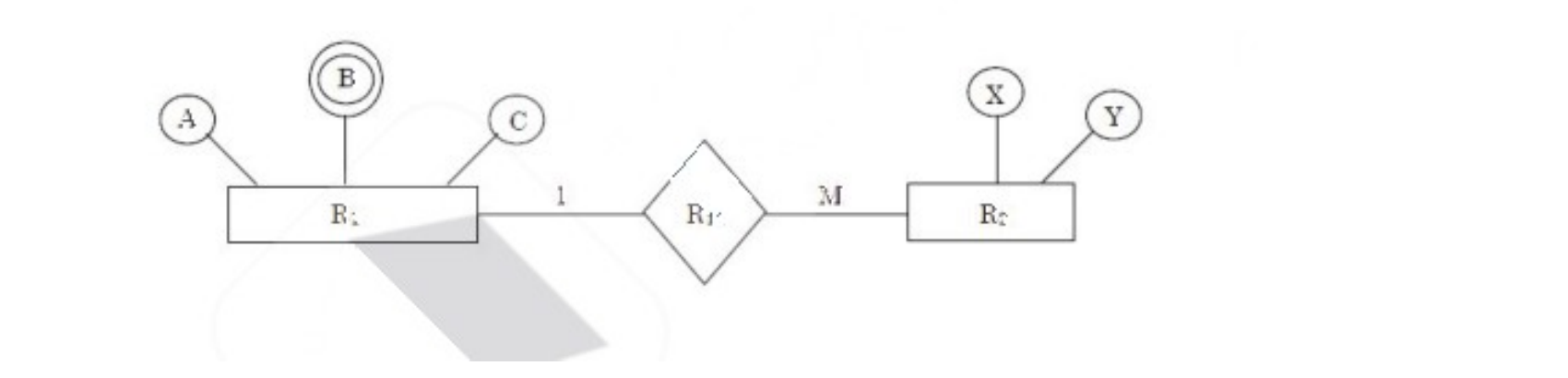
Entity-Relationship diagram with entities R1 and R2 connected by relationship R12
- A2
- B4
- C3
- D5
Answer: (C) 3
Explanation
Sign in to read the full explanationQuestion 112
UGC NET December 2019Given two tables R1(x, y) and R2(y, z) with 50 and 30 number of tuples respectively. Find maximum number of tuples in the output of natural join between tables R1 and R2 i.e. R1 * R2? (* - Natural Join)
- A30
- B20
- C50
- D1500
Answer: (D) 1500
Explanation
Sign in to read the full explanationQuestion 113
UGC NET December 2019Which of the component module of DBMS does rearrangement and possible ordering of operations, eliminate redundancy in query and use efficient algorithms and indexes during the execution of a query?
- Aquery compiler
- Bquery optimizer
- CStored data manager
- DDatabase processor
Answer: (B) query optimizer
Explanation
Sign in to read the full explanationQuestion 114
UGC NET December 2019Two concurrent executing transactions T₁ and T₂ are allowed to update same stock item say ‘A’ in an uncontrolled manner. In such scenario, following problems may occur:
A. Dirty read problem
B. Lost update problem
C. Transaction failure
D. Inconsistent database stateWhich of the following option is correct if database system has no concurrency module and allows concurrent execution of above two transactions?
- AA, B and C only
- BC and D only
- CA and B only
- DA, B and D only
Answer: (D) A, B and D only
Explanation
Sign in to read the full explanationQuestion 115
UGC NET December 2019An organization needs to maintain database having five attributes A, B, C, D, E. These attributes are functionally dependent on each other for which functional dependency set F is given as:
F = {A → BC, D → E, BC → D, A → D }
Consider a universal relation R(A, B, C, D, E ) with functional dependency set F. Also all attributes are simple and take atomic values only.
Minimal cover F' of functional dependency set F is:
- AF' = {A → B, A → C, BC → D, D → E}
- BF' = {A → BC, B → D, D → E}
- CF' = {A → B, A → C, A → D, D → E}
- DF' = {A → B, A → C, B → D, C → D, D → E}
Answer: (A) F' = {A → B, A → C, BC → D, D → E}
Explanation
Sign in to read the full explanationQuestion 116
UGC NET December 2019An organization needs to maintain database having five attributes A, B, C, D, E with functional dependency set F = {A → BC, D → E, BC → D, A → D }.
Assume that given table R is decomposed into two tables:
R₁(A, B, C ) with functional dependency set F₁ = {A → B, A → C}, and
R₂(A, D, E ) with functional dependency set F₂ = {A → D, D → E}.Which of the following option is true with respect to the given decomposition?
- ADependency preservation property is followed
- BR₁ and R₂ are both in 2 NF
- CR₁ is in 2 NF and R₂ is in 3 NF
- DR₁ is in 3 NF and R₂ is in 2 NF
Answer: (D) R₁ is in 3 NF and R₂ is in 2 NF
Explanation
Sign in to read the full explanationQuestion 117
UGC NET December 2019An organization needs to maintain database having five attributes A, B, C, D, E with functional dependency set F = {A → BC, D → E, BC → D, A → D }.
Identify primary key of table R with functional dependency set F.
- ABC
- BAD
- CA
- DAB
Answer: (C) A
Explanation
Sign in to read the full explanationQuestion 118
UGC NET December 2019An organization needs to maintain database having five attributes A, B, C, D, E with functional dependency set F = {A → BC, D → E, BC → D, A → D }. Consider relation R(A, B, C, D, E ) where all attributes are simple and atomic.
Identify the normal form to which relation R belongs:
- A1 NF
- B2 NF
- C3 NF
- DBCNF
Answer: (B) 2 NF
Explanation
Sign in to read the full explanationQuestion 119
UGC NET December 2019An organization needs to maintain database having five attributes A, B, C, D, E with functional dependency set F = {A → BC, D → E, BC → D, A → D }.
Identify the redundant functional dependency in F.
- ABC → D
- BD → E
- CA → D
- DA → BC
Answer: (C) A → D
Explanation
Sign in to read the full explanationQuestion 120
UGC NET June 2019In relational database management, which of the following is/are property/properties of candidate key?
P: Uniqueness
Q: Irreducibility- AP only
- BQ only
- CBoth P and Q
- DNeither P nor Q
Answer: (C) Both P and Q
Explanation
Sign in to read the full explanationQuestion 121
UGC NET June 2019A relation has two attributes Employee_id and Manager_id, where Employee_id is a primary key and manager_id is a foreign key referencing Employee_id with on-delete cascade:
On deleting the tuple (20, 40), the set of other tuples that must be deleted to maintain the referential integrity of table is
Employee_id Manager_id 20 40 25 40 30 35 35 20 40 45 45 25 - A(30, 35) only
- B(30, 35) and (35, 20) only
- C(35, 20) only
- D(40, 45) and (25, 40) only
Answer: (B) (30, 35) and (35, 20) only
Explanation
Sign in to read the full explanationQuestion 122
UGC NET June 2019With respect to relational algebra, which of the following operations are included from mathematical set theory?
(a) Join
(b) Intersection
(c) Cartisian product
(d) Project- A(a) and (d)
- B(b) and (c)
- C(c) and (d)
- D(b) and (d)
Answer: (B) (b) and (c)
Explanation
Sign in to read the full explanationQuestion 123
UGC NET June 2019Which of the following key constraints is required for functioning of foreign key in the context of relational databases?
- AUnique key
- BPrimary key
- CCandidate key
- DCheck key
Answer: (B) Primary key
Explanation
Sign in to read the full explanationQuestion 124
UGC NET June 2019Hadoop (a big data tool) works with number of related tools. Choose from the following, the common tools included into Hadoop:
- AMySQL, Google API and Map reduce
- BMap reduce, Scala and Hummer
- CMap reduce, H Base and Hive
- DMap reduce, Hummer and Heron
Answer: (C) Map reduce, H Base and Hive
Explanation
Sign in to read the full explanationQuestion 125
UGC NET June 2019In relational databases, if relation R is in BCNF, then which of the following is true about relation R?
- AR is in 4NF
- BR is not in 1NF
- CR is in 2NF and not in 3NF
- DR is in 2NF and 3NF
Answer: (D) R is in 2NF and 3NF
Explanation
Sign in to read the full explanation- Practise Database Management Systems in a timed set
Question 126
UGC NET June 2019Which of the following features is supported in the relational database model?
- AComplex data-types
- BMultivalued attributes
- CAssociations with multiplicities
- DGeneralization relationships
Answer: (C) Associations with multiplicities
Explanation
Sign in to read the full explanationQuestion 127
UGC NET June 2019Which of the following statements are DML statements?
(a) Update [tablename]
Set [columnname] = VALUE
(b) Delete [tablename]
(c) Select * from [tablename]- A(a) and (b)
- B(a) and (d)
- C(a), (b) and (c)
- D(b) and (c)
Answer: (C) (a), (b) and (c)
Explanation
Sign in to read the full explanationQuestion 128
UGC NET June 2019Which of the following has same expressive power with regard to relational query language?
(a) Relational algebra and domain relational calculus
(b) Relational algebra and tuples relational calculus
(c) Relational algebra and domain relational calculus restricted to safe expression
(d) Relational algebra and tuples relational calculus restricted to safe expression- A(a) and (b) only
- B(c) and (d) only
- C(a) and (c) only
- D(b) and (d) only
Answer: (B) (c) and (d) only
Explanation
Sign in to read the full explanationQuestion 129
UGC NET December 2018Data scrubbings is
- AA process to upgrade the quality of data before it is moved into a data warehouse.
- BA process to load the data in the data warehouse and to create the necessary indexes.
- CA process to reject data from the data warehouse and to create the necessary indexes.
- DA process to upgrade the quality of data after it is moved into a data warehouse.
Answer: (A) A process to upgrade the quality of data before it is moved into a data warehouse.
Explanation
Sign in to read the full explanationQuestion 130
UGC NET December 2018Consider the following tables (relations):
Students
Roll-No Name 18CS101 Ramesh 18CS102 Mukesh 18CS103 Ramesh Performance
Roll-No Course Marks 18CS101 DBMS 60 18CS101 Compiler Design 65 18CS102 DBMS 80 18CS103 DBMS 85 18CS102 Compiler Design 75 18CS103 Operating System 70 Primary keys in the tables are shown using underline. Now, consider the following query:
SELECT S.Name, Sum(P.Marks)
FROM Students S, Performance P
WHERE S.Roll-No = P.Roll-No
GROUP BY S.Name
The number of rows returned by above query is
- A3
- B2
- C0
- D1
Answer: (B) 2
Explanation
Sign in to read the full explanationQuestion 131
UGC NET December 2018Consider the following sequence of two transactions on bank account A with initial balance 20,000 that transfers 5,000 to another account B and then apply 10% interest.
(i) T1 start
(ii) T1 A old = 20,000 new 15,000
(iii) T1 B old = 12,000 new = 17,000
(iv) T1 commit
(v) T2 start
(vi) T2 A old = 15,000 new = 16,500
(vii) T2 commitSuppose the database system crashes just before log record (vii) is written. When the system is restarted, which one statement is true of the recovery process ?
- AWe must redo log record (vi) to set A to 16,500 and then redo log records (ii) and (iii).
- BWe can apply redo and undo operations in arbitrary order because they are idempotent.
- CWe must redo log record (vi) to set A to 16,500.
- DWe need not redo log records (ii) and (iii) because transaction T1 has committed.
Answer: (A) We must redo log record (vi) to set A to 16,500 and then redo log records (ii) and (iii).
Explanation
Sign in to read the full explanationQuestion 132
UGC NET December 2018Which of the following statement/s is/are true ?
(i) Facebook has the world’s largest Hadoop Cluster.
(ii) Hadoop 2·0 allows live stream processing of Real time data.Choose the correct answer from the code given below :
Code :- A(ii) only
- BNeither (i) nor (ii)
- C(i) only
- DBoth (i) and (ii)
Answer: (D) Both (i) and (ii)
Explanation
Sign in to read the full explanationQuestion 133
UGC NET December 2018A clustering index is defined on the fields which are of type
- Akey and ordering
- Bnon-key and non-ordering
- Cnon-key and ordering
- Dkey and non-ordering
Answer: (C) non-key and ordering
Explanation
Sign in to read the full explanationQuestion 134
UGC NET December 2018_________ command is used to remove a relation from an SQL database.
- AUpdate table
- BDrop table
- CRemove table
- DDelete table
Answer: (B) Drop table
Explanation
Sign in to read the full explanationQuestion 135
UGC NET December 2018An attribute A of datatype varchar (20) has the value ‘xyz’, and the attribute B of datatype char(20) has the value “Imnop”, then the attribute A has ________ spaces and attribute B has ________ spaces.
- A20, 5
- B3, 5
- C20, 20
- D3, 20
Answer: (D) 3, 20
Explanation
Sign in to read the full explanationQuestion 136
UGC NET December 2018Data warehouse contains __________ data that is never found in operational environment.
- AScripted
- BEncrypted
- CEncoded
- DSummary
Answer: (D) Summary
Explanation
Sign in to read the full explanationQuestion 137
UGC NET December 2018Consider a relation schema R = (A, B, C, D, E, F) on which the following functional dependencies hold :
A → B
B, C → D
E → C
D → AWhat are the candidate keys of R ?
- AAE, BE and DE
- BAEF, BEF and BCF
- CAEF, BEF and DEF
- DAE and BE
Answer: (C) AEF, BEF and DEF
Explanation
Sign in to read the full explanation
Frequently asked questions
How many Database Management Systems questions have been asked in UGC NET Computer Science?
137 Database Management Systems questions appear in the UGC NET Computer Science papers held between 2018–2026, and all of them are on this page with their answer key.
Are the answers on this page free?
Yes. Every question, its options, and the correct answer are free to read with no account. Signing in additionally unlocks the detailed explanation under each question.
Is Database Management Systems an important topic for UGC NET Computer Science?
Database Management Systems appears in every recent UGC NET Computer Science paper, across all 14 sittings covered here. Its share of the paper makes it worth revising thoroughly rather than sampling.
How should I practise Database Management Systems after reading these questions?
Attempt the Database Management Systems topic-wise sets, which put the same questions into a timed interface with instant scoring and weak-area analysis afterwards.
More Computer Science PYQs by topic
More Computer Science practice
Ready for a full paper?
Attempt Paper 1 + Paper 2 (Computer Science) together in a single timed session.