UGC NET Computer Science Programming Languages and Computer Graphics Previous Year Questions (PYQs)
Practise 141 Programming Languages and Computer Graphics questions asked in UGC NET Computer Science from 2018–2026. Questions cover Language design, Programming paradigms, C and C++ constructs, Java, Storage management and Web technologies. Every question is shown with its options and the correct answer, free to read.
Practise Programming Languages and Computer Graphics as timed sets
Focused 10-question sets with instant scoring, explanations, and weak-area analysis.
All 141 Programming Languages and Computer Graphics PYQs
Ordered newest exam first. Each question links back to the full paper it came from.
Question 1
UGC NET June 2026Match List-I with List-II.
List-I List-II A. Pivot point
B. Fixed point
C. Mirror image
D. DistortionI. Reflection
II. Shear
III. Rotation
IV. Scaling- AA-III, B-IV, C-I, D-II
- BA-III, B-IV, C-II, D-I
- CA-IV, B-III, C-II, D-I
- DA-I, B-II, C-III, D-IV
Answer: (A) A-III, B-IV, C-I, D-II
Explanation
Sign in to read the full explanationQuestion 2
UGC NET June 2026Arrange these C++ data types in non-decreasing order of representation length.
A. char
B. int
C. float
D. double- AB, A, C, D
- BA, B, D, C
- CD, C, B, A
- DA, B, C, D
Answer: (D) A, B, C, D
Explanation
Sign in to read the full explanationQuestion 3
UGC NET June 2026Match List-I with List-II.
List-I List-II A. long signed int
B. double
C. long double
D. unsigned characterI. %lf
II. %Lf
III. %c
IV. %ld- AA-II, B-I, C-IV, D-III
- BA-IV, B-I, C-II, D-III
- CA-III, B-I, C-II, D-IV
- DA-I, B-II, C-IV, D-III
Answer: (B) A-IV, B-I, C-II, D-III
Explanation
Sign in to read the full explanationQuestion 4
UGC NET June 2026What is the output of this C program?
#include <stdio.h>
int main() {
int i;
for (i = 0; i++ < 10;)
printf("%d", i++);
return 0;
}- A0123456789
- B12345678
- C13579
- D2468
Answer: (C) 13579
Explanation
Sign in to read the full explanationQuestion 5
UGC NET June 2026The number of pixel columns divided by the number of scan lines displayed by a system is called:
- APixmap
- BBitmap
- CAspect ratio
- DDepth
Answer: (C) Aspect ratio
Explanation
Sign in to read the full explanationQuestion 6
UGC NET June 2026Which statements about C++ constructors are correct?
A. They have the same name as the class.
B. They can return values.
C. They are called automatically when an object is created.
D. They can be overloaded.
E. They can be inherited.- AA, B, C and D only
- BA, C and D only
- CB, C and D only
- DC, D and E only
Answer: (B) A, C and D only
Explanation
Sign in to read the full explanationQuestion 7
UGC NET June 2026What is z after this C code executes?
x = 16;
y = 4;
z = x >> y;- A5
- B4
- C2
- D1
Answer: (D) 1
Explanation
Sign in to read the full explanationQuestion 8
UGC NET June 2026The shown transformation is a reflection about which axis?

Original and reflected triangle positions about the vertical axis.
- AA and D only
- BA and C only
- CB and C only
- DB and D only
Answer: (C) B and C only
Explanation
Sign in to read the full explanationQuestion 9
UGC NET January 2026Assertion (A): The control points have only local control over the shape of the B-Splines.
Reason (R): Bezier curves do have local control.- ABoth A and R are correct and R is the correct explanation of A
- BBoth A and R are correct but R is NOT the correct explanation of A
- CA is correct but R is not correct
- DA is not correct but R is correct
Answer: (C) A is correct but R is not correct
Explanation
Sign in to read the full explanationQuestion 10
UGC NET January 2026Which of the following statements are true?
A. Painters' algorithm is also called depth sort algorithm.
B. Gourad shading is an interpolating shading method.
C. Gourad shading is an averaging shading method.
D. The Z-buffer algorithm finds the largest depth value Z.- AA, B Only
- BB, C Only
- CC, D Only
- DA, D Only
Answer: (A) A, B Only
Explanation
Sign in to read the full explanationQuestion 11
UGC NET January 2026Match List-I (C++ file mode parameters) with List-II.
LIST-I (File mode parameter) LIST-II (Meaning) A. ios::ate I. Go to end of file on opening B. ios::in II. Open fails if the file already exists C. ios::nocreate III. Open file for reading only D. ios::noreplace IV. Open fails if the file does not exist - AA-III, B-IV, C-II, D-I
- BA-I, B-III, C-II, D-IV
- CA-II, B-IV, C-I, D-III
- DA-I, B-III, C-IV, D-II
Answer: (D) A-I, B-III, C-IV, D-II
Explanation
Sign in to read the full explanationQuestion 12
UGC NET January 2026Which of the following statements are true?
A. The ++ operator can be overloaded to perform decrementation of a variable.
B. It is necessary that a constructor in a class should always be public.
C. Size of an object is equal to the sum of sizes of data members and member functions within the class.
D. A static data member is useful when all objects of a class are to share a common item of information.
E. Thethispointer always contains the address of the object using which the member function is being called.- AA, B, C Only
- BB, C, E Only
- CA, D, E Only
- DB, D, E Only
Answer: (C) A, D, E Only
Explanation
Sign in to read the full explanationQuestion 13
UGC NET January 2026Assertion (A): We can build an object from a class containing a pure virtual function.
Reason (R): A class containing a pure virtual function is called an abstract class.- ABoth A and R are correct and R is the correct explanation of A
- BBoth A and R are correct but R is NOT the correct explanation of A
- CA is correct but R is not correct
- DA is not correct but R is correct
Answer: (D) A is not correct but R is correct
Explanation
Sign in to read the full explanationQuestion 14
UGC NET January 2026For implicit type conversion, arrange the following from a lower size type to a higher size type.
A. double
B. unsigned long int
C. unsigned int
D. long double
E. long int- AE, C, B, A, D
- BC, B, E, D, A
- CE, C, A, B, D
- DC, E, B, A, D
Answer: (D) C, E, B, A, D
Explanation
Sign in to read the full explanationQuestion 15
UGC NET January 2026Match List-I (Quadric surfaces) with List-II (Equations).
List-I (Quadric Surface) List-II (Equation) A. One-sheeted hyperboloid I. x²/a² + y²/b² = cz B. Two-sheeted hyperboloid II. x²/a² + y²/b² - z²/c² = 1 C. Elliptic paraboloid III. x²/a² - y²/b² = cz D. Hyperbolic paraboloid IV. z²/c² - x²/a² - y²/b² = 1 - AA-I, B-II, C-III, D-IV
- BA-II, B-III, C-IV, D-I
- CA-II, B-IV, C-I, D-III
- DA-IV, B-II, C-I, D-III
Answer: (C) A-II, B-IV, C-I, D-III
Explanation
Sign in to read the full explanationQuestion 16
UGC NET January 2026Which of the following is not true about constructors?
- AWhen an object is created and initialized at the same time, a copy constructor gets called
- BThey do not have return types, not even void
- CThey can be virtual
- DThey cannot be inherited, though a derived class can call the base class constructor
Answer: (C) They can be virtual
Explanation
Sign in to read the full explanationQuestion 17
UGC NET January 2026A normalized matrix maps a 3D window specified by coordinates (1, 1, 1) and (4, 5, 6) onto a viewport specified by coordinates (2, 4, 2) and (8, 10, 8). Which of the following matrices correctly represents this transformation?
- A2 0 0 0
0 3/2 0 5/2
0 0 6/5 4/5
0 0 0 1 - B2 0 0 0
0 3 0 5
0 0 6 4
0 0 0 1 - C2 1 0 1
1 3 4 5
0 0 2 4
0 1 0 0 - D1 0 0 1
2 3 0 5
1 0 4 5
0 0 0 1
Answer: (A) 2 0 0 0
0 3/2 0 5/2
0 0 6/5 4/5
0 0 0 1Explanation
Sign in to read the full explanation- A2 0 0 0
Question 18
UGC NET January 2026Arrange the following applet life cycle methods in sequence.
A. start()
B. paint()
C. init()
D. stop()- AA, B, C, D
- BC, A, B, D
- CA, C, B, D
- DB, A, C, D
Answer: (B) C, A, B, D
Explanation
Sign in to read the full explanationQuestion 19
UGC NET June 2025What is printed by this C program?
int x = 128, y = 110; do { if (x > y) x = x - y; else y = y - x; } while (x != y); printf("%d", x);- A18
- B2
- C92
- D74
Answer: (B) 2
Explanation
Sign in to read the full explanationQuestion 20
UGC NET June 2025Which technique is used for clipping?
- AStack-based seed
- BScan-line seed
- CSutherland-Cohen
- DInverse scaling
Answer: (C) Sutherland-Cohen
Explanation
Sign in to read the full explanationQuestion 21
UGC NET June 2025What is printed by this C program?
int i, j; for (i = 1; i < 5; i += 2) for (j = 1; j < i; j += 2) printf("%d", j);- A1
- B1 2
- C1 3
- D1 1 3
Answer: (A) 1
Explanation
Sign in to read the full explanationQuestion 22
UGC NET June 2025Which pointer expression refers to the array element
ar[m][n][o]?- A((*(ar) + m + n) + o)
- B(((*ar + m) + n) + o)
- C(((ar + m) + n) + o)
- D((*(ar + m) + n) + o)
Answer: (D) ((*(ar + m) + n) + o)
Explanation
Sign in to read the full explanationQuestion 23
UGC NET June 2025What is printed by this C code?
int *i, a = 12, b = 2, c; c = (a = a + b, b = a / b, a = a * b, b = a - b); i = &c; printf("%d", --(*i));- A91
- B90
- C98
- D92
Answer: (B) 90
Explanation
Sign in to read the full explanationQuestion 24
UGC NET June 2025For C operators
&&,+=,>>,>=, and?:, what is the precedence order from higher to lower?- A
, >=, ?:, +=, &&
- B
, &&, >=, ?:, +=
- C
, >=, &&, ?:, +=
- D
=, >>, &&, +=, ?:
Answer: (C)
, >=, &&, ?:, +=
Explanation
Sign in to read the full explanation- A
Question 25
UGC NET June 2025Which pointer operations are legal in C?
- AA, B, C only
- BA, B, D only
- CA and B only
- DA and E only
Answer: (D) A and E only
Explanation
Sign in to read the full explanation- Practise Programming Languages and Computer Graphics in a timed set
Question 26
UGC NET June 2025Editorially repaired version of an NTA-dropped item. Treat the following descriptions as a one-to-one matching. Which mapping is correct?
List I List II A. Overloading I. An overridden method call is selected at runtime B. Early binding II. A function call is resolved at compile time C. Method overriding III. Supports compile-time polymorphism D. Late binding IV. Supports runtime polymorphism - AA-III, B-II, C-I, D-IV
- BA-IV, B-II, C-III, D-I
- CA-III, B-I, C-IV, D-II
- DA-IV, B-I, C-III, D-II
Answer: (A) A-III, B-II, C-I, D-IV
Explanation
Sign in to read the full explanationQuestion 27
UGC NET June 2025Match oblique, cavalier, cabinet, and orthographic projection with their defining projection properties.
List I List II A. Oblique projection I. Perpendicular lines are foreshortened B. Cavalier projection II. Perpendicular lines are not foreshortened C. Cabinet projection III. Projectors are perpendicular to the plane D. Orthographic projection IV. Projector angle to plane is not 90° - AA-III, B-II, C-IV, D-I
- BA-IV, B-II, C-I, D-III
- CA-III, B-I, C-IV, D-II
- DA-IV, B-I, C-III, D-II
Answer: (B) A-IV, B-II, C-I, D-III
Explanation
Sign in to read the full explanationQuestion 28
UGC NET January 2025Which statement is not true about global variables?
- AValues of global variables sent to a called function may be changed inadvertently by that function.
- BFunctions lose their independence and isolation when they use global variables.
- CIt is not immediately apparent to a reader which values are sent to a called function.
- DA function that uses global variables does not suffer from reusability.
Answer: (D) A function that uses global variables does not suffer from reusability.
Explanation
Sign in to read the full explanationQuestion 29
UGC NET January 2025The light given off by a phosphor during exposure to an electron beam is known as
- AFluorescence
- BPhosphorescence
- CPersistence
- DRetracing
Answer: (A) Fluorescence
Explanation
Sign in to read the full explanationQuestion 30
UGC NET January 2025Match C file functions with their uses.
List-I List-II A. fseek()
B. ftell()
C. feof()
D. rewind()I. Current file position
II. Beginning of file
III. Desired file position
IV. End-of-file test- AA-II, B-III, C-I, D-IV
- BA-III, B-I, C-IV, D-II
- CA-III, B-I, C-II, D-IV
- DA-II, B-IV, C-III, D-I
Answer: (B) A-III, B-I, C-IV, D-II
Explanation
Sign in to read the full explanationQuestion 31
UGC NET January 2025Arrange the 2-D viewing transformation pipeline.
A. Convert world coordinates to viewing coordinates.
B. Map viewing coordinates to normalized viewing coordinates using window–viewport specifications.
C. Construct the world-coordinate scene using modelling-coordinate transformations.
D. Map normalized viewport coordinates to device coordinates.- AD, C, B, A
- BD, C, A, B
- CC, A, B, D
- DB, C, A, D
Answer: (C) C, A, B, D
Explanation
Sign in to read the full explanationQuestion 32
UGC NET January 2025Consider the conditional statement
if (m == 20 - 10 || n > 10). What is the order of execution of the following operations?A. ==
B. -
C. ||
D. >- AD, B, A, C
- BB, D, C, A
- CB, D, A, C
- DA, B, D, C
Answer: (C) B, D, A, C
Explanation
Sign in to read the full explanationQuestion 33
UGC NET January 2025Which of the following statements is not true?
- AA data member of a class can be declared static and is normally used to maintain values common to the entire class.
- BA friend function can be invoked like a normal function without the help of any object.
- CThe scope-resolution operator (::) can be overloaded like normal operators.
- DMultiple inheritance may duplicate inherited members from a grandparent base class; this may be avoided by making the common base class virtual.
Answer: (C) The scope-resolution operator (::) can be overloaded like normal operators.
Explanation
Sign in to read the full explanationQuestion 34
UGC NET January 2025The major adverse side effects of scan conversion are:
A. Staircase appearance
B. Unequal brightness of slanted lines
C. Picket-fence problem
D. Rasterization
E. Pre-filtering and post-filtering- AA and B only
- BA, B and C only
- CB, C and D only
- DC, D and E only
Answer: (B) A, B and C only
Explanation
Sign in to read the full explanationQuestion 35
UGC NET January 2025Consider:
int x = 10, y = 15;
x = ((x = y) ? (y + x) : (y - x));What is the value of x after execution?
- A5
- B25
- C15
- D30
Answer: (D) 30
Explanation
Sign in to read the full explanationQuestion 36
UGC NET August 2024Which of the following statements about
pointers in C are TRUE.
A. Pointers can be used to access array elements
B. Pointers can store the address of another
pointer
C. Pointers are automatically dereferenced in
expression
D. Pointers cannot be used to access structure
members- A(A) and (C) Only
- B(A) and (B) Only
- C(B) and (C) Only
- D(C) and (D) Only
Answer: (B) (A) and (B) Only
Explanation
Sign in to read the full explanationQuestion 37
UGC NET August 2024Consider the function in C code :
Cal(a, b) { if( b!=1 ) { if( a!=1 ) { printf("*"); Cal(a/2,b); } else { b=b-1; Cal(10,b); } } } How many times * is going to be printed, if the function is called with Cal(10, 10); ?- A25
- B23
- C24
- D27
Answer: (D) 27
Explanation
Sign in to read the full explanationQuestion 38
UGC NET August 2024Which of the following is correct way to declare a
functional pointer in C ?- Aint *func (int, int);
- Bint (*func) (int, int);
- Cint (func*) (int, int);
- Dint func (int, int);
Answer: (B) int (*func) (int, int);
Explanation
Sign in to read the full explanationQuestion 39
UGC NET August 2024Consider the following C program :
#include<stdio.h> int main() { int x[] = {2,4,6,8,10}; int a, b=0, *y=x+4; for( a=0; a<5; a++) { b = b +(*y-a) - *(y-a); } printf("%d\n",b); return 0; } What will be the output of the above C program ?- A4
- B6
- C8
- D10
Answer: (D) 10
Explanation
Sign in to read the full explanationQuestion 40
UGC NET August 2024Which of the following are TRUE about
constructors in C++ ?
A. A constructor can be overloaded.
B. A constructor does not have a return type.
C. A constructor must be declared as a friend
function.
D. A constructor is called when an object is
destroyed.- A(B), (C), (D) Only
- B(B), (C) Only
- C(A), (B), (C) Only
- D(A), (B) Only
Answer: (D) (A), (B) Only
Explanation
Sign in to read the full explanationQuestion 41
UGC NET August 2024#include<stdio.h> void f1(char *x, char *y) { char *t1; t1 = x; x = y; y = t1; } void f2(char **x, char **y) { char *t1; t1 = *x; *x = *y; *y = t1; } int main() { char *a = "ONE", *b = "TWO"; f1(a, b); printf("%s %s ", a, b); f2(&a, &b); printf("%s %s", a, b); return 0; }What is the output of the program?
- AONE TWO TWO ONE
- BTWO ONE ONE TWO
- CONE TWO ONE TWO
- DTWO ONE TWO ONE
Answer: (A) ONE TWO TWO ONE
Explanation
Sign in to read the full explanationQuestion 42
UGC NET August 2024Which of the following C++ statements correctly
declares an abstract class ?- Aclass A { virtual void show ()=0 ; };
- Bclass A { void show ()=0 ; };
- Cclass A { void show() { } ; } ;
- Dclass A { show ()=0; };
Answer: (A) class A { virtual void show ()=0 ; };
Explanation
Sign in to read the full explanationQuestion 43
UGC NET August 2024Match List-I with List-II.
List-I (computing systems) List-II (working/output) (A) Half Adder (I) Has n input and 2ⁿ output (B) Decoder (II) CPU Storage Unit (C) Register (III) Used to store program at runtime (D) Main memory (IV) 2-bit addition circuit - A(A)-(II), (B)-(III), (C)-(IV), (D)-(I)
- B(A)-(IV), (B)-(II), (C)-(III), (D)-(I)
- C(A)-(IV), (B)-(I), (C)-(II), (D)-(III)
- D(A)-(II), (B)-(IV), (C)-(III), (D)-(I)
Answer: (C) (A)-(IV), (B)-(I), (C)-(II), (D)-(III)
Explanation
Sign in to read the full explanationQuestion 44
UGC NET August 2024Consider the following statements regarding
combinational and sequential circuits.
A. Output of combinational circuits depends on
the only current input.
B. Output of combinational circuit depends on
the both current input and previous output.
C. Output of sequential circuit depends on the
current input.
D. Output of sequential circuit depends on both
current input and previous output.- A(A) and (C) Only
- B(A) and (D) Only
- C(B) and (D) Only
- D(B) and (C) Only
Answer: (B) (A) and (D) Only
Explanation
Sign in to read the full explanationQuestion 45
UGC NET August 2024#include<iostream.h> using namespace std; void swap(int &x, int &y) { int temp=x; x=y; y=temp; } int main() { int a=5, b=10; swap(a,b); swap(a,b); cout<<a<<" "<<b; return 0; } What will be the output of the above code?- A5, 10
- B10, 5
- C5, 5
- D10, 10
Answer: (A) 5, 10
Explanation
Sign in to read the full explanationQuestion 46
UGC NET August 2024What is the output of the code given below :
#include<iostream.h> using namespace std; class Base { public: Base(){ cout<<"Base Const"; } virtual ~Base() { cout<<"Base dest"; } }; class Derived : public Base { public: Derived() { cout<<"Derived Const"; } ~Derived() { cout<<"Derived dest"; } }; int main() { Base *b = new Derived(); delete b; return 0; }- ABase Const Derived Const Derived dest Base dest
- BBase Const Derived Const Base dest Derived dest
- CDerived Const Base Const Base dest Derived dest
- DBase Const Derived Const Base dest
Answer: (A) Base Const Derived Const Derived dest Base dest
Explanation
Sign in to read the full explanationQuestion 47
UGC NET August 2024Consider the following C code:
#include<stdio.h> int temp =0; int fun(int x, int y) { int z; temp++; if(y==3) return (x*x*x); else { z=fun(x,y/3); return (z*z*z); } } int main() { fun(4,81); printf("%d",temp); } what will be the output of the following code :- A3
- B4
- C5
- D6
Answer: (B) 4
Explanation
Sign in to read the full explanationQuestion 48
UGC NET August 2024Arrange the following steps of file handling in C
in the correct order :
A. Close the file
B. Read from or write to the file
C. Open the file
D. Check for error- A(A), (C), (D), (B)
- B(D), (B), (C), (A)
- C(C), (D), (B), (A)
- D(B), (D), (A), (C)
Answer: (C) (C), (D), (B), (A)
Explanation
Sign in to read the full explanationQuestion 49
UGC NET August 2024What will be the output of the following C code?
#include<stdio.h> void main() { int arr[5] = {10,20,30,40,50}; int *p = (int*) (&arr +1); printf("%d%d", *(arr+1), *(p-1)); }- A10 50
- B20 50
- C30 40
- D20 40
Answer: (B) 20 50
Explanation
Sign in to read the full explanationQuestion 50
UGC NET August 2024#include<stdio.h> void main() { int arr[ ] = {1, 2, 3, 4, 5}; int *p = arr; printf("%d", *p++); printf("%d", *(p+1)); } Find the output of the above code?- A1,2
- B1,3
- C2,3
- D1,4
Answer: (B) 1,3
Explanation
Sign in to read the full explanation- Practise Programming Languages and Computer Graphics in a timed set
Question 51
UGC NET December 2023A program that is used by other routines to accomplish a particular task, is called :
- AMicro program
- BMicro operation
- CRoutine
- DSubroutine
Answer: (D) Subroutine
Explanation
Sign in to read the full explanationQuestion 52
UGC NET December 2023Consider a triangle PQR with coordinates as P(0,0), Q(2,2) and R(10,4). If this triangle is to be magnified to four times its size while keeping R(10, 4) fixed, then the coordinates of the magnified triangle are :
- A(—20, —12), Q(—20, —4) and R(10, 4)
- B(—30, —12), Q(—22, —4) and R(10, 4)
- C(—25, —10), Q(22, —4) and R(10, 4)
- D(30, —12), Q(—22, 4) and R(10, 4)
Answer: (B) (—30, —12), Q(—22, —4) and R(10, 4)
Explanation
Sign in to read the full explanationQuestion 53
UGC NET December 2023Which of the following statements is TRUE ?
- AVirtual functions do not implement polymorphism
- BVirtual functions do not permit calling of derived class functions using a base class pointer
- CWe can never build an object from a class containing a pure virtual function
- DPure virtual functions can never have a body
Answer: (C) We can never build an object from a class containing a pure virtual function
Explanation
Sign in to read the full explanationQuestion 54
UGC NET December 2023What is the output of the following program ? #include<stdio.h> int main( ) { int i=3; while (i— —) { int i=10; i=} printf("%d", i); } printf("%d", i); }
- A990
- B9990
- C999-1
- D99-1
Answer: (C) 999-1
Explanation
Sign in to read the full explanationQuestion 55
UGC NET December 2023A system bus in which each data item is transferred during a time slice known in advance to both units source and destination is called :
- AMIMD
- BDMA
- Casynchronous bus
- Dsynchronous bus
Answer: (D) synchronous bus
Explanation
Sign in to read the full explanationQuestion 56
UGC NET December 2023Which of the following are tautology ?
A. @3PAQ)3(23Q)
B. (€3Q)Q)>PvQ) (CQ) (VAP) 3Q)((PV>P)R)
D. (Q4(PAAP))3(R(PA=P)) Choose the correct answer from the options given below :- A(A) Only
- B(B) Only
- C(A) and(B) Only
- D(©) and (D) Only
Answer: (C) (A) and(B) Only
Explanation
Sign in to read the full explanationQuestion 57
UGC NET December 2023Consider the three points P1(1, 2, 0), P2(3, 6, 20) and P3(2, 4, 6) and a view point C(0, 0, —10). Choose the correct options.
A. P1 obscure P2, if viewed from
C.
B. 2 obscure P1, if viewed from
C.
C. P3 does not obscure P1, if viewed from
C.
D. P2 does not obscure P3, if viewed from
C. Choose the correct answer from the options given below :- A(A), (B) and (© Only
- B(A), (© and (D) Only
- C(B), (©) and (D) Only
- D(A), (B) and (D) Only
Answer: (B) (A), (© and (D) Only
Explanation
Sign in to read the full explanationQuestion 58
UGC NET December 2023Find the number of tuples by applying the operation Xb x05 aye"
X (S, Si, C) Y (S, P, D) (J, 1, M)
(B, 2, N)
(R, 3, H)
(T, 4, G)
(J, S₁, CA)
(B, P₁, AB)
(R, D₁, DC)
(A, H₁, MD)
- A1
- B3
- C4
- D6
Answer: (C) 4
Explanation
Sign in to read the full explanationQuestion 59
UGC NET December 2023Match List-I with List-II.
Source matching prompt Source values See question stem See answer choices - A(A), (B)-V), ©)-(, (P)-CI)
- B(A), (B)-(D, (C)-@), (D)-(IV)
- C(A)-(HD), (B)-@D, (C)-CV), (B)-)
- D(A)-(), (B)-(V), (C)-@D), (D)-@)
Answer: (A) (A), (B)-V), ©)-(, (P)-CI)
Explanation
Sign in to read the full explanationQuestion 60
UGC NET December 2023Match List-I with List-II.
Source matching prompt Source values See question stem See answer choices - A(A), (B)-(), (©-€V), (D)-()
- B(A)-(), (B)-CV), (©-(), (P)-@)
- C(A)-(, (B)-()), (©-€V), (D)-()
- D(A)-(1D), (B)-(), (C)-(IV), (D)-
Answer: (A) (A), (B)-(), (©-€V), (D)-()
Explanation
Sign in to read the full explanationQuestion 61
UGC NET June 2023The clipping process in computer graphics is used for
- AAdding graphics
- BCopying
- CZooming
- DRemoving objects and lines
Answer: (D) Removing objects and lines
Explanation
Sign in to read the full explanationQuestion 62
UGC NET June 2023What will be the output of the following code?
#include <stdio.h> int main(){ int a, b, c; a = 0x10; b = 010; c = a + b; printf("%d", c); return 0; }- A20
- B24
- CGarbage
- Derror
Answer: (B) 24
Explanation
Sign in to read the full explanationQuestion 63
UGC NET June 2023What is the output of the following code?
int main() { struct s1 { char *z; int i; struct s1 *p; }; static struct s1 a[] = { {"Nagpur", 1, a + 1}, {"Raipur", 2, a + 2}, {"Kanpur", 3, a} }; struct s1 *ptr = a; printf("%s %s %s\n", a[0].z, ptr->z, a[2].p->z); return 0; }- ANagpur Raipur Kanpur
- BNagpur Nagpur Nagpur
- CKanpur Kanpur Kanpur
- DError
Answer: (B) Nagpur Nagpur Nagpur
Explanation
Sign in to read the full explanationQuestion 64
UGC NET June 2023How will you free the memory allocated by the following program?
#include <stdio.h> #include <stdlib.h> #define MAXROW 3 #define MAXCOL 4 int main() { int **p, i, j; p = (int **)malloc(MAXROW * sizeof(int*)); return 0; }- Amemfree (int p);
- Bdealloc (p);
- Cmalloc (p, 0);
- Dfree (p);
Answer: (D) free (p);
Explanation
Sign in to read the full explanationQuestion 65
UGC NET June 2023Which two-dimensional transformation is used to resize a two-dimensional object?
- ATranslation
- BRotation
- CScaling
- DShearing
Answer: (C) Scaling
Explanation
Sign in to read the full explanationQuestion 66
UGC NET June 2023Match List I with List II on curve and surface representations.
List-I List-II A. Bezier curves I. 3 dim objects that have translation rotational symmetry B. B-Splines II. Fractal geometry C. Sweep representations III. Bias and tension D. Natural objects IV. painting drawing CAD List I / List II: computer graphics representation techniques
- AA-IV, B-I, C-III, D-II
- BA-II, B-III, C-IV, D-I
- CA-IV, B-III, C-I, D-II
- DA-II, B-IV, C-I, D-III
Answer: (C) A-IV, B-III, C-I, D-II
Explanation
Sign in to read the full explanationQuestion 67
UGC NET June 2023Sutherland Hodgman method is used on
- ASmooth curves
- BLine segment
- CConvex polygons
- DConcave polygons
Answer: (C) Convex polygons
Explanation
Sign in to read the full explanationQuestion 68
UGC NET June 2023Consider the rectangle with vertices (0, 0), (0, 2), (3, 0), (3, 2). There is scaling of 2 towards x-axis and 3 towards y-axis. The new coordinates of the rectangle are
- A(0, 0), (6, 0), (0, 4), (6, 4)
- B(0, 0), (6, 0), (0, 4), (3, 2)
- C(0, 0), (6, 0), (0, 6), (6, 6)
- D(0, 0), (4, 0), (0, 6), (4, 6)
Answer: (C) (0, 0), (6, 0), (0, 6), (6, 6)
Explanation
Sign in to read the full explanationQuestion 69
UGC NET June 2023What is the output of the following code?
main ( ) { static float a [ ] = {13.24, 1.5, 4.5, 5.4, 3.5}; float *j, *k; j = a; k = a + 4; j = j * 2; k = k/2; printf("%f %f", *j, *k); }- A13.25, 4.5
- B1.5, 3.5
- C13.24, 1.5, 4.5, 5.4, 3.5
- DIllegal use of pointer in main function
Answer: (D) Illegal use of pointer in main function
Explanation
Sign in to read the full explanationQuestion 70
UGC NET June 2023What is the type of x in the following program?
#include <stdio.h> int main() { typedef (*(*arrfptr[3])())[10]; arrfptr x; return 0; }- Ax is a pointer
- Bx is a array of three pointer
- Cx is an array of three function pointer
- DError in x declaration
Answer: (C) x is an array of three function pointer
Explanation
Sign in to read the full explanationQuestion 71
UGC NET March 2023Consider the following conditional code, which returns a Boolean value:
if ((x > 25) && (y > 100))
    return 'false';
else if ((x <= 25) && (y <= 100))
    return 'true';
else if ((x > 25) && (y <= 100))
    return 'false';
else
    return 'true';
Simplify it by filling in the following blank with a single Boolean expression without changing the behaviour of the conditional code:
if (------) return 'true'; else return 'false';- Ax > 25
- Bx <= 25
- Cy > 100
- Dy <= 100
Answer: (B) x <= 25
Explanation
Sign in to read the full explanationQuestion 72
UGC NET March 2023If a constructor 'Date' is declared explicitly and has to be defined outside the class, which of the following is correct?
- ADate::Date(int dd) { /.../ }
- Bexplicit Date:: Date(int dd) { /.../ }
- CSuch a constructor cannot be defined
- DConstructor always has to be defined inside the class
Answer: (A) Date::Date(int dd) { /.../ }
Explanation
Sign in to read the full explanationQuestion 73
UGC NET March 2023Which one of the following allows the session to continue?
- AWhen a user quits a browser
- BWhen the user logs out and is invalidated by the servlet
- CWhen the session is timed out due to inactivity
- DWhen the user refreshes the browser and there is a persistent cookie
Answer: (D) When the user refreshes the browser and there is a persistent cookie
Explanation
Sign in to read the full explanationQuestion 74
UGC NET March 2023Given a vector with cartesian components (x,y), if scaling is done with matrix [[0.5, 0], [0, 1.5]] which of the following are true.
A. Decreases the vertical by three halves
B. Increases the vertical by three halves
C. Doubles the horizontal
D. Halves the horizontalChoose the correct answer from the options given below:
- AA and C only
- BA and D only
- CB and C only
- DB and D only
Answer: (D) B and D only
Explanation
Sign in to read the full explanationQuestion 75
UGC NET March 2023Which of the following lists defined in HTML share similar elements?
A. Unordered lists
B. Ordered lists
C. Definition Lists
D. Correlated lists
E. Enumerated listsChoose the most appropriate answer from the options given below:
- AA, B, D only
- BA, C, E only
- CA, B, C only
- DA, C, D only
Answer: (C) A, B, C only
Explanation
Sign in to read the full explanation- Practise Programming Languages and Computer Graphics in a timed set
Question 76
UGC NET March 2023Match List I with List II.
List-I List-II A. If the implementation of generated or derived classes differ only through a parameter, we have I. To use class hierarchy B. If the actual types of objects used cannot be known at compile time, then we have II. Improved run-time efficiency C. If inline operations are essential and templates are used then we have III. To use templates D. To gain access to differing instances for derived classes through base we have IV. To use explicit casting List I and List II for the matching question
- AA-I, B-II, C-IV, D-III
- BA-III, B-I, C-II, D-IV
- CA-I, B-III, C-II, D-IV
- DA-II, B-I, C-III, D-IV
Answer: (B) A-III, B-I, C-II, D-IV
Explanation
Sign in to read the full explanationQuestion 77
UGC NET March 2023In what sequence the initialization, testing and execution of body is done while using do-while loop?
A. Commenting
B. Execution of the body
C. Initialisation
D. Testing the conditionChoose the correct answer from the following
- AD,B,C
- BD,C,B
- CC,A,B
- DC,B,D
Answer: (D) C,B,D
Explanation
Sign in to read the full explanationQuestion 78
UGC NET March 2023Assertion (A): A Raster scan device is a CRT graphic device and can use a television monitor for display.
Reason (R): In Raster scan display the picture is composed of a series of dots. These dots are traced out as a series of horizontal lines. Television works in a similar fashion.
In the light of the above statements, choose the correct answer from the options given below:
- ABoth A and R are true and R is the correct explanation of A
- BBoth A and R are true but R is not the correct explanation of A
- CA is true but R is false
- DA is false but R is true
Answer: (A) Both A and R are true and R is the correct explanation of A
Explanation
Sign in to read the full explanationQuestion 79
UGC NET March 2023Given
int arr[3][4][2] = {{{2,4},{7,8},{3,4},{5,6}},{{7,6},{3,4},{5,3},{2,3}},{{8,9},{7,2},{3,4},{5,1}}};
Which one of the following can be used to refer to element 1 in the above 3-d array?
- Aarr[3][4][2]
- B((*(arr+2)+3)+1)
- C*(arr+2) + *(arr+3) + *(arr+1)
- Darr[2][3][2]
Answer: (B) ((*(arr+2)+3)+1)
Explanation
Sign in to read the full explanationQuestion 80
UGC NET March 2023Allowing different derived classes to be used interchangeably through the interface provided by a common base class is called ______.
- ADerived polymorphism
- BCompile time polymorphism
- CStatic polymorphism
- DRun time polymorphism
Answer: (D) Run time polymorphism
Explanation
Sign in to read the full explanationQuestion 81
UGC NET March 2023In ______ curve the last and the first vertices of the polygon lie on the curve and all other vertices define the derivatives, order and shape of the curve.
- AB-Spline Curve
- BBoxline curve
- CBezier curve
- DGaussian curve
Answer: (C) Bezier curve
Explanation
Sign in to read the full explanationQuestion 82
UGC NET March 2023FFTs are ________ techniques used to encode digital video and audio information and helps analyse the signal in __________ domain.
- AEncryption, time
- BEncryption, frequency
- CCompression, time
- DCompression, frequency
Answer: (D) Compression, frequency
Explanation
Sign in to read the full explanationQuestion 83
UGC NET March 2023Inheritance provides the benefits of ________.
A. shared interfaces
B. run-time polymorphism
C. less redundant information
D. dynamic bindingChoose the Correct answer from the options given below:
- AA, B, C only
- BA, B, D only
- CB, C, D only
- DA, C, D only
Answer: (B) A, B, D only
Explanation
Sign in to read the full explanationQuestion 84
UGC NET March 2023Which of the following are correct using the constructor?
A. string s1
B. string s2 (s1)
C. string s3 {7}
D. string s4 {'a'}
E. string s5{7,'a'}Choose the most appropriate answer from the options given below:
- AA, B, D, E only
- BA, B, C only
- CA, B, D only
- DA and B only
Answer: (A) A, B, D, E only
Explanation
Sign in to read the full explanationQuestion 85
UGC NET March 2023Suppose that a corporate website appearance varies according to the department that owns various documents. All the documents need to follow the corporate look and feel. The HR department does not need a separate style sheet. It needs only the sheet containing the difference from the corporate sheet.
Which of the following statements justify the above scenario?
A. The styles sheets cannot stack on each other
B. The style sheets can stack on each other
C. The style sheets can override each other
D. The style sheets cannot override each otherChoose the most appropriate answer from the options given below:
- AA, C Only
- BB, C Only
- CB, D only
- DA, D only
Answer: (B) B, C Only
Explanation
Sign in to read the full explanationQuestion 86
UGC NET March 2023Match List I with List II.
List-I List-II A. 2-D Array Input I. Liquid Crystal display B. Transmissive device II. Flat-bed scanner C. Binary image III. Camera D. 1-D array input IV. Ink jet printer - AA-I, B-III, C-II, D-IV
- BA-III, B-I, C-IV, D-II
- CA-III, B-I, C-II, D-IV
- DA-I, B-II, C-IV, D-III
Answer: (B) A-III, B-I, C-IV, D-II
Explanation
Sign in to read the full explanationQuestion 87
UGC NET October 2022Hidden surface removal problem with minimal 3D pipeline can be solved with
- APainter's algorithm
- BWindow Clipping algorithm
- CBrute force rasterization algorithm
- DFlood fill algorithm
Answer: (A) Painter's algorithm
Explanation
Sign in to read the full explanationQuestion 88
UGC NET October 2022The condition num != 65 cannot be replaced by
- Anum > 65 || num < 65
- B!(num == 65)
- Cnum − 65
- D!(num = 65)
Answer: (D) !(num = 65)
Explanation
Sign in to read the full explanationQuestion 89
UGC NET October 2022Pointers cannot be used to
- Afind the address of a variable in memory
- Breference value directly
- Csimulate call by reference
- Dmanipulate dynamic data structure
Answer: (B) reference value directly
Explanation
Sign in to read the full explanationQuestion 90
UGC NET October 2022This transformation is called
[x̅ y̅ z̅ w̅]ᵀ = [[a₁ b₁ c₁ d₁],[a₂ b₂ c₂ d₂],[a₃ b₃ c₃ d₃],[e f g h]] [x y z 1]ᵀ- AScaling
- BShear
- CHomography
- DSteganography
Answer: (C) Homography
Explanation
Sign in to read the full explanationQuestion 91
UGC NET October 2022Of the following, which is NOT a logical error?
- AUsing the '=', instead of '==' to determine if two values are equal
- BDivide by zero
- CFailing to initialize counter and total variables before the body of loop
- DUsing commas instead of two required semicolon in a for loop header
Answer: (B) Divide by zero
Explanation
Sign in to read the full explanationQuestion 92
UGC NET October 2022Which statement is false?
- AAll function calls in C pass arguments using call by value.
- BCall by reference enables a called function to modify a variable in calling function.
- CCall by value is always more efficient than call by reference.
- DProgrammers use pointers and indirection operation to simulate call by reference.
Answer: (C) Call by value is always more efficient than call by reference.
Explanation
Sign in to read the full explanationQuestion 93
UGC NET November 2021It is always important and useful to include an 'alt' attribute on an 'img' tag in HTML. Which of the reasons given below is/are correct?
A. Users who cannot see the image due to vision impairment can be given a textual description that a screen reader speaks aloud.
B. If the image fails to load (slow connection, broken path, etc.), the alt text is displayed instead.
C. It gives SEO (Search Engine Optimization) benefits.Choose the correct answer from the options given below:
- AA only
- BB and C only
- CC only
- DA, B, and C
Answer: (D) A, B, and C
Explanation
Sign in to read the full explanationQuestion 94
UGC NET November 2021What does the following function f() in C return?
int f(unsigned int N) { unsigned int counter = 0; while (N > 0) { counter += N & 1; N = N >> 1; } return counter == 1; }- A1 if N is odd, otherwise 0
- B1 if N is a power of 2, otherwise 0
- C1 if the binary representation of N is all 1s, otherwise 0
- D1 if the binary representation of N has any 1s, otherwise 0
Answer: (B) 1 if N is a power of 2, otherwise 0
Explanation
Sign in to read the full explanationQuestion 95
UGC NET November 2021Consider the following recursive function F() in Java that takes an integer and returns a String:
public static String F(int N) {
    if (N <= 0) return "-";
    return F(N - 3) + N + F(N - 2) + N;
}
What is the value of F(5)?
- A-2-25-3-135
- B-2-25-1-3-135
- C-1-145-2-245
- D-2-25-3-1-135
Answer: (D) -2-25-3-1-135
Explanation
Sign in to read the full explanationQuestion 96
UGC NET November 2021Match List-I (Programming Terms) with List-II (Meaning).
List-I List-II A. JNDI I. Runtime support for running a Java program B. RMI II. The API in support of naming and directory services C. JDK III. The methods and runtime support for calling remote methods D. JRE IV. The compiler and class libraries to develop Java applications - AA-II, B-III, C-IV, D-I
- BA-II, B-IV, C-III, D-I
- CA-I, B-III, C-IV, D-II
- DA-III, B-II, C-IV, D-I
Answer: (A) A-II, B-III, C-IV, D-I
Explanation
Sign in to read the full explanationQuestion 97
UGC NET November 2021Match List-I (Programming Paradigms) with List-II (Characteristics).
List-I List-II A. Imperative I. Declarative, clausal representation, theorem proving B. Object-oriented II. Side-effect-free, declarative, expression evaluation C. Logic III. Imperative, abstract data type D. Functional IV. Command-based, procedural - AA-IV, B-III, C-I, D-II
- BA-III, B-IV, C-I, D-II
- CA-IV, B-III, C-II, D-I
- DA-II, B-III, C-I, D-IV
Answer: (A) A-IV, B-III, C-I, D-II
Explanation
Sign in to read the full explanationQuestion 98
UGC NET November 2021You have eight black-and-white images taken with a 1-megapixel camera and one 8-colour image taken with an 8-megapixel camera. How much disk space in total is needed to store these images?
- A1 GB
- B4 MB
- C3 MB
- D3 GB
Answer: (B) 4 MB
Explanation
Sign in to read the full explanationQuestion 99
UGC NET November 2021The midpoint (Bresenham) algorithm for rasterizing lines is optimized relative to the DDA algorithm in that:
A. It avoids round-off operations.
B. It is incremental.
C. It uses only integer arithmetic.
D. All straight lines can be displayed as exactly straight.Choose the correct answer from the options given below:
- AA and B only
- BA and C only
- CA, B, C, and D
- DA, B, and C only
Answer: (D) A, B, and C only
Explanation
Sign in to read the full explanationQuestion 100
UGC NET November 2021Find the transformation matrix M that maps the square with vertices (1,1), (-1,1), (-1,-1), (1,-1) to the parallelogram with corresponding vertices (2,1), (0,1), (-2,-1), (0,-1).
- A[[1, 1, 0], [0, 1, 0], [0, 0, 1]]
- B[[1, 0, 0], [1, 1, 0], [0, 0, 1]]
- C[[1, 1, 1], [0, 1, 0], [0, 0, 1]]
- D[[1, 1, 0], [1, 1, 0], [0, 0, 1]]
Answer: (A) [[1, 1, 0], [0, 1, 0], [0, 0, 1]]
Explanation
Sign in to read the full explanation- Practise Programming Languages and Computer Graphics in a timed set
Question 101
UGC NET November 2021A Bezier curve P(t) is defined by four control points in the xy-plane: P0 = (-2, 0), P1 = (-2, 4), P2 = (2, 4), P3 = (2, 0). Which statements are correct?
A. P(t) has degree 3.
B. P(1/2) = (0, 3).
C. P(t) may extend outside the convex hull of its control points.Choose the correct answer from the options given below:
- AA and B only
- BA and C only
- CB and C only
- DA, B, and C
Answer: (A) A and B only
Explanation
Sign in to read the full explanationQuestion 102
UGC NET November 2021Statement I: The maximum number of sides a triangle can have after being clipped to a rectangular viewport is 6.
Statement II: In 3D graphics, the perspective transformation is nonlinear in z.In light of the above statements, choose the correct answer from the options given below:
- ABoth Statement I and Statement II are true
- BBoth Statement I and Statement II are false
- CStatement I is true but Statement II is false
- DStatement I is false but Statement II is true
Answer: (D) Statement I is false but Statement II is true
Explanation
Sign in to read the full explanationQuestion 103
UGC NET November 2020In HTML, the <map> tag is used for
- Adefining a path between two nodes in an image
- Bdefining clickable regions in an image
- Chighlighting an area in an image
- Ddefining the site map of a website
Answer: (B) defining clickable regions in an image
Explanation
Sign in to read the full explanationQuestion 104
UGC NET November 2020A compiler uses 1-byte chars, 2-byte shorts, 4-byte ints, and 8-byte doubles. Every primitive must begin at an address that is a multiple of its size; fields cannot be reordered. How much space is consumed by an array A[10] of this structure?
struct { short s; char c; short t; char d; double r; int i; }
- A150 bytes
- B320 bytes
- C240 bytes
- D200 bytes
Answer: (C) 240 bytes
Explanation
Sign in to read the full explanationQuestion 105
UGC NET November 2020Consider the recursive Java function:
public static float f(long m, long n) {
float result = (float)m / (float)n;
if (m < 0 || n < 0) return 0.0f;
else result -= f(m + 2, n * 3);
return result;
}Which real value best approximates f(1, 3)?
- A0.2
- B0.4
- C0.6
- D0.8
Answer: (A) 0.2
Explanation
Sign in to read the full explanationQuestion 106
UGC NET November 2020Which statements regarding XML are true?
A. XML is a set of tags designed to tell browsers how to display a web page.
B. XML defines syntax for representing data, while the data meaning depends on the application.
C. <Letter>, <LETTER>, and <letter> are different XML tags.- A(A) and (B) only
- B(A) and (C) only
- C(B) and (C) only
- D(A), (B), and (C)
Answer: (C) (B) and (C) only
Explanation
Sign in to read the full explanationQuestion 107
UGC NET November 2020In 3D computer graphics, which statements are correct?
A. Under perspective projection, parallel lines generally do not remain parallel, except lines parallel to the view plane.
B. The perspective step uses a division by the depth coordinate after homogeneous transformation.
C. Perspective transformation is linear.- A(A) and (B) only
- B(A) and (C) only
- C(B) and (C) only
- D(A), (B), and (C)
Answer: (A) (A) and (B) only
Explanation
Sign in to read the full explanationQuestion 108
UGC NET November 2020For Gouraud and Phong shading, which statements are true?
A. Gouraud shading requires more computation than Phong shading.
B. Gouraud shading interpolates vertex colours across a polygon.
C. Phong shading interpolates vertex normals across a polygon.- A(A) and (B) only
- B(A) and (C) only
- C(B) and (C) only
- D(A), (B), and (C)
Answer: (C) (B) and (C) only
Explanation
Sign in to read the full explanationQuestion 109
UGC NET November 2020Match List-I with List-II. List I gives 3x3 matrices representing 2D transformations and
List-II shows the corresponding transformation diagrams.List I (Matrix) List II (Transformation Diagram)
2 00
A. |0 2 0
001 MO ,
Shear — x (2).aList I List II Items are listed in the question stem. Match each item to its stated description or complexity. - A0 2
(B) jo 1 2 seale (2, 2).a
00 1L
(788)
a
05 —0.866 0
(C) |0.866 0.5 0
0 0 1 rotate(60°).
(II)
a
120
@) jo 1 0 a
001 (Iv) translate (2, 2).a Choose the correct answer from the options given below:- A-IV, B-II, C-III, D-I (2) A-IV. B-II, C-II, D-I
- BOCR review required
- CA-II, B-II, C-IV, D-I (4) A-II, B-IV, C-II, D-I
- DOCR review required
Answer: (D) OCR review required
Explanation
Sign in to read the full explanation- A0 2
Question 110
UGC NET November 2020Given below are different properties of 3D projections from A-D. Identify the correct order on
the basis of property true of (i) a perspective projection only, (ii) an orthographic projection
only, (iii) both orthographic and projective transformations and (iv) neither orthographic nor
projective transformation, respectively.
A. B. C. D. Straight lines are mapped to straight lines.
Distances and angles are (in general) preserved.
Far away objects appear the same size as closer ones.Requires homogeneous coordinates in order for it to be encoded into a linear
transformation.- AOCR review required
- BOCR review required
- CD, C. B.A (2) B,C,D.A
D,C, A,B (4) C,D,BA - DOCR review required
Answer: (C) D, C. B.A (2) B,C,D.A
D,C, A,B (4) C,D,BAExplanation
Sign in to read the full explanationQuestion 111
UGC NET November 2020Given below are two statements:
Statement I: Bezier curves are curves that interpolate all of their control points.
Statement II: A cubic bezier curve has four control points.In the light of the above statements, choose the correct answer from the options given below
- ABoth Statement I and Statement II are true
- BBoth Statement I and Statement II are false
- CStatement I is correct but Statement II is false
- DStatement I is incorrect but Statement II is true.
Answer: (D) Statement I is incorrect but Statement II is true.
Explanation
Sign in to read the full explanationQuestion 112
UGC NET December 2019Consider the following statements with respect to approaches to fill area on raster systems:
P. To determine the overlap intervals for scan lines that cross the area
Q. To start from a given interior position and paint outward from this point until a encounter the specified boundary conditionsSelect the correct answer:
- AP only
- BQ only
- CBoth P and Q
- DNeither P nor Q
Answer: (C) Both P and Q
Explanation
Sign in to read the full explanationQuestion 113
UGC NET December 2019Which of the following algorithms is not used for line clipping?
- ACohen-Sutherland algorithm
- BSoutherland-Hodgeman algorithm
- CLiang-Barsky algorithm
- DNicholl-Lee-Nicholl algorithm
Answer: (B) Southerland-Hodgeman algorithm
Explanation
Sign in to read the full explanationQuestion 114
UGC NET December 2019Java Virtual Machine (JVM) is used to execute architectural neutral byte code. Which of the following is needed by the JVM for execution of Java Code?
- AClass loader only
- BClass loader and Java Interpreter
- CClass loader, Java Interpreter and API
- DJava Interpreter only
Answer: (C) Class loader, Java Interpreter and API
Explanation
Sign in to read the full explanationQuestion 115
UGC NET December 2019Which of the following statements are true regarding C++?
A. Overloading gives the capability to an existing operator to operate on other data types.
B. Inheritance in object oriented programming provides support to reusability.
C. When object of a derived class is defined, first the constructor of derived class is executed then constructor of a base class is executed.
D. Overloading is a type of polymorphism.Choose the correct option from the options:
- AA and B only
- BA, B and C only
- CA, B and D only
- DB, C and D only
Answer: (C) A, B and D only
Explanation
Sign in to read the full explanationQuestion 116
UGC NET December 2019What is the output of following C program?
#include <stdio.h> main() { int i, j, x = 0; for (i = 0; i < 5; ++i) for (j = 0; j < i; ++j) { x += (i + j - 1); break; } printf ("%d", x); }- A6
- B5
- C4
- D3
Answer: (A) 6
Explanation
Sign in to read the full explanationQuestion 117
UGC NET December 2019Match List-I with List-II.
List-I List-II (a) Frame attribute (i) to create link in HTML (b) <tr> tag (ii) for vertical alignment of content in cell (c) Valign attribute (iii) to enclose each row in table (d) <a> tag (iv) to specify the side of the table frame that display border - A(a)-(i), (b)-(ii), (c)-(iii), (d)-(iv)
- B(a)-(ii), (b)-(i), (c)-(iii), (d)-(iv)
- C(a)-(iv), (b)-(iii), (c)-(ii), (d)-(i)
- D(a)-(iii), (b)-(iv), (c)-(ii), (d)-(i)
Answer: (C) (a)-(iv), (b)-(iii), (c)-(ii), (d)-(i)
Explanation
Sign in to read the full explanationQuestion 118
UGC NET December 2019Let A be the base class in C++ and B be the derived class from A with protected inheritance. Which of the following statement is false for class B?
- AMember function of class B can access protected data of class A
- BMember function of Class B can access public data of class A
- CMember function of class B cannot access private data of class A
- DObject of derived class B can access public base class data
Answer: (D) Object of derived class B can access public base class data
Explanation
Sign in to read the full explanationQuestion 119
UGC NET December 2019Which of the following are legal statements in C programming language?
(a)
int *P = &44;
(b)int *P = &r;
(c)int P = &a;
(d)int P = a;Choose the correct option:
- A(a) and (b)
- B(b) and (c)
- C(b) and (d)
- D(a) and (d)
Answer: (C) (b) and (d)
Explanation
Sign in to read the full explanationQuestion 120
UGC NET December 2019A rectangle is bound by the lines x = 0; y = 0; x = 5 and y = 3. The line segment joining (-1, 0) and (4, 5), if clipped against this window will connect the points __________.
- A(0, 1) and (3, 3)
- B(0, 1) and (2, 3)
- C(0, 1) and (4, 5)
- D(0, 1) and (3, 5)
Answer: (B) (0, 1) and (2, 3)
Explanation
Sign in to read the full explanationQuestion 121
UGC NET December 2019Which tag is used to enclose any number of javascript statements in HTML document?
- A<code>
- B<script>
- C<title>
- D<body>
Answer: (B) <script>
Explanation
Sign in to read the full explanationQuestion 122
UGC NET December 2019If we want to resize a 1024 × 768 pixels image to one that is 640 pixels wide with the same aspect ratio, what would be the height of the resized image?
- A420 Pixels
- B460 Pixels
- C480 Pixels
- D540 Pixels
Answer: (C) 480 Pixels
Explanation
Sign in to read the full explanationQuestion 123
UGC NET June 2019Which of the following statements is/are true?
P: An XML document with correct syntax as specified by W3C is called "Well Formed".
Q: An XML documented validated against a DTD is both "Well formed" and "Valid".
R: <?xml version="1.0" encoding="UTF-8"> is syntactly correct declaration for the version of an XML document.Select the correct answer from the options given below:
- AP and Q only
- BP and R only
- CQ and R only
- DAll of P, Q and R
Answer: (A) P and Q only
Explanation
Sign in to read the full explanationQuestion 124
UGC NET June 2019Consider the following C-code fragment running on a 32-bit x86 machine:
typedef struct {
  union {
    unsigned char a;
    unsigned short b;
  } U;
  unsigned char c;
} S;

S B[10];
S *p = &B[4];
S *q = &B[5];
p -> U.b = 0x1234; /* structure S takes 32-bits */
If M is the value of q - p and N is the value of ((int) &(p -> c)) - ((int)p), then (M, N) is
- A(1, 1)
- B(3, 2)
- C(1, 2)
- D(4, 4)
Answer: (C) (1, 2)
Explanation
Sign in to read the full explanationQuestion 125
UGC NET June 2019Consider the following C++ function f():
unsigned int f(unsigned int n) {
  unsigned int b = 0;
  while (n) {
    b += n & 1;
    n >>= 1;
  }
  return b;
}
The function f() returns the int that represents the P in the binary representation of positive integer n, where P is
- Anumber of 0's
- Bnumber of bits
- Cnumber of consecutive 1's
- Dnumber of 1's
Answer: (D) number of 1's
Explanation
Sign in to read the full explanation- Practise Programming Languages and Computer Graphics in a timed set
Question 126
UGC NET June 2019Consider a raster system with resolution 640 by 480. What size is frame buffer (in bytes) for this system to store 12 bits per pixel?
- A450 kilobytes
- B500 kilobytes
- C350 kilobytes
- D400 kilobytes
Answer: (A) 450 kilobytes
Explanation
Sign in to read the full explanationQuestion 127
UGC NET June 2019Consider the following statements regarding 2D transforms in computer graphics:
S1: [1 0; 0 -1] is a 2×2 matrix that reflects (mirrors) any 2D point about the X-axis.
S2: A 2×2 matrix which mirrors any 2D point about the X-axis, is a rotation matrix.What can you say about the statements S1 and S2?
- ABoth S1 and S2 are true
- BOnly S1 is true
- COnly S2 is true
- DBoth S1 and S2 are false
Answer: (B) Only S1 is true
Explanation
Sign in to read the full explanationQuestion 128
UGC NET June 2019Which of the following statements is/are true?
P: In a scripting language like JavaScript, types are typically associated with values, not variables.
Q: It is not possible to show images on a web page without the <img> tag of HTML.Select the correct answer from the options given below:
- AP only
- BQ only
- CBoth P and Q
- DNeither P nor Q
Answer: (A) P only
Explanation
Sign in to read the full explanationQuestion 129
UGC NET June 2019Using the phong reflectance model, the strength of the specular highlight is determined by the angle between
- Athe view vector and the normal vector
- Bthe light vector and the normal vector
- Cthe light vector and the reflected vector
- Dthe reflected vector and the view vector
Answer: (D) the reflected vector and the view vector
Explanation
Sign in to read the full explanationQuestion 130
UGC NET June 2019What is the output of the following JAVA program?
public class Good { private int m; public Good(int m) { this.m = m; } public Boolean equals(Good n) { return n.m == m; } public static void main (String args []){ Good m₁ = new Good(22); Good m₂ = new Good(22); Object s₁ = new Good(22); Object s₂ = new Good(22); System.out.println(m₁.equals(m₂)); System.out.println(s₁.equals(s₂)); System.out.println(m₁.equals(s₂)); System.out.println(s₁.equals(m₁)); } }- ATrue, True, False, False
- BTrue, False, True, False
- CTrue, True, False, True
- DTrue, False, False, False
Answer: (D) True, False, False, False
Explanation
Sign in to read the full explanationQuestion 131
UGC NET June 2019In the context of 3D computer graphics, which of the following statements is/are true?
P: Orthographic transformations keep parallel lines parallel.
Q: Orthographic transformations are affine transformations.Select the correct answer from the options given below:
- ABoth P and Q
- BNeither P nor Q
- COnly P
- DOnly Q
Answer: (A) Both P and Q
Explanation
Sign in to read the full explanationQuestion 132
UGC NET December 2018In 3D Graphics, which of the following statements about perspective and parallel projection is/are true ?
P : In a perspective projection, the farthest an object is from the centre of projection, the smaller it appears.
Q : Parallel projection is equivalent to a perspective projection where the viewer is standing infinitely far away.
R : Perspective projections do not preserve straight lines.Choose the correct answer from the code given below :
Code :- AP and Q only
- BP and R only
- CQ and R only
- DP, Q and R
Answer: (A) P and Q only
Explanation
Sign in to read the full explanationQuestion 133
UGC NET December 2018Consider the following recursive Java function if that takes two long arguments and returns a float value :
public static float f(long m, long n)
{
 float result = (float) m / (float) n;
 if (m < 0 || n < 0)
 return 0·0f;
 else
 result += f(m*2, n*3);
 return result;
}
Which of the following integers best approximates the value of f(2, 3) ?
- A1
- B0
- C3
- D2
Answer: (D) 2
Explanation
Sign in to read the full explanationQuestion 134
UGC NET December 2018If the frame buffer has 10-bits per pixel and 8-bits are allocated for each of the R, G, and B components, then what would be the size of the color lookup table (LUT) ?
- A(2¹⁰ + 2²⁴) bytes
- B(2¹⁰ + 2¹¹) bytes
- C(2⁸ + 2⁹) bytes
- D(2¹⁰ + 2⁸) bytes
Answer: (B) (2¹⁰ + 2¹¹) bytes
Explanation
Sign in to read the full explanationQuestion 135
UGC NET December 2018In 3D Graphics, which of the following statements is/are true ?
P : Back-face culling is an example of an image-precision visible-surface determination procedure.
Q : Z-buffer is a 16-bit, 32-bit, or 64-bit field associated with each pixel in a frame buffer that can be used to determine the visible surfaces at each pixel.Choose the correct answer from the code given below :
Code :- AQ only
- BP and Q
- CNeither P nor Q
- DP only
Answer: (A) Q only
Explanation
Sign in to read the full explanationQuestion 136
UGC NET December 2018Which homogeneous 2D matrix transforms figure (a) to figure (b) ?
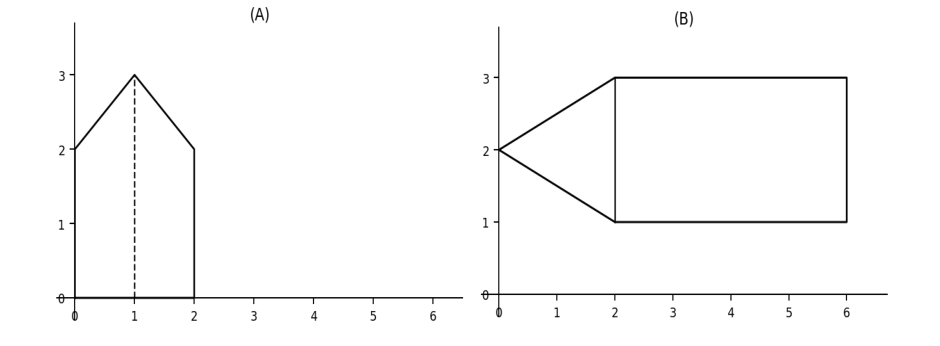
2D geometric transformation of Figure (a) to Figure (b)
- A[ 1 -2 6 ; 1 0 2 ; 0 0 1 ]
- B[ 0 -2 6 ; 1 0 1 ; 0 0 1 ]
- C[ 0 2 -6 ; 2 0 1 ; 0 0 1 ]
- D[ 0 2 6 ; 1 0 1 ; 0 0 1 ]
Answer: (B) [ 0 -2 6 ; 1 0 1 ; 0 0 1 ]
Explanation
Sign in to read the full explanationQuestion 137
UGC NET December 2018What does the following Java function perform ? (Assume int occupies four bytes of storage)
public static int f(int a) { // Pre-conditions : a > 0 and no overflow/underflow occurs int b = 0; for (int i = 0; i < 32; i++) { b = b << 1; b = b | (a & 1); a = a >>> 1; // This is a logical shift } return b; }- AReturn the int that represents the number of 0’s in the binary representation of integer a.
- BReturn the int that represents the number of 1’s in the binary representation of integer a.
- CReturn the int that has the reversed binary representation of integer a.
- DReturns the int that has the binary representation of integer a.
Answer: (C) Return the int that has the reversed binary representation of integer a.
Explanation
Sign in to read the full explanationQuestion 138
UGC NET December 2018Consider the C/C++ function f() given below :
void f(char w[])
{
 int x = strlen(w); //length of a string
 char c;
 for (int i = 0; i < x; i++)
 {
 c = w[i];
 w[i] = w[x–i–1];
 w[x–i–1] = c;
 }
}
Which of the following is the purpose of f( ) ?
- AIt outputs the contents of the array in the original order
- BIt outputs the contents of the array with the characters shifted over by one position
- CIt outputs the contents of the array with the characters rearranged so they are no longer recognized as the words in the original phrase.
- DIt outputs the contents of the array in reverse order.
Answer: (A) It outputs the contents of the array in the original order
Explanation
Sign in to read the full explanationQuestion 139
UGC NET December 2018Consider the midpoint (or Bresenham) algorithm for rasterizing lines given below :
(1) Input (x1, y1) and (x2, y2)
(2) y = y1
(3) d = f(x1 + 1, y1 + 1/2) //f is the implicit form of a line
(4) for x = x1 to x2
(5) do
(6) plot(x, y)
(7) if(d < 0)
(8) then
(9) y = y + 1
(10) d = d + (y1 – y2) + (x2 – x1)
(11) else
(12) d = d + (y1 – y2)
(13) end
(14) endWhich statements are true?
P : For a line with slope m > 1, we should change the outer loop in line (4) to be over y.
Q : Lines (10) and (12) update the decision variable d through an incremental evaluation of the line equation f.
R : The algorithm fails if d is ever 0.Choose the correct answer from the code given below :
Code :- AQ and R only
- BP and Q only
- CP, Q and R
- DP only
Answer: (B) P and Q only
Explanation
Sign in to read the full explanationQuestion 140
UGC NET December 2018Which of the following HTML5 codes will affect the horizontal as well as vertical alignment of the table content ?
- A<td align=“middle” valign=“center”> BASH </td>
- B<td halign=“middle” valign=“center”> BASH </td>
- C<td style=“text-align : center; vertical-align : middle;”> BASH </td>
- D<td style=“horizontal-align : center; vertical-align : middle;”> BASH </td>
Answer: (C) <td style=“text-align : center; vertical-align : middle;”> BASH </td>
Explanation
Sign in to read the full explanationQuestion 141
UGC NET December 2018Consider the following two C++ programs P1 and P2 and two statements S1 and S2 about these programs :
P1:
void f (int a, int * b, int & c)
{ a = 1; *b = 2; c = 3; }
int main()
{ int i = 0; f(i, &i, i); cout << i; }
P2:
double a = 1, b = 2;
double & f(double & d)
{ d = 4; return b; }
int main()
{ f(a) = 5; cout << a << " : " << b; }
S1 : P1 prints out 3
S2 : P2 prints out 4 : 2What can you say about the statements S1 and S2 ?
- AOnly S1 is true
- BBoth S1 and S2 are true
- COnly S2 is true
- DNeither S1 nor S2 is true
Answer: (A) Only S1 is true
Explanation
Sign in to read the full explanation
Frequently asked questions
How many Programming Languages and Computer Graphics questions have been asked in UGC NET Computer Science?
141 Programming Languages and Computer Graphics questions appear in the UGC NET Computer Science papers held between 2018–2026, and all of them are on this page with their answer key.
Are the answers on this page free?
Yes. Every question, its options, and the correct answer are free to read with no account. Signing in additionally unlocks the detailed explanation under each question.
Is Programming Languages and Computer Graphics an important topic for UGC NET Computer Science?
Programming Languages and Computer Graphics appears in every recent UGC NET Computer Science paper, across all 14 sittings covered here. Its share of the paper makes it worth revising thoroughly rather than sampling.
How should I practise Programming Languages and Computer Graphics after reading these questions?
Attempt the Programming Languages and Computer Graphics topic-wise sets, which put the same questions into a timed interface with instant scoring and weak-area analysis afterwards.
More Computer Science PYQs by topic
More Computer Science practice
Ready for a full paper?
Attempt Paper 1 + Paper 2 (Computer Science) together in a single timed session.