UGC NET Computer Science Artificial Intelligence Previous Year Questions (PYQs)
Practise 133 Artificial Intelligence questions asked in UGC NET Computer Science from 2018–2026. Questions cover Problem solving by state space search, Uninformed search, Heuristic search, Game playing, Knowledge representation and Semantic networks. Every question is shown with its options and the correct answer, free to read.
Practise Artificial Intelligence as timed sets
Focused 10-question sets with instant scoring, explanations, and weak-area analysis.
All 133 Artificial Intelligence PYQs
Ordered newest exam first. Each question links back to the full paper it came from.
Question 1
UGC NET June 2026Which field deals with interaction between computers and humans using natural language?
- APROLOG
- BELIZA
- CNLP
- DLISP
Answer: (C) NLP
Explanation
Sign in to read the full explanationQuestion 2
UGC NET June 2026Classifying email as spam, labeling web pages by context, and voice recognition are examples of which approach?
- AReinforcement learning
- BShortest-path algorithm
- CSupervised learning
- DUnsupervised learning
Answer: (C) Supervised learning
Explanation
Sign in to read the full explanationQuestion 3
UGC NET June 2026For the shown neural network, what are the net input yᵢₙ and final threshold output y?

Neural-network inputs, weights, bias, and threshold function.
- Ayᵢₙ = 2.03, y = 1
- Byᵢₙ = 1.53, y = 1
- Cyᵢₙ = 1.07, y = 1
- Dyᵢₙ = 0.57, y = 0
Answer: (C) yᵢₙ = 1.07, y = 1
Explanation
Sign in to read the full explanationQuestion 4
UGC NET June 2026A doctor knows P(s | m) = 0.70, P(m) = 1/50,000, and P(s) = 0.01, where s is a stiff neck and m is meningitis. Compute P(m | s).
- A0.014
- B0.0014
- C0.14
- D0.00014
Answer: (B) 0.0014
Explanation
Sign in to read the full explanationQuestion 5
UGC NET January 2026In a multi-agent system (MAS), what are the key characteristics of individual agents?
A. They must be identical in their capabilities and goals.
B. They are autonomous and act independently.
C. They interact with each other and their environment.
D. They are controlled by a single, centralized authority at all times.- AA, B & C Only
- BB, C & D Only
- CB & C Only
- DA & D Only
Answer: (C) B & C Only
Explanation
Sign in to read the full explanationQuestion 6
UGC NET January 2026Consider the following statements about reinforcement learning.
A. The adaptive dynamic programming agent leaves the transition model between states utilizes to solve the corresponding Markov decision process using dynamic programming.
B. Temporal difference needs a transition model to perform its updates.
C. The prioritized sweeping heuristic focuses on adjusting states with successors that have undergone significant changes in utility estimates.
D. The approach of modified policy iteration involves adopting a simplified value utility estimates following each change to the learned model.- AA, B & C Only
- BA, B & D Only
- CA, C & D Only
- DB, C & D Only
Answer: (C) A, C & D Only
Explanation
Sign in to read the full explanationQuestion 7
UGC NET January 2026Which logic is designed to address the problem of referential opacity in propositional attitudes?
- ARegular Logic
- BModal Logic
- CFirst-order logic
- DPredicate logic
Answer: (B) Modal Logic
Explanation
Sign in to read the full explanationQuestion 8
UGC NET January 2026Arrange the following sequence related to the FASTUS system.
A. Basic-group handling
B. Structure merging
C. Tokenization
D. Complex phrase handling
E. Complex word handling- AC, A, D, E, B
- BE, A, C, D, B
- CC, E, A, D, B
- DC, E, D, A, B
Answer: (C) C, E, A, D, B
Explanation
Sign in to read the full explanationQuestion 9
UGC NET January 2026Match List-I (AI subfields) with List-II.
LIST-I LIST-II A. Expert systems I. Medical Diagnosis B. NLP II. Text Summarization C. Computer Vision III. Image Classification D. ML IV. Predictive Analysis - AA-I, B-II, C-III, D-IV
- BA-II, B-I, C-III, D-IV
- CA-II, B-III, C-I, D-IV
- DA-III, B-II, C-I, D-IV
Answer: (A) A-I, B-II, C-III, D-IV
Explanation
Sign in to read the full explanationQuestion 10
UGC NET January 2026Assertion (A): Unsupervised learning algorithms are used for tasks like data summarization and exploratory data analysis.
Reason (R): Unsupervised learning requires a labelled dataset to find relationships and patterns in data.- ABoth A and R are correct and R is the correct explanation of A
- BBoth A and R are correct but R is NOT the correct explanation of A
- CA is correct but R is not correct
- DA is not correct but R is correct
Answer: (C) A is correct but R is not correct
Explanation
Sign in to read the full explanationQuestion 11
UGC NET January 2026Which planning approach is used for an environment with no observations?
- AHierarchical planning
- BReactive planning
- CConformant planning
- DContingency Planning
Answer: (C) Conformant planning
Explanation
Sign in to read the full explanationQuestion 12
UGC NET January 2026Arrange the following steps of the Natural Language Processing pipeline in the correct order.
A. Syntax Analysis
B. Morphological Analysis
C. Pragmatics
D. Semantic Analysis- AA, B, C, D
- BB, A, D, C
- CB, D, A, C
- DA, C, B, D
Answer: (B) B, A, D, C
Explanation
Sign in to read the full explanationQuestion 13
UGC NET January 2026In artificial intelligence, the term "Turing Test" is primarily associated with:
- ATesting neural network convergence
- BMeasuring computational efficiency of an algorithm
- CEvaluating a machine's ability to exhibit human-like behavior
- DVerifying correctness of an AI search algorithm
Answer: (C) Evaluating a machine's ability to exhibit human-like behavior
Explanation
Sign in to read the full explanationQuestion 14
UGC NET January 2026Assertion (A): Neural networks are capable of approximating any continuous function to an arbitrary degree of accuracy.
Reason (R): This is explained by the universal approximation theorem.- ABoth A and R are correct and R is the correct explanation of A
- BBoth A and R are correct but R is NOT the correct explanation of A
- CA is correct but R is not correct
- DA is not correct but R is correct
Answer: (A) Both A and R are correct and R is the correct explanation of A
Explanation
Sign in to read the full explanationQuestion 15
UGC NET January 2026Match List-I (Horn-clause terms) with List-II.
List-I List-II A. Definite clause I. Forward chaining B. Horn clause II. At most one is positive literal C. Goal clause III. No positive literals D. Inference with Horn clause IV. Exactly one is positive literal - AA-II, B-IV, C-III, D-I
- BA-IV, B-III, C-I, D-III
- CA-II, B-III, C-I, D-IV
- DA-IV, B-II, C-III, D-I
Answer: (D) A-IV, B-II, C-III, D-I
Explanation
Sign in to read the full explanationQuestion 16
UGC NET January 2026Assertion (A): In supervised learning, the model is trained using labelled data.
Reason (R): Supervised learning algorithms find patterns in data to predict outcomes without any prior knowledge of the correct output.- ABoth A and R are correct and R is the correct explanation of A
- BBoth A and R are correct but R is NOT the correct explanation of A
- CA is correct but R is not correct
- DA is not correct but R is correct
Answer: (C) A is correct but R is not correct
Explanation
Sign in to read the full explanationQuestion 17
UGC NET June 2025Which is not a valid property of λ-cuts of fuzzy relations R̃ and S̃?
- A(R̃ ∪ S̃)λ = Rλ ∪ Sλ
- B(R̃ ∩ S̃)λ = Rλ ∩ Sλ
- CThe λ-cut of the complement of R̃ differs from the complement of Rλ except when λ = 1.
- DFor λ ≤ β with 0 ≤ β ≤ 1, Rβ ⊆ Rλ.
Answer: (C) The λ-cut of the complement of R̃ differs from the complement of Rλ except when λ = 1.
Explanation
Sign in to read the full explanationQuestion 18
UGC NET June 2025Which is not a parent-selection technique in genetic-algorithm implementations?
- ARadial
- BTournament
- CBoltzmann
- DRank
Answer: (A) Radial
Explanation
Sign in to read the full explanationQuestion 19
UGC NET June 2025With η as learning rate and xi as the ith input, which update rule best describes a Kohonen self-organizing map weight wij?
- Awij(new) = (1 − η)wij(old) + ηxi
- Bwij(new) = ηwij(old) + (1 − η)xi
- Cwij(new) = (1 − η)wij(old) + xi
- Dwij(new) = wij(old) + ηxi
Answer: (A) wij(new) = (1 − η)wij(old) + ηxi
Explanation
Sign in to read the full explanationQuestion 20
UGC NET June 2025After applying samples S1 through S4 in order to a perceptron with initial weights w1 = w2 = 0, learning rate 0.1, no bias, and output 0 when yin = 0, what are the updated weights?
Sample x1 x2 Target S1 0 0 0 S2 0 1 1 S3 1 0 1 S4 1 1 1 - Aw1 = 0.1, w2 = 0.1
- Bw1 = 0.0, w2 = 0.2
- Cw1 = 0.0, w2 = 0.1
- Dw1 = 0.2, w2 = 0.2
Answer: (A) w1 = 0.1, w2 = 0.1
Explanation
Sign in to read the full explanationQuestion 21
UGC NET June 2025For knowledge-base design, arrange choosing a task domain, selecting atoms for propositions, axiomatizing the domain, and asking questions about the intended interpretation.
- AC → A → D → B
- BC → A → B → D
- CB → C → A → D
- DA → C → B → D
Answer: (A) C → A → D → B
Explanation
Sign in to read the full explanationQuestion 22
UGC NET June 2025Arrange these genetic-algorithm actions: calculate population fitness, select parents, apply crossover, and mutate each locus.
- AA → C → B → D
- BC → A → D → B
- CC → A → B → D
- DA → D → B → C
Answer: (B) C → A → D → B
Explanation
Sign in to read the full explanationQuestion 23
UGC NET June 2025Which statements about agent systems are correct: an agent system comprises an agent and its environment; an agent controller receives percepts and sends commands; actuators are always reliable; and actuators convert stimuli into percepts?
- AA and B only
- BB and D only
- CC and D only
- DB, C, and D only
Answer: (A) A and B only
Explanation
Sign in to read the full explanationQuestion 24
UGC NET June 2025Which STRIPS statements are correct: it is feature-centric; world-state features are primitive and derived; an action has preconditions and effects; and it directly defines conditional effects?
- AA and C only
- BB and C only
- CA and D only
- DB, C, and D only
Answer: (B) B and C only
Explanation
Sign in to read the full explanationQuestion 25
UGC NET June 2025Match fuzzy-set intersection, bounded sum, bounded difference, and algebraic sum with their membership functions.
Operation Membership function A. Intersection I. μA(x) + μB(x) − μA(x)μB(x) B. Bounded Sum II. max(0, μA(x) − μB(x)) C. Bounded Difference III. min(1, μA(x) + μB(x)) D. Algebraic Sum IV. min(μA(x), μB(x)) - AA-III, B-I, C-II, D-IV
- BA-III, B-II, C-IV, D-I
- CA-IV, B-III, C-II, D-I
- DA-II, B-I, C-III, D-IV
Answer: (C) A-IV, B-III, C-II, D-I
Explanation
Sign in to read the full explanation- Practise Artificial Intelligence in a timed set
Question 26
UGC NET June 2025Match worst individual, best individual, sum of fitness, and median fitness termination criteria with their convergence descriptions.
Criterion Description A. Worst Individual I. At least half the individuals are at or above convergence value B. Best Individual II. Virtually all individuals are within a fitness range C. Sum of Fitness III. Entire population meets a minimum standard D. Median Fitness IV. At least one best solution / faster convergence - AA-III, B-IV, C-II, D-I
- BA-IV, B-III, C-I, D-II
- CA-II, B-I, C-III, D-IV
- DA-II, B-III, C-IV, D-I
Answer: (A) A-III, B-IV, C-II, D-I
Explanation
Sign in to read the full explanationQuestion 27
UGC NET January 2025What is the correct sequence of steps used in knowledge-base design?
A. Ask questions about the intended interpretation.
B. Choose the task domain or world to represent.
C. Select atoms to represent propositions of interest.
D. Tell the system propositions that are true in the intended interpretation.- AA, B, C, D
- BB, C, D, A
- CC, D, A, B
- DD, A, B, C
Answer: (B) B, C, D, A
Explanation
Sign in to read the full explanationQuestion 28
UGC NET January 2025Which are correct for a neural network?
A. Training time depends on network size.
B. A neural network can be simulated on a conventional computer.
C. A neural network mimics the way the human brain works.
D. A neural network includes feedback.- AA and B only
- BA, C and D only
- CA, B and C only
- DA and C only
Answer: (B) A, C and D only
Explanation
Sign in to read the full explanationQuestion 29
UGC NET January 2025Which is not a component of the classic planning definition?
- AInit
- BDomain
- CAction
- DGoal
Answer: (B) Domain
Explanation
Sign in to read the full explanationQuestion 30
UGC NET January 2025Which one of the following is not related to feed-forward networks in the backpropagation algorithm?
- ABoolean function
- BContinuous function
- CArbitrary function
- DGreedy function
Answer: (D) Greedy function
Explanation
Sign in to read the full explanationQuestion 31
UGC NET January 2025Definitions organised into the four categories Thinking Humanly, Thinking Rationally, Acting Humanly and Acting Rationally describe
- AMachine Learning
- BDeep Learning
- CArtificial Intelligence
- DNeural Network
Answer: (C) Artificial Intelligence
Explanation
Sign in to read the full explanationQuestion 32
UGC NET January 2025Match List-I with List-II.
List-I List-II A. Decision tree
B. Supervised learning
C. Artificial neural network
D. Instance-based learningI. Delta learning rule
II. Self-organizing map
III. C4.5 algorithm
IV. Nonlinear regression algorithm- AA-I, B-II, C-III, D-IV
- BA-II, B-III, C-IV, D-I
- CA-III, B-IV, C-I, D-II
- DA-IV, B-I, C-II, D-III
Answer: (C) A-III, B-IV, C-I, D-II
Explanation
Sign in to read the full explanationQuestion 33
UGC NET August 2024Match List-I with List-II.
List-I List-II (A) The activation function (I) is called the delta rule. (B) The learning method of perceptron (II) is one of the key components of the perceptron, as in the most common neural network architecture. (C) Areas of application of artificial neural networks (III) is always boolean, like a switch. (D) The output of the perceptron (IV) system identification and control. - A(A)-(II), (B)-(IV), (C)-(III), (D)-(I)
- B(A)-(IV), (B)-(III), (C)-(II), (D)-(I)
- C(A)-(II), (B)-(I), (C)-(IV), (D)-(III)
- D(A)-(III), (B)-(IV), (C)-(II), (D)-(I)
Answer: (C) (A)-(II), (B)-(I), (C)-(IV), (D)-(III)
Explanation
Sign in to read the full explanationQuestion 34
UGC NET August 2024Arrange the following steps in proper sequence
involved in a Genetic Algorithm :
A. Selection
B. Initialization
C. Crossover
D. Mutation
E. Evaluation- A(A), (B), (C), (D), (E)
- B(E), (A), (B), (D), (C)
- C(B), (E), (A), (C), (D)
- D(A), (C), (B), (D), (E)
Answer: (C) (B), (E), (A), (C), (D)
Explanation
Sign in to read the full explanationQuestion 35
UGC NET August 2024Arrange the following steps in a proper sequence
for the process of training a neural network.
A. Weight initialization
B. Feed forward
C. Back Propagation
D. Loss Calculation
E. Weight Update- A(A), (B), (D), (C), (E)
- B(D), (B), (A), (C), (E)
- C(A), (C), (D), (B), (E)
- D(E), (C), (B), (D), (A)
Answer: (A) (A), (B), (D), (C), (E)
Explanation
Sign in to read the full explanationQuestion 36
UGC NET August 2024Match List-I with List-II.
List-I List-II (A) Natural language processing (I) A method of training algorithm by rewarding desired behaviour and/or punishing undesired one. (B) Reinforcement learning (II) System designed to emulate the decision making abilities of a human expert. (C) Support vector machine (III) A branch of AI focused on understanding and generating human language. (D) Expert system (IV) A machine learning technique that finds the hyperplane that best separates different classes in a feature space. - A(A)-(I), (B)-(II), (C)-(IV), (D)-(III)
- B(A)-(III), (B)-(II), (C)-(I), (D)-(IV)
- C(A)-(III), (B)-(I), (C)-(IV), (D)-(II)
- D(A)-(II), (B)-(IV), (C)-(III), (D)-(I)
Answer: (C) (A)-(III), (B)-(I), (C)-(IV), (D)-(II)
Explanation
Sign in to read the full explanationQuestion 37
UGC NET August 2024What is the role of Back Propagation
Algorithm?Artificial Neural Networks (ANNs) are computational models inspired by the human brain’s neural networks. They consist of interconnected nodes, or neurons, organized into layers: an input layer, one or more hidden layers and an output layer. Each connection between neurons has a weight that adjusts as learning progresses, allowing the network to adapt and improve its performance. ANNs are particularly effective in recognizing patterns, making them valuable for tasks such as image and speech recognition, natural language processing and predictive analytics. Learning in ANNs typically involves training algorithms like back propagation, which minimize the error by adjusting the weights. As a subset of machine learning, ANNs have revolutionized the field of Artificial Intelligence by providing solutions to complex problems that traditional algorithms struggle with.
- ATo reduce error
- BTo secure network
- CTo control speed of data
- DTo add different layers
Answer: (A) To reduce error
Explanation
Sign in to read the full explanationQuestion 38
UGC NET August 2024What is the role of weights in an ANN ?
Artificial Neural Networks (ANNs) are computational models inspired by the human brain’s neural networks. They consist of interconnected nodes, or neurons, organized into layers: an input layer, one or more hidden layers and an output layer. Each connection between neurons has a weight that adjusts as learning progresses, allowing the network to adapt and improve its performance. ANNs are particularly effective in recognizing patterns, making them valuable for tasks such as image and speech recognition, natural language processing and predictive analytics. Learning in ANNs typically involves training algorithms like back propagation, which minimize the error by adjusting the weights. As a subset of machine learning, ANNs have revolutionized the field of Artificial Intelligence by providing solutions to complex problems that traditional algorithms struggle with.
- ATo store data
- BTo adjust and improve network performance
- CTo control the speed
- DTo secure the network
Answer: (B) To adjust and improve network performance
Explanation
Sign in to read the full explanationQuestion 39
UGC NET August 2024Which of the following is/are the
application area(s) of ANN ?
A. Natural Language Processing
B. Image Processing
C. Pattern Recognition
D. Speech Recognition
Choose the correct answer from the
options given below :Artificial Neural Networks (ANNs) are computational models inspired by the human brain’s neural networks. They consist of interconnected nodes, or neurons, organized into layers: an input layer, one or more hidden layers and an output layer. Each connection between neurons has a weight that adjusts as learning progresses, allowing the network to adapt and improve its performance. ANNs are particularly effective in recognizing patterns, making them valuable for tasks such as image and speech recognition, natural language processing and predictive analytics. Learning in ANNs typically involves training algorithms like back propagation, which minimize the error by adjusting the weights. As a subset of machine learning, ANNs have revolutionized the field of Artificial Intelligence by providing solutions to complex problems that traditional algorithms struggle with.
- A(A) and (B) Only
- B(B) and (C) Only
- C(A), (B) and (C) Only
- D(A), (B), (C) and (D)
Answer: (D) (A), (B), (C) and (D)
Explanation
Sign in to read the full explanationQuestion 40
UGC NET August 2024Artificial Neural Networks (ANNs) are
inspired by :Artificial Neural Networks (ANNs) are computational models inspired by the human brain’s neural networks. They consist of interconnected nodes, or neurons, organized into layers: an input layer, one or more hidden layers and an output layer. Each connection between neurons has a weight that adjusts as learning progresses, allowing the network to adapt and improve its performance. ANNs are particularly effective in recognizing patterns, making them valuable for tasks such as image and speech recognition, natural language processing and predictive analytics. Learning in ANNs typically involves training algorithms like back propagation, which minimize the error by adjusting the weights. As a subset of machine learning, ANNs have revolutionized the field of Artificial Intelligence by providing solutions to complex problems that traditional algorithms struggle with.
- AQuantum mechanics
- BHuman brain's neural network
- CComputer Hardware architecture
- DGenetic algorithm
Answer: (B) Human brain's neural network
Explanation
Sign in to read the full explanationQuestion 41
UGC NET August 2024Which of the following layers may be more
than one in number ?Artificial Neural Networks (ANNs) are computational models inspired by the human brain’s neural networks. They consist of interconnected nodes, or neurons, organized into layers: an input layer, one or more hidden layers and an output layer. Each connection between neurons has a weight that adjusts as learning progresses, allowing the network to adapt and improve its performance. ANNs are particularly effective in recognizing patterns, making them valuable for tasks such as image and speech recognition, natural language processing and predictive analytics. Learning in ANNs typically involves training algorithms like back propagation, which minimize the error by adjusting the weights. As a subset of machine learning, ANNs have revolutionized the field of Artificial Intelligence by providing solutions to complex problems that traditional algorithms struggle with.
- AInput layer
- BHidden layer
- COutput layer
- DPhysical layer
Answer: (B) Hidden layer
Explanation
Sign in to read the full explanationQuestion 42
UGC NET December 2023What is the generic structure of Multi Agent System (MAS) ?
- ASingle agent with multiple objectives
- BMultiagents with a single objectives
- CMultiagents with diverse objectives and communication abilities
- DMultiagent with two objectives
Answer: (C) Multiagents with diverse objectives and communication abilities
Explanation
Sign in to read the full explanationQuestion 43
UGC NET December 2023A point of fuzzy set A is a point xeX at which wA(x)=0.5
- ACore
- BSupport
- CCrossover
- Da-—cut
Answer: (C) Crossover
Explanation
Sign in to read the full explanationQuestion 44
UGC NET December 2023In a genetic algorithm optimization problem the fitness function is defined as f(x) =x?- 4x +4. Given a population of four individuals with values of x : {1.5, 2.0, 3.0, 4.5} What is the fitness value of the individual that will be selected as the parent for reproduction in one generation ?
- A25
- B0
- C0
- D25
Answer: (D) 25
Explanation
Sign in to read the full explanationQuestion 45
UGC NET December 2023In the content of Alpha Beta pruning in game trees which of the following statements are correct regarding cut off procedures ?
A. Alpha Beta pruning can eliminate subtrees with certainly when the value of a node exceeds both the alpha and beta bonds.
B. The primarily purpose of Alpha-Beta proning is to save computation time by searching fewer nodes in the same tree.
C. Alpha Beta pruning guarantees the optimal solution in all cases by exploring the entire game tree.
D. Alpha and Beta bonds are initialized to negative and positive infinity respectively at the root note. Choose the correct answer from the options given below :- A(A), ©), () Only
- B(B), (C), (DB) Only
- C(A), (B), (DB) Only
- D(©, (B) Only
Answer: (C) (A), (B), (DB) Only
Explanation
Sign in to read the full explanationQuestion 46
UGC NET December 2023Match List-I with List-II.
Source matching prompt Source values See question stem See answer choices - A(A), (B)-(), (C)-C), (D)-(IV)
- B(A), (B)-@, (©), (D)-(IV)
- C(A)-(1, (B)-@, (C)-(V), (D)-C)
- D(A)-(0), (B)-(), (C)-(IV), (D)-
Answer: (D) (A)-(0), (B)-(), (C)-(IV), (D)-
Explanation
Sign in to read the full explanationQuestion 47
UGC NET December 2023Which of the following constrains when formulating the LPP ?
Food X contains 6 units of Vitamin D per gram and 7 units of Vitamin E per gram and costs Rs. 12 per gram. Food Y contains 8 units of Vitamin D per gram and 12 units of Vitamin E per gram and costs Rs. 20 per gram. The daily minimum requirements of vitamin D and vitamin E are 100 units and 120 units respectively. Let x and y be the quantities in grams of Food X and Food Y.
- A6x+7y<100, 8x+12y<120, x,y 20
- B6x+8y<100, 7x+12y<120, x,y20
- C6x+7y 2100, 8x+12y>120, x,y>0
- D6x+8y 2100, 7x+12y 2120, x,y20
Answer: (D) 6x+8y 2100, 7x+12y 2120, x,y20
Explanation
Sign in to read the full explanationQuestion 48
UGC NET December 2023Which of the following are quantities (in grams) of food X and Y respectively when the cost of food is minimum : 1
Food X contains 6 units of Vitamin D per gram and 7 units of Vitamin E per gram and costs Rs. 12 per gram. Food Y contains 8 units of Vitamin D per gram and 12 units of Vitamin E per gram and costs Rs. 20 per gram. The daily minimum requirements of vitamin D and vitamin E are 100 units and 120 units respectively. Let x and y be the quantities in grams of Food X and Food Y.
- AOand 125 5
- B15 and 7 P 120 49
- C7 an
- D0 and 10
Answer: (B) 15 and 7 P 120 49
Explanation
Sign in to read the full explanationQuestion 49
UGC NET December 2023The dual of the formulated LPP is :
Food X contains 6 units of Vitamin D per gram and 7 units of Vitamin E per gram and costs Rs. 12 per gram. Food Y contains 8 units of Vitamin D per gram and 12 units of Vitamin E per gram and costs Rs. 20 per gram. The daily minimum requirements of vitamin D and vitamin E are 100 units and 120 units respectively. Let x and y be the quantities in grams of Food X and Food Y.
- AMax Z = 100u + 120v; 6u + 7v ≤ 12; 8u + 12v ≤ 20; u, v ≥ 0
- BMax Z = 12u + 20v; 6u + 7v ≤ 100; 8u + 12v ≤ 120; u, v ≥ 0
- CMax Z = 100u + 120v; 6u + 7u ≤ 12; 8u + 7v ≤ 20; u, v unrestricted
- DMax Z = 100u + 120u; 6u + 7v ≥ 12; 8u + 12v ≥ 20; u, v ≥ 0
Answer: (A) Max Z = 100u + 120v; 6u + 7v ≤ 12; 8u + 12v ≤ 20; u, v ≥ 0
Explanation
Sign in to read the full explanationQuestion 50
UGC NET December 2023Match List-I with List-II.
Source matching prompt Source values See question stem See answer choices - A(A)-C, @)-€V), ()-0), (P)-Ca)
- B(A)-CV), (B)-CM), ()-@), (P)-
- C(A)-CV), (BN), (C)-(), (P)-(IN)
- D(A)-(IID), (B)-(IV), (C)-(), (D)-()
Answer: (B) (A)-CV), (B)-CM), ()-@), (P)-
Explanation
Sign in to read the full explanation- Practise Artificial Intelligence in a timed set
Question 51
UGC NET June 2023Which of the following is not a solution representation in a genetic algorithm?
- ABinary valued
- BReal valued
- CPermutation
- DCombinations
Answer: (D) Combinations
Explanation
Sign in to read the full explanationQuestion 52
UGC NET June 2023Statement I: Fuzzifier is a part of a fuzzy system.
Statement II: Inference engine is a part of a fuzzy system.- ABoth Statement I and Statement II are correct
- BBoth Statement I and Statement II are incorrect
- CStatement I is correct but Statement II is incorrect
- DStatement I is incorrect but Statement II is correct
Answer: (A) Both Statement I and Statement II are correct
Explanation
Sign in to read the full explanationQuestion 53
UGC NET June 2023Which is not a basic approach to problem conflict resolution in a production system?
- AAssigning preference based on rule that matched
- BAssigning preference based the object that matched
- CAssigning preference based on the action that the matched rule would perform
- DAssigning preference based on the action that the matched object would perform
Answer: (D) Assigning preference based on the action that the matched object would perform
Explanation
Sign in to read the full explanationQuestion 54
UGC NET June 2023Match List I with List II on AI systems and techniques.
List-I List-II A. Expert system I. Decision tree B. Fuzzy system II. Scramble C. Operator in genetic algorithm III. Inference engine D. Supervised technique IV. Mycin AI concepts to match with their associated terms
- AA-IV, B-I, C-III, D-II
- BA-III, B-IV, C-II, D-I
- CA-IV, B-III, C-II, D-I
- DA-I, B-II, C-III, D-IV
Answer: (C) A-IV, B-III, C-II, D-I
Explanation
Sign in to read the full explanationQuestion 55
UGC NET June 2023Assertion (A): Dendral is an expert system.
Reason (R): The rationality of an agent is not related to its reaction to the environment.- ABoth A and R are true and R is the correct explanation of A
- BBoth A and R are true but R is NOT the correct explanation of A
- CA is true but R is false
- DA is false but R is true
Answer: (C) A is true but R is false
Explanation
Sign in to read the full explanationQuestion 56
UGC NET June 2023Which is not the component of the natural language understanding process?
- AMorphological analysis
- BSemantic analysis
- CPragmatic analysis
- DMeaning analysis
Answer: (D) Meaning analysis
Explanation
Sign in to read the full explanationQuestion 57
UGC NET June 2023Which of the following is not a mutation operator in a genetic algorithm?
A. Random resetting
B. Scramble
C. Inversion
D. Difference- AA and B only
- BB and D only
- CC and D only
- DD only
Answer: (D) D only
Explanation
Sign in to read the full explanationQuestion 58
UGC NET June 2023Consider the following statements
A. Fuzzy C-means clustering is a supervised method of learning
B. PCA is used for dimension reduction
C. Apriori is not a supervised technique
D. When a machine learning model becomes so specially tuned to its exact input data that it fails to generalize to other similar data it is called underfittingChoose the correct answer from the options given below.
- AA and B
- BB and C
- CC and D
- DD and A
Answer: (B) B and C
Explanation
Sign in to read the full explanationQuestion 59
UGC NET June 2023Which of the following is not a property of a good system for representing knowledge in a particular domain?
- APresentation adequacy
- BInferential adequacy
- CInferential efficiency
- DAcquisitional efficiency
Answer: (A) Presentation adequacy
Explanation
Sign in to read the full explanationQuestion 60
UGC NET March 2023Overfitting is expected when we observe that?
- AWith training iterations error on training set as well as test set decreases
- BWith training iterations error on training set decreases but test set increases
- CWith training iterations error on training set as well as test set increases
- DWith training iterations training set as well as test error remains constant
Answer: (B) With training iterations error on training set decreases but test set increases
Explanation
Sign in to read the full explanationQuestion 61
UGC NET March 2023The A* algorithm is optimal when,
- AIt always finds the solution with the lowest total cost if the heuristic 'h' is admissible.
- BAlways finds the solution with the highest total cost if the heuristic 'h' is admissible.
- CFinds the solution with the lowest total cost if the heuristic 'h' is not admissible.
- DIt always finds the solution with the highest total cost if the heuristic 'h' is not admissible.
Answer: (A) It always finds the solution with the lowest total cost if the heuristic 'h' is admissible.
Explanation
Sign in to read the full explanationQuestion 62
UGC NET March 2023Which Artificial intelligence technique enables the computers to understand the associations and relationships between objects & Events?
- AHeuristic Processing.
- BCognitive Science.
- CRelative symbolism.
- DPattern Matching.
Answer: (D) Pattern Matching.
Explanation
Sign in to read the full explanationQuestion 63
UGC NET March 2023Where does the values of alpha-beta search get updated?
- AAlong the path of search.
- BInitial state itself.
- CAt the end.
- DNone of these.
Answer: (A) Along the path of search.
Explanation
Sign in to read the full explanationQuestion 64
UGC NET March 2023A 4-input neuron has weights 1,2,3,4. The transfer function is linear with the constant of proportionality being equal to 3. The inputs are 5,7,10,30, respectively.
Then the output will be,
- A120
- B213
- C410
- D507
Answer: (D) 507
Explanation
Sign in to read the full explanationQuestion 65
UGC NET March 2023Which AI System mimics the evolutionary process to generate increasingly better solutions to a process to a problem?
A. Self organizing neural network.
B. Back propagation neural network.
C. Genetic algorithm.
D. Forward propagation neural network.Choose the correct answer from the options given below:
- AA Only
- BB Only
- CC Only
- DD Only
Answer: (C) C Only
Explanation
Sign in to read the full explanationQuestion 66
UGC NET March 2023Consider the following Learning algorithms.
A. Logistic regression
B. Back propagation
C. Linear regression
D. Forward propagationWhich of the following options represents classification algorithm?
Choose the correct answer from the options given below:
- AA & C only
- BB & D only
- CA & B only
- DC & D only
Answer: (C) A & B only
Explanation
Sign in to read the full explanationQuestion 67
UGC NET March 2023Which Boolean operation on two variables can be represented by a single perceptron layer?
A. X1 AND X2
B. X1 OR X2
C. X1 NOR X2
D. X1 XOR X2Choose the most appropriate answer from the options given below:
- AA and B Only
- BB and C Only
- CA, B and C Only
- DA, B, C and D Only
Answer: (C) A, B and C Only
Explanation
Sign in to read the full explanationQuestion 68
UGC NET March 2023Match List I with List II.
List-I List-II A. Text planning I. Natural language understanding B. Sentence planning II. Natural language generation C. Sentence generation — D. Map the input to useful representations — List I and List II for the matching question
- AA-I, B-II, C-I, D-II
- BA-II, B-II, C-I, D-II
- CA-I, B-II, C-II, D-I
- DA-II, B-II, C-II, D-I
Answer: (D) A-II, B-II, C-II, D-I
Explanation
Sign in to read the full explanationQuestion 69
UGC NET March 2023Select the correct order of DBSCAN algorithm.
A. Find recursively all its density connected points and assign them to the same cluster as the core point.
B. Find all the neighbor points within eps and identify the core points with more than MinPts neighbors.
C. Iterate through the remaining unvisited points in the dataset.
D. For each core point if it is not already assigned to a cluster, create a new cluster.Choose the correct answer from the following:
- AB, D, C, A
- BD, B, C, A
- CB, D, A, C
- DD, B, A, C
Answer: (C) B, D, A, C
Explanation
Sign in to read the full explanationQuestion 70
UGC NET March 2023Choose the correct option describing the features of Artificial neural network
A. It is essentially machine learning algorithm.
B. It is useful when solving the problems for which the data set is very large.
C. They are able to extract features without input from the programmer.
D. These are systems modeled on the human brain and nervous systemChoose the correct answer from the options given below:
- AAll the statements are correct.
- BOnly B & C are correct.
- COnly A & D are correct.
- DAll the statements are not correct.
Answer: (A) All the statements are correct.
Explanation
Sign in to read the full explanationQuestion 71
UGC NET March 2023If we convert a decision tree to a set of logical rules, then:
- AThe internal nodes in a branch are connected by AND and branches by AND
- BThe internal nodes in a branch are connected by OR and branches by OR
- CThe internal nodes in a branch are connected by AND and branches by OR
- DThe internal nodes in a branch are connected by OR and branches by AND
Answer: (C) The internal nodes in a branch are connected by AND and branches by OR
Explanation
Sign in to read the full explanationQuestion 72
UGC NET March 2023Which search technique is complete and optimal, when h(n) is consistent?
- ABest First Search
- BDepth First Search
- CA* Search
- DBreadth First Search
Answer: (C) A* Search
Explanation
Sign in to read the full explanationQuestion 73
UGC NET March 2023What is the process of capturing inference process as a single inference rule?
- APonens
- BClauses
- CGeneralized modus ponens
- DVariables
Answer: (C) Generalized modus ponens
Explanation
Sign in to read the full explanationQuestion 74
UGC NET March 2023Fuzzy logic is a form of __________.
- ATwo valued logic
- BCrisp set logic
- CBinary set logic
- DMany valued logic
Answer: (D) Many valued logic
Explanation
Sign in to read the full explanationQuestion 75
UGC NET March 2023The 4Ws problem canvas helps in identifying the key elements related to the problem. 4Ws problem canvas is a part of ________.
- AProblem scoping
- BData acquisition
- CData modeling
- DProblem Evaluation
Answer: (A) Problem scoping
Explanation
Sign in to read the full explanation- Practise Artificial Intelligence in a timed set
Question 76
UGC NET March 2023Consider the following features of Neural networks.
A. It is essentially a machine learning algorithm.
B. It is useful when solving the problems for which the data set is very large.
C. They are able to extract features without input from the programmer.
D. These are systems modeled on the human brain and nervous system.Choose the most appropriate answer from the options given below:
- AA Only
- BA & B Only
- CA, B & C Only
- DA, B, C & D
Answer: (D) A, B, C & D
Explanation
Sign in to read the full explanationQuestion 77
UGC NET March 2023Consider the following drawbacks of a Rule based approach:
A. The learning is static.
B. Any changes made to the original data will not be considered.
C. Once trained the model cannot improve on the basis of feedback.Choose the correct answer from the options given below:
- AAll the above statements are correct
- BThe statements A & B only are not correct
- CThe statements B & C only are not correct
- DAll the above statements are not correct
Answer: (A) All the above statements are correct
Explanation
Sign in to read the full explanationQuestion 78
UGC NET March 2023Match List I with List II.
List-I List-II A. Regression I. Unsupervised Learning B. KNN II. Supervised Learning C. Clustering D. Decision Tree - AA-I, B-II, C-I, D-II
- BA-II, B-II, C-I, D-II
- CA-I, B-II, C-II, D-I
- DA-II, B-II, C-II, D-I
Answer: (B) A-II, B-II, C-I, D-II
Explanation
Sign in to read the full explanationQuestion 79
UGC NET March 2023Consider a weighted directed graph with nodes A, B, C, D, E, F and a goal node Z, where A is the start node.
What is the order in which the nodes mentioned in the options are to be traversed to find the shortest path from A to Z using best first search?
A. Node-A
B. Node-B
C. Node-C
D. Node-D
E. Node-E
F. Node-FChoose the correct answer from the options given below:
- AA→C→F→D→E
- BA→C→E→B
- CA→C→F→E→B
- DA→C→D→F
Answer: (A) A→C→F→D→E
Explanation
Sign in to read the full explanationQuestion 80
UGC NET March 2023Which of the following is related to function of layers in a neural network?
A. Information → Input layer → Hidden layer
B. Bias → output layer → hidden layer.
C. Hidden layer → algorithm → output layer.
D. Input layer → output layer → algorithms.Choose the correct answer from the options given below:
- AOnly sequence 'A' is correct.
- BOnly sequence 'B' is correct.
- COnly sequence 'C' is correct.
- DOnly sequence 'D' is correct.
Answer: (A) Only sequence 'A' is correct.
Explanation
Sign in to read the full explanationQuestion 81
UGC NET March 2023Given below are two statements: one is labelled as Assertion A and the other is labelled as Reason R.
Assertion (A): Artificial Neural Networks are the backbone of deep learning algorithms.
Reason (R): Back propagation is one of the techniques used to train an ANN.In the light of the above statements, choose the most appropriate answer from the options given below:
- ABoth A and R are correct and R is the correct explanation of A.
- BBoth A and R are correct but R is NOT the correct explanation of A.
- CA is correct but R is not correct.
- DA is not correct but R is correct.
Answer: (B) Both A and R are correct but R is NOT the correct explanation of A.
Explanation
Sign in to read the full explanationQuestion 82
UGC NET October 2022In a database, a rule is defined as (P1 and P2) or P3: R1 (0.8) and R2 (0.3), where P1, P2, P3 are premises and R1, R2 are conclusions of rules with certainty factors (CF) 0.8 and 0.3 respectively. If any running program has produced P1, P2, P3 with CF as 0.5, 0.8, 0.2 respectively, find the CF of results on the basis of premises.
- ACF (R1 = 0.8), CF (R2 = 0.3)
- BCF (R1 = 0.40), CF (R2 = 0.15)
- CCF (R1 = 0.15), CF (R2 = 0.35)
- DCF (R1 = 0.8), CF (R2 = 0.35)
Answer: (B) CF (R1 = 0.40), CF (R2 = 0.15)
Explanation
Sign in to read the full explanationQuestion 83
UGC NET October 2022In a game playing search tree, upto which depth α – β pruning can be applied?
A. Root (0) level
B. 6 level
C. 8 level
D. Depends on utility value in a breadth first order
Choose the correct answer from the options given below:- A(B) and (C) only
- B(A) and (B) only
- C(A), (B) and (C) only
- D(A) and (D) only
Answer: (D) (A) and (D) only
Explanation
Sign in to read the full explanationQuestion 84
UGC NET October 2022Match List I with List II regarding knowledge representation.
List-I List-II A. Ontological Engineering I. Organizing subclass relations B. Taxonomy Hierarchy II. Organizing knowledge into category and sub category C. Inheritance III. Attaches a number with each possibility D. Probability mode IV. Representing concepts, events, time, physical concepts of different domains - A(A)-(II), (B)-(I), (C)-(IV), (D)-(III)
- B(A)-(I), (B)-(II), (C)-(III), (D)-(IV)
- C(A)-(IV), (B)-(III), (C)-(I), (D)-(II)
- D(A)-(IV), (B)-(I), (C)-(II), (D)-(III)
Answer: (D) (A)-(IV), (B)-(I), (C)-(II), (D)-(III)
Explanation
Sign in to read the full explanationQuestion 85
UGC NET October 2022Given below are two statements:
Statement I: "Grandparent is a parent of one's parent".
Statement II: First Order Predicate Logic (FOPL) representation of above statement is
∀ g, c grandparent(g, c) ⇔ ∃ p parent(g, p) ∧ parent(p, c)
In the light of the above statements, choose the most appropriate answer from the options given below:- ABoth Statement I and Statement II are correct
- BBoth Statement I and Statement II are incorrect
- CStatement I is correct but Statement II is incorrect
- DStatement I is incorrect but Statement II is correct
Answer: (A) Both Statement I and Statement II are correct
Explanation
Sign in to read the full explanationQuestion 86
UGC NET November 2021Which type of agent deals with 'happy' and 'unhappy' states?
- AUtility-based agent
- BModel-based agent
- CGoal-based agent
- DLearning agent
Answer: (A) Utility-based agent
Explanation
Sign in to read the full explanationQuestion 87
UGC NET November 2021Statement I: Breadth-first search is optimal when all step costs are equal, whereas uniform-cost search is optimal for any step cost.
Statement II: When all step costs are the same, uniform-cost search expands more nodes at depth d than breadth-first search.In light of the above statements, choose the correct answer from the options given below:
- ABoth Statement I and Statement II are true
- BBoth Statement I and Statement II are false
- CStatement I is true but Statement II is false
- DStatement I is false but Statement II is true
Answer: (A) Both Statement I and Statement II are true
Explanation
Sign in to read the full explanationQuestion 88
UGC NET November 2021For the game tree shown, compute the value backed up to the root using the alpha-beta pruning algorithm.

A three-ply game tree: root A is a MAX node, B and C are MIN nodes, D to G are MAX nodes with leaf values 3, 5, 6, 9, 1, 2, 0, -1 from left to right.
- A3
- B5
- C6
- D9
Answer: (B) 5
Explanation
Sign in to read the full explanationQuestion 89
UGC NET November 2021Which of the following statements is/are FALSE?
A. Greedy best-first search is not optimal but is often efficient.
B. A* is complete and optimal provided h(n) is admissible or consistent.
C. Recursive best-first search is efficient in time complexity but poor in space complexity.
D. h(n) = 0 is an admissible heuristic for the 8-puzzle.Choose the correct answer from the options given below:
- AA only
- BA and D only
- CC only
- DC and D only
Answer: (C) C only
Explanation
Sign in to read the full explanationQuestion 90
UGC NET November 2021'There is a country that borders both India and Pakistan.' Using Country(x) for 'x is a country' and Borders(x, y) for 'x and y share a border', which logical expression states this correctly?
- Aexists c: Country(c) AND Borders(c, India) AND Borders(c, Pakistan)
- Bexists c: Country(c) => [Borders(c, India) AND Borders(c, Pakistan)]
- C[exists c: Country(c)] => [Borders(c, India) AND Borders(c, Pakistan)]
- Dexists c: Borders(Country(c), India AND Pakistan)
Answer: (A) exists c: Country(c) AND Borders(c, India) AND Borders(c, Pakistan)
Explanation
Sign in to read the full explanationQuestion 91
UGC NET November 2021From the joint distribution, the marginal probability P(cavity) is ______.
Consider a domain with three Boolean variables Toothache, Cavity and Catch. The full joint distribution is the 2 x 2 x 2 table below.
Row toothache, catch toothache, not-catch not-toothache, catch not-toothache, not-catch cavity 0.108 0.012 0.072 0.008 not-cavity 0.016 0.064 0.144 0.576 - A0.200
- B0.216
- C0.120
- D0.080
Answer: (A) 0.200
Explanation
Sign in to read the full explanationQuestion 92
UGC NET November 2021From the joint distribution, P(cavity | toothache) is ______.
Consider a domain with three Boolean variables Toothache, Cavity and Catch. The full joint distribution is the 2 x 2 x 2 table below.
Row toothache, catch toothache, not-catch not-toothache, catch not-toothache, not-catch cavity 0.108 0.012 0.072 0.008 not-cavity 0.016 0.064 0.144 0.576 - A0.400
- B0.600
- C0.280
- D0.216
Answer: (B) 0.600
Explanation
Sign in to read the full explanationQuestion 93
UGC NET November 2021From the joint distribution, P(toothache | cavity) is ______.
Consider a domain with three Boolean variables Toothache, Cavity and Catch. The full joint distribution is the 2 x 2 x 2 table below.
Row toothache, catch toothache, not-catch not-toothache, catch not-toothache, not-catch cavity 0.108 0.012 0.072 0.008 not-cavity 0.016 0.064 0.144 0.576 - A0.400
- B0.600
- C0.280
- D0.216
Answer: (B) 0.600
Explanation
Sign in to read the full explanationQuestion 94
UGC NET November 2021From the joint distribution, P(cavity OR toothache) is ______.
Consider a domain with three Boolean variables Toothache, Cavity and Catch. The full joint distribution is the 2 x 2 x 2 table below.
Row toothache, catch toothache, not-catch not-toothache, catch not-toothache, not-catch cavity 0.108 0.012 0.072 0.008 not-cavity 0.016 0.064 0.144 0.576 - A0.200
- B0.120
- C0.280
- D0.600
Answer: (C) 0.280
Explanation
Sign in to read the full explanationQuestion 95
UGC NET November 2021From the joint distribution, P(Cavity | toothache OR catch) is ______.
Consider a domain with three Boolean variables Toothache, Cavity and Catch. The full joint distribution is the 2 x 2 x 2 table below.
Row toothache, catch toothache, not-catch not-toothache, catch not-toothache, not-catch cavity 0.108 0.012 0.072 0.008 not-cavity 0.016 0.064 0.144 0.576 - A0.6000
- B0.5384
- C0.8000
- D0.4615
Answer: (D) 0.4615
Explanation
Sign in to read the full explanationQuestion 96
UGC NET November 2020The process of removing details from a given state representation is called
- AExtraction
- BMining
- CSelection
- DAbstraction
Answer: (D) Abstraction
Explanation
Sign in to read the full explanationQuestion 97
UGC NET November 2020Which statement is NOT true of problem solving in artificial intelligence?
- AIt implements heuristic search techniques.
- BSolution steps are not explicit.
- CKnowledge is imprecise.
- DIt works on or implements a repetition mechanism.
Answer: (D) It works on or implements a repetition mechanism.
Explanation
Sign in to read the full explanationQuestion 98
UGC NET November 2020What kind of clauses occur in conjunctive normal form?
- ADisjunctions of literals
- BDisjunctions of variables
- CConjunctions of literals
- DConjunctions of variables
Answer: (A) Disjunctions of literals
Explanation
Sign in to read the full explanationQuestion 99
UGC NET November 2020Which of the following statements are true?
A. Asentence a entails another sentence f if 8 is true in few worlds where @ is true.
B. Forward chaining and backward chaining are very natural reasoning algorithms for
knowledge bases in Horn form.
C. Sound inference algorithms derive all sentences that are entailed.
D. Propositional logic does not scale to environments of unbounded size.- AOCR review required
- BOCR review required
- C(C) and (D) only (4) (B) and (D) only
- DOCR review required
Answer: (D) OCR review required
Explanation
Sign in to read the full explanationQuestion 100
UGC NET November 2020Which of the following statements are true?
A. Minimax search is breadth-first; it processes all the nodes at a level before moving to
a node in next level.
B. The effectiveness of the alpha-beta pruning is highly dependent on the order in which
the states are examined.
C. The alpha-beta search algorithm computes the same optimal moves as minimax
algorithm.
D. Optimal play in games of imperfact information does not require reasoning about the
current and future belief states of each player.- AOCR review required
- BOCR review required
- C(B) and (C) only (4) (C) and (D) only
- DOCR review required
Answer: (C) (B) and (C) only (4) (C) and (D) only
Explanation
Sign in to read the full explanation- Practise Artificial Intelligence in a timed set
Question 101
UGC NET November 2020Match List I with List II
List I
A. Branch-and-bound
B. (©)
D. Steepest-accent hill climbingConstraint satisfaction
Means-end-analysis
@)
aD
(ly
Statement IV: List ITKeeps track of all partial paths which
can be candidate for further
exploration.Detects difference between current
state and goal stateDiscovers problem state(s) that satisfy
a set of constraints.Considers all moves from current state
and selects best moveList I List II Items are listed in the question stem. Match each item to its stated description or complexity. - AOCR review required
- BOCR review required
- COCR review required
- DOCR review required
Answer: (A) OCR review required
Explanation
Sign in to read the full explanationQuestion 102
UGC NET November 2020Match List I with List II
List I List II
A. Greedy Best-First Search () Space complexity is O(d) where
d=depth of the deepest optimal
solution
B. A* (I) Incomplete even if the search space is
finite.
C. Recursive Best-First Search (I) Optimal if optimal solution is
reachable; otherwise, returns the best
reachable optimal solution.
D. SMA* (IV) Computation and space complexity is
too high.List I List II Items are listed in the question stem. Match each item to its stated description or complexity. - AOCR review required
- BOCR review required
- CA-III, B-II, C-IV, D-I (4) A-III. B-IV. C-II, D-I
- DOCR review required
Answer: (A) OCR review required
Explanation
Sign in to read the full explanationQuestion 103
UGC NET November 2020Given below are two statements:
If two variables V, and V; are used for clustering, then consider the following statements for
k means clustering with k = 3:-
Statement I: If V, and V2 have correlation of 1 the cluster centroid will be in straight line.
Statement II: IfV, and V2 have correlation of 0 the cluster centroid will be in straight line.
In the light of the above statements, choose the correct answer from the options given below
ce) Both Statement I and Statement II are true- AOCR review required
- BBoth Statement I and Statement II are false
- CStatement I is correct but Statement IT is false
- DStatement I is incorrect but Statement IT is true.
Answer: (C) Statement I is correct but Statement IT is false
Explanation
Sign in to read the full explanationQuestion 104
UGC NET November 2020Given below are two statements:
Statement I: A genetic algorithm is a stochastic hill-climbing search in which a large
population of states is maintained.
Statement II: In nondeterministic environments. agents can apply AND-OR search to
generate contingent plans that reach the goal regardless of which outcomes
occur during execution.In the light of the above statements, choose the Correct answer from the options given below
qa)
- AOCR review required
- BOCR review required
- COCR review required
- DOCR review required
Answer: (A) OCR review required
Explanation
Sign in to read the full explanationQuestion 105
UGC NET December 2019Let the population of chromosomes in genetic algorithm is represented in terms of binary number. The strength of fitness of a chromosome in decimal form, x, is given by:
S f(x) = f(x) / Σ f(x), where f(x) = x²
The population is given by P where:
P = {(01101), (11000), (01000), (10011)}The strength of fitness of chromosome (11000) is:
- A24
- B576
- C14.4
- D49.2
Answer: (D) 49.2
Explanation
Sign in to read the full explanationQuestion 106
UGC NET December 2019A fuzzy conjunction operators, t(x,y), and a fuzzy disjunction operator, s(x,y), form a pair if they satisfy:
t(x,y) = 1 - s(1-x, 1-y)If t(x,y) = xy/(x+y-xy) then s(x,y) is given by:
- A(x+y)/(1-xy)
- B(x+y-2xy)/(1-xy)
- C(x+y-xy)/(1-xy)
- D(x+y-xy)/(1+xy)
Answer: (B) (x+y-2xy)/(1-xy)
Explanation
Sign in to read the full explanationQuestion 107
UGC NET December 2019The order of schema ?10?101? and ???0??1 are __________ and __________ respectively.
- A5, 3
- B5, 2
- C7, 5
- D8, 7
Answer: (B) 5, 2
Explanation
Sign in to read the full explanationQuestion 108
UGC NET December 2019According to Dempster-Shafer theory for uncertainty management,
where Bel(A) denotes Belief of event A:- ABel(A) + Bel(¬A) ≤ 1
- BBel(A) + Bel(¬A) ≥ 1
- CBel(A) + Bel(¬A) = 1
- DBel(A) + Bel(¬A) = 0
Answer: (A) Bel(A) + Bel(¬A) ≤ 1
Explanation
Sign in to read the full explanationQuestion 109
UGC NET December 2019Let Wᵢⱼ represents weight between node i at layer k and node j at layer (k-1) of a given multilayer perceptron. The weight updation using gradient descent method is given by:
- AWᵢⱼ(t+1) = Wᵢⱼ(t) + α ∂E/∂Wᵢⱼ
- BWᵢⱼ(t+1) = Wᵢⱼ(t) - α ∂E/∂Wᵢⱼ
- CWᵢⱼ(t+1) = α ∂E/∂Wᵢⱼ
- DWᵢⱼ(t+1) = -α ∂E/∂Wᵢⱼ, 0 ≤ α ≤ 1
Answer: (B) Wᵢⱼ(t+1) = Wᵢⱼ(t) - α ∂E/∂Wᵢⱼ
Explanation
Sign in to read the full explanationQuestion 110
UGC NET December 2019Consider the game tree. Here ○ and □ represent MIN and MAX nodes respectively. The value of the root node of the game tree is:
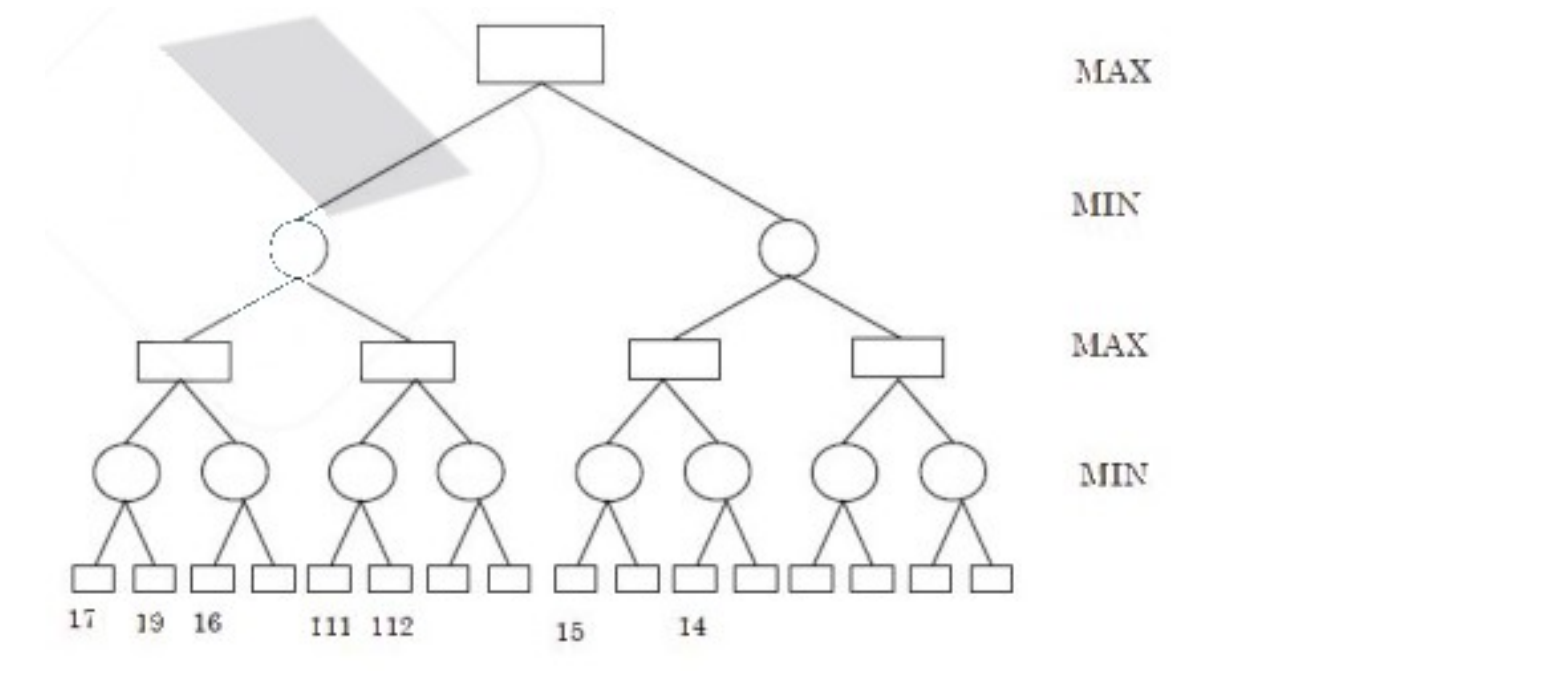
Game tree with alternating MAX and MIN levels
- A14
- B17
- C111
- D112
Answer: (B) 17
Explanation
Sign in to read the full explanationQuestion 111
UGC NET December 2019Consider the following learning algorithms:
A. Logistic regression
B. Back propagation
C. Linear regressionWhich of the following option represents classification algorithms?
- AA and B only
- BA and C only
- CB and C only
- DA, B and C
Accepted answers: (A) A and B only, (D) A, B and C
Explanation
Sign in to read the full explanationQuestion 112
UGC NET December 2019Consider the following:
(a) Trapping at local maxima
(b) Reaching a plateau
(c) Traversal along the ridgeWhich of the following option represents shortcomings of the hill climbing algorithm?
- A(a) and (b) only
- B(a) and (c) only
- C(b) and (c) only
- D(a), (b) and (c)
Answer: (D) (a), (b) and (c)
Explanation
Sign in to read the full explanationQuestion 113
UGC NET December 2019Consider the following models:
M₁: Mamdani model
M₂: Takagi-Sugeno-Kang model
M₃: Kosko’s additive model (SAM)Which of the following option contains examples of additive rule model?
- AOnly M₁ and M₂
- BOnly M₂ and M₃
- COnly M₁ and M₃
- DM₁, M₂ and M₃
Answer: (B) Only M₂ and M₃
Explanation
Sign in to read the full explanationQuestion 114
UGC NET June 2019The value of the derivative of Sigmoid function given by
f(x) = 1/(1 + e^(-2x))
at x = 0 is- A0
- B1/2
- C1/4
- D∞
Answer: (B) 1/2
Explanation
Sign in to read the full explanationQuestion 115
UGC NET June 2019The STRIPS representation is
- Aa feature-centric representation
- Ban action-centric representation
- Ca combination of feature-centric and action-centric representations
- Da hierarchical feature-centric representation
Answer: (B) an action-centric representation
Explanation
Sign in to read the full explanationQuestion 116
UGC NET June 2019Match List-I with List-II:
List-I List-II (a) Greedy best-first (i) Minimal cost (p) + h(p) (b) Lowest cost-first (ii) Minimal h(p) (c) A* algorithm (iii) Minimal cost (p) - A(a)-(i); (b)-(ii); (c)-(iii)
- B(a)-(iii); (b)-(ii); (c)-(i)
- C(a)-(i); (b)-(iii); (c)-(ii)
- D(a)-(ii); (b)-(iii); (c)-(i)
Answer: (D) (a)-(ii); (b)-(iii); (c)-(i)
Explanation
Sign in to read the full explanationQuestion 117
UGC NET June 2019Consider the following:
(a) Evolution
(b) Selection
(c) Reproduction
(d) MutationWhich of the following are found in genetic algorithms?
- A(b), (c) and (d) only
- B(b) and (d) only
- C(a), (b), (c) and (d)
- D(a), (b) and (d) only
Answer: (C) (a), (b), (c) and (d)
Explanation
Sign in to read the full explanationQuestion 118
UGC NET June 2019Consider the game tree given below:
Here ○ and □ represents MIN and MAX nodes respectively.
The value of the root node of the game tree is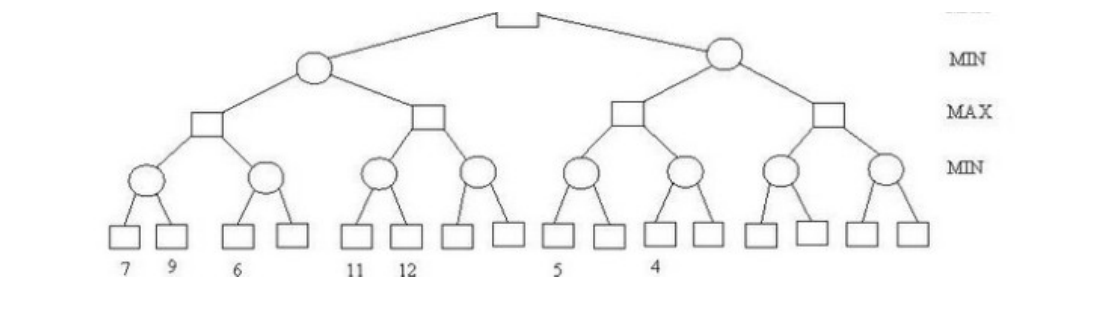
Game tree with alternating MIN and MAX nodes
- A4
- B7
- C11
- D12
Answer: (B) 7
Explanation
Sign in to read the full explanationQuestion 119
UGC NET June 2019A fuzzy conjunction operator denoted as t(x, y) and a fuzzy disjunction operator denoted as s(x, y) form a dual pair if they satisfy the condition:
- At(x, y) = 1 - s(x, y)
- Bt(x, y) = s(1-x, 1-y)
- Ct(x, y) = 1 - s(1-x, 1-y)
- Dt(x, y) = s(1+x, 1+y)
Answer: (C) t(x, y) = 1 - s(1-x, 1-y)
Explanation
Sign in to read the full explanationQuestion 120
UGC NET June 2019K-mean clustering algorithm has clustered the given 8 observations into 3 clusters after 1st iteration as follows:
C1: {(3, 3), (5, 5), (7, 7)}
C2: {(0, 6), (6, 0), (3, 0)}
C3: {(8, 8), (4, 4)}What will be the Manhattan distance for observation (4, 4) from cluster centroid C1 in second iteration?
- A2
- B√2
- C0
- D18
Answer: (A) 2
Explanation
Sign in to read the full explanationQuestion 121
UGC NET June 2019Reinforcement learning can be formalized in terms of ______ in which the agent initially only knows the set of possible ______ and the set of possible actions.
- AMarkov decision processes, objects
- BHidden states, objects
- CMarkov decision processes, states
- Dobjects, states
Answer: (C) Markov decision processes, states
Explanation
Sign in to read the full explanationQuestion 122
UGC NET June 2019Consider the following methods:
M₁: Mean of maximum
M₂: Centre of area
M₃: Height methodWhich of the following is/are defuzzification method(s)?
- AOnly M₁
- BOnly M₁ and M₂
- COnly M₂ and M₃
- DM₁, M₂ and M₃
Answer: (D) M₁, M₂ and M₃
Explanation
Sign in to read the full explanationQuestion 123
UGC NET June 2019Let Aα₀ denotes the α-cut of a fuzzy set A at α₀. If α₁ < α₂, then
- AAα₁ ⊇ Aα₂
- BAα₁ ⊃ Aα₂
- CAα₁ ⊆ Aα₂
- DAα₁ ⊂ Aα₂
Answer: (A) Aα₁ ⊇ Aα₂
Explanation
Sign in to read the full explanationQuestion 124
UGC NET June 2019Which of the following is an example of unsupervised neural network?
- ABack-propagation network
- BHebb network
- CAssociative memory network
- DSelf-organizing feature map
Answer: (D) Self-organizing feature map
Explanation
Sign in to read the full explanationQuestion 125
UGC NET December 2018Which of the following is true for semi-dynamic environment ?
- AEnvironment and performance score, both change simultaneously.
- BThe environment may change while the agent is deliberating.
- CThe environment itself does not change with the passage of time but the agent’s performance score does.
- DEven if the environment changes with the passage of time while deliberating, the performance score does not change.
Answer: (C) The environment itself does not change with the passage of time but the agent’s performance score does.
Explanation
Sign in to read the full explanation- Practise Artificial Intelligence in a timed set
Question 126
UGC NET December 2018Consider the following statements :
S1 : A heuristic is admissible if it never overestimates the cost to reach the goal.
S2 : A heuristic is monotonous if it follows triangle inequality property.Which one of the following is true referencing the above statements ?
Choose the correct answer from the code given below :
Code :- ANeither of the statements S1 and S2 are true.
- BStatement S1 is false but statement S2 is true.
- CStatement S1 is true but statement S2 is false.
- DBoth the statements S1 and S2 are true.
Answer: (D) Both the statements S1 and S2 are true.
Explanation
Sign in to read the full explanationQuestion 127
UGC NET December 2018An agent can improve its performance by
- AResponding
- BPerceiving
- CObserving
- DLearning
Answer: (D) Learning
Explanation
Sign in to read the full explanationQuestion 128
UGC NET December 2018Match List-I with List-II and choose the correct answer from the code:
List-I List-II (a) Greedy Best-First Search (i) Selects a node for expansion if optimal path to that node has been found. (b) A* Search (ii) Avoids substantial overhead associated with keeping the sorted queue of nodes. (c) Recursive Best-First Search (iii) Suffers from excessive node generation. (d) Iterative-deepening A* Search (iv) Time complexity depends on the quality of heuristic. Informed search algorithms and their characteristics
- A(iv) (i) (ii) (iii)
- B(i) (iv) (iii) (ii)
- C(iv) (iii) (ii) (i)
- D(i) (ii) (iii) (iv)
Answer: (B) (i) (iv) (iii) (ii)
Explanation
Sign in to read the full explanationQuestion 129
UGC NET December 2018Consider the following statements related to AND-OR Search algorithm.
S1 : A solution is a subtree that has a goal node at every leaf.
S2 : OR nodes are analogous to the branching in a deterministic environment.
S3 : AND nodes are analogous to the branching in a non-deterministic environment.Which one of the following is true referencing the above statements ?
Choose the correct answer from the code given below :
Code :- AS1 – True, S2 – True, S3 – True
- BS1 – False, S2 – True, S3 – True
- CS1 – False, S2 – True, S3 – False
- DS1 – True, S2 – True, S3 – False
Answer: (A) S1 – True, S2 – True, S3 – True
Explanation
Sign in to read the full explanationQuestion 130
UGC NET December 2018Consider a vocabulary with only four propositions A, B, C and D. How many models are there for the following sentence ?
¬A ∨ ¬B ∨ ¬C ∨ ¬D
- A16
- B15
- C8
- D7
Answer: (B) 15
Explanation
Sign in to read the full explanationQuestion 131
UGC NET December 2018Consider the following terminology and match List-I with List-II and choose the correct answer from the code:
b = branching factor
d = depth of the shallowest solution
m = Maximum depth of the search tree
l = depth limitList-I (Algorithms) List-II (Space Complexity) (a) BFS search (i) O(bd) (b) DFS search (ii) O(b^d) (c) Depth-limited search (iii) O(bm) (d) Iterative deepening search (iv) O(bl) Search algorithms and their space complexities
- A(ii) (iii) (iv) (i)
- B(i) (iii) (iv) (ii)
- C(iii) (ii) (iv) (i)
- D(i) (iii) (iv) (ii)
Answer: (A) (ii) (iii) (iv) (i)
Explanation
Sign in to read the full explanationQuestion 132
UGC NET December 2018Consider the minimax game tree search shown in the diagram.
What will be the value propagated at the root ?
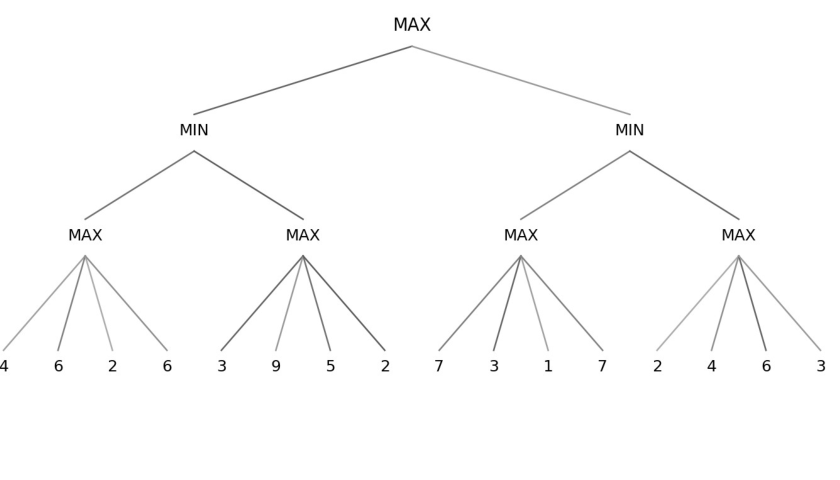
Minimax game tree search with alternating levels
- A4
- B5
- C6
- D3
Answer: (C) 6
Explanation
Sign in to read the full explanationQuestion 133
UGC NET December 2018A full joint distribution for the Toothache, Cavity and Catch is given in the table:
Toothache Catch Toothache ¬Catch ¬Toothache Catch ¬Toothache ¬Catch Cavity 0·108 0·012 0·072 0·008 ¬Cavity 0·016 0·064 0·144 0·576 What is the probability of Cavity, given evidence of Toothache?
- A<0·2, 0·8>
- B<0·6, 0·8>
- C<0·6, 0·4>
- D<0·4, 0·8>
Answer: (C) <0·6, 0·4>
Explanation
Sign in to read the full explanation
Frequently asked questions
How many Artificial Intelligence questions have been asked in UGC NET Computer Science?
133 Artificial Intelligence questions appear in the UGC NET Computer Science papers held between 2018–2026, and all of them are on this page with their answer key.
Are the answers on this page free?
Yes. Every question, its options, and the correct answer are free to read with no account. Signing in additionally unlocks the detailed explanation under each question.
Is Artificial Intelligence an important topic for UGC NET Computer Science?
Artificial Intelligence appears in every recent UGC NET Computer Science paper, across all 14 sittings covered here. Its share of the paper makes it worth revising thoroughly rather than sampling.
How should I practise Artificial Intelligence after reading these questions?
Attempt the Artificial Intelligence topic-wise sets, which put the same questions into a timed interface with instant scoring and weak-area analysis afterwards.
More Computer Science PYQs by topic
More Computer Science practice
Ready for a full paper?
Attempt Paper 1 + Paper 2 (Computer Science) together in a single timed session.